
BuddhistCatholicContemplativeEvangelicalGeneral ChristianHinduJewishLatter-day SaintMuslimNew VisionsProgressive Christian
Beliefs
- Buddhist
- Catholic
- Contemplative
- Evangelical
- General Christian
- Hindu
- Jewish
- Latter-day Saint
- More Voices
- Muslim
- New Visions
- Pagan
- Progressive Christian
Topics
- Religion News
- Food and Religion
- Sports and Religion
- Religious Art
- Religious Music and Entertainment
- Religious Events
- History and Religion
- Style and Religion
- Politics and Religion
- Women in Religion
- Recreation Outdoors and Religion
- Business Finance and Religion
- Careers Workplace and Religion
- Education and Religion
- Family Parenting and Religion
- Health Fitness and Religion
- Home and Religion
- Relationships and Religion
- Technology and Religion
- Travel and Religion
Columnists
- Buddhist Columnists
- Business Finance and Religion Columnists
- Careers Workplace and Religion Columnists
- Catholic Columnists
- Contemplative Columnists
- Education and Religion Columnists
- Evangelists Columnists
- Family Parenting and Religion Columnists
- General Christian Columnists
- Health Fitness and Religion Columnists
- Hindu Columnists
- History and Religion Columnists
- Home and Religion Columnists
- Jewish Columnists
- More Voices Columnists
- Latter Day Columnists
- Muslim Columnists
- New Visions Columnists
- Nonreligious Columnists
- Pagan Columnists
- Politics and Religion Columnists
- Progressive Columnists
- Recreation Outdoors and Religion Columnists
- Relationships and Religion Columnists
- Religion News Columnists
- Religious Art Columnists
- Religious Events Columnists
- Religious Music and Entertainment Columnists
- Sports and Religion Columnists
- Style and Religion Columnists
- Technology and Religion Columnists
- Travel and Religion Columnists
- Women in Religion Columnists
Resource Library
- 2026 Calendar
- Library of World Religions
- The 100 Most Holy Places on Earth
- Patheos Answers
- Podcasts
- Videos
- Faith Leaders Database
- Anglican Episcopalian
- Bahai
- Baptist
- Buddhism
- Christianity
- Confucianism
- Eastern Orthodoxy
- Hinduism
- Holiness and Pentecostal
- ISKCON
- Islam
- Judaism
- Lutheran
- Methodist
- The Church of Jesus Christ of Latter-day Saints
- New Age
- Paganism
- Presbytarian and Reformed
- Protestantism
- Religion Behind the Scenes
- Roman Catholic
- Scientology
- Shia Islam
- Sikhism
- Sufism
- Sunni Islam
- Taoism
- Zen
- See all religions
Research Tools
 Ad-Free & Subscriber Log-In Subscription Support
Ad-Free & Subscriber Log-In Subscription Support
Follow Patheos 

- Trending:
- Forgiveness
- |
- Marriage
- |
- Consciousness
- |
- Death Penalty
- |
- Election
- |
- Halloween

- Home
- Catholic
- Politics and Religion
- Mass as a Memorial: Sacrament, Sign, Bond, and Banquet
Mass as a Memorial: Sacrament, Sign, Bond, and Banquet
Last updated on: February 19, 2024 at 12:43 am by Fr. Nicholas Sheehy, LC
Mass as a Memorial: Sacrament, Sign, Bond, and Banquet 2024-02-19T00:43:14-08:00 Fr. Nicholas Sheehy, LC
Patheos Explore the world's faith through different perspectives on religion and spirituality! Patheos has the views of the prevalent religions and spiritualities of the world.
The movie The Ultimate Gift tells the story of a young man who inherits a tremendous amount of wealth–at least that was what he expected upon the death of his grandfather. To receive the money, however, he has to change himself dramatically from the self-centered playboy we see at the beginning of the movie who wastes money with abandon. Upon the death of his grandfather, his supply of money is cut off and he experiences financial limitations for the first time in his life. He goes through a series of tests until he is able to receive the prize of his inheritance I will stop here to avoid giving more details so that you can enjoy the movie. In any case, what the grandfather did is an example of a memorial, a remembrance. He ensured that his memory would be enshrined with his grandson and that his heir would be taught a valuable lesson. Does this sound like Jesus? Did he just want to make sure that we remember him and learn some life-lessons?
Some people claim just that. They think that the fact that Jesus says “do this in remembrance of me” at the Last Supper shows that later re-enactments of the Last Supper are a remembrance and nothing more. In doing so, they deny the sacrificial aspect of the Mass. We can put on a play and remember what Jesus did at the Last Supper, but this would be essentially different from the Sacrifice of the Mass. At the same time, the Eucharistic Celebration does have an aspect of memorial, as the Catechism teaches in number 1232:
At the Last Supper, on the night when He was betrayed, our Savior instituted the eucharistic sacrifice of His Body and Blood. He did this in order to perpetuate the sacrifice of the Cross throughout the centuries until He should come again, and so to entrust to His beloved spouse, the Church, a memorial of His death and resurrection: a sacrament of love, a sign of unity, a bond of charity, a paschal banquet in which Christ is eaten, the mind is filled with grace, and a pledge of future glory is given to us. (Constitution on the Sacred Liturgy Sacrosanctum Concilium, 47; quoted in Catechism of the Catholic Church, 1323)
We see four basic features of the Eucharist as memorial: it is sacrament, a sign, a bond, and a banquet. We need to take each one of these aspects into account if we want to remember Jesus correctly.
Sacrament of Love
The Eucharist is a sacrament. The word “sacrament” comes from sacramentum in Latin, meaning “oath.” A solemn promise takes place. Within Catholic theology, the sacraments are
efficacious signs of grace, instituted by Christ and entrusted to the Church, by which divine life is dispensed to us. The visible rites by which the sacraments are celebrated signify and make present the graces proper to each sacrament. They bear fruit in those who receive them with the required dispositions. (Catechism of the Catholic Church, 1131)
Even among the sacraments, the Eucharist takes on a privileged place.
The mystery of the Incarnation is central to the Christian faith. God became man, and in doing so, elevated everything that is human. There is something earthly and something divine in every sacrament. For baptism, regular water is used to introduce somebody into divine life and the mystery of the Church. The Eucharist begins with ordinary bread but through the words of consecration ends up as the true Body and Blood of Christ. The sacrament of the Eucharist is a sacrament of love and is the center of the Church. The “gaze of the Church is constantly turned to her Lord, present in the Sacrament of the Altar, in which she discovers the full manifestation of his boundless love” (Pope John Paul II, Ecclesia de Eucharistia, 1)
The Eucharist is a sacrament of love because it is an oath of love between God and the faithful.
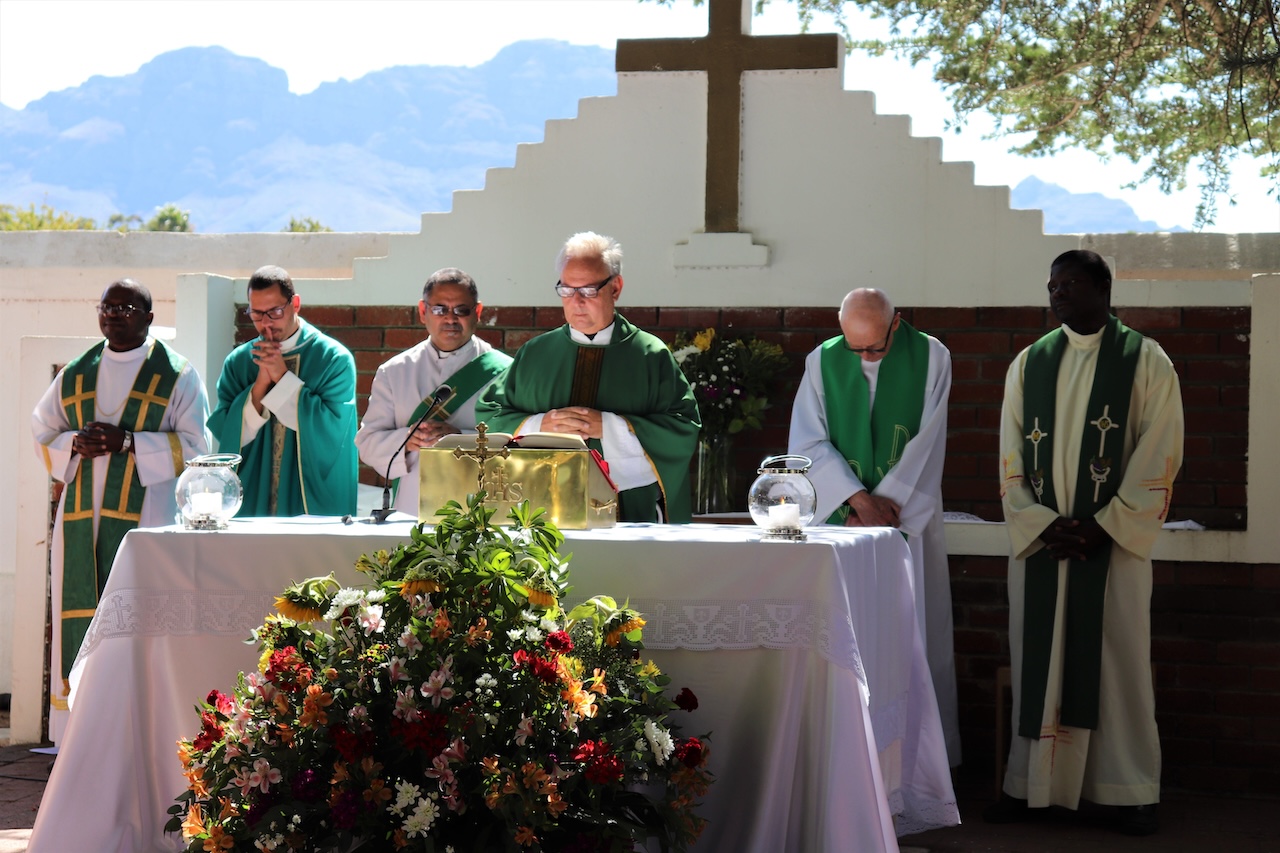
Priests Concelebrate Memorial of Christ’s Death | Courtesy Pexels.com
Sign of Unity
The Eucharist is a sign. The term “sign” comes up in the definition of “sacrament” showing that sacraments are signs. Signs are things that point us to something else. The matter of the water of baptism turn our attention to the reality of entering into the divine life. What appears to be bread and wine in the Eucharist draw our attention to Jesus, the Lord, whom we receive in Communion. The Eucharist is a sign of unity because we all partake of the same Christ. St. Paul expresses this in Romans 12:5. “So we, though many, are one body in Christ* and individually parts of one another” (Rm. 12:5)
Bond of Charity
The term “bond of charity” comes from Saint Augustine’s commentary on the Gospel of John. It does not make any sense to attack one’s own body, so by partaking in the Eucharist we pledge loyalty to the body, which is the Church. Every covenant is a bond. This comes out clearly in the New Testament as a bond of charity because the Covenant is a covenant of love. Charity is love, and so our covenant of love is a bond of charity.
Paschal Banquet
Finally, the Eucharist is a banquet. Jesus asks us to eat together in remembrance of him. There should be a sense of feasting when we come together to celebrate the Eucharist. It is a paschal banquet because it reminds us of the reality of the Passover. For the Jews, this feast was a remembrance of their escape from Egypt and the beginning of the Exodus. God then established a covenant with them by giving them the Law. For Christians, the paschal banquet serves as a remembrance of the institution of the New Law which is ratified every time we celebrate the Eucharist, the presiding priest as minister, and the congregation participating by the common priesthood of the faithful.
Memorial
Through the Eucharistic Celebration, we remember the death of the Lord, as well as his resurrection. To reduce it to being “simply a remembrance” would be a grave mistake, since even under this lens of remembrance, it contains these four aspects of sacrament, sign, bond, and banquet. This does not fully take into consideration its essential nature as a true sacrifice. Jesus does want us to remember him, but even beyond that he wants us to participate in the sacrifice of the Mass because this opens to us the doors to Heaven.
Subscribe to the newsletter to never miss an article.
Read about the Mass as the authentic sacrifice to the Father.
General Christian
Religious Music and Entertainment

About Fr. Nicholas Sheehy, LC
Fr. Nicholas Sheehy was ordained a Catholic priest in 2013 for the Legionaries of Christ. He has been involved in youth work including missions, retreats and apostolic outreach in Germany, Italy, the United States and Central America. He is passionate about the New Evangelization and formation for young adults and married couples. He is a spiritual director and retreat director, offering marriage preparation and marriage counseling through the Divine Mercy Clinic and Family Center. He is currently Executive Director and Chaplain of the Newman Center at St. Philip the Apostle Parish in Pasadena, California. You can read more about the author here.
Previous Post

February 16, 2024
From Sinner to Saint – Conversion and How to Live Lent
Next Post
February 20, 2024 The Eucharist: Christ at the Center
Recent Comments
"Peace is a precious resource. Humankind and Planet Earth are thirsting for peace. Long live ..."
The Man Who Taught Nagasaki to ..."
"Searching and finding truth and traveling from truth to Truth is an exciting journey. The ..."
Your Writing Makes the Pope Happy
"Rich or poor, we are all fellow pilgrims enthusiastically marching together to our cherished destination. ..."
"There's no moral difference between avoiding conception by using 'artificial' contraception and using a 'natural' ..."
Browse Our Archives
Select a Category Church News Education Eucharist Faith and Mental Health Family Living the Faith Marriage Relationships Spiritual Direction Uncategorized Vocations Women Young Adults
Select a Month October 2026 September 2026 August 2026 July 2026 June 2026 November 2025 October 2025 September 2025 August 2025 July 2025 May 2025 April 2025 March 2025 February 2025 January 2025 December 2024 November 2024 October 2024 September 2024 August 2024 July 2024 June 2024 May 2024 April 2024 March 2024 February 2024 January 2024 December 2023 November 2023
Follow Us!
TAKE THE
Religious Wisdom Quiz
What does "Tetragrammaton" refer to in biblical studies?
Select your answer to see how you score.
The first four books of the Bible The first four commandments The four Gospels The four-letter name of God
Related posts from Formation Matters
Never Forget: What 9/11 Should Teach Us 25...
Bridging the Chasm Between God and Man with...
Indifference and the Mystery of the Incarnation
Do You Feel At Home At Church?
TRENDING AT PATHEOS Catholic

The Real AI Story Is Adoption Without Trust
Artificial intelligence has crossed a political threshold. It is no longer a...

A new article, written by Jeff Lindsay and Gale L. Pooley,...

Swimfan: Forgotten Aughts Pleasures
This is a recovery effort. In 2002, My Big Fat Greek Wedding...

Top Three Anti-Catholic Lies About Catholicism
This is my initial transcript for the video, "THE 3 WORST...

Pope Leo Celebrates Mass for Nurses & Docs...
I don't have any idea how he did it, but Pope Leo...

The Sermon on the Mount, Part I: Matthew...
The Sermon on the Mount, Part I (Matthew 4:12-5:12) St. Matthew moves...
view all Catholic blogs
What Are Your Thoughts?leave a comment
Ad-Free & Subscriber Log-In Subscription Support
- About Us
- 2026 Calendar
- Videos
- Podcasts
- Library of World Religions
- Faith In Media Tracker
- Advertise With Us
- Write for Us
- Privacy Policy
- Terms of Service
- Do Not Sell My Data
- Contact Us
- Radiant Digital
- Manage Newsletter Subscriptions
- Unsubscribe From Notifications
- Sitemap
Copyright 2008-2026, Patheos. All rights reserved.
Subscription Support Ad-Free & Subscriber Log-In
Follow Patheos