
BuddhistCatholicContemplativeEvangelicalGeneral ChristianHinduJewishLatter-day SaintMuslimNew VisionsProgressive Christian
Beliefs
- Buddhist
- Catholic
- Contemplative
- Evangelical
- General Christian
- Hindu
- Jewish
- Latter-day Saint
- More Voices
- Muslim
- New Visions
- Pagan
- Progressive Christian
Topics
- Religion News
- Food and Religion
- Sports and Religion
- Religious Art
- Religious Music and Entertainment
- Religious Events
- History and Religion
- Style and Religion
- Politics and Religion
- Women in Religion
- Recreation Outdoors and Religion
- Business Finance and Religion
- Careers Workplace and Religion
- Education and Religion
- Family Parenting and Religion
- Health Fitness and Religion
- Home and Religion
- Relationships and Religion
- Technology and Religion
- Travel and Religion
Columnists
- Buddhist Columnists
- Business Finance and Religion Columnists
- Careers Workplace and Religion Columnists
- Catholic Columnists
- Contemplative Columnists
- Education and Religion Columnists
- Evangelists Columnists
- Family Parenting and Religion Columnists
- General Christian Columnists
- Health Fitness and Religion Columnists
- Hindu Columnists
- History and Religion Columnists
- Home and Religion Columnists
- Jewish Columnists
- More Voices Columnists
- Latter Day Columnists
- Muslim Columnists
- New Visions Columnists
- Nonreligious Columnists
- Pagan Columnists
- Politics and Religion Columnists
- Progressive Columnists
- Recreation Outdoors and Religion Columnists
- Relationships and Religion Columnists
- Religion News Columnists
- Religious Art Columnists
- Religious Events Columnists
- Religious Music and Entertainment Columnists
- Sports and Religion Columnists
- Style and Religion Columnists
- Technology and Religion Columnists
- Travel and Religion Columnists
- Women in Religion Columnists
Resource Library
- 2026 Calendar
- Library of World Religions
- The 100 Most Holy Places on Earth
- Patheos Answers
- Podcasts
- Videos
- Faith Leaders Database
- Anglican Episcopalian
- Bahai
- Baptist
- Buddhism
- Christianity
- Confucianism
- Eastern Orthodoxy
- Hinduism
- Holiness and Pentecostal
- ISKCON
- Islam
- Judaism
- Lutheran
- Methodist
- The Church of Jesus Christ of Latter-day Saints
- New Age
- Paganism
- Presbytarian and Reformed
- Protestantism
- Religion Behind the Scenes
- Roman Catholic
- Scientology
- Shia Islam
- Sikhism
- Sufism
- Sunni Islam
- Taoism
- Zen
- See all religions
Research Tools
 Ad-Free & Subscriber Log-In Subscription Support
Ad-Free & Subscriber Log-In Subscription Support
Follow Patheos 

- Trending:
- Forgiveness
- |
- Marriage
- |
- Consciousness
- |
- Death Penalty
- |
- Election
- |
- Halloween

- Home
- Catholic
- Politics and Religion
- Catholic Mass is Orthodox – Right Worship of the Father
Catholic Mass is Orthodox – Right Worship of the Father
Last updated on: February 15, 2024 at 4:21 am by Fr. Nicholas Sheehy, LC
Catholic Mass is Orthodox – Right Worship of the Father 2024-02-15T04:21:17-08:00 Fr. Nicholas Sheehy, LC
Patheos Explore the world's faith through different perspectives on religion and spirituality! Patheos has the views of the prevalent religions and spiritualities of the world.
If you ask people why they go to Mass, you are sure to get a lot of answers. “I go because I want to receive the Eucharist.” “I go to spend time with family.” Others will remark “I want to hear the Word of God.” Someone else will say “I like the preaching,” Ok, maybe I just hope someone would answer that. However, all these answers fall short: Catholic Mass is about perpetuating the Paschal mystery. Mass is a sacrifice, in which we all participate, led by the priest. The Reformers of the 16th century could not accept this basic truth of the faith. Who is right: Luther and his followers, or the Catholic Church? In this article, I will explore how the Catholic Mass is a sacrifice.
From the Last Supper to the Passion
Jesus celebrated the Last Supper right before his Passion because he connected it so intimately with his sacrifice on the Cross. The Second Vatican Council Constitution on the Liturgy, Sacrosanctum Concilium, points out that the Mass is essentially a sacrifice in Number 47. The Catechism of the Catholic Church cites the entire paragraph.
At the Last Supper, on the night when He was betrayed, our Savior instituted the eucharistic sacrifice of His Body and Blood. He did this in order to perpetuate the sacrifice of the Cross throughout the centuries until He should come again, and so to entrust to His beloved spouse, the Church, a memorial of His death and resurrection: a sacrament of love, a sign of unity, a bond of charity, a paschal banquet in which Christ is eaten, the mind is filled with grace, and a pledge of future glory is given to us. (Constitution on the Sacred Liturgy Sacrosanctum Concilium, 47; quoted in Catechism of the Catholic Church, 1323)
We see four basic aspects of the Eucharist as memorial: it is sacrament, sign, bond, and banquet in which three things happen: Christ is eaten, our mind is filled with grace, and we receive a pledge of future glory.
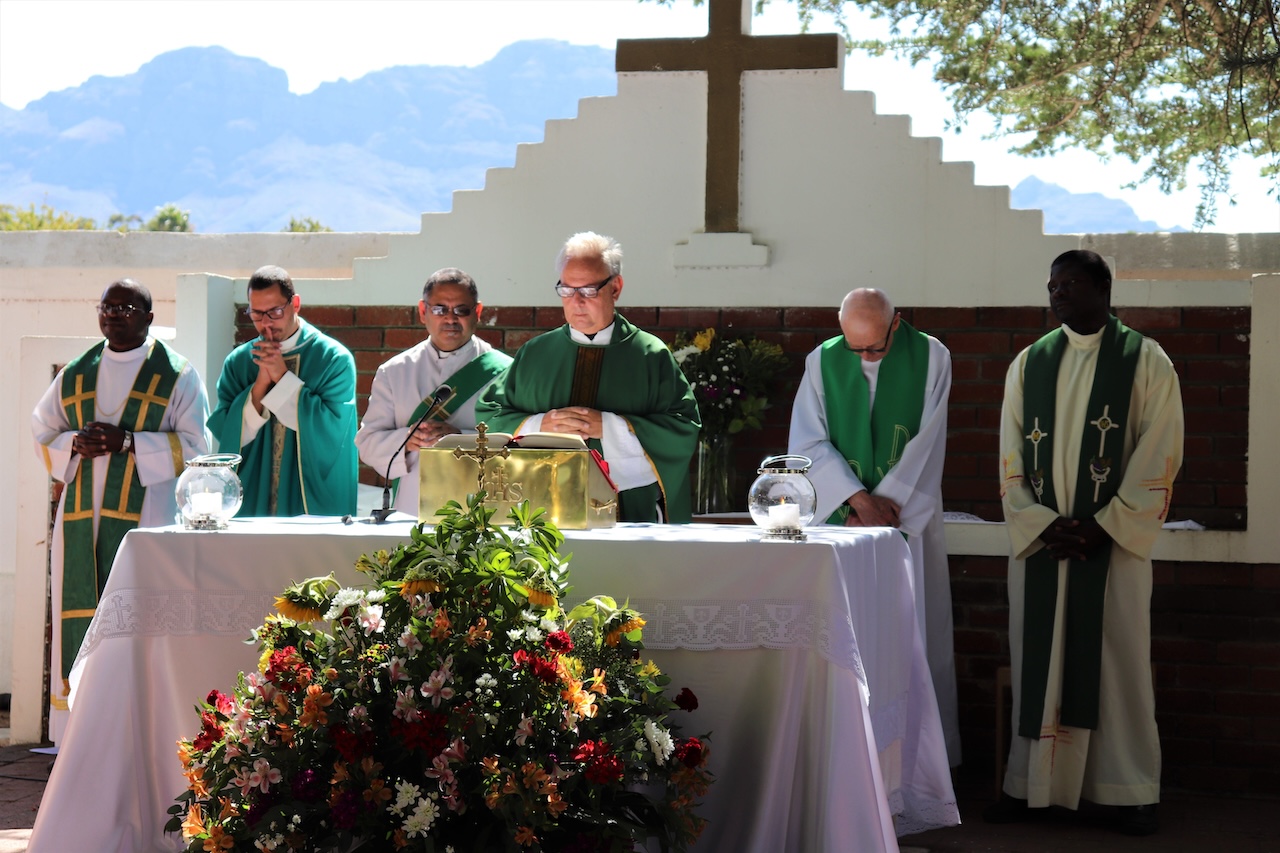
Priests Concelebrate Catholic Mass | Courtesy Pexels.com
Mass is Essentially a Sacrifice
In this article, I will concentrate on the Mass as essentially a sacrifice. The author of the Letter to the Hebrews makes it clear that the New Covenant begins with a sacrifice.
First, the establishment of a covenant (diatheke) requires death (Heb 9:16–17). Second, Hebrews is also clear that there is no forgiveness of sins without the shedding of blood (Heb 9:22). The author of Hebrews is emphatic that Christ’s sacrifice is patterned on the sacrifices of the Old Law, which required both death and blood. (Christian Washburn, “A Defense of St. Robert Bellarmine’s Definition of Sacrifice”)
Through the Mass, Jesus establishes the continuity between the Old and the New Covenant through the aspect of sacrifice. While the priest presents his sacrifice in an unbloody manner, it is real. The Eucharistic sacrifice shows us in a real way what it means for Jesus to die on the Cross. In a mysterious way, it makes us present at Calvary.
Martin Luther’s Dissent
Martin Luther highlighted his distaste for the celebration of the Eucharist in his criticism of the Church, particularly because of the sacrificial aspect. He suggested that it was something man-made and needed to disassemble it to respect the purity of the Gospel. In response, the Council of Trent focused on the sacraments of the Eucharist and of the priesthood. Thus, they established firmly that the Mass is indeed a sacrifice.
Protestant theologians had multiple reasons for rejecting the Mass as a true and proper sacrifice. First, they objected that the Mass is a human work whereby we try to please God, which they believed impossible to do. Second, Protestant theologians viewed the Eucharistic sacrifice as detracting from the sufficiency of Christ’s sacrifice on the cross. Third, the sacrifice of the cross was the final sacrifice, and so there is no other necessary sacrifice in either Christianity or elsewhere. Fourth, they argued that the Mass cannot be a propitiatory sacrifice for the living and the dead, since only Christ’s death is propitiatory.(Christian Washburn, “A Defense of St. Robert Bellarmine’s Definition of Sacrifice”)
Purely Human Works Cannot Satisfy God
Taking into account their point of view, the Reformers are partially right. Much of what they do are human works designed to please God, so it is natural that they interpret the Catholic Mass in the same way. There is a big difference, however, because the Mass has been given to the Church by Jesus himself in the Last Supper and his bloody sacrifice on the Cross, which is presented in the Mass in an unbloody manner.
The Council of Trent responded to the Reformers by clarifying Catholic doctrine on subjects such as the Eucharist and the priesthood. One of the pre-eminent theologians in this debate was the Jesuit, Cardinal Robert Bellarmine. One of the problems that Cardinal Bellarmine addressed was that the term “sacrifice” in the Old Testament had a real and sensible meaning. He argued that we dilute the concept of sacrifice into a generalized sense of “any ceremony or good work offered to God to worship Him” as Melancthon proposed (Melancthon, The Apology of the Augsburg Confession, XXIV). Bellarmine knew that a sacrifice of this kind is something deeper than what the Reformers proposed.
Bellarmine’s Response
Rooted in the Revelation of God in the Old Testament, Bellarmine states firmly in his Disputationes de Controversiis Christianae fidei adversus huius temporis haereticos that Jesus has already completed his sacrifice on the Cross, but that this same sacrifice is still present each time we celebrate Mass. “For Bellarmine altar and priesthood are co-relative. If there is to be a true and proper sacrifice, there must be a true and proper priesthood” (Christian Washburn, “A Defense of St. Robert Bellarmine’s Definition of Sacrifice”). If Christianity were to exist without sacrifice, it would be a departure from what God has commanded through Judaism.
Orthodoxy of the Catholic Mass
We know the term “right worship” more commonly through its transliteration from the Greek: “orthodoxy.” Orthodoxy – right worship – can take place only when we are worshiping God in the way that he himself sets down. This is why the Mass is perfect prayer, and why we cannot and should not change its nature. If Jesus established the Mass as a sacrifice, it is a matter of Christian obedience to treat it as such.
How do we live this out in our everyday life? Do we approach the altar with reverence and awe, recognizing that we are encountering the King of Kings, who became man for our sake and died on the cross to save us from our sins? When we realize that we are offering orthodox sacrifice through our worship at Mass, we can begin to enter into the Eucharistic mystery and become more fitting worshipers of Christ the Lord.
What helps you worship well at a Catholic Mass? Share your thoughts below.
Would you like to see this as a video? Watch The Mass as Sacrifice.
Subscribe to the newsletter to never miss an article.
Evangelical
History and Religion

About Fr. Nicholas Sheehy, LC
Fr. Nicholas Sheehy was ordained a Catholic priest in 2013 for the Legionaries of Christ. He has been involved in youth work including missions, retreats and apostolic outreach in Germany, Italy, the United States and Central America. He is passionate about the New Evangelization and formation for young adults and married couples. He is a spiritual director and retreat director, offering marriage preparation and marriage counseling through the Divine Mercy Clinic and Family Center. He is currently Executive Director and Chaplain of the Newman Center at St. Philip the Apostle Parish in Pasadena, California. You can read more about the author here.
Previous Post

February 8, 2024
Catholic Woman’s Considerable Contribution To Chemistry
Next Post
February 13, 2024 Smudges On Our Foreheads - Lent Brings Religion to the World
Recent Comments
"Peace is a precious resource. Humankind and Planet Earth are thirsting for peace. Long live ..."
The Man Who Taught Nagasaki to ..."
"Searching and finding truth and traveling from truth to Truth is an exciting journey. The ..."
Your Writing Makes the Pope Happy
"Rich or poor, we are all fellow pilgrims enthusiastically marching together to our cherished destination. ..."
"There's no moral difference between avoiding conception by using 'artificial' contraception and using a 'natural' ..."
Browse Our Archives
Select a Category Church News Education Eucharist Faith and Mental Health Family Living the Faith Marriage Relationships Spiritual Direction Uncategorized Vocations Women Young Adults
Select a Month October 2026 September 2026 August 2026 July 2026 June 2026 November 2025 October 2025 September 2025 August 2025 July 2025 May 2025 April 2025 March 2025 February 2025 January 2025 December 2024 November 2024 October 2024 September 2024 August 2024 July 2024 June 2024 May 2024 April 2024 March 2024 February 2024 January 2024 December 2023 November 2023
Follow Us!
TAKE THE
Religious Wisdom Quiz
Who was known as "the disciple whom Jesus loved"?
Select your answer to see how you score.
James Thomas John Peter
Related posts from Formation Matters

Beyond Left and Right: Catholic Church on Immigration

The Treasure Meant to Be Shared
TRENDING AT PATHEOS Catholic

16 Spiritual Touchstones for a More Grounded Life
After decades of spiritual study, here are 16 principles I try...

Catholic Evangelization: Sharing Your Faith Every Day
Welcome back to the Graceful Awakening mini-series called, “From Faith to Mission.” ...

The Pillar of the Boatmen: the Ancient Monument...
The Pillar of the Boatmen is a Romano-Gaulish sculpture that dates from...

In one sense walking into Westminster Abbey is like walking down the...

'Super Scam Me' Exposes AI Jon Bon Jovi...
Leslie Pickett believed she was in a relationship with Jon Bon Jovi....

The Brazilian Remake of Kendricks' 'Flywheel' Opens in...
“Flywheel,” the story that launched the Kendrick Brothers’ filmmaking career is getting...
view all Catholic blogs
What Are Your Thoughts?leave a comment
Ad-Free & Subscriber Log-In Subscription Support
- About Us
- 2026 Calendar
- Videos
- Podcasts
- Library of World Religions
- Faith In Media Tracker
- Advertise With Us
- Write for Us
- Privacy Policy
- Terms of Service
- Do Not Sell My Data
- Contact Us
- Radiant Digital
- Manage Newsletter Subscriptions
- Unsubscribe From Notifications
- Sitemap
Copyright 2008-2026, Patheos. All rights reserved.
Subscription Support Ad-Free & Subscriber Log-In
Follow Patheos