
BuddhistCatholicContemplativeEvangelicalGeneral ChristianHinduJewishLatter-day SaintMuslimNew VisionsProgressive Christian
Beliefs
- Buddhist
- Catholic
- Contemplative
- Evangelical
- General Christian
- Hindu
- Jewish
- Latter-day Saint
- More Voices
- Muslim
- New Visions
- Pagan
- Progressive Christian
Topics
- Religion News
- Food and Religion
- Sports and Religion
- Religious Art
- Religious Music and Entertainment
- Religious Events
- History and Religion
- Style and Religion
- Politics and Religion
- Women in Religion
- Recreation Outdoors and Religion
- Business Finance and Religion
- Careers Workplace and Religion
- Education and Religion
- Family Parenting and Religion
- Health Fitness and Religion
- Home and Religion
- Relationships and Religion
- Technology and Religion
- Travel and Religion
Columnists
- Buddhist Columnists
- Business Finance and Religion Columnists
- Careers Workplace and Religion Columnists
- Catholic Columnists
- Contemplative Columnists
- Education and Religion Columnists
- Evangelists Columnists
- Family Parenting and Religion Columnists
- General Christian Columnists
- Health Fitness and Religion Columnists
- Hindu Columnists
- History and Religion Columnists
- Home and Religion Columnists
- Jewish Columnists
- More Voices Columnists
- Latter Day Columnists
- Muslim Columnists
- New Visions Columnists
- Nonreligious Columnists
- Pagan Columnists
- Politics and Religion Columnists
- Progressive Columnists
- Recreation Outdoors and Religion Columnists
- Relationships and Religion Columnists
- Religion News Columnists
- Religious Art Columnists
- Religious Events Columnists
- Religious Music and Entertainment Columnists
- Sports and Religion Columnists
- Style and Religion Columnists
- Technology and Religion Columnists
- Travel and Religion Columnists
- Women in Religion Columnists
Resource Library
- 2026 Calendar
- Library of World Religions
- The 100 Most Holy Places on Earth
- Patheos Answers
- Podcasts
- Videos
- Faith Leaders Database
- Anglican Episcopalian
- Bahai
- Baptist
- Buddhism
- Christianity
- Confucianism
- Eastern Orthodoxy
- Hinduism
- Holiness and Pentecostal
- ISKCON
- Islam
- Judaism
- Lutheran
- Methodist
- The Church of Jesus Christ of Latter-day Saints
- New Age
- Paganism
- Presbytarian and Reformed
- Protestantism
- Religion Behind the Scenes
- Roman Catholic
- Scientology
- Shia Islam
- Sikhism
- Sufism
- Sunni Islam
- Taoism
- Zen
- See all religions
Research Tools
 Ad-Free & Subscriber Log-In Subscription Support
Follow Patheos 

- Trending:
- Advent
- |
- Forgiveness
- |
- Thanksgiving
- |
- Election
- |
- Seasonal Holidays
- |
- Marriage

- Home
- Catholic
- Politics and Religion
- How Augustine’s Response to Fundamentalism Helps Us Today
How Augustine’s Response to Fundamentalism Helps Us Today
Last updated on: January 10, 2024 at 1:53 pm by Fr. Nicholas Sheehy, LC
How Augustine’s Response to Fundamentalism Helps Us Today 2024-01-10T13:53:12-08:00 Fr. Nicholas Sheehy, LC
Patheos Explore the world's faith through different perspectives on religion and spirituality! Patheos has the views of the prevalent religions and spiritualities of the world.
Augustine begins his prologue of De Doctrina Christiana addressing fundamentalism. Fundamentalism is present today in the Church in some sectors. It takes the form of a certain anti-intellectualism and seems to be present in the traditionalist and charismatic sectors. Augustine argues for deep Christian formation that will help overcome anti-intellectualism and lead to a deeper grasp of the mysteries of the faith.
He writes the work in two different moments. The first three books come from his early years as bishop. But, he goes back to it writes the fourth book and the prologue. So his prologue addresses many problems he has seen over the course of his time as bishop. It reflects his own intellectual conversion, as well as the various controversies he has faced.
Those who do not understand
As such a brilliant mind and teacher, it must have been frustrating to have so many people criticize him because of their own lack of knowledge. (Augustine, De Doctrina Christiana, 0.2) For him, it was simply to deal with ignorance.
Those who do not get what they want
Others read and understand his rules, but do not then receive the capacity to interpret passages of the Bible which are still beyond their understanding. Pope Benedict speaks of the dark passages of the Bible. He “encourage[s] scholars and pastors to help all the faithful to approach these passages through an interpretation which enables their meaning to emerge in the light of the mystery of Christ.” (Pope Benedict XVI, Verbum Domini, 42) Getting to know the rules of interpretation are no guarantee to understand everything in Scripture.
Those who are assisted directly by God
Augustine mentions a third group. These are those who feel that they are assisted directly by God and do not need his teaching. He is dealing with an anti-intellectual group. Perhaps he is thinking of the Donatists, who set up a parallel church following the controversy over the lapsed clergy. They tended to be more charismatic and rejected everything coming from the Church united to Rome. These are those who “divinas Scripturas vel re vera bene tractant vel bene tractare sibi videntur.” (Augustine, De Doctrina Christiana, 0.2) They either really understand the reality of Sacred Scripture or at least they think they do.
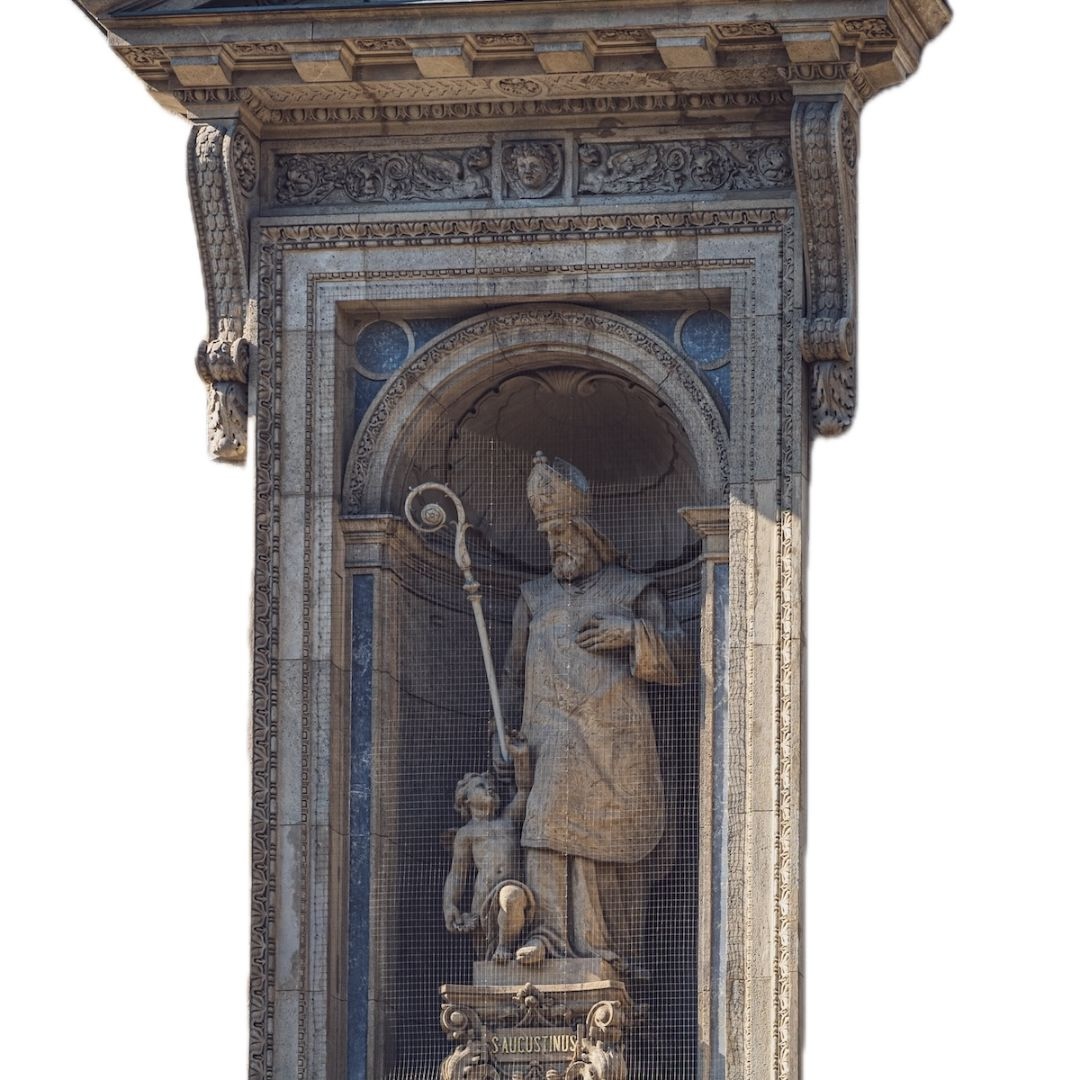
St. Augustine statue with small boy | courtesy of Pexels
It is hard for me to not associate this attitude with the Protestants when they claim they are able to know God’s Will “sola Scriptura.” They think that Scripture alone is enough. Augustine comes back to them when he criticizes that some think they are enlightened by God directly. Yet, they dare to teach others. If they truly knew the truth directly from God, why do they teach others? It would make sense to send others to God.
The necessity of teaching
Augustine is actually getting at something deeper here, and it is the interdependence of learning for the sake of salvation. He is applying an incarnational principle. Just as God became man, he also uses other human beings to help us along the path to salvation. It is something deeply sacramental. It takes humility to recognize that we are able to learn from someone else. And yet, it seems that God wants this humility for us to get to know the truth.
He points out as well that Paul was sent to Ananias when he had his conversion experience. (Acts 9:10-19) There is a profound experience of the sacramentality of human existence. We could argue that all of human existence is sacramental. There are signs that point to deeper reality. This will come out in the first book of De Doctrina Christiana when Augustine reflects on “res et signum.”
Fundamentalism in the Church
Fundamentalism is an attitude that comes up throughout Church history. There is a bit of anti-intellectualism. The fundamentalist likes to come up with a few basic tenets and then hold on to them ferociously, confident that thereby he is better than other hangers-on of the religion. In our own times, we see this attitude among many evangelicals. Sola Scriptura is a doctrine that reeks of fundamentalism.
Fundamentalism among Traditionalists
Within Catholicism, this could describe the position of many traditionalists. Perhaps it is this version of Catholics that is particularly bothersome to Pope Francis. He spoke of it in a colloquial interview with Jesuits in Portugal. (Antonio Spadaro, “The Water Has Been Agitated”, 5 August, 2023) I would argue that preferring tradition is not in and of itself fundamentalist, but holding on to the past for its own sake can lead to a closed attitude.
Fundamentalism among Charismatics
“Classical Pentecostalism, from which the “neo-Pentecostalism” of the Charismatic Renewal derives, is essentially a form of fundamentalist evangelical Protestantism and has derived much of its substance from the Methodist Revival Movement of the nineteenth century.” (Gary Hershman, “A Closer Look at the Charismatic Renewal”) The Charismatic Movement would do well to examine fundamentalist attitudes in their way of being and acting. Rather than recognizing their form of worship as an expression of the Spirit, they expect the rest of the Church to change to become more like them. This is a confusion between the Spirit and some of his manifestations.
Augustine’s Response
Augustine feels the pressure of the fundamentalist pressures around him. This could be coming from Gnostic or Manichean sectors, as well as some who are within the bosom of the Church. He argues against the anti-intellectual current by proposing a deeper education. By encouraging Christians to become educated and to know their faith more deeply, he is able to effectively stamp out the anti-intellectual current. We would do well to do the same. Ignorance is rampant in the Church. If we are able to educate the lay faithful, they will be much less susceptible to demagogues and counterfeit spiritualities that seek to distract them so as to avoid them attaining the higher things. (cf. 1Cor. 12:31)
Second of a series on De Doctrina Christiana. Subscribe to the newsletter to never miss an article.
Check out Augustine’s 3 keys to forming Christian culture here.
Evangelical
Education and Religion
About Fr. Nicholas Sheehy, LC
Fr. Nicholas writes to learn. He enjoys sharing spirituality topics and examining issues of current events under the lens of a Catholic anthropology. He holds a licentiate in philosophy and a Master's in psychology. Fr. Nicholas Sheehy is a Catholic priest for the Legionaries of Christ since 2013. At 18 years of age, he joined the Legionaries of Christ and his formation has taken him around the world. He has directed teams for youth work including missions, retreats and apostolic outreach in Germany, Italy, the United States and Central America. He served for three years on the formation team of the Legionaries of Christ Novitiate and College of Humanities in Cheshire, Connecticut. He is passionate about the New Evangelization and formation for young adults and married couples. As a Catholic priest, he is a spiritual director and retreat director, offering marriage preparation and marriage counseling through the Divine Mercy Clinic and Family Center. He is currently Executive Director and Chaplain of the Newman Center at St. Philip the Apostle Parish in Pasadena, California. "Omnis enim res quae dando non deficit, dum habetur et non datur, nondum habetur quomodo habenda est." St. Augustine teaches that we only truly possess the knowledge that we give to others. This is the inspiration for his writing: to grow spiritually and to share with others the spiritual riches he discovers. His hobbies include cycling, reading about space and astronomy, and languages. He is an avid baseball fan. He is available as a speaker for young adult and marriage groups in the Los Angeles Archdiocese and beyond. Subscribe to the newsletter to never miss an article. You can read more about the author here.
Previous Post
January 1, 2024
Starting Anew, In Christ, Under The Maternal Gaze Of Mary
Next Post
January 8, 2024 Pope Francis Condemns Freemasonry In The Philippines
Recent Comments
"Being invited, welcomed, selected, supported, and empowered to join other pilgrims in the task of ..."
Building Without Keeping Score
"Peace is a precious resource. Humankind and Planet Earth are thirsting for peace. Long live ..."
The Man Who Taught Nagasaki to ..."
"Searching and finding truth and traveling from truth to Truth is an exciting journey. The ..."
Your Writing Makes the Pope Happy
"Rich or poor, we are all fellow pilgrims enthusiastically marching together to our cherished destination. ..."
Browse Our Archives
Select a Category Church News Education Eucharist Faith and Mental Health Family Living the Faith Marriage Relationships Spiritual Direction Uncategorized Vocations Women Young Adults
Select a Month November 2026 October 2026 September 2026 August 2026 July 2026 June 2026 November 2025 October 2025 September 2025 August 2025 July 2025 May 2025 April 2025 March 2025 February 2025 January 2025 December 2024 November 2024 October 2024 September 2024 August 2024 July 2024 June 2024 May 2024 April 2024 March 2024 February 2024 January 2024 December 2023 November 2023
Follow Us!
TAKE THE
Religious Wisdom Quiz
What was Isaiah's most famous prophecy about the Messiah's birth?
Select your answer to see how you score.
A king will rise in Nineveh A prophet like Moses A child will lead lions A virgin will conceive
Related posts from Formation Matters

The Big Opportunity for Bishops After the SSPX...

Let Freedom Ring: Truth and the American Soul

Beyond Left and Right: Catholic Church on Immigration

TRENDING AT PATHEOS Catholic

Adventurous Lectionary -1st. Sunday of Advent - November...
The Adventurous Lectionary - The First Sunday of Advent – November 29,...

Will Islam become the world's biggest religion by 2035? Congo will replace...

The resilience of the Christian faith in the english speaking world of...

An Advent Calendar, and a Tree full of...
I've spent the weekend deeply invested in internet drama about a $150...

How to Have Financial Transparency in Marriage
Despite the fact that financial issues and money problems are the number...
The Healing Power of Forgiveness in Marriage
Learning how to give and accept apologies are essential ingredients of a...
view all Catholic blogs
What Are Your Thoughts?leave a comment
Ad-Free & Subscriber Log-In Subscription Support
- About Us
- 2026 Calendar
- Videos
- Podcasts
- Library of World Religions
- Faith In Media Tracker
- Advertise With Us
- Write for Us
- Privacy Policy
- Terms of Service
- Do Not Sell My Data
- Contact Us
- Radiant Digital
- Manage Newsletter Subscriptions
- Unsubscribe From Notifications
- Sitemap
Copyright 2008-2026, Patheos. All rights reserved.
Subscription Support Ad-Free & Subscriber Log-In
Follow Patheos