
BuddhistCatholicContemplativeEvangelicalGeneral ChristianHinduJewishLatter-day SaintMuslimNew VisionsProgressive Christian
Beliefs
- Buddhist
- Catholic
- Contemplative
- Evangelical
- General Christian
- Hindu
- Jewish
- Latter-day Saint
- More Voices
- Muslim
- New Visions
- Pagan
- Progressive Christian
Topics
- Religion News
- Food and Religion
- Sports and Religion
- Religious Art
- Religious Music and Entertainment
- Religious Events
- History and Religion
- Style and Religion
- Politics and Religion
- Women in Religion
- Recreation Outdoors and Religion
- Business Finance and Religion
- Careers Workplace and Religion
- Education and Religion
- Family Parenting and Religion
- Health Fitness and Religion
- Home and Religion
- Relationships and Religion
- Technology and Religion
- Travel and Religion
Columnists
- Buddhist Columnists
- Business Finance and Religion Columnists
- Careers Workplace and Religion Columnists
- Catholic Columnists
- Contemplative Columnists
- Education and Religion Columnists
- Evangelists Columnists
- Family Parenting and Religion Columnists
- General Christian Columnists
- Health Fitness and Religion Columnists
- Hindu Columnists
- History and Religion Columnists
- Home and Religion Columnists
- Jewish Columnists
- More Voices Columnists
- Latter Day Columnists
- Muslim Columnists
- New Visions Columnists
- Nonreligious Columnists
- Pagan Columnists
- Politics and Religion Columnists
- Progressive Columnists
- Recreation Outdoors and Religion Columnists
- Relationships and Religion Columnists
- Religion News Columnists
- Religious Art Columnists
- Religious Events Columnists
- Religious Music and Entertainment Columnists
- Sports and Religion Columnists
- Style and Religion Columnists
- Technology and Religion Columnists
- Travel and Religion Columnists
- Women in Religion Columnists
Resource Library
- 2026 Calendar
- Library of World Religions
- The 100 Most Holy Places on Earth
- Patheos Answers
- Podcasts
- Videos
- Faith Leaders Database
- Anglican Episcopalian
- Bahai
- Baptist
- Buddhism
- Christianity
- Confucianism
- Eastern Orthodoxy
- Hinduism
- Holiness and Pentecostal
- ISKCON
- Islam
- Judaism
- Lutheran
- Methodist
- The Church of Jesus Christ of Latter-day Saints
- New Age
- Paganism
- Presbytarian and Reformed
- Protestantism
- Religion Behind the Scenes
- Roman Catholic
- Scientology
- Shia Islam
- Sikhism
- Sufism
- Sunni Islam
- Taoism
- Zen
- See all religions
Research Tools
 Ad-Free & Subscriber Log-In Subscription Support
Ad-Free & Subscriber Log-In Subscription Support
Follow Patheos 

- Trending:
- Forgiveness
- |
- Marriage
- |
- Consciousness
- |
- Death Penalty
- |
- Election
- |
- Halloween
 The Earth is the Lord's
- Home
- Evangelical
- Praying for Full Provision for All
Praying for Full Provision for All
Last updated on: October 3, 2012 at 8:06 am by Alexei Laushkin
Praying for Full Provision for All 2012-10-03T08:06:35-05:00 Alexei Laushkin
Patheos Explore the world's faith through different perspectives on religion and spirituality! Patheos has the views of the prevalent religions and spiritualities of the world.
by Gary Bergel
“Come, follow me, Jesus said, and I will send you out to fish for people…. This, then, is how you should pray…. Take my yoke upon you and learn from me, for I am gentle and humble in heart, and you will find rest for your souls.” (Matthew 4:19, 6:9, 11:29)
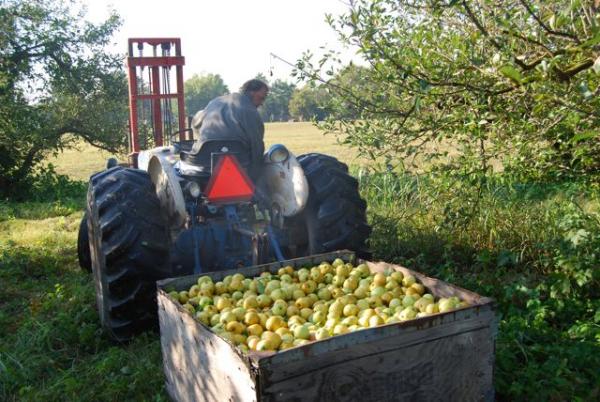
Harvest 2012 Jefferson County WV photo by G. Bergel
A prayer common to Christians worldwide is what we now call “The Our Father” or “The Lord’s Prayer” — a model prayer which Jesus of Nazareth, Rabbi Yeshua, taught his disciples as they sat together on the Mount of Beatitudes overlooking the Sea of Galilee. A “rule” or pattern of prayer was part of the “yoke” of teaching that each rabbi presented to their followers and guided them in. Jesus lived the “yoke,” the “Way,” that He taught. (Matthew 6:9-13, 14:23; Mark 1:35; Luke 5:16; John 11:41; Acts 9:2, 9:9,23)
Every now and then I try to set myself free from ruts of familiarity with the phrases of this oft-repeated prayer. I do word studies, reflect on commentaries and sermons, and read teaching by authors new to me. Such study and meditation deepens my understanding and refreshes my prayer life. I often glean significant nuances of language and meaning.
One “discovery” radically adjusted the way in which I approach the Lord for provisions ” whether finances for family or ministry, evangelistic outreach and church-planting, earth stewardship and community service, equipment and supplies, education and training for the children, music, books and reading materials, even in making Sabbath, vacation and recreational selections.
“Give us this day our daily bread,” contains a compound word which is used nowhere else in the New Testament.
The very familiar phrase, “Give us this day our daily bread,” contains a compound word which is rare in either classical or sacred Greek, and is used nowhere else in the New Testament. The Greek word, epiousios, rendered “daily,” is found only in Matthew 6:11 and Luke 11:3. Linguists and Bible commentators have speculated upon its derivations and full meaning for centuries. Some speculate that it is derived from epi and ousia and signifies “bread for sustenance.” Others contend that a more probable derivation is from epi and eimi, “to go,” and that the prayer is for “bread for going on.” Another linguistic derivation is from he epiousa which yields “for the next day” or “for the day already dawning.”
A literal English translation of the Greek can be rendered “the bread of us, belonging to the morrow, give us each day.” Many versions of the Bible include the marginal translation, “Give us our bread for the morrow” or “for the morrow’s journey.” Commentators agree that the word carries a settled sense of an appointed, sustaining measure” an amount that is sufficient “for the day already dawning.” In ancient Israel an adequate supply of bread might be purchased by or passed to those travelers setting out on “a day’s journey,” often across arid, hostile and dangerous, or uninhabited regions. Jesus notes that such a provision to sustain those sojourning might even be persistently demanded and procured at midnight. (Luke 11:5-13)
Our pattern for asking for “our daily bread” might then better be understood to mean, “grant to us our full provision for the morrow, that which is necessary to sustain us on our assigned journey and to complete our appointed mission.” This would interpret and position “our daily bread” more in the context of the “Thy will be done” and “Thy kingdom come” emphases immediately preceding. It would also reflect and heed the Lord’s prior admonitions from both the Matthew and Luke accounts that we be careful to know our Father’s heart toward us, and not to doubt His covenantal commitment to supply our basic human needs.
We are admonished not to worry, waste words or vainly repeat requests.

Harvest 2012 Jefferson County WV photo by G. Bergel
We are clearly admonished not to waste words, worry, or vainly repeat requests when praying for mundane personal needs. Our Father already knows what we have need of before we ask Him. (Matthew 6:6-8) Scripture also instructs us to emulate the example of Mary who worshipfully waited upon the Lord and was not worried and obsessively concerned about the many small matters of life. (Luke 10:38-42)
The unique Greek compound shows that our Lord’s directive reaches far beyond asking for daily sustenance. I believe it points to the proactive, strategic, tactical requests we are to be making for the daily proclamation and actualization of the “gospel of the kingdom.” It encompasses a thoughtful and regular requisitioning for the finances, supplies, collaborative assistance, provisions and protection necessary for “fishing for people” — the redemption and disciplining of all nations, all peoples, all ethnos, and for the tending, cultivating and renewing of the earth. (Matthew 24:14)
Personally, I now pray for “our daily bread” primarily in the light of fulfilling the Great Commandment and the Great Commission. (Matthew 5:43-45, 28:19-20) The daily ushering in of more of Christ’s renewal and kingdom reign — His person, peace and rule already in our midst, reaching for our neighbors and all in the human family, coming and coming more, unto consummation at His return. Such “kingdom” world-reaching requisitioning connotes a military aspect and is part of each believer’s spiritual warfare. The Bible reveals Jesus Christ as “the ruler over the kings of the earth,” and “the Lord God of hosts,” conquering Lamb and Commander of the armies of heaven. (Revelation 1:5, 5:12, 11:15)
Imagine that you are on officer on the front lines engaged in a continuing battle. (Ephesians 6:10-13 teaches that we are all engaged in ongoing spiritual “wrestling,” a warfare ultimately not with human beings but with unseen satanic forces.) Past training and experience helps you assess what assistance, equipment and supplies it will take to hold your position, and what additional deployments will be necessary to advance your front. You make phone or radio contact with headquarters, and you brief your Commander, on the situation and requisition what is needed. Your requisition is either approved as is, or is adjusted and forwarded to the supply depots, which dispatch all that you need to fulfill your mission.
Think of the consequences if you were foolish enough not to connect with headquarters and failed to requisition what you knew was necessary for survival and success. Asking only for K-rations might allow you to stay alive, maybe long enough to be overrun by the enemy when you run out of fuel and munitions.
This kingdom insight into praying for “our daily bread” should be of strategic interest to all of us collaborating together as part of the Evangelical Environmental Network. Undeniable climate change and discordant severe weather is enveloping the earth. The poor suffering from pollution and treatable diseases, and from water and food scarcity, climate orphans and refugees, energy-deprived nations needing light and electricity from clean, sustainable sources—all these and more need our immediate and ongoing collaborative concern and assistance. The rule of prayer which Jesus taught His disciples is actually universal and “other” minded.
In summary, let us see that the Way of Jesus instructs that we must (be careful to) requisition heaven (our headquarters and supply depot) for the supplies, volunteers and staffing, finances, equipment, “munitions and protective air cover” necessary to complete our assigned evangelical redemptive life-care and earth-care missions.
“Do not be afraid, little flock, for your Father has been pleased to give you the kingdom.” (Luke 12:32)
Christ’s “yoke” requires that we, like Him, take time to draw off, inquire, and know the will of God and the foreordained works we are to individually and corporately accomplish. (Ephesians 2:10) Such relational engagement entails consultation, obedience, accountability and adjustment.
Keeping this heightened “Lord’s Prayer” perspective in mind, let us unite anew in requisitioning our Lord for tomorrow’s full provision today. Let us pray for the supplies WE ALL NEED for ALL of our strategic EEN partnerships and deployments: “Give US this day, OUR daily bread.”
With supplies “for the morrow” on hand, in transit and released anew each day from the storehouses and treasuries of heaven–which transcend fluctuating earthly economies and never suffer lack”we can be certain of ongoing impact and redemptive achievement.
Previous Post

September 27, 2012
The Biblical Art of Naming
Next Post
October 3, 2012 Tim Keller on Common Grace
Browse Our Archives
Select a Category Book Review Compassion for a World in Need Mercury and the Unborn Reflections on God's Creation The Christian Life The Public Square Uncategorized Worldview
Select a Month May 2014 April 2014 March 2014 January 2014 December 2013 September 2013 July 2013 June 2013 May 2013 April 2013 March 2013 February 2013 January 2013 December 2012 November 2012 October 2012 September 2012 August 2012 May 2012 April 2012 March 2012
TAKE THE
Religious Wisdom Quiz
Why did Jesus often use parables?
Select your answer to see how you score.
To show off To entertain only To confuse listeners To reveal truths to those open to God
Related posts from The Earth is the Lord's

Suffering, Vocations, St. George, Hope, and Endurance

Holy Week Creation Care Podcast
Caring for God's Creation is Part of a...

Confessions of a Non-Sustainable Carnivore
TRENDING AT PATHEOS Evangelical

The REST of Your Life: A Creative Wrestles...
This week I had a conversation with a good friend from church....

How the author of the world's best hymn...
I've been working with John Newton for a while now. This makes...

Long before this Lectio Divina, Psalm 130 - the song - started...

What About the Trees? Another Living Parable
After I finished writing the last article about falling leaves as a...

Why Classical Education Is a Conversation, Not a...
Come and Read: Joy in Classical Education When I was a little...

Cornell University has received a great deal of negative publicity and intense...
view all Evangelical blogs
Ad-Free & Subscriber Log-In Subscription Support
- About Us
- 2026 Calendar
- Videos
- Podcasts
- Library of World Religions
- Faith In Media Tracker
- Advertise With Us
- Write for Us
- Privacy Policy
- Terms of Service
- Do Not Sell My Data
- Contact Us
- Radiant Digital
- Manage Newsletter Subscriptions
- Unsubscribe From Notifications
- Sitemap
Copyright 2008-2026, Patheos. All rights reserved.
Subscription Support Ad-Free & Subscriber Log-In
Follow Patheos