
BuddhistCatholicContemplativeEvangelicalGeneral ChristianHinduJewishLatter-day SaintMuslimNew VisionsProgressive Christian
Beliefs
- Buddhist
- Catholic
- Contemplative
- Evangelical
- General Christian
- Hindu
- Jewish
- Latter-day Saint
- More Voices
- Muslim
- New Visions
- Pagan
- Progressive Christian
Topics
- Religion News
- Food and Religion
- Sports and Religion
- Religious Art
- Religious Music and Entertainment
- Religious Events
- History and Religion
- Style and Religion
- Politics and Religion
- Women in Religion
- Recreation Outdoors and Religion
- Business Finance and Religion
- Careers Workplace and Religion
- Education and Religion
- Family Parenting and Religion
- Health Fitness and Religion
- Home and Religion
- Relationships and Religion
- Technology and Religion
- Travel and Religion
Columnists
- Buddhist Columnists
- Business Finance and Religion Columnists
- Careers Workplace and Religion Columnists
- Catholic Columnists
- Contemplative Columnists
- Education and Religion Columnists
- Evangelists Columnists
- Family Parenting and Religion Columnists
- General Christian Columnists
- Health Fitness and Religion Columnists
- Hindu Columnists
- History and Religion Columnists
- Home and Religion Columnists
- Jewish Columnists
- More Voices Columnists
- Latter Day Columnists
- Muslim Columnists
- New Visions Columnists
- Nonreligious Columnists
- Pagan Columnists
- Politics and Religion Columnists
- Progressive Columnists
- Recreation Outdoors and Religion Columnists
- Relationships and Religion Columnists
- Religion News Columnists
- Religious Art Columnists
- Religious Events Columnists
- Religious Music and Entertainment Columnists
- Sports and Religion Columnists
- Style and Religion Columnists
- Technology and Religion Columnists
- Travel and Religion Columnists
- Women in Religion Columnists
Resource Library
- 2026 Calendar
- Library of World Religions
- The 100 Most Holy Places on Earth
- Patheos Answers
- Podcasts
- Videos
- Faith Leaders Database
- Anglican Episcopalian
- Bahai
- Baptist
- Buddhism
- Christianity
- Confucianism
- Eastern Orthodoxy
- Hinduism
- Holiness and Pentecostal
- ISKCON
- Islam
- Judaism
- Lutheran
- Methodist
- The Church of Jesus Christ of Latter-day Saints
- New Age
- Paganism
- Presbytarian and Reformed
- Protestantism
- Religion Behind the Scenes
- Roman Catholic
- Scientology
- Shia Islam
- Sikhism
- Sufism
- Sunni Islam
- Taoism
- Zen
- See all religions
Research Tools
 Ad-Free & Subscriber Log-In Subscription Support
Ad-Free & Subscriber Log-In Subscription Support
Follow Patheos 

- Trending:
- Forgiveness
- |
- Marriage
- |
- Consciousness
- |
- Death Penalty
- |
- Election
- |
- Halloween
 The Earth is the Lord's
- Home
- Evangelical
- The State of Coral Reefs
The State of Coral Reefs
Last updated on: August 16, 2012 at 8:33 am by Alexei Laushkin
The State of Coral Reefs 2012-08-16T08:33:50-05:00 Alexei Laushkin
Patheos Explore the world's faith through different perspectives on religion and spirituality! Patheos has the views of the prevalent religions and spiritualities of the world.
By John Elwood
More than 2,600 of the world’s top marine scientists warned last week that coral reefs around the world are in rapid decline due to human impacts. They urged action on climate to stem the tide of decay.
The world’s largest society of reef scientists, the International Coral Reef Symposium (ICRS), met in the northeastern Australian city of Cairns, and warned that people’s livelihoods were at risk. They pinpointed warming oceans, increasing ocean acidification, overfishing, and pollution as the principal causes of present and future reef decay. Take a look at their Consensus Statement.
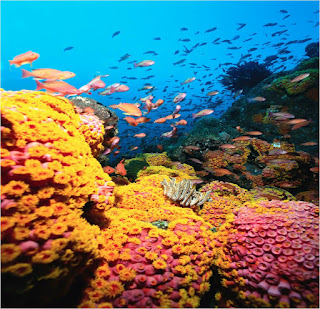
Healthy reef ecosystems foster amazing biodiversity
Like so much of God’s creation, coral reefs provide unseen services to the earth and its creatures. They function as natural breakwaters for waves and storms, protecting coastal communities. They are crucial to global tourism. Their diverse creatures provide countless pharmaceutical benefits. And coral reefs provide food and livelihood for many millions of people.
“Worldwide, more than three billion people depend on marine and coastal biodiversity for their livelihoods,” said Jane Lubchenco, a marine scientist and head of the U.S. National Oceanic and Atmospheric Administration. “Marine fisheries directly or indirectly employ over 200 million people.” Corals act as the nursery for many fish species. No one is certain what would happen to global sea life without them.
The ICRS warned that 25-30% of the world’s reefs are already severely degraded. And the Great Barrier Reef off Australia has seen a 50 percent decline in the last 50 years, scientists say.
The ICRS Consensus Statement warned of much greater near-term losses: During this century, “CO2 emissions at the current rate will warm sea surface temperatures by at least 2-3 °C, raise sea-level by as much as 1.7 meters, reduce ocean pH from 8.1 to less than 7.9, and increase storm frequency and/or intensity.”
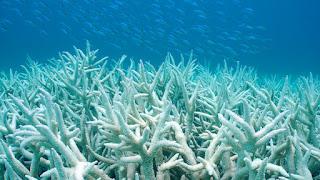
One in four reefs are degraded, and many bleach and die
They are describing a perfect storm for coral reef decay: warmer ocean temperatures which cause corals to bleach and often die; ocean acidification from higher atmospheric CO2, which makes it difficult for corals to build their skeletal structures; and rising sea levels and stronger storms, driving increased sedimentation that chokes or buries reefs.
“This combined change in temperature and ocean chemistry,” says the ICRS, “has not occurred since the last reef crisis 55 million years ago.”
To make that clear, the world’s largest reef-science society is warning us that within 88 years, our actions will give rise to conditions not seen in 55 million years. And apparently, that was a bad time for reefs.
Jeremy Jackson, senior scientist at the Smithsonian Institution in the U.S. explains, “What’s good for reefs is also critically important for people and we should wake up to that fact.”
For the most part, we are lay people, not research scientists. What should we make of these warnings from the scientists? The Christian Reformed Church (CRC) Creation Stewardship Report has some excellent guidance for us:
“Pay particular attention to consensus statements from scientific societies. It is true that scientists too are human; scientific conclusions may also contain error, exaggeration, or misstatement. As imperfect humans, this is unavoidable. Nevertheless, when a broad community of experienced and reliable experts, utilizing the checks and balances implicit in scientific review, agrees on consistent conclusions over a period of several decades, it is reasonable to accept these broadly based conclusions and plan for the future.” (CRC, p.39)
The Consensus Statement on coral reefs would appear to be just the sort of broad agreement that the CRC has in mind. As partners by grace in God’s work of reconciling all things, we recognize that this includes his oceans and its innumerable creatures. But we now hear that our own activities are contributing to harmful conditions not seen on earth for millions of years.
What should we do? Again, we look to the CRC for help:
Pray: Individually and communally, ask God for forgiveness for the sins of arrogance, pride, and greed that cause us to fail in our roles as stewards of creation, consume more than we need or ought, and ignore the plight of the poor and vulnerable. Consider joining one of EEN’s prayer gatherings or even being a part of EEN’s Prayer Team.
Increase awareness: Learn together what it would mean to act with justice and mercy among, with, and on behalf of those most affected by environmental degradation. Share this video from Rev. Mitch Hescox about the importance of being a good steward of God’s creation.
Walk and talk: Personally and as a community, take an inventory of where we stand with respect to God’s creation, and brainstorm together where we will go from here. (CRC, p.57). Consider starting with this short study on how to be a good steward of God’s oceans.
Let us add one further thought: Do it quickly! The passage of time does not favor God’s vulnerable reef creatures and the human communities that depend on them. It’s time to take action to reduce our own contribution to the oceans decay. Consider taking action by supporting Young Evangelicals for Climate Action (Y.E.C.A.), taking action on the need to reduce carbon pollution, or join the Creation Care Teaching Institute and join with others taking meaningful steps.
Action starts with you.
You can read more of John’s writing here.
Evangelical Environmental Network
International Coral Reef Symposium
The Christian Reformed Church (CRC) Creation Stewardship Report
Young Evangelicals for Climate Action
Previous Post

August 14, 2012
A Passion for His Kingdom, A Passion for His Name
Next Post
August 17, 2012 Nature's Dictionary
Browse Our Archives
Select a Category Book Review Compassion for a World in Need Mercury and the Unborn Reflections on God's Creation The Christian Life The Public Square Uncategorized Worldview
Select a Month May 2014 April 2014 March 2014 January 2014 December 2013 September 2013 July 2013 June 2013 May 2013 April 2013 March 2013 February 2013 January 2013 December 2012 November 2012 October 2012 September 2012 August 2012 May 2012 April 2012 March 2012
TAKE THE
Religious Wisdom Quiz
Which harvest festival is also called the Feast of Booths?
Select your answer to see how you score.
Sukkot Hanukkah Passover Purim
Related posts from The Earth is the Lord's

Caring for God's Creation is Part of a...

This Lent, Consider God's Creation

This Republican Agrees with President Obama on Climate...

Genesis 9: The Forgotten Covenant
TRENDING AT PATHEOS Evangelical

The REST of Your Life: A Creative Wrestles...
This week I had a conversation with a good friend from church....

How the author of the world's best hymn...
I've been working with John Newton for a while now. This makes...

Long before this Lectio Divina, Psalm 130 - the song - started...

What About the Trees? Another Living Parable
After I finished writing the last article about falling leaves as a...

Why Classical Education Is a Conversation, Not a...
Come and Read: Joy in Classical Education When I was a little...

Cornell University has received a great deal of negative publicity and intense...
view all Evangelical blogs
Ad-Free & Subscriber Log-In Subscription Support
- About Us
- 2026 Calendar
- Videos
- Podcasts
- Library of World Religions
- Faith In Media Tracker
- Advertise With Us
- Write for Us
- Privacy Policy
- Terms of Service
- Do Not Sell My Data
- Contact Us
- Radiant Digital
- Manage Newsletter Subscriptions
- Unsubscribe From Notifications
- Sitemap
Copyright 2008-2026, Patheos. All rights reserved.
Subscription Support Ad-Free & Subscriber Log-In
Follow Patheos