
BuddhistCatholicContemplativeEvangelicalGeneral ChristianHinduJewishLatter-day SaintMuslimNew VisionsProgressive Christian
Beliefs
- Buddhist
- Catholic
- Contemplative
- Evangelical
- General Christian
- Hindu
- Jewish
- Latter-day Saint
- More Voices
- Muslim
- New Visions
- Pagan
- Progressive Christian
Topics
- Religion News
- Food and Religion
- Sports and Religion
- Religious Art
- Religious Music and Entertainment
- Religious Events
- History and Religion
- Style and Religion
- Politics and Religion
- Women in Religion
- Recreation Outdoors and Religion
- Business Finance and Religion
- Careers Workplace and Religion
- Education and Religion
- Family Parenting and Religion
- Health Fitness and Religion
- Home and Religion
- Relationships and Religion
- Technology and Religion
- Travel and Religion
Columnists
- Buddhist Columnists
- Business Finance and Religion Columnists
- Careers Workplace and Religion Columnists
- Catholic Columnists
- Contemplative Columnists
- Education and Religion Columnists
- Evangelists Columnists
- Family Parenting and Religion Columnists
- General Christian Columnists
- Health Fitness and Religion Columnists
- Hindu Columnists
- History and Religion Columnists
- Home and Religion Columnists
- Jewish Columnists
- More Voices Columnists
- Latter Day Columnists
- Muslim Columnists
- New Visions Columnists
- Nonreligious Columnists
- Pagan Columnists
- Politics and Religion Columnists
- Progressive Columnists
- Recreation Outdoors and Religion Columnists
- Relationships and Religion Columnists
- Religion News Columnists
- Religious Art Columnists
- Religious Events Columnists
- Religious Music and Entertainment Columnists
- Sports and Religion Columnists
- Style and Religion Columnists
- Technology and Religion Columnists
- Travel and Religion Columnists
- Women in Religion Columnists
Resource Library
- 2026 Calendar
- Library of World Religions
- The 100 Most Holy Places on Earth
- Patheos Answers
- Podcasts
- Videos
- Faith Leaders Database
- Anglican Episcopalian
- Bahai
- Baptist
- Buddhism
- Christianity
- Confucianism
- Eastern Orthodoxy
- Hinduism
- Holiness and Pentecostal
- ISKCON
- Islam
- Judaism
- Lutheran
- Methodist
- The Church of Jesus Christ of Latter-day Saints
- New Age
- Paganism
- Presbytarian and Reformed
- Protestantism
- Religion Behind the Scenes
- Roman Catholic
- Scientology
- Shia Islam
- Sikhism
- Sufism
- Sunni Islam
- Taoism
- Zen
- See all religions
Research Tools
 Ad-Free & Subscriber Log-In Subscription Support
Ad-Free & Subscriber Log-In Subscription Support
Follow Patheos 

- Trending:
- Forgiveness
- |
- Marriage
- |
- Consciousness
- |
- Death Penalty
- |
- Election
- |
- Halloween

- Home
- Evangelical
- Relationships and Religion
- Peace in the Strife: A Year of Blogging (Mostly) on the Patriarchy
Peace in the Strife: A Year of Blogging (Mostly) on the Patriarchy
Last updated on: December 7, 2023 at 5:44 pm by Talley Cross
Peace in the Strife: A Year of Blogging (Mostly) on the Patriarchy 2023-12-07T17:44:30-05:00 Talley Cross
Patheos Explore the world's faith through different perspectives on religion and spirituality! Patheos has the views of the prevalent religions and spiritualities of the world.
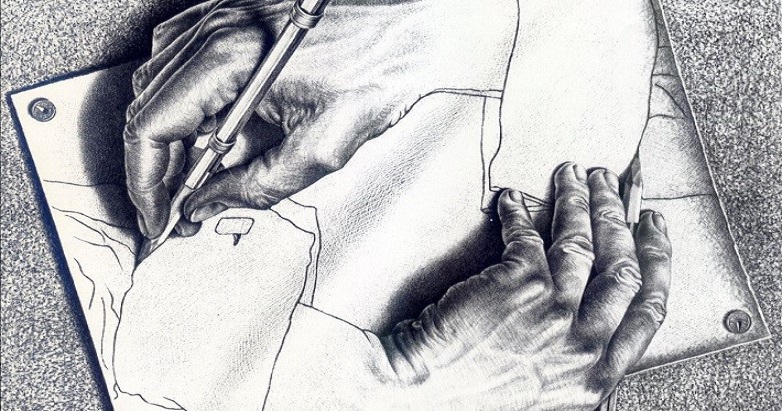
Writing about my writing: a year in review / Drawing Hands, 1948 – M.C. Escher – WikiArt.org / public domain
Looking back over the past year, it’s hard to imagine a blank space in place of the 15 posts here. None is perfect, but all are special to me. They are canvasses onto which I have poured out my soul, intellect, and imagination pondering the things of God; they have been catalysts for spiritual formation – mine, hopefully others’ – and productive engagement. Blogging (mostly) on the patriarchy has been a burden and a blessing: the burden and blessing of peace in the strife.
As I soldier on, one thing that continues to surprise me are the people at my church who’ve read this blog. I’m not on social media, nor do I consider myself to be popular or notable in my community, so I’d assumed my exposure here would be limited. Yet a deacon at my church was concerned about me after reading my caustic post on the Rt. Rev. Julian Dobbs. She wondered if I had peace.
So I asked her: what does peace mean?
Peace in the Strife: A Cruciform Life
A favorite hymn of mine, by fellow Sewanee alum William Alexander Percy, contemplates what peace means for Christians. It’s more complicated than we might think. Percy begins by considering the simple, relatively quiet lives of the apostles prior to their conversion and contrasts that shallow “peace” to the peace of the Christian life:
They cast their nets in Galilee
Just off the hills of brown,
Such happy, simple fisherfolk
Before the Lord came down.Contented, peaceful fishermen,
Before they ever knew
The peace of God that filled their hearts
Brimful, and broke them too.Young John who trimmed the flapping sail
Homeless in Patmos died.
Peter, who hauled the teeming net,
Head down was crucified.
Percy then concludes:
The peace of God, it is no peace,
But strife closed in the sod.
Yet Christians pray for but one thing –
The marvelous peace of God.
I’m familiar with this hymn because of my dad. As organist/choirmaster, he was responsible for selecting our hymns, and I think he appreciated this one for its lyrical beauty and depth. The tune, Georgetown, is appropriately haunting. I remember practicing the hymn in choir once, and Dad said to us, “This seems to have a profound but difficult message; what do you think it is?” His concern was not merely with the vocal performance of the piece but that its meaning, as well as its music, would resonate in us.
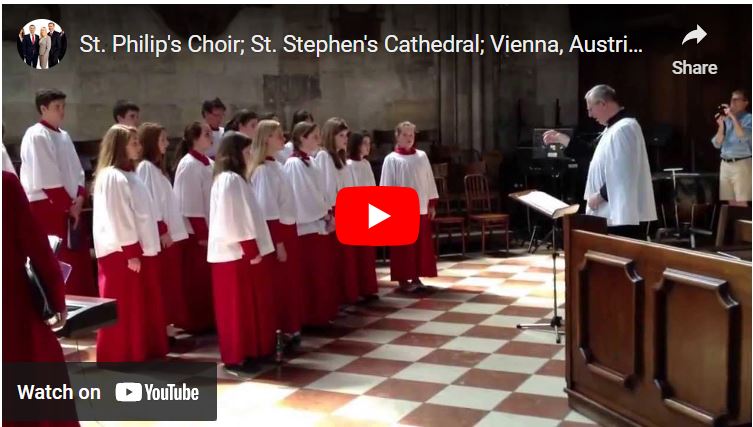
My dad, Capers Cross, conducting the St. Philip’s choir as they sing “Adoramus Te” at St. Stephen’s Cathedral, Vienna, August 2013. Video by John Kuhn. Watch on YouTube here.
Do I have peace?
Did John and Peter have peace?
Yes and no, but there is peace in the strife.
I told my deacon that I had the peace of someone doing what God is calling me to do. And if that looks like strife, then perhaps I’m right on the money.
Thanks, Dad!
Encountering God
It bears mentioning that when I write something involving God, I try to invite him into that creative process. I don’t always sense his presence, but several times in the past year, I could feel the Holy Spirit’s inspiration and Jesus speaking Scripture to me as I drafted these posts. Encountering God in profound and surprising ways – as I ruminated on dark topics – certainly brought me some peace in the strife.
The post on Mary Magdelene was particularly memorable for me. I wrote most of it on my back porch, and while I hit some roadblocks, at times I felt the Holy Spirit like a gentle wind buffeting my thoughts. The lightness of his presence was unexpected and encouraging; I knew then that I was on to something, and that deep knowledge kept me going.
I finished my post denouncing the ESV Bible translation’s treatment of women late at night and went to bed straight away. I was satisfied with what I’d accomplished, but as I nodded off, I felt as if Jesus was speaking Luke 13 to me. In this passage, he heals a woman stricken for years with a debilitating, deforming condition. But rather than celebrating her freedom and healing, the synagogue leaders criticize Jesus for doing “work” on the Sabbath.
Heaven itself seemed to open in my mind. I suddenly realized that Carolyn Custis James’ criticism of the ESV – its refusal to update the Old English translation of “man” in Gen. 1:26-27 and replace it with the more accurate and female-inclusive term “human beings,” while updating without hesitation older terms like “ass” to the more appropriate term “donkey” – recapitulates the same double standard Jesus criticized in Luke 13, where he blasts the spiritual authorities for treating donkeys better than women:
“You hypocrites! Does not each of you on the Sabbath untie his ox or his donkey from the manger and lead it to water? And ought not this woman, a daughter of Abraham whom Satan bound for eighteen long years, be set free from this bondage on the Sabbath day?” (10-16)
Why is it that modern-day scribes are happy to update the language for animals, giving the donkey its place of honor in the text, yet refuse to update the Hebrew translation of adam (“earth creature”) in Gen. 1:26-27 from “man” to “human beings”, denying to women the place of honor that God ordained for us – in this narrative – as equal partners of men?
Before my encounter with Jesus that night, I thought I’d sufficiently (perhaps too harshly?) detailed the distortions of the ESV and their significance to Christian living. But Jesus, as he cried Luke 13 out to me and underscored the old donkey/woman double standard, was condemning the ESV in even stronger terms. God’s presence to me then, as I was falling asleep, was no gentle wind but an urgent appeal, a clarion call (wake up! don’t miss this! there’s more!), the Word of God come alive from the pages of the Bible straight into my heart like a sword. I thought I was being subversive, but from God’s perspective, I hadn’t gone far enough.
Why? Because my criticism, sharp though it was, didn’t do justice to God’s moral outrage. I believe Jesus stopped me before I published that post because he had something more powerful for me to say, something he wanted to make crystal clear: that the motives behind the ESV translation are part of a pattern of sin – the arrogance and ignorance of men in power – that he has already condemned.
Woe to the scribes.
Writing As Weaving: Making Peace in the Strife
My great-grandmother and namesake, Nell Serena Talley Ward, passed away when I was 11. As a child, I’d visit her throughout the year with my family, but I hadn’t known her well. When she was gone, what I remembered most about her – besides her incredible faith – was her skill at crochet. With needle and thread, which was always by her side in a basket, she created the most exquisite textiles: tablecloths, Christmas ornaments, doilies, runners.
Years after her death, in high school, I dreamed I was back in her home. In the dream, she’d just died, and I wanted to take her crochet needle with me. I went to her bedroom, found her sewing basket in the closet, grabbed the needle, and left.
Just last year, almost 30 years after that dream, there was an estate sale at her home. The night before the auction, I spied her sewing basket and its contents in the auction photos; they were part of the sale. I asked a family member to save the basket for me, and it’s in my home now.
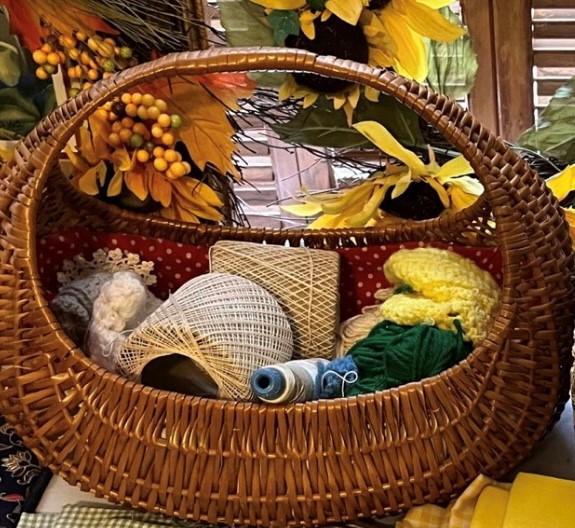
My late nana’s sewing basket. Inside I found unfinished pieces. What had she been planning next?
I finally got that needle, and although I can’t crochet, like my nana, I can create. That was my inheritance. I just use thoughts and words instead of needle and thread. The metaphor to writing is apt; a crochet needle bears a striking resemblance to a pen.
I’m not sure what I’ll write here next, but the making of it will be part of my peace in the strife. And I look forward to seeing God, and seeing what he does, in my offering.
General Christian
Women in Religion

About Talley Cross
Talley is a compliance manager at a global payments company. She received her Master’s degree in Middle Eastern Studies from the American University in Cairo, where she was a University Fellow, and worked with the Anglican Diocese of Egypt on Muslim/Christian interfaith dialog projects. Talley has a Bachelor’s degree in Religious Studies from Sewanee / The University of the South. You can read more about the author here.
Previous Post

July 24, 2023
Gender Role Theology: A Slippery Slope to LGBTQ+?
Recent Comments
"Hi, I see that something you sent over awhile back was automatically put in the ..."
"Hi Talley. It's been 18 days since I replied to this. Is there a reason ..."
"You don't need to read others' comments on my posts on this topic to know ..."
"Thank you for your response however you saying that I won't find wide support for ..."
Browse Our Archives
Select a Category ACNA angels Anglican Communion bliblical womanhood Christian dating complementarianism ESV female submission feminism Gender love marriage patriarchy prayer Resurrection sexual abuse sexual ethics Sexuality singleness the Fall Uncategorized
Select a Month October 2026 August 2026 June 2026 April 2026 February 2026 December 2025 November 2025 August 2025 July 2025 May 2025 March 2025 February 2025 October 2024 July 2024 June 2024 April 2024 March 2024 February 2024 December 2023 October 2023 September 2023 July 2023 June 2023 May 2023 April 2023 March 2023 February 2023 January 2023 December 2022 November 2022 October 2022 September 2022 August 2022
TAKE THE
Religious Wisdom Quiz
Where did David spare Saul's life when he found him in a cave?
Select your answer to see how you score.
Gilgal En Gedi Hebron Bethlehem
Related posts from Flesh of My Flesh
Is Complementarianism Misogyny?

The Myth That Fathers Shape Kids' Faith More...
Push for Transparency on Gender Roles in Your...
TRENDING AT PATHEOS Evangelical

'Super Scam Me' Exposes AI Jon Bon Jovi...
Leslie Pickett believed she was in a relationship with Jon Bon Jovi....

The Brazilian Remake of Kendricks' 'Flywheel' Opens in...
“Flywheel,” the story that launched the Kendrick Brothers’ filmmaking career is getting...

The Dangers of Gradual Accommodation (Winking at Sin)
Recently, the “law of gradualness” resurfaced during the opening of a weeklong,...

The Iron Gates and the Lion of the...
Yesterday, I didn't finish my report about, well, yesterday. So I'll...

The Image: On the Horror of Capitalism and...
The Image Then went the Pharisees, and took counsel how they might...

We are approaching the date of our new American national holiday: October...
view all Evangelical blogs
What Are Your Thoughts?leave a comment
Ad-Free & Subscriber Log-In Subscription Support
- About Us
- 2026 Calendar
- Videos
- Podcasts
- Library of World Religions
- Faith In Media Tracker
- Advertise With Us
- Write for Us
- Privacy Policy
- Terms of Service
- Do Not Sell My Data
- Contact Us
- Radiant Digital
- Manage Newsletter Subscriptions
- Unsubscribe From Notifications
- Sitemap
Copyright 2008-2026, Patheos. All rights reserved.
Subscription Support Ad-Free & Subscriber Log-In
Follow Patheos