
BuddhistCatholicContemplativeEvangelicalGeneral ChristianHinduJewishLatter-day SaintMuslimNew VisionsProgressive Christian
Beliefs
- Buddhist
- Catholic
- Contemplative
- Evangelical
- General Christian
- Hindu
- Jewish
- Latter-day Saint
- More Voices
- Muslim
- New Visions
- Pagan
- Progressive Christian
Topics
- Religion News
- Food and Religion
- Sports and Religion
- Religious Art
- Religious Music and Entertainment
- Religious Events
- History and Religion
- Style and Religion
- Politics and Religion
- Women in Religion
- Recreation Outdoors and Religion
- Business Finance and Religion
- Careers Workplace and Religion
- Education and Religion
- Family Parenting and Religion
- Health Fitness and Religion
- Home and Religion
- Relationships and Religion
- Technology and Religion
- Travel and Religion
Columnists
- Buddhist Columnists
- Business Finance and Religion Columnists
- Careers Workplace and Religion Columnists
- Catholic Columnists
- Contemplative Columnists
- Education and Religion Columnists
- Evangelists Columnists
- Family Parenting and Religion Columnists
- General Christian Columnists
- Health Fitness and Religion Columnists
- Hindu Columnists
- History and Religion Columnists
- Home and Religion Columnists
- Jewish Columnists
- More Voices Columnists
- Latter Day Columnists
- Muslim Columnists
- New Visions Columnists
- Nonreligious Columnists
- Pagan Columnists
- Politics and Religion Columnists
- Progressive Columnists
- Recreation Outdoors and Religion Columnists
- Relationships and Religion Columnists
- Religion News Columnists
- Religious Art Columnists
- Religious Events Columnists
- Religious Music and Entertainment Columnists
- Sports and Religion Columnists
- Style and Religion Columnists
- Technology and Religion Columnists
- Travel and Religion Columnists
- Women in Religion Columnists
Resource Library
- 2026 Calendar
- Library of World Religions
- The 100 Most Holy Places on Earth
- Patheos Answers
- Podcasts
- Videos
- Faith Leaders Database
- Anglican Episcopalian
- Bahai
- Baptist
- Buddhism
- Christianity
- Confucianism
- Eastern Orthodoxy
- Hinduism
- Holiness and Pentecostal
- ISKCON
- Islam
- Judaism
- Lutheran
- Methodist
- The Church of Jesus Christ of Latter-day Saints
- New Age
- Paganism
- Presbytarian and Reformed
- Protestantism
- Religion Behind the Scenes
- Roman Catholic
- Scientology
- Shia Islam
- Sikhism
- Sufism
- Sunni Islam
- Taoism
- Zen
- See all religions
Research Tools
 Ad-Free & Subscriber Log-In Subscription Support
Ad-Free & Subscriber Log-In Subscription Support
Follow Patheos 

- Trending:
- Forgiveness
- |
- Marriage
- |
- Consciousness
- |
- Death Penalty
- |
- Election
- |
- Halloween

- Home
- Evangelical
- Relationships and Religion
- The Trinity and Gender Relationships
The Trinity and Gender Relationships
Last updated on: November 21, 2022 at 9:23 am by Talley Cross
The Trinity and Gender Relationships 2022-11-21T09:23:12-05:00 Talley Cross
Patheos Explore the world's faith through different perspectives on religion and spirituality! Patheos has the views of the prevalent religions and spiritualities of the world.
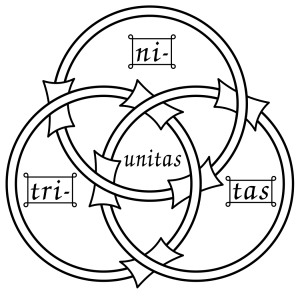
The Borromean rings as a symbol of the Christian Trinity, based on an illustration in a 13th-century French manuscript found at Chartres, as reproduced in Didron’s book “Christian Iconography” (1843) / Wikimedia
In pondering the Trinity and gender relationships, I am reminded – as important and unique as this doctrine is to Christianity – how remarkable it is that the Trinity per se is never mentioned in the Bible. Evidently, neither Biblical authors, nor Jesus, felt the need to define it as such; yet, the concept of the Trinity is articulated clearly enough in the Bible that it is identified, if also unnamed, in our creeds.
Of course, the Trinity is a holy mystery that not even millennia of Christian scholarship can explain satisfactorily. Artists throughout the ages have attempted to render the Trinity in various ways, and their visual interpretations are worth considering as well; as the saying goes, a picture is worth a thousand words.
In this post I will explore the potential parallels between the inner relational dynamics of the Trinity and gender relationships through an examination of credal doctrine, relevant Biblical texts, and a representation of the Trinity in a medieval French manuscript.
The Trinity in the Nicene creed
In the Nicene creed, we confess the following: “I believe in one God, the Father Almighty, maker of heaven and earth…And in one Lord Jesus Christ, the only-begotten Son of God, begotten of his Father before all worlds, God of God, Light of Light, very God of very God, begotten, not made, being of one substance with the Father; by whom all things were made…and [who] sits on the right hand of the Father…And I believe in the Holy Ghost, the Lord, and Giver of Life, who proceeds from the Father and the Son; who with the Father and the Son together is worshiped and glorified; who has spoken through the Prophets.”
The relationship of the persons of the Trinity, as outlined above, has been traditionally expressed in terms of two doctrines:
- The doctrine of eternal generation, which describes the Son’s relationship to the Father. Although “begotten of” his Father, the Son exists eternally with him and is not “created” as such. Creation implies a beginning, and there is no beginning for the Son – just as there is no beginning for the Father. They are “of one substance”: “God from God, Light from Light, very God of very God.”
- The doctrine of eternal procession, which describes the Holy Spirit’s relationship with the Father and the Son as “proceeding” from them and “worshipped and glorified” together with them. Jesus articulates the concept of eternal procession in John 15:26: “When the Advocate comes, whom I will send to you from the Father, the Spirit of truth who comes from the Father, he will testify on my behalf.”
The Trinity in art: the Borromean rings
The illustration for this post, taken from a 13th century French manuscript, provides a tangible metaphor for understanding the “one substance” of the Trinity and the equality of its persons. Each ring, equal in size and representing a person of the Trinity, is overlayed proportionately atop the other, but not exactly overlayed, so that three distinct rings (or persons) can still be distinguished. This graphic captures the tension of unity in trinity that the doctrine of the Trinity invites us to embrace.
The Trinity and gender dynamics: bearing the image of a triune God
Since human beings are created in the image of God – and God himself is triune in nature – it makes sense that trinitarian relational dynamics might be somehow enfolded into human relationships. It’s important to note, as Keith Johnson does here, that we have to be careful inferring human relational dynamics from those of the Trinity. In discussing Augustine’s analysis of the matter, Johnson writes that nothing created can sufficiently mirror God’s immanent and sinless nature. Moreover, Johnson notes that using the Trinity as a “blueprint” for human relationships is a modern theological trend that is not reflected in the New Testament.
But what if God intended human relationships to reflect his own internal relational paradigm?
By creating humans as male and female – two gendered persons of the same fundamental substance – who come together to create third person, a child, God recapitulates, as it were, his own ontology – a community of persons. This community of persons generates over and over again, in abundance, until there are tribes, states, civilizations. Ideally, humanity prospers. The structure of the Trinity, its abundance, and its life-giving nature are thus imparted to humanity through gender and the sexual reproduction that ensues from sexually differentiated, gendered bodies. While one does not have to reproduce sexually to build community, procreation, as ordained by God, is foundational for human flourishing, as I discuss further in a previous post.
In Faithful: A Theology of Sex, Beth Felker Jones posits that sex is so important to God because it is one of the most powerful icons of his self-giving love, which we see at work in the persons of the Trinity. In her view, man and woman, through sexual love, uniquely bear God’s image.
The Trinity and gender hierarchies
Can we also infer gender hierarchies (or their absence) from the Trinity?
In the Nicene creed, the co-equality of the persons of the Trinity is described in the following way: “God from God, Light from Light, very God from very God.” Similar language is used by Adam to describe Eve in Gen. 2:23, when he sees her for the first time: “This one at last is bone of my bones and flesh of my flesh!” Like the persons of the Trinity, men and women are co-equals, of the same substance. Even if, as Johnson argues, the New Testament is silent on human relational parallels to the Trinity, the striking parallel to Genesis in the creed’s description of God’s persons establishes a solid basis for using the Trinity – at least to a certain extent – as a schema for gender relationships.
In recent decades, advocates of complementarianism have attempted to reformulate the doctrine of the Trinity in ways that support a gender hierarchy. (Apparently, one must reformulate the doctrine of the Trinity to support complementarianism, because the doctrine – as traditionally interpreted by the church – doesn’t do that.)
These efforts to redefine the Trinity potentially cross over into heresy by ultimately denying the credal (and Biblical) co-equality God’s Persons, through the following concepts:
- Eternal Subordination of the Son (ESS);
- Eternal Functional Subordination of the Son (EFS);
- and Eternal Relations of Authority and Submission (ERAS), a follow-on to ESS and EFS
While I am grossly simplifying ESS/EFS/ERAS for the sake of expediency, the argument is essentially that the Father, Son, and Holy Spirit are ontologically equal, but the Son remains eternally, functionally subordinate to the Father’s will. Thus ESS/EFS/ERAS maps onto gender relations in the sense that men and women are ontologically equal, but women are functionally subordinate.
The Trinity and the ESS/EFS/ERAS mess
As mentioned, redefining the trinitarian relationship in this way comes at a great cost.
First, we have the problem of heresy. If the Son is eternally subordinate to the Father, that implies that the Father and Son have two wills, which is at odds with the unity of will and “one being” described in the creeds; a being that is one cannot have two separate wills. William G. Witt describes this conundrum in more detail here.
Second, the idea of an ontological/functional split between the persons of God seems fundamentally illogical. As I argue in a post addressing cognitive errors in Todd Wilson’s book Mere Sexuality, being precedes doing/functioning; doing/functioning reflects being. The idea that the Father and the Son are equal in being but not in function is a silly contradiction, a kind of fallacious dualism that doesn’t make any sense. If the Son is eternally subordinated to the Father – that actually affects, and subordinates, his being! I’m not sure why deep and convoluted analyses of ESS/EFS/ERAS have proliferated when this basic logical problem exposes a house of cards. The Emperor has no clothes!
In her review of the 2016 RTS Trinity Conference in Houston, Rachel Green Miller notes that Ligon Duncan, a complementarian theologian, acknowledged the problems with ESS/EFS/ERAS but argued that these concepts aren’t necessary to support complementarianism. I understand his argument, since the usual arguments for complementarianism rest in what are arguably misinterpretations of specific Biblical passages dealing with gender relations – not in ESS/EFS/ERAS.
Given the problems with ESS/EFS/ERAS, it’s smart for Duncan to disassociate these concepts from complementarianism. On the other hand, Duncan’s acknowledgement opens a Pandora’s box for patriarchy: if ESS/EFS/ERAS is fundamentally wrong because it presumes a false ontological/functional split between the Father and the Son – and there is no ontological/functional split – the implications for gender relationships, using the Trinity as a paradigm, lean egalitarian.
Concluding thoughts on the Trinity and gender implications
The medieval sketch of the Trinity is just one person’s rendering of a holy mystery, but it becomes increasingly meaningful the more one dwells on it. There is an artistic preoccupation with symmetry, balance, and equal proportions, even the implied shape of a cross at the center. While the medieval world was certainly entrenched in patriarchy, I don’t see ESS/EFS/ERAS in this design. I see no hierarchy at all, just three co-equal, co-eternal persons existing in perfect harmony and mutuality. This harmony and mutuality seem to illustrate a relationship in which the persons of God defer seamlessly and comparably to one another, not a relationship involving exclusive functional subordination of one of God’s persons.
While on earth, although Jesus was God, he emptied himself of his majesty, being in the form of a servant (Phil. 2:6-8). Yet when Jesus ascends into heaven, we see him exalted at the right hand of the Father (Acts 7:55-56), signifying his place at the Father’s side as a full equal. The details of Jesus’ ascension are not the only evidence of his co-equal status with the Father. He says that no one comes to Father except through him (John 14:6). We know that through Jesus, the Word of the Father, all things were made, and not anything was made that was not made through him (1 John: 1-3). The Holy Spirit proceeds from the Father and the Son working together (John 15:26). To clear up any possible confusion on his equality with the Father, Jesus pointedly says, “I and the Father are one.” (John 10:30).
The persons of the Trinity seem to dance together in mutual deference. This dance is a form perhaps like nothing that we, in our sin, can ever fully conceive or replicate. But if men and women are of each other’s flesh and bone, echoing the creed’s “very God of very God” description of the Trinity – might we be called to a similar dance? Paul seems to think so; in 1 Cor. 11:11-12 he reminds men and women of their interdependence. Adam may have been the source of Eve, but all men are born from women – and all things come from God. Paul ends the chapter by pleading for harmony and enjoins us to mutual submission, in reverence to Christ, in Ephesians 5:21.
As men and women, we are called to take part in a relational dance resembling that of the Trinity, because we resemble the Trinity. Marked by sin, our relationships cannot attain to the perfection of this form, illustrated so aptly in the medieval manuscript, but we can prayerfully commit ourselves and our relationships to be more and more shaped into the image of a triune God.
Progressive Christian
General Christian
Catholic

About Talley Cross
Talley is a compliance manager at a global payments company. She received her Master’s degree in Middle Eastern Studies from the American University in Cairo, where she was a University Fellow, and worked with the Anglican Diocese of Egypt on Muslim/Christian interfaith dialog projects. Talley has a Bachelor’s degree in Religious Studies from Sewanee / The University of the South. You can read more about the author here.
Previous Post

September 8, 2022
Rethinking Order in Genesis
Next Post
October 14, 2022 Where Christianity and Feminism Cross
Browse Our Archives
Select a Category ACNA angels Anglican Communion bliblical womanhood Christian dating complementarianism ESV female submission feminism Gender love marriage patriarchy prayer Resurrection sexual abuse sexual ethics Sexuality singleness the Fall Uncategorized
Select a Month October 2026 August 2026 June 2026 April 2026 February 2026 December 2025 November 2025 August 2025 July 2025 May 2025 March 2025 February 2025 October 2024 July 2024 June 2024 April 2024 March 2024 February 2024 December 2023 October 2023 September 2023 July 2023 June 2023 May 2023 April 2023 March 2023 February 2023 January 2023 December 2022 November 2022 October 2022 September 2022 August 2022
TAKE THE
Religious Wisdom Quiz
Which feast was reinstituted with great joy, reading the Law daily for seven days?
Select your answer to see how you score.
Purim Feast of Tabernacles Passover Day of Atonement
Related posts from Flesh of My Flesh
Is Complementarianism Misogyny?


Yes, There Is Sex in the Resurrection

Push for Transparency on Gender Roles in Your...
TRENDING AT PATHEOS Evangelical

The Iron Gates and the Lion of the...
Yesterday, I didn't finish my report about, well, yesterday. So I'll...

Dolly Parton’s Last Song Wins Dove Award with...
Bluegrass band The Grascals, speaking on the red carpet at the 57th...

The Image: On the Horror of Capitalism and...
The Image Then went the Pharisees, and took counsel how they might...

We are approaching the date of our new American national holiday: October...

Letters on Living the Faith by C.S. Lewis
Most of us met C.S. Lewis as a public intellectual. Mere Christianity....

When Halloween Unmasks Married Hearts
Written by Dr. David K. Ewen from Eternal Truth Bible College Behind...
view all Evangelical blogs
Ad-Free & Subscriber Log-In Subscription Support
- About Us
- 2026 Calendar
- Videos
- Podcasts
- Library of World Religions
- Faith In Media Tracker
- Advertise With Us
- Write for Us
- Privacy Policy
- Terms of Service
- Do Not Sell My Data
- Contact Us
- Radiant Digital
- Manage Newsletter Subscriptions
- Unsubscribe From Notifications
- Sitemap
Copyright 2008-2026, Patheos. All rights reserved.
Subscription Support Ad-Free & Subscriber Log-In
Follow Patheos