
BuddhistCatholicContemplativeEvangelicalGeneral ChristianHinduJewishLatter-day SaintMuslimNew VisionsProgressive Christian
Beliefs
- Buddhist
- Catholic
- Contemplative
- Evangelical
- General Christian
- Hindu
- Jewish
- Latter-day Saint
- More Voices
- Muslim
- New Visions
- Pagan
- Progressive Christian
Topics
- Religion News
- Food and Religion
- Sports and Religion
- Religious Art
- Religious Music and Entertainment
- Religious Events
- History and Religion
- Style and Religion
- Politics and Religion
- Women in Religion
- Recreation Outdoors and Religion
- Business Finance and Religion
- Careers Workplace and Religion
- Education and Religion
- Family Parenting and Religion
- Health Fitness and Religion
- Home and Religion
- Relationships and Religion
- Technology and Religion
- Travel and Religion
Columnists
- Buddhist Columnists
- Business Finance and Religion Columnists
- Careers Workplace and Religion Columnists
- Catholic Columnists
- Contemplative Columnists
- Education and Religion Columnists
- Evangelists Columnists
- Family Parenting and Religion Columnists
- General Christian Columnists
- Health Fitness and Religion Columnists
- Hindu Columnists
- History and Religion Columnists
- Home and Religion Columnists
- Jewish Columnists
- More Voices Columnists
- Latter Day Columnists
- Muslim Columnists
- New Visions Columnists
- Nonreligious Columnists
- Pagan Columnists
- Politics and Religion Columnists
- Progressive Columnists
- Recreation Outdoors and Religion Columnists
- Relationships and Religion Columnists
- Religion News Columnists
- Religious Art Columnists
- Religious Events Columnists
- Religious Music and Entertainment Columnists
- Sports and Religion Columnists
- Style and Religion Columnists
- Technology and Religion Columnists
- Travel and Religion Columnists
- Women in Religion Columnists
Resource Library
- 2026 Calendar
- Library of World Religions
- The 100 Most Holy Places on Earth
- Patheos Answers
- Podcasts
- Videos
- Faith Leaders Database
- Anglican Episcopalian
- Bahai
- Baptist
- Buddhism
- Christianity
- Confucianism
- Eastern Orthodoxy
- Hinduism
- Holiness and Pentecostal
- ISKCON
- Islam
- Judaism
- Lutheran
- Methodist
- The Church of Jesus Christ of Latter-day Saints
- New Age
- Paganism
- Presbytarian and Reformed
- Protestantism
- Religion Behind the Scenes
- Roman Catholic
- Scientology
- Shia Islam
- Sikhism
- Sufism
- Sunni Islam
- Taoism
- Zen
- See all religions
Research Tools
 Ad-Free & Subscriber Log-In Subscription Support
Ad-Free & Subscriber Log-In Subscription Support
Follow Patheos 

- Trending:
- Forgiveness
- |
- Marriage
- |
- Consciousness
- |
- Death Penalty
- |
- Election
- |
- Halloween

- Home
- Evangelical
- Relationships and Religion
- Rethinking Order in Genesis
Rethinking Order in Genesis
Last updated on: September 22, 2022 at 9:00 am by Talley Cross
Rethinking Order in Genesis 2022-09-22T09:00:16-04:00 Talley Cross
Patheos Explore the world's faith through different perspectives on religion and spirituality! Patheos has the views of the prevalent religions and spiritualities of the world.
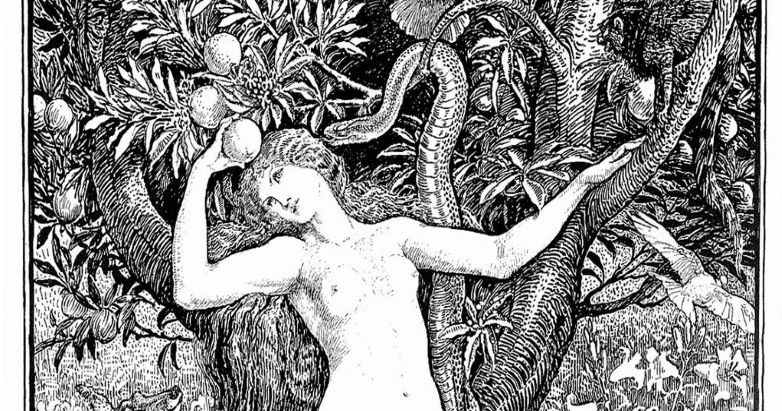
Eve taking the forbidden fruit from the tree of knowledge / Paris Iconographic Collections, by Walter Crane; photographed by Lemercier / Wikimedia
Why did God Confront Adam First after the Fall?
Someone once posed this question to me after speculating that, although both men and women are sinners, men may be deeply responsible for human sin in a way that women are not. The exegetical influence on his thinking comes from his reading of the order in Genesis 1-3: God commands Adam directly not to eat of the tree of life, then confronts Adam first after both he and Eve sin. Since Adam, not Eve, is the direct subject of God’s command “you shall not eat” (Gen.2.17) and first in the line of questioning when that command is broken, we might infer that men are somehow more accountable for sin, even if men and women are both culpable.
Order seems to have symbolic significance in the creation narrative, but it’s worth rethinking exactly what that order signifies. Does being first in the line of questioning connote some kind of “priority,” in terms of responsibility, or something else?
In fact, a hermeneutic of first=priority contradicts how order is actually portrayed in the creation story arc, which gives priority and privilege to humankind as God’s final, crowning creative act. The right hermeneutic here is important, as assumptions that order indicates priority have been used to justify a complementarian exegesis that may not otherwise be implied, or supported, by the text.
Order in Genesis: A Movement from Less to More
The most obvious reason for God confronting Adam first (rather than Adam and Eve together, or Eve first) is narrative parallelism, i.e., God does not create Adam and Eve together; he creates Adam first. Therefore, he approaches Adam first after the Fall. With God, man is always first, woman is always second. (Interestingly, with Satan, it’s a different story. He is literally out-of-order, initiating his attack against Eve, not Adam.) As a woman, I used to resent my place in this order – first in sin, second in creation – until I recognized that the creation story arc involves a movement from less to more; what comes next represents advancement. We start with the basics, with light, we eventually get to animals, and then finally humankind. Creation is a long crescendo that culminates in us. In my previous post I wrote about how God’s own characterization of his creation moves from “good” to finally “very good.” Being last in this narrative isn’t a bad place to be!
One might conclude that God confronted Adam first because he was more to blame, since God commanded him directly not to eat of the tree. But if being “first” in the creation narrative doesn’t connote a sense of “more,” then maybe we shouldn’t assume that from the order of God’s questioning. God’s interrogation of Adam first, followed by Eve, reaffirms God’s established order of man then woman, which Satan subverted, without necessarily implying that Adam is somehow more responsible than Eve.
In his book Flame of Yahweh: Sexuality in the Old Testament, Richard M. Davidson provides several explanations as to why God confronts Adam first, including my point on narrative parallelism. He notes that the order of questioning may reflect God’s direct command to Adam not to eat; however, he doesn’t infer that this direct command to Adam, or the order of interrogation, indicates some deeper responsibility on Adam’s part. Davidson also gives an additional reason for why God didn’t approach Adam and Eve together, comparing their individual interrogation to a trial in which each party must be examined separately. As summarized here:
“God questions the man first for a number of reasons that are apparent in the text: (1) A primary reason no doubt is that the man was created first and the first one to have received the command not to eat from the fruit of the forbidden tree (2:17), and so, since he had been the one directly and personally warned, it was natural for him to be the one God would approach first….(5) The interrogation of vv. 9-13 proceeds in chiastic order from that in which the characters in the narrative are introduced in vv. 1-8, with God in the center of the structure (this is in overall harmony with the overarching chiastic structure of the entire chapter, and with another reversal of order in vv. 14-19. (6) In this legal trial investigation, God must examine the witnesses one by one to demonstrate their individual guilt; the man blames the woman, who then naturally is put on the witness stand for divine interrogation.” (66-67)
Notably, Davidson is adamant that God’s questioning of Adam first in no way implies that Adam was responsible for Eve, whom God calls separately to account; or, in a similar vein, that Adam is in a position of authority over Eve (65-67). This latter point is particularly important, as complementarians have interpreted order in Genesis, particularly Adam’s creation prior to Eve’s, as evidence that male “headship” and female submission (i.e., patriarchy) existed before the Fall and is part of God’s good plan for humanity.
Re-imagining Order in Genesis
Anglican theologian William G. Witt has challenged whether Adam was actually created first, noting that the word ha’adam in Hebrew doesn’t connote Adam, the man, but humankind; and that the linguistic transition to “male” doesn’t happen until Eve is also created, in Gen. 2:23. In a blog post entitled “Women in the Holy Orders,” he writes:
“Unlike modern English, Hebrew makes a distinction between the word ha’adam (properly translated “the human being” or “humanity”) and the word translated “male human being.” Gen. 1:28 describes the creation of humanity or humankind (ha’adam) in the image of God as male and female. Gen. 2:4 describes (with a deliberate pun) the creation of a single human being (ha’adam)….The Hebrew word for “male human being” does not appear until Gen. 2:23, when sexuality first enters the picture as the Hebrew word for “man” (male human being) is introduced rather than the generic ha’adam as both man and woman are identified as such for the first time: “ ‘This at last is bone of my bones and flesh of my flesh; she call be called Woman (‘issa) because she was taken out of Man (‘is)’.”
Witt goes on to essentially say that it’s impossible for a man to have been created first, because male sexuality is only manifest in relation to its complement, which is female sexuality: “Men exist as men and women as women only as companions of one another. Neither can be complete without the other.”
Interestingly, if we follow the interpretation that Adam wasn’t created first and doesn’t appear properly until Gen. 2:23, then God’s command not to eat from the tree, in Gen 2:17, was given to “the human being” – not to Adam directly. While this reading cancels out the narrative parallelism of created first/directed first/questioned first, Davidson’s explanation of chiastic structure and narrative harmony would still suffice to explain the order of interrogation.
Concluding Thoughts
It seems compelling that a reading of Genesis in which Adam is created first, and engaged by God first, doesn’t necessarily reflect the patriarchal order that complementarians infer. We are so accustomed to associating priority and prominence to what is first, but we must be careful not to make this hermeneutical error in Genesis – which privileges what comes last – or our exegesis may veer off course. As Witt demonstrates, we must be careful in assigning order at all, in terms of the creation of humankind. As I hope to examine in a future post, man and woman can only be defined as such in relationship to one another. That is, our sexual identities as men and women can only be realized together and not in isolation. Similarly, the persons of the triune God, in whose image we are made (Gen. 1:26), are co-eternal and although distinct, cannot be accurately perceived apart from their relational context.
Catholic
General Christian
Progressive Christian

About Talley Cross
Talley is a compliance manager at a global payments company. She received her Master’s degree in Middle Eastern Studies from the American University in Cairo, where she was a University Fellow, and worked with the Anglican Diocese of Egypt on Muslim/Christian interfaith dialog projects. Talley has a Bachelor’s degree in Religious Studies from Sewanee / The University of the South. You can read more about the author here.

Next Post

September 22, 2022 The Trinity and Gender Relationships
Browse Our Archives
Select a Category ACNA angels Anglican Communion bliblical womanhood Christian dating complementarianism ESV female submission feminism Gender love marriage patriarchy prayer Resurrection sexual abuse sexual ethics Sexuality singleness the Fall Uncategorized
Select a Month October 2026 August 2026 June 2026 April 2026 February 2026 December 2025 November 2025 August 2025 July 2025 May 2025 March 2025 February 2025 October 2024 July 2024 June 2024 April 2024 March 2024 February 2024 December 2023 October 2023 September 2023 July 2023 June 2023 May 2023 April 2023 March 2023 February 2023 January 2023 December 2022 November 2022 October 2022 September 2022 August 2022
TAKE THE
Religious Wisdom Quiz
Who urged Esther to approach the king, saying, "For such a time as this"?
Select your answer to see how you score.
Mordecai Ezra Nehemiah Haggai
Related posts from Flesh of My Flesh
Is Complementarianism Misogyny?


Yes, There Is Sex in the Resurrection

Push for Transparency on Gender Roles in Your...
TRENDING AT PATHEOS Evangelical

Catholic Evangelization: Sharing Your Faith Every Day
Welcome back to the Graceful Awakening mini-series called, “From Faith to Mission.” ...

The Pillar of the Boatmen: the Ancient Monument...
The Pillar of the Boatmen is a Romano-Gaulish sculpture that dates from...

In one sense walking into Westminster Abbey is like walking down the...

'Super Scam Me' Exposes AI Jon Bon Jovi...
Leslie Pickett believed she was in a relationship with Jon Bon Jovi....

The Brazilian Remake of Kendricks' 'Flywheel' Opens in...
“Flywheel,” the story that launched the Kendrick Brothers’ filmmaking career is getting...

The Dangers of Gradual Accommodation (Winking at Sin)
Recently, the “law of gradualness” resurfaced during the opening of a weeklong,...
view all Evangelical blogs
Ad-Free & Subscriber Log-In Subscription Support
- About Us
- 2026 Calendar
- Videos
- Podcasts
- Library of World Religions
- Faith In Media Tracker
- Advertise With Us
- Write for Us
- Privacy Policy
- Terms of Service
- Do Not Sell My Data
- Contact Us
- Radiant Digital
- Manage Newsletter Subscriptions
- Unsubscribe From Notifications
- Sitemap
Copyright 2008-2026, Patheos. All rights reserved.
Subscription Support Ad-Free & Subscriber Log-In
Follow Patheos