
BuddhistCatholicContemplativeEvangelicalGeneral ChristianHinduJewishLatter-day SaintMuslimNew VisionsProgressive Christian
Beliefs
- Buddhist
- Catholic
- Contemplative
- Evangelical
- General Christian
- Hindu
- Jewish
- Latter-day Saint
- More Voices
- Muslim
- New Visions
- Pagan
- Progressive Christian
Topics
- Religion News
- Food and Religion
- Sports and Religion
- Religious Art
- Religious Music and Entertainment
- Religious Events
- History and Religion
- Style and Religion
- Politics and Religion
- Women in Religion
- Recreation Outdoors and Religion
- Business Finance and Religion
- Careers Workplace and Religion
- Education and Religion
- Family Parenting and Religion
- Health Fitness and Religion
- Home and Religion
- Relationships and Religion
- Technology and Religion
- Travel and Religion
Columnists
- Buddhist Columnists
- Business Finance and Religion Columnists
- Careers Workplace and Religion Columnists
- Catholic Columnists
- Contemplative Columnists
- Education and Religion Columnists
- Evangelists Columnists
- Family Parenting and Religion Columnists
- General Christian Columnists
- Health Fitness and Religion Columnists
- Hindu Columnists
- History and Religion Columnists
- Home and Religion Columnists
- Jewish Columnists
- More Voices Columnists
- Latter Day Columnists
- Muslim Columnists
- New Visions Columnists
- Nonreligious Columnists
- Pagan Columnists
- Politics and Religion Columnists
- Progressive Columnists
- Recreation Outdoors and Religion Columnists
- Relationships and Religion Columnists
- Religion News Columnists
- Religious Art Columnists
- Religious Events Columnists
- Religious Music and Entertainment Columnists
- Sports and Religion Columnists
- Style and Religion Columnists
- Technology and Religion Columnists
- Travel and Religion Columnists
- Women in Religion Columnists
Resource Library
- 2026 Calendar
- Library of World Religions
- The 100 Most Holy Places on Earth
- Patheos Answers
- Podcasts
- Videos
- Faith Leaders Database
- Anglican Episcopalian
- Bahai
- Baptist
- Buddhism
- Christianity
- Confucianism
- Eastern Orthodoxy
- Hinduism
- Holiness and Pentecostal
- ISKCON
- Islam
- Judaism
- Lutheran
- Methodist
- The Church of Jesus Christ of Latter-day Saints
- New Age
- Paganism
- Presbytarian and Reformed
- Protestantism
- Religion Behind the Scenes
- Roman Catholic
- Scientology
- Shia Islam
- Sikhism
- Sufism
- Sunni Islam
- Taoism
- Zen
- See all religions
Research Tools
 Ad-Free & Subscriber Log-In Subscription Support
Ad-Free & Subscriber Log-In Subscription Support
Follow Patheos 

- Trending:
- Forgiveness
- |
- Marriage
- |
- Consciousness
- |
- Death Penalty
- |
- Election
- |
- Halloween

- Home
- Pagan
- Wicca is Dead Again. Long Live Fidget Spinners.
Wicca is Dead Again. Long Live Fidget Spinners.
Last updated on: November 23, 2022 at 2:54 am by Thumper Forge
Wicca is Dead Again. Long Live Fidget Spinners. 2022-11-23T02:54:11+06:00 Thumper Forge
Patheos Explore the world's faith through different perspectives on religion and spirituality! Patheos has the views of the prevalent religions and spiritualities of the world.
“I have a point. I promise.” –Elle Woods
So I started reading this book on “Traditional” Witchcraft, because I’d heard a lot of good things about the author — by all accounts, he knew his stuff, so I figured it would be educational, if not entertaining. Disappointingly, the introduction lead with, “This is REAL, TRADITIONAL WITCHCRAFT; this is NOT the Wicca Gerald Gardner invented,” followed by a smattering of anti-Wiccan nonsense, which got a big eye-roll out of me: I mean, it’s just kind of late in the game for “WICCA BAD” to still be considered a talking point. But I shrugged it off and plowed ahead into the first chapter.
And after a few pages about the formation of a coven (or, as the author called it, cuveen), I was like, “Wow. This is starting to sound… eerily familiar.”
I pulled out some other TradCraft books to see if I could locate references to the information presented but turned up zilch. I also poured through Aradia: The Gospel of the Witches and The Witch Cult in Western Europe, but no dice. However, after another hour or so of digging, I finally found the source.
In my handwritten copy of the Gardnerian Book of Shadows.
And I was like, “That’s it. We need to talk about fidget spinners.”

Our Lady of Fidget Abatement. (Image via Pixabay.)
The idea of using a small object to keep one’s hands busy is an ancient one: Worry stones can be found in the varied histories of Tibet, Ireland, and First Nation tribes; Greek komboloi, or worry beads, originated in Medieval times; and Chinese Baoding balls trace back to the Ming Dynasty.
We can’t really be sure if any of the above inspired what we now know as fidget spinners, but what we do know is that in the mid-80s, a chemical engineer named Catherine Hettinger began designing a new toy that started, according to her, “as a way of promoting peace, and then I went on to find something that was very calming.”
Hettinger finished the prototype of her spinning toy in 1993 and had a patent approved four years later. Toy companies didn’t show any interest in her device, though, and when the patent expired in 2005, she chose not to renew it — which meant that anyone could now take the product concept and run with it. A decade later, fidget spinners started popping up all over the place, and they were being promoted as tools to help kids with ADHD and anxiety improve their ability to focus.

An unassuming fidget spinner in a very soothing color. 10/10 would fiddle with. (Image via Pixabay.)
It feels a bit ambitious to take an item that was originally meant to just instill a sense of calm and rebrand it as a neurodiversity cure-all, but by 2017, fidget spinners had saturated pop culture and found their way into the hands of children everywhere (and not just the ones who were anxious and/or hyperactive). They became the must-have toy of the year, but, as often happens with fads, the newness wore off, and people started questioning how useful the spinners really were.
Studies came out claiming that fidget spinners were actually harmful to children’s psychological development, and in classrooms, the spinners were turning out to be harmful in general — mainly when they slipped out of kids’ hands and propellered into other kids’ heads.
At this point, they weren’t being used as Hettinger intended: They weren’t really ever supposed to be anything more than mass-produced worry stone alternatives with ball bearings, but because of how they were marketed, the primordial intent was abandoned. People who didn’t have any personal experience with them saw them as aggravating distractions, which opened the door for skeptics to claim that they’d never served a beneficial purpose in the first place.
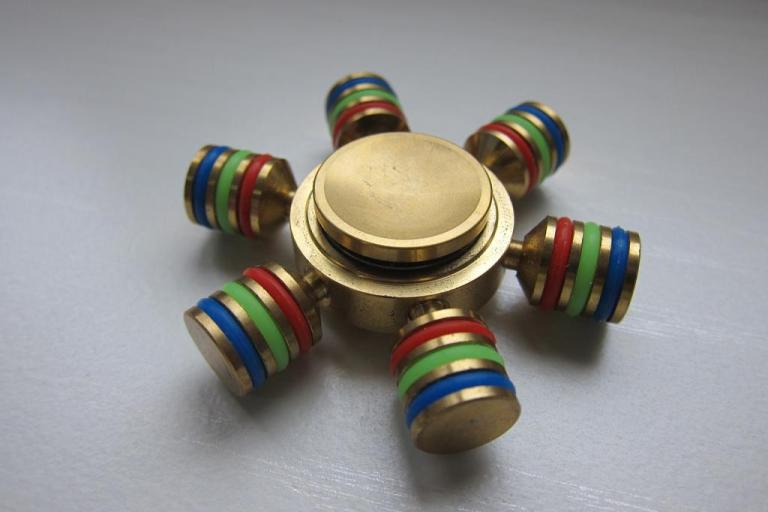
Okay, yeah, this one looks mildly deadly. (Image via Pixabay.)
Just as quickly as fidget spinners had taken over the world, they were written off as follies. The Wikipedia article on fidget spinners is pointed, stating, “[A]s of May 2017, there is no scientific evidence that they are effective as a treatment for ADHD.” The page also dismisses Hettinger as the inventor of the fidget spinner and reassigns credit to a guy whose “cutting edge” versions start at $150.
Meanwhile, the fidget industry has exploded. An Amazon search for fidget toys turns up more than 4000 results, and non-spinning fidget accessories are being hailed as the perfect resources for managing both ADHD and autism.
Those spinners, though: They are problematic and obsolete. (Except for the $150 model. Apparently.)

Although I am excited for the next generation of fidget droids. (Image via Pixabay.)
As someone who lives with ADHD and a panic disorder, it was painful to witness the rise and fall of the fidget spinner. But it’s also what I think about every time someone tries to step on Wicca to promote their own Tradition, or when a “teacher” announces, “Wicca doesn’t work,” before walking their student through a series of Wiccan practices.
And then I remember that Catherine Hettinger hasn’t given up on her spinning toy, and that she holds no ill will towards the companies that flooded the market with copycat designs and promptly ran them into the ground. And I remember that Hettinger doesn’t mind that that other dude gets credited with inventing the fidget spinner, and that if a spinner helps keep me calm when my anxiety flares up, then that’s all that matters, regardless of what anyone else thinks of it.
So if people want to hate on Wicca, or try to turn it into something it’s not, or strip-mine it to flesh out their own “legitimate” Traditions without attribution, or choose to remain willfully ignorant about its origins, or whatever, that’s fine.
None of it will stop me from spinning.

Apple of Discord fidget spinner courtesy of The Bestest Stuff.
Like what you’ve read? You ca**n buy me a coffee about it.
Oh, more discord, you say? But of course! Follow Fivefold Law on Facebook**, Instagram**, Linktree, Mastodon, TikTok**, Twitter**, and Zazzle**.
The Witch Cult in Western Europe

About Thumper
Thumper Marjorie Splitfoot Forge is a Gardnerian High Priest, an initiate of the Minoan Brotherhood, an Episkopos of the Dorothy Clutterbuck Memorial Cabal of Laverna Discordia, a recovering alcoholic, and a notary public from Houston, TX. You can read more about the author here.
Previous Post
August 20, 2021
The Horned God of the Witches: a Discordian Book Review
Next Post
August 26, 2021 Sisyphus Shrugged: A Stab at Defining Paganism
Browse Our Archives
Select a Category 12-Step Recovery Chaos Magic Discordianism Divination Gender and Sexual Minorities Greek Mythology Neurodiversity Pagan Saints Uncategorized Wicca Witch This Not That Witchcraft
Select a Month September 2026 May 2026 April 2026 February 2026 January 2026 October 2025 September 2025 August 2025 May 2025 March 2025 February 2025 January 2025 November 2024 October 2024 August 2024 July 2024 June 2024 May 2024 April 2024 March 2024 February 2024 January 2024 December 2023 November 2023 October 2023 September 2023 July 2023 June 2023 May 2023 March 2023 February 2023 January 2023 December 2022 November 2022 August 2022 July 2022 June 2022 May 2022 April 2022 March 2022 February 2022 January 2022 December 2021 November 2021 October 2021 September 2021 August 2021 July 2021 June 2021 May 2021 April 2021 March 2021 February 2021 January 2021
Follow Us!
TAKE THE
Religious Wisdom Quiz
What does Paul, as a spiritual father of the Corinthians, beseech them to do?
Select your answer to see how you score.
Pray Be Followers of Him Eat Send Paul Money
Related posts from Fivefold Law

Give It to the Squid: The Realness of...

And Now, a Word on Transphobia

Two Smoking Wands: A Witchfest Mystery Romance

Zach Cregger Thinks I'm a Parasite: A Weaponized...
TRENDING AT PATHEOS Pagan

A new article, written by Jeff Lindsay and Gale L. Pooley,...

Swimfan: Forgotten Aughts Pleasures
This is a recovery effort. In 2002, My Big Fat Greek Wedding...

Top Three Anti-Catholic Lies About Catholicism
This is my initial transcript for the video, "THE 3 WORST...

Pope Leo Celebrates Mass for Nurses & Docs...
I don't have any idea how he did it, but Pope Leo...

The Sermon on the Mount, Part I: Matthew...
The Sermon on the Mount, Part I (Matthew 4:12-5:12) St. Matthew moves...

What's up from Crossway: Reviewing some of their latest A few weeks...
view all Pagan blogs
Ad-Free & Subscriber Log-In Subscription Support
- About Us
- 2026 Calendar
- Videos
- Podcasts
- Library of World Religions
- Faith In Media Tracker
- Advertise With Us
- Write for Us
- Privacy Policy
- Terms of Service
- Do Not Sell My Data
- Contact Us
- Radiant Digital
- Manage Newsletter Subscriptions
- Unsubscribe From Notifications
- Sitemap
Copyright 2008-2026, Patheos. All rights reserved.
Subscription Support Ad-Free & Subscriber Log-In
Follow Patheos