
BuddhistCatholicContemplativeEvangelicalGeneral ChristianHinduJewishLatter-day SaintMuslimNew VisionsProgressive Christian
Beliefs
- Buddhist
- Catholic
- Contemplative
- Evangelical
- General Christian
- Hindu
- Jewish
- Latter-day Saint
- More Voices
- Muslim
- New Visions
- Pagan
- Progressive Christian
Topics
- Religion News
- Food and Religion
- Sports and Religion
- Religious Art
- Religious Music and Entertainment
- Religious Events
- History and Religion
- Style and Religion
- Politics and Religion
- Women in Religion
- Recreation Outdoors and Religion
- Business Finance and Religion
- Careers Workplace and Religion
- Education and Religion
- Family Parenting and Religion
- Health Fitness and Religion
- Home and Religion
- Relationships and Religion
- Technology and Religion
- Travel and Religion
Columnists
- Buddhist Columnists
- Business Finance and Religion Columnists
- Careers Workplace and Religion Columnists
- Catholic Columnists
- Contemplative Columnists
- Education and Religion Columnists
- Evangelists Columnists
- Family Parenting and Religion Columnists
- General Christian Columnists
- Health Fitness and Religion Columnists
- Hindu Columnists
- History and Religion Columnists
- Home and Religion Columnists
- Jewish Columnists
- More Voices Columnists
- Latter Day Columnists
- Muslim Columnists
- New Visions Columnists
- Nonreligious Columnists
- Pagan Columnists
- Politics and Religion Columnists
- Progressive Columnists
- Recreation Outdoors and Religion Columnists
- Relationships and Religion Columnists
- Religion News Columnists
- Religious Art Columnists
- Religious Events Columnists
- Religious Music and Entertainment Columnists
- Sports and Religion Columnists
- Style and Religion Columnists
- Technology and Religion Columnists
- Travel and Religion Columnists
- Women in Religion Columnists
Resource Library
- 2026 Calendar
- Library of World Religions
- The 100 Most Holy Places on Earth
- Patheos Answers
- Podcasts
- Videos
- Faith Leaders Database
- Anglican Episcopalian
- Bahai
- Baptist
- Buddhism
- Christianity
- Confucianism
- Eastern Orthodoxy
- Hinduism
- Holiness and Pentecostal
- ISKCON
- Islam
- Judaism
- Lutheran
- Methodist
- The Church of Jesus Christ of Latter-day Saints
- New Age
- Paganism
- Presbytarian and Reformed
- Protestantism
- Religion Behind the Scenes
- Roman Catholic
- Scientology
- Shia Islam
- Sikhism
- Sufism
- Sunni Islam
- Taoism
- Zen
- See all religions
Research Tools
 Ad-Free & Subscriber Log-In Subscription Support
Ad-Free & Subscriber Log-In Subscription Support
Follow Patheos 

- Trending:
- Forgiveness
- |
- Marriage
- |
- Consciousness
- |
- Death Penalty
- |
- Election
- |
- Halloween

- Home
- Pagan
- The Momentum of Misattribution
The Momentum of Misattribution
Last updated on: November 23, 2024 at 1:37 am by Thumper Forge
The Momentum of Misattribution 2024-11-23T01:37:00+06:00 Thumper Forge
Patheos Explore the world's faith through different perspectives on religion and spirituality! Patheos has the views of the prevalent religions and spiritualities of the world.
“Some random quote from Lord of the Rings incorrectly attributed to Martin Luther King. Is this heaven? Or am I looking at a white woman’s Instagram?” –Bo Burnham
My last post about names got me thinking about my very first blogging endeavor: a fun little dog-and-pony show called Lover of Strife, which came to a close in 2012. To say it had even a modest following is too kind, but I did have a couple of die-hard fans, including my compatriot Veles, who called me one day to announce, “Some douchebag is ripping you off.”

“Don’t mind me. Just gonna yoink these ideas from you right quick.” (Image via Pixabay.)
What the douchebag in question had done was taken a turn of phrase and a satirical name from one of my posts and incorporated them into the brand he was building for himself. It wasn’t plagiarism per se, and it’s not like I could’ve taken him to court over it (“Tonight, on a very uncomfortable episode of Judge Judy…”), but whenever he was asked about his Pagan name, he would say, “I found it through a Pagan name generator,” which always rubbed me the wrong way. I never understood why he wouldn’t just say, “I found it on some nobody’s blog.” I mean, he wasn’t taking credit for coming up with the content, but he also wasn’t being accurate about the original source.
To sum up, he was misattributing.
Justified and Ancient
Misattribution can be defined as incorrectly identifying the origin or creator of something. Within Pagandom, the qualifier that most often leads to misattribution is “traditional,” which is a word that sometimes gets used when we’re not sure where a given thing came from — usually because someone forgot to write down where they found it.
In Lid Off the Cauldron, Patricia Crowther offers a relevant anecdote:
This particular spell came through me when I was in trance, back in the sixties. We found that it worked; so my husband wrote the above verse to accompany it. Subsequently I read a bowdlerized version of this rhyme in an American book on witchcraft. It was described as an ‘Ancient Runic Spell’ which had been handed down by word of mouth from generations of witch families! The verse was definitely not ancient, and there was no explanation of how to perform the spell, which is why I have included it here, together with its true origin!
Speaking of bowdlerized, Trothwy and I once got invited to a semi-public hiving ritual, and about halfway through, the High Priest went around the circle and murmured, “May you never hunger; may you never thirst,” to each attendee while they partook of cakes and wine and nodded reverently. And why wouldn’t he? It’s a traditional Wiccan thing to say, right?
Except it’s not. It comes from the Church of All Worlds, which was inspired by Stranger in a Strange Land by Robert A. Heinlein. The group putting on the ritual was an eclectic, bootstrap Tradition, which was great, but in their drive to be seen as a “real” trad, they didn’t put a lot of effort into documenting the sources of their material — somewhere along the line, their version of Cakes and Wine got mislabeled “Traditional Wicca” instead of “Lifted from a 1960s Sci-Fi Novel.”

“Oh, that? According to ancient, traditional sources, it’s the Moon.” (Image via Pixabay.)
To be fair, I don’t think Pagans who misattribute things do so maliciously (bloggy dude being the notable exception), but I do think there’s a certain amount of laziness involved, which causes way too many problems in the long run.
For example, a few of the contemporary names for the Sabbats were coined in the early 1970s, which you’d think would be common knowledge, but there’s always a pushback whenever the subject comes up. If anyone had bothered to regularly cite the history of these names, we wouldn’t have to struggle so much with explaining them today — and the people who truly believed that their ancient forebears called the Autumn Equinox “Mabon” wouldn’t feel so hoodwinked and disillusioned when they learn the truth.
Document, Document, Document. And Then, for Good Measure, Document.
I reread Doreen Valiente‘s The Rebirth of Witchcraft a few months ago, and I loved being reminded that the pioneering initiates of contemporary Witchcraft were fully aware of the influence of Freemasonry, which rituals were handed down and which were cribbed from Aleister Crowley, who wrote and/or added what, etc. And this emphasis on documentation has been passed down to Gardnerians today. Like, if I find a spell or a poem or something that I want to put in my Book of Shadows, I’ll include where I found it and when I added it, so that no one in my downline will have to stress over trying to figure out where it came from.
It’s when we don’t document these things that confusions arise. And the longer we go without proper attributions, the harder and harder it becomes to disentangle crucial, core materials from latter-day addendums.
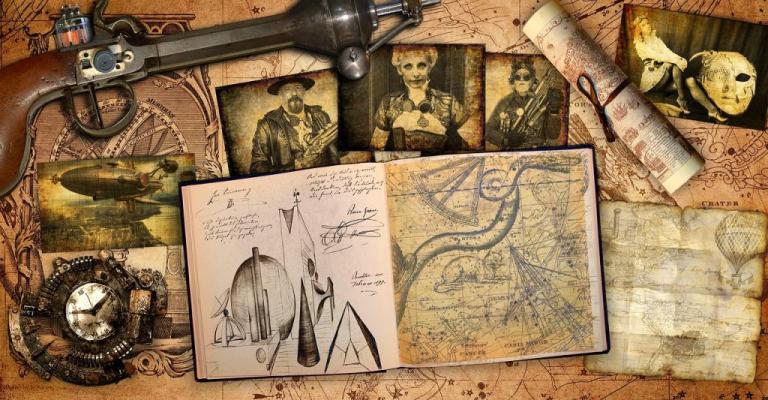
Gardnerians know a whole lot more about dirigible airships than we let on. (Image via Pixabay.)
Here’s the reality of the situation, my peeps: When it comes to Witchcraft, I know that “ancient, traditional” knowledge can feel more alluring or valid than anything published after 2010. But if we don’t put any thought into documenting and accurately attributing the sources we use in our practices, we’re doing a huge disservice to the creators of that content. And we’re creating unnecessary headaches for our descendants, increasing the probability that future Witches will look at anything we’ve accomplished and say, “They clearly just made this all up.”
Inventing History
I want to spend the rest of this post looking at one big, particular misattribution, since it’s possibly the most egregious in modern Paganism.
We’ve all heard or read something to the effect of, “Gerald Gardner invented Wicca,” or “Gardner called his creation Wicca.” It’s pretty much a no-brainer at this point, but it’s not accurate — not because Gardner gets credit for founding a religion, but because no one decided to call it Wicca until long after he died.
Strap yourselves in, folks. We’re going on a ride.
The word “wicca” made its first modern print appearance way back in 1891, as an etymological footnote in Charles Godfrey Leland‘s G*psy Sorcery and Fortune Telling:
As the English word witch, Anglo-Saxon Wicca*, comes from a root implying wisdom, so the pure Slavonian word* vjestica*, Bulgarian,* vjescirica (masculine, viestae*), meant originally the one knowing or well informed, and it has preserved the same power in allied languages, as* Veaa (New Slovenish), knowledge, Vedavica*, a fortune-teller by cards,* Viedma (Russian), a witch, and Vedwin*, fatidicus.*
Insert something about the roots of religous Witchcraft developing over different time periods here. Or just admire the clock lady. Whichever. (Image via Pixabay.)
Margaret Murray, the next author to write about Witchcraft as a pre-Christian religion…
Oh, wait. I need to pull over for a second. The idea of Witchcraft as a pre-Christian religion predates Murray. Jules Michelet was writing about Witchcraft as a religion back in the 1860s, followed by Leland in the 1890s. And yet today, there’s this understanding that Murray pulled her hypotheses out of thin air, when she actually just took concepts that were already in existence and ran with them. Assigning the “invention” of these theories to Murray is another example of misattribution.
Anyway, Murray never used the word “wicca” in her works. Instead, she consistently referred to the “Witch Cult,” as did Gerald Gardner when he began writing on the subject. Gardner put out five books in his life, three of which were about Witchcraft. The first, his novel High Magic’s Aid (published in 1949) described a secret brotherhood of Witches (no mention of Wicca), while his next book, Witchcraft Today, detailed his personal speculations on the history of the modern Witch cult, specifically the one into which he’d been initiated.
This is where things get a little confusing. But stay with me.

“Still with you, just resting our eyes.” (Image via Pixabay.)
Gardner usually referred to the people who initiated him as Witches, although he sometimes called them “the Wica.” Critics often latch onto this as a spelling error, citing that he probably meant to say “the Wicca,” and that’s certainly a workable assumption, except that in his following book The Meaning of Witchcraft (pub. 1959), Gardner does use the word “wicca” a total of five times when discussing the etymology of the word “witch,” just as Leland had done. Five times, compared to mentioning “the Wica” 17 times in the same book and three times in Witchcraft Today.
The possibility of spelling errors aside, it’s pretty clear that Gardner saw a distinction between the Anglo-Saxon wicca and the Wica who initiated him.
So how did we get from the Wica to Wicca?
Proofreading, apparently.
In 1970, transcripts of a series of lectures given by Alex Sanders were circulated among students of the Alexandrian tradition. In this series, Sanders talked extensively about being one of “the Wicca”; whether by Sanders or his scribe, the debatable “spelling error” had been corrected. In 1971, Stewart Farrar, himself an initiate of Sanders, compiled these lectures, added his own thoughts and experiences, and published the now-classic What Witches Do, in which he used Wicca (no “the”) and Witchcraft interchangeably.
The name stuck. And so we find ourselves today.
This is why I get apoplectic when the know-it-alls blather on about how “Gardner invented Wicca.” Gerald Gardner was just a Witch, y’all. Alex Sanders and Stewart Farrar, though, now they invented Wicca.
More discord, you say? But of course! Follow Fivefold Law on Twitter, Instagram, and Facebook.

About Thumper
Thumper Marjorie Splitfoot Forge is a Gardnerian High Priest, an initiate of the Minoan Brotherhood, an Episkopos of the Dorothy Clutterbuck Memorial Cabal of Laverna Discordia, a recovering alcoholic, and a notary public from Houston, TX. You can read more about the author here.

Next Post

June 18, 2021 It's All Fun and Games Until the Trees Start Hugging Back
Browse Our Archives
Select a Category 12-Step Recovery Chaos Magic Discordianism Divination Gender and Sexual Minorities Greek Mythology Neurodiversity Pagan Saints Uncategorized Wicca Witch This Not That Witchcraft
Select a Month September 2026 May 2026 April 2026 February 2026 January 2026 October 2025 September 2025 August 2025 May 2025 March 2025 February 2025 January 2025 November 2024 October 2024 August 2024 July 2024 June 2024 May 2024 April 2024 March 2024 February 2024 January 2024 December 2023 November 2023 October 2023 September 2023 July 2023 June 2023 May 2023 March 2023 February 2023 January 2023 December 2022 November 2022 August 2022 July 2022 June 2022 May 2022 April 2022 March 2022 February 2022 January 2022 December 2021 November 2021 October 2021 September 2021 August 2021 July 2021 June 2021 May 2021 April 2021 March 2021 February 2021 January 2021
Follow Us!
TAKE THE
Religious Wisdom Quiz
Which major biblical covenant is first introduced in Genesis?
Select your answer to see how you score.
Mosaic Covenant New Covenant Abrahamic Covenant Davidic Covenant
Related posts from Fivefold Law

Give It to the Squid: The Realness of...

And Now, a Word on Transphobia
Two Smoking Wands: A Witchfest Mystery Romance

Zach Cregger Thinks I'm a Parasite: A Weaponized...
TRENDING AT PATHEOS Pagan

How to Make a Decision When You Can't...
Main point: It’s much more valuable to stay close to God so...

Archdiocese Hosts Military Marriage Retreat in Germany
RASTATT, Germany — The transient military lifestyle, with its frequent deployments and...

Nearly every morning, I make the drive to Detroit with my high-school-age...

The Real AI Story Is Adoption Without Trust
Artificial intelligence has crossed a political threshold. It is no longer a...

A new article, written by Jeff Lindsay and Gale L. Pooley,...

Swimfan: Forgotten Aughts Pleasures
This is a recovery effort. In 2002, My Big Fat Greek Wedding...
view all Pagan blogs
Ad-Free & Subscriber Log-In Subscription Support
- About Us
- 2026 Calendar
- Videos
- Podcasts
- Library of World Religions
- Faith In Media Tracker
- Advertise With Us
- Write for Us
- Privacy Policy
- Terms of Service
- Do Not Sell My Data
- Contact Us
- Radiant Digital
- Manage Newsletter Subscriptions
- Unsubscribe From Notifications
- Sitemap
Copyright 2008-2026, Patheos. All rights reserved.
Subscription Support Ad-Free & Subscriber Log-In
Follow Patheos