
BuddhistCatholicContemplativeEvangelicalGeneral ChristianHinduJewishLatter-day SaintMuslimNew VisionsProgressive Christian
Beliefs
- Buddhist
- Catholic
- Contemplative
- Evangelical
- General Christian
- Hindu
- Jewish
- Latter-day Saint
- More Voices
- Muslim
- New Visions
- Pagan
- Progressive Christian
Topics
- Religion News
- Food and Religion
- Sports and Religion
- Religious Art
- Religious Music and Entertainment
- Religious Events
- History and Religion
- Style and Religion
- Politics and Religion
- Women in Religion
- Recreation Outdoors and Religion
- Business Finance and Religion
- Careers Workplace and Religion
- Education and Religion
- Family Parenting and Religion
- Health Fitness and Religion
- Home and Religion
- Relationships and Religion
- Technology and Religion
- Travel and Religion
Columnists
- Buddhist Columnists
- Business Finance and Religion Columnists
- Careers Workplace and Religion Columnists
- Catholic Columnists
- Contemplative Columnists
- Education and Religion Columnists
- Evangelists Columnists
- Family Parenting and Religion Columnists
- General Christian Columnists
- Health Fitness and Religion Columnists
- Hindu Columnists
- History and Religion Columnists
- Home and Religion Columnists
- Jewish Columnists
- More Voices Columnists
- Latter Day Columnists
- Muslim Columnists
- New Visions Columnists
- Nonreligious Columnists
- Pagan Columnists
- Politics and Religion Columnists
- Progressive Columnists
- Recreation Outdoors and Religion Columnists
- Relationships and Religion Columnists
- Religion News Columnists
- Religious Art Columnists
- Religious Events Columnists
- Religious Music and Entertainment Columnists
- Sports and Religion Columnists
- Style and Religion Columnists
- Technology and Religion Columnists
- Travel and Religion Columnists
- Women in Religion Columnists
Resource Library
- 2026 Calendar
- Library of World Religions
- The 100 Most Holy Places on Earth
- Patheos Answers
- Podcasts
- Videos
- Faith Leaders Database
- Anglican Episcopalian
- Bahai
- Baptist
- Buddhism
- Christianity
- Confucianism
- Eastern Orthodoxy
- Hinduism
- Holiness and Pentecostal
- ISKCON
- Islam
- Judaism
- Lutheran
- Methodist
- The Church of Jesus Christ of Latter-day Saints
- New Age
- Paganism
- Presbytarian and Reformed
- Protestantism
- Religion Behind the Scenes
- Roman Catholic
- Scientology
- Shia Islam
- Sikhism
- Sufism
- Sunni Islam
- Taoism
- Zen
- See all religions
Research Tools
 Ad-Free & Subscriber Log-In Subscription Support
Ad-Free & Subscriber Log-In Subscription Support
Follow Patheos 

- Trending:
- Forgiveness
- |
- Marriage
- |
- Consciousness
- |
- Death Penalty
- |
- Election
- |
- Halloween

- Home
- Pagan
- Sri Syadasti and the Season of Confusion
Sri Syadasti and the Season of Confusion
Last updated on: April 9, 2025 at 10:45 pm by Thumper Forge
Sri Syadasti and the Season of Confusion 2025-04-09T22:45:18+06:00 Thumper Forge
Patheos Explore the world's faith through different perspectives on religion and spirituality! Patheos has the views of the prevalent religions and spiritualities of the world.
I could’ve sworn yesterday was May 30, y’all. But it’s fitting that I got my dates mixed up, since May 31 is the fifth day of the Season of Confusion, which, according to the Discordian calendar, makes it Syaday, the feast of the Apostle Sri Syadasti.
His full name is Sri Syadasti Syadavaktavya Syadasti Syannasti Syadasti Cavaktavyasca Syadasti Syannasti Syadavatavyasca Syadasti Syannasti Syadavaktavyasca, which means: “All affirmations are true in some sense, meaningless in some sense, true and false in some sense, true and meaningless in some sense, false and meaningless in some sense, and true and false and meaningless in some sense.” Since it can be used as a mantra, his name is considered to be his primary contribution to Discordianism.
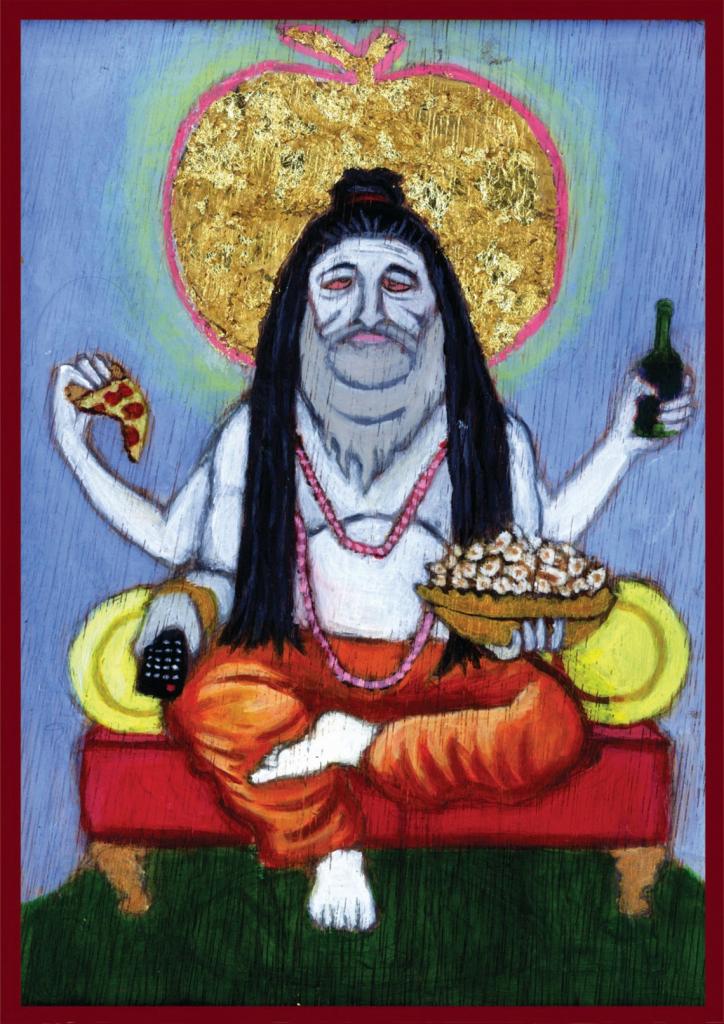
Sri Syadasti by Alex Screen (reprinted with permission from the artist).
Sri Syadasti is first mentioned on page 00009 of the Principa Discordia, by none other than Eris Herself:
Tell constricted mankind that there are no rules, unless they choose to invent rules. Keep close the words of Syadasti: ‘TIS AN ILL WIND THAT BLOWS NO MINDS. And remember that there is no tyranny in the State of Confusion.
Further details about Syadasti are provided on page 00039, and the description is… okay, I’m not gonna lie. It’s problematic. So let’s brace ourselves and dive right into the middle of it.
Racism and Misogyny in an Otherwise Lovely Fake Religion
According to the Principia…
He is an Indian Pundit and Prince, born of the Peyotl Tribe, son of Gentle Chief Sun Flower Seed and the [Chieftess] Merry Jane. Patron to psychedelic type Discordians. Patron of the Season of Confusion. Sri Syadasti should not be confused with Blessed St. Gulik the Stoned, who is not the same person but is the same Apostle.
So right away there’s a mash-up of Indigenous American and East Indian symbology, which is more than a little shocking to find included in a book that encourages the abandonment of social mores and states unequivocally that gender is an illusion. My guess is that the authors were trying to play up the whole Season of Confusion thing by jumbling the two cultures, which is comprehensible but ultimately not condonable: As a comedic turn, it falls flat.
You’ll also notice that the word “Chieftess” is in brackets. This is because the specific word used in the text was, for a very long time, thought to be a generic Native American word that meant “woman,” but is actually a corruption of a Haudenosaunee word that means “female genitalia.” Despite its popular usage in the past, it is now understood to be an unacceptable ethnic and sexual slur.
That’s pretty awful. What should we do about it?
Well, we’ve got a few options:
- Cancel Discordianism.
- Pretend Sri Syadasti doesn’t exist and replace him with St. Gulik.
- Acknowledge that the founders of Discordianism said something unintentionally hurtful, and make every effort to not repeat their mistake.
Personally, I’m down with number three, while keeping in mind the disclaimer that Warner Bros. included at the beginning of their Looney Tunes Golden Collection DVD boxed set:
The cartoons you are about to see are products of their time. They may depict some of the ethnic and racial prejudices that were common in American society. These depictions were wrong then and are wrong today. While the following does not represent the Warner Bros. view of today’s society, these cartoons are being presented as they were originally created, because to do otherwise would be the same as claiming these prejudices never existed.
Long story short, erasing this section of the Principia would suggest that we’re trying to make our founders infallible. And they were awesome guys, but they were human, and it’s really important not to forget that. But something we can do is set aside the bad Indian jokes for now and look at the Sanskrit origin of Sri Sysadasti to figure out who he really is.
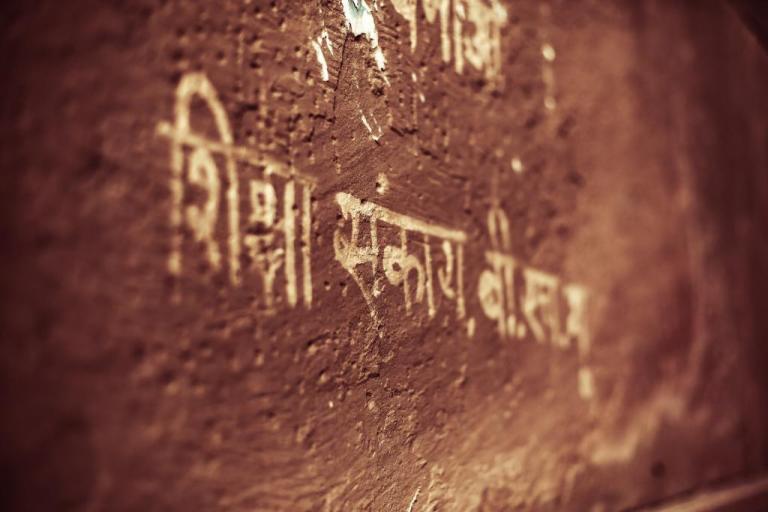
Tagged in Sanskrit. (Image via Unsplash.)
True, False, Meaningless, Everywhere
Sanskrit is a sacred language in Jainism, Hinduism, and Buddhism, and there is one figure who is worshipped in all three religions (as well as in ancient Rome, according to at least one 18th-Century source): Ganesha, the elephant-headed Opener of the Ways. Just as St. Gulik connects to Hermes/St. Expedite and Dr. Van Van Mojo groks with St. Cyprian, I strongly believe that Sri Syadasti was either inspired by or is an avatar of Ganesha. (Which would make Sun Flower Seed and Merry Jane Shiva and Parvati, respectively; an interesting thing to consider.)
My first encounter with Ganesha was in 1997, in the Theatre Arts section of a used book store. I was an intercollegiate competitive speaker at the time, and I was digging around for material to use at an upcoming tournament, when I came across a hardcover edition of Terrence McNally’s Pulitzer-nominated play A Perfect Ganesh. There are four characters in the show: Margaret and Katherine, best friends, each secretly dealing with a personal tragedy, who have decided to have a two-week adventure in India; “Man,” an ensemble performer who takes on numerous roles; and Ganesha, who plays Himself, but who is also an ensemble performer who takes on numerous roles. Because, as He says in the opening scene, “I am everywhere.”
It’s an incredibly powerful story, and it was my introduction to the concept of immanence — that is, God(s) in everything. I ended up developing a healthy respect for Ganesha because of it.

Sri Syadasti just hanging out with the boys. (Image via Pixabay.)
A few years later, on a lunch break, I saw a wooden Ganesha plaque tucked in among the all-natural candles at a local health food store. I’d wanted an icon of Ganesha ever since I read the play, although I’d never found one that particularly moved me. But this one grabbed my attention, so I bought it, went back to work and put it next to my office computer. I also eventually came across a sandalwood mala, which I kept next to His image, figuring He might like it.
I learned more about Ganesha here and there, but I never really developed any kind of religious practice around Him. And I never asked Him for anything, which is kind of odd, considering that’s His stock in trade: He’s the Remover of Obstacles, and He’s very good at it. But I just kept His likeness around, thought about Him whenever I saw it, sometimes picked up my mala and chanted His name 108 times or said a quick prayer, then went about whatever else I was doing.
And that was my entire history with Ganesha, up until the fateful afternoon I popped into the convenience store across the street from my apartment, on account of I was out of Fritos.
A Perfect Moment of Perfect Ganesh
“Hello!” said the Hindustani cashier as I piled processed snack foods on the counter. “How are you today?”
“Doing well, thanks!” I replied. Then, noticing the strand of prayer beads wrapped around his wrist, I said, “And hey, I like your mala.”
Cashier: “What?!” [suspiciously] “How do you know what a mala is?”
Me: “Um… because I have one, too.”

Pick a mala. Any mala. (Image via Pixabay.)
Cashier: “Did you get it as a souvenir somewhere?”
[Inner Me: He thinks you’re appropriating his culture. Nice going, colonizer.]
Me: “I found it at a curio shop over near the Galleria.”
Cashier: “Okay… but why do you have one?”
Me: “Well, sometimes I use it to meditate, and sometimes I use it to pray to Ganesha.”
Cashier: “You pray to Ganesha.”
Me: “I do.”
[uncomfortably long silence]
HCSC: “Pray to Him on Tuesdays. He likes milk and fresh fruit as offerings.”
Me: “Noted.”
Needless to say, my veneration has gotten a little more structured since then. And whether he’s fictitious or Ganesha or somewhere in between, Sri Syadasti has held doors open for me ever since.
More discord, you say? But of course! Follow Fivefold Law on Twitter, Instagram, and Facebook.

About Thumper
Thumper Marjorie Splitfoot Forge is a Gardnerian High Priest, an initiate of the Minoan Brotherhood, an Episkopos of the Dorothy Clutterbuck Memorial Cabal of Laverna Discordia, a recovering alcoholic, and a notary public from Houston, TX. You can read more about the author here.
Previous Post

May 29, 2021
Looking for Signs in All the Wrong Places

Browse Our Archives
Select a Category 12-Step Recovery Chaos Magic Discordianism Divination Gender and Sexual Minorities Greek Mythology Neurodiversity Pagan Saints Uncategorized Wicca Witch This Not That Witchcraft
Select a Month September 2026 May 2026 April 2026 February 2026 January 2026 October 2025 September 2025 August 2025 May 2025 March 2025 February 2025 January 2025 November 2024 October 2024 August 2024 July 2024 June 2024 May 2024 April 2024 March 2024 February 2024 January 2024 December 2023 November 2023 October 2023 September 2023 July 2023 June 2023 May 2023 March 2023 February 2023 January 2023 December 2022 November 2022 August 2022 July 2022 June 2022 May 2022 April 2022 March 2022 February 2022 January 2022 December 2021 November 2021 October 2021 September 2021 August 2021 July 2021 June 2021 May 2021 April 2021 March 2021 February 2021 January 2021
Follow Us!
TAKE THE
Religious Wisdom Quiz
Which Assyrian king threatened Jerusalem and received a prophecy from Isaiah?
Select your answer to see how you score.
Tiglath-Pileser Nebuchadnezzar Shalmaneser Sennacherib
Related posts from Fivefold Law

Goblinposting in the Name of Shared Values

How to Succeed in Chaos Without Really Trying

The Discordian Cabal of Unitarian Universalist Pagans

Zach Cregger Thinks I'm a Parasite: A Weaponized...
TRENDING AT PATHEOS Pagan

Archdiocese Hosts Military Marriage Retreat in Germany
RASTATT, Germany — The transient military lifestyle, with its frequent deployments and...

Nearly every morning, I make the drive to Detroit with my high-school-age...

The Real AI Story Is Adoption Without Trust
Artificial intelligence has crossed a political threshold. It is no longer a...

A new article, written by Jeff Lindsay and Gale L. Pooley,...

Swimfan: Forgotten Aughts Pleasures
This is a recovery effort. In 2002, My Big Fat Greek Wedding...

Top Three Anti-Catholic Lies About Catholicism
This is my initial transcript for the video, "THE 3 WORST...
view all Pagan blogs
Ad-Free & Subscriber Log-In Subscription Support
- About Us
- 2026 Calendar
- Videos
- Podcasts
- Library of World Religions
- Faith In Media Tracker
- Advertise With Us
- Write for Us
- Privacy Policy
- Terms of Service
- Do Not Sell My Data
- Contact Us
- Radiant Digital
- Manage Newsletter Subscriptions
- Unsubscribe From Notifications
- Sitemap
Copyright 2008-2026, Patheos. All rights reserved.
Subscription Support Ad-Free & Subscriber Log-In
Follow Patheos