
BuddhistCatholicContemplativeEvangelicalGeneral ChristianHinduJewishLatter-day SaintMuslimNew VisionsProgressive Christian
Beliefs
- Buddhist
- Catholic
- Contemplative
- Evangelical
- General Christian
- Hindu
- Jewish
- Latter-day Saint
- More Voices
- Muslim
- New Visions
- Pagan
- Progressive Christian
Topics
- Religion News
- Food and Religion
- Sports and Religion
- Religious Art
- Religious Music and Entertainment
- Religious Events
- History and Religion
- Style and Religion
- Politics and Religion
- Women in Religion
- Recreation Outdoors and Religion
- Business Finance and Religion
- Careers Workplace and Religion
- Education and Religion
- Family Parenting and Religion
- Health Fitness and Religion
- Home and Religion
- Relationships and Religion
- Technology and Religion
- Travel and Religion
Columnists
- Buddhist Columnists
- Business Finance and Religion Columnists
- Careers Workplace and Religion Columnists
- Catholic Columnists
- Contemplative Columnists
- Education and Religion Columnists
- Evangelists Columnists
- Family Parenting and Religion Columnists
- General Christian Columnists
- Health Fitness and Religion Columnists
- Hindu Columnists
- History and Religion Columnists
- Home and Religion Columnists
- Jewish Columnists
- More Voices Columnists
- Latter Day Columnists
- Muslim Columnists
- New Visions Columnists
- Nonreligious Columnists
- Pagan Columnists
- Politics and Religion Columnists
- Progressive Columnists
- Recreation Outdoors and Religion Columnists
- Relationships and Religion Columnists
- Religion News Columnists
- Religious Art Columnists
- Religious Events Columnists
- Religious Music and Entertainment Columnists
- Sports and Religion Columnists
- Style and Religion Columnists
- Technology and Religion Columnists
- Travel and Religion Columnists
- Women in Religion Columnists
Resource Library
- 2026 Calendar
- Library of World Religions
- The 100 Most Holy Places on Earth
- Patheos Answers
- Podcasts
- Videos
- Faith Leaders Database
- Anglican Episcopalian
- Bahai
- Baptist
- Buddhism
- Christianity
- Confucianism
- Eastern Orthodoxy
- Hinduism
- Holiness and Pentecostal
- ISKCON
- Islam
- Judaism
- Lutheran
- Methodist
- The Church of Jesus Christ of Latter-day Saints
- New Age
- Paganism
- Presbytarian and Reformed
- Protestantism
- Religion Behind the Scenes
- Roman Catholic
- Scientology
- Shia Islam
- Sikhism
- Sufism
- Sunni Islam
- Taoism
- Zen
- See all religions
Research Tools
 Ad-Free & Subscriber Log-In Subscription Support
Follow Patheos 

- Trending:
- Advent
- |
- Forgiveness
- |
- Thanksgiving
- |
- Election
- |
- Seasonal Holidays
- |
- Marriage

-
Articles
- Home
- Religious Music & Entertainment
- Magdala round-up: clips, photos, and reviews from Cannes
Magdala round-up: clips, photos, and reviews from Cannes
Last updated on: June 10, 2022 at 1:34 pm by Peter T. Chattaway
Magdala round-up: clips, photos, and reviews from Cannes 2022-06-10T13:34:44-07:00 Peter T. Chattaway
Patheos Explore the world's faith through different perspectives on religion and spirituality! Patheos has the views of the prevalent religions and spiritualities of the world.

The Cannes Film Festival came and went a few weeks ago, and with it, the world premiere of Damien Manivel’s Magdala, which played in the ACID (Association for the Distribution of Independent Cinema) sidebar to the festival.
I’ve been meaning to post some reviews of the film, which depicts Mary Magdalene living in isolation some years after the life of Jesus, but very few reviews have come my way. However, a few have trickled out, so take a look at them below.
Also: we have actual clips from the film!
First, the clips, courtesy of Cineuropa.
First, a woman with a candle approaches the sleeping Mary Magdalene in a cave:
Second, a man and a woman — Jesus and the young Mary Magdalene, presumably — look at each other and hold hands (note: there is some brief nudity here):
You can also see these clips on the ACID’s YouTube channel (Clip 1, Clip 2).
IndieWire, meanwhile, profiled the film’s cinematographer Mathieu Gaudet (the parts that jump out at me, I’m putting in italics):
“Magdala”
Dir: Damien Manivel, DoP: Mathieu Gaudet
Format: 16mm Kodak 500T
Camera: Aaton Xtera
Lens: Zeiss Super SpeedGaudet: At the beginning of the shooting preparation Damien told me he wanted us to have the impression that the footage of his movie had been found, buried somewhere in the forest where Magdala lived. Just like for the actress, who is an extraordinary dancer, capable of putting so much physical intensity in the smallest gesture, he was looking for something with a strong physical presence within the image itself. To follow up on this idea, we decided to shoot everything handheld and in long shots, to “humanize” the camera. That’s also what brings us to film. Because of its physicality and its fragility, it’s a bit like the movie has a body too. Damien was at first hesitating between film and DV. DV has also a kind of materiality, with the magnetic tape. We ran tests with both formats, on locations, making the shots Damien had in mind: 16mm was the obvious choice. The physicality of the support was very sensitive. It was also conveying, in a very simple way, a kind of sacredness to what we filmed. We also ran tests between the Kodak 500T and 250D film. We chose the 500T because there is more texture and we also needed its high sensitivity for the candle scenes. 16mm — instead of the 35mm — was also obvious, because the image had to feel humble, as is the character. Damien didn’t want to idealize his character too easily. That’s also why we finally chose, during color grading, not to add too much contrast or color saturation. I chose the Aaton Xtera because of its ergonomy, specially made for handheld shots. I knew it would be a great asset, because Damien wanted to do long lasting shots. And In the end, most of the shots took up the whole 12 minutes of the 16mm reels. I chose the Zeiss Super Speed because I like their aesthetic, they have a discreet softness that I find very simple and beautiful. It was also for practical reasons, because they are light and the 1.3 T-stop was very useful for the candle scenes.
And now, the reviews.
Rotten Tomatoes currently lists only one, from Amber Wilkinson at Screen Daily:
French director Damien Manivel’s quiet contemplation of the last days of Jesus’ disciple Mary Magdalene is built as much from the imagination of the viewer as it is by what he puts on the screen – he may show us what Mary is doing but it is us who must supply the thoughts that lie inside her head. This is a portrait of Mary (Elsa Wolliaston) in exile, following her retreat to an autumnal forest and, subsequently, a cave following the death of Christ, who Manivel indicates she loved, or at least aspired to love, in the physical sense as well as the emotional. . . .
Manivel’s main approach is to study Mary in the moment, whether it’s the delicate way she removes a blackberry from a bush, repeatedly fashions tiny crosses out of leaves and grass, or how she relieves her bladder while holding a tree for support. Wolliaston – who previously collaborated with Manivel on his short film The Lady With A Dog (2010) and his Locarno best director award-winning feature Isadora’s Children (2019) – has a dance and choreography background and brings a grace to Mary’s movements, even as we can see she is also struggling with ageing. . . .
The director periodically also allows more mystical elements to intrude, including memories of a different sun-dappled forest, filled with the heat of youthful desire, along with more anguished recollections of Christ, as Mary recalls his nailed feet. The mood of melancholy is enhanced by the autumnal setting, at one point shrouding Mary in mist, and two pieces of music. One, Franz Schubert’s ‘The Hurdy-Gurdy Man’, whose lyrics speak of an ageing soul and his instrument, the other Henry Purcell’s wistfully mournful ‘O Solitude, My Sweetest Choice’, both speaking to a sort of paradoxical comfort in loneliness.
Blake Williams at Filmmaker Magazine writes:
I was introduced to the work of French filmmaker Damien Manivel when his lovely Le Parc screened in Cannes’s ACID sidebar in 2016, and checked in with him there again for Magdala. The 78-minute film is an imagined portrait of Mary Magdalene shortly after the death of Jesus, and is a throwback to aughts-era slow cinema rigor. The conservatively color-graded 16mm cinematography was transferred to digital sans matting (i.e. the edges are rounded and feathered, sprockets vaguely visible), as Manivel goes all in on the elemental minimalism of early Lisandro Alonso and Albert Serra (viz. La Libertad [2001] and Birdsong [2008], respectively). Until she cries to heavens, “My love, my love…”, the film envelops the viewer in a score of rustling leaves, snapping twigs and the occasional breeze as Magdalena methodically crawls, walks, pees and weeps her way through a forest, encouraging us to consider the pointedly profane materiality of her image, situation, and environment.
Moments of abstraction peak in, such as a cutaway to Jesus’s bloody, staked feet, or another to Magdalena literally ripping out her own heart, but these exceptions are metaphors for the trauma absorbing her imagination; this is, in every essential way, an image-forward movie. Manivel is well aware that the action onscreen is held together by popular familiarity with Christian narratives—the religion’s mythology and iconography does all of the heavy lifting—and flirts with the limits of content and context in Magdala’s construction. Like the first filmed Passion Plays that helped usher narrative logic into cinema during its early years (e.g. the Lumière brothers’ La Passion [1897]), Magdala pushes information to the margins, and asks if an image can simply be an image. When Magdalena idly uses her walking stick to etch a portrait that I quickly recognized to be Jesus into the ground, my own act of inserting information into an image that gave very little of it—completing it, imposing upon it, with memories of other images of Him I’ve encountered in the past—became palpable in ways I’ve rarely felt in movies, and that’s not nothing.
Fabien Lemercier at Cineuropa writes:
Sometimes words don’t mean anything, and actually, they did not even exist in the early days of cinema. It is in this raw essence of the image and the body which lives in the heart of a deep forest, embraced by the sounds of nature, that Damien Manivel decided to immerse the well-known dancer and choreographer Elsa Wolliaston in Magdala. . . .
Filming the quintessence in its most radical austerity requires two components: a charismatic subject mastering every small body inflection (which the incredible Elsa Wolliaston does) and a director like Damien Manivel, who has great sensitivity and looks for strong creativity in simple elements. It makes for a mystic and sensory experience and becomes an ode to nature and art that cultivates open minds and nature lovers.
Michael Sicinski at In Review writes:
Magdala is a meditative film, proffering only the broadest outline of narrative information. That’s partly because Manivel is operating in the mythic register. This film observes the agonized final days on earth of Mary Magdalene, played by veteran actress Elsa Wolliaston in a bracingly physical performance. For much of the film, Magdala is hunched over and hobbling through a wooded thicket beside a stream, bearing herself along with a walking stick and soothing her parched lips with rainwater dropping off of leaves. At various moments, her survivalist resolve breaks down, and she curls up in anguish as she mourns for the lover she has, in a sense, outlived, but who of course is ever-present. . . .
The film is attractively shot by Mathieu Gaudet, and the images often lend Wolliaston’s skin a verdant tone, as if she were less a human being than an extension of the surrounding landscape which, under the circumstances, we’re asked to recognize as God’s creation. . . .
But when it comes to the cinema of longueurs, editing is paramount. Manivel assembled Magdala himself, and at times there is a lack of clear motivation for one image following another. Also, although the final act may be preordained in some respect, it is protracted without achieving the desired rhythm or mood. Magdala almost signals this sense by ending on a strikingly literal note, a move very much at odds with the atmospheric film that we’ve just watched.
Finally, there is this video review from Ryan Coleman via UniFrance, who found the film “moving” and also makes an interesting comment about the film’s ending:
Last but not least, some new photos, courtesy of ACID and UniFrance:


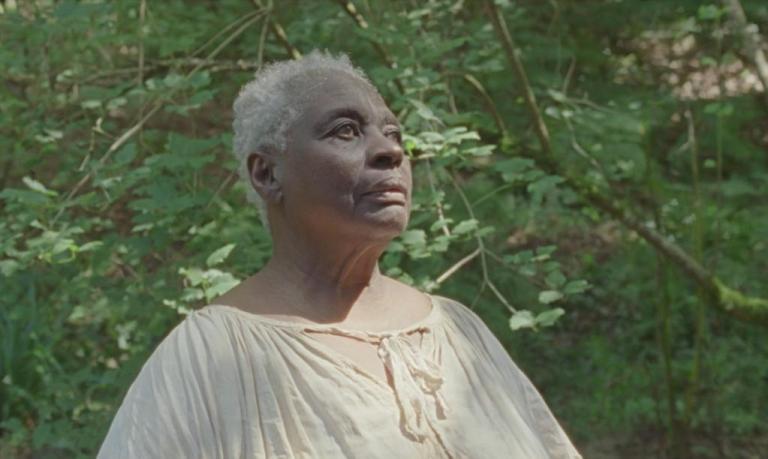
There is also one photo of Jesus and Mary lying naked in the grass together, which I won’t post here in case anyone finds it offensive. But you can see it at the sites linked above.
Also, IndieWire posted this behind-the-scenes shot with their profile of Gaudet:

The film is reportedly opening in French theatres July 20, which happens to be two days before Mary Magdalene’s feast day in the Orthodox and Catholic churches. I’ll be keeping my ears open for any North American screenings. If you hear anything, please let me know (whether in the comments below or via my public social-media accounts).
Previous Post
June 8, 2022
Is Terrence Malick's Jesus movie going to play festivals this year?
Browse Our Archives
Select a Category Anglican Planet Articles BC Christian News BC Report Bible Movies Bible Review Blog Books & Culture Campus Times CBC Radio Christianity Today ChristianWeek Essays Faith Today Festival Cinemas Guide Film Journals Georgia Straight Interviews MB Herald National Catholic Register Salvationist Today's Christian Two Chairs Ubyssey Uncategorized Vancouver Courier Vancouver Sun
Select a Month August 2025 April 2025 January 2025 December 2024 November 2024 May 2024 February 2024 December 2023 May 2023 March 2023 November 2022 July 2022 June 2022 May 2022 April 2022 February 2022 January 2022 December 2021 November 2021 October 2021 September 2021 August 2021 July 2021 June 2021 April 2021 March 2021 February 2021 January 2021 December 2020 November 2020 October 2020 August 2020 July 2020 June 2020 May 2020 March 2020 February 2020 January 2020 December 2019 November 2019 September 2019 July 2019 May 2019 April 2019 March 2019 February 2019 January 2019 December 2018 November 2018 October 2018 September 2018 July 2018 June 2018 May 2018 April 2018 March 2018 February 2018 January 2018 December 2017 November 2017 October 2017 September 2017 August 2017 July 2017 June 2017 May 2017 April 2017 March 2017 February 2017 January 2017 December 2016 November 2016 October 2016 September 2016 August 2016 July 2016 June 2016 May 2016 April 2016 March 2016 February 2016 January 2016 December 2015 November 2015 October 2015 September 2015 August 2015 July 2015 June 2015 May 2015 April 2015 March 2015 February 2015 January 2015 December 2014 November 2014 October 2014 September 2014 August 2014 July 2014 June 2014 May 2014 April 2014 March 2014 February 2014 January 2014 December 2013 November 2013 October 2013 September 2013 August 2013 July 2013 June 2013 May 2013 April 2013 March 2013 February 2013 January 2013 December 2012 November 2012 October 2012 September 2012 August 2012 July 2012 June 2012 April 2012 January 2012 January 2011 December 2010 November 2010 October 2010 September 2010 August 2010 July 2010 June 2010 May 2010 April 2010 March 2010 February 2010 January 2010 December 2009 November 2009 October 2009 September 2009 August 2009 July 2009 June 2009 May 2009 April 2009 March 2009 February 2009 January 2009 December 2008 November 2008 October 2008 September 2008 August 2008 July 2008 June 2008 May 2008 April 2008 March 2008 February 2008 January 2008 December 2007 November 2007 October 2007 September 2007 August 2007 July 2007 June 2007 May 2007 April 2007 March 2007 February 2007 January 2007 December 2006 November 2006 October 2006 September 2006 August 2006 July 2006 June 2006 May 2006 April 2006 March 2006 February 2006 January 2006 December 2005 November 2005 October 2005 September 2005 August 2005 July 2005 June 2005 May 2005 April 2005 March 2005 January 2005 December 2004 November 2004 October 2004 September 2004 August 2004 July 2004 June 2004 May 2004 April 2004 March 2004 February 2004 January 2004 November 2003 October 2003 August 2003 July 2003 June 2003 May 2003 January 2003 December 2002 November 2002 August 2002 July 2002 June 2002 May 2002 March 2002 January 2002 December 2001 November 2001 September 2001 August 2001 July 2001 June 2001 April 2001 March 2001 February 2001 December 2000 November 2000 October 2000 September 2000 August 2000 July 2000 June 2000 May 2000 April 2000 March 2000 January 2000 October 1999 August 1999 May 1999 April 1999 February 1999 January 1999 December 1998 November 1998 October 1998 August 1998 July 1998 June 1998 April 1998 March 1998 January 1998 November 1997 September 1997 July 1997 June 1997 April 1997 March 1997 February 1997 January 1997 December 1996 October 1996 September 1996 June 1996 March 1996 February 1996 January 1996 April 1995 November 1994 September 1994 September 1991
Follow Us!
TAKE THE
Religious Wisdom Quiz
What does Paul tell the Philippians to work out with fear and trembling?
Select your answer to see how you score.
Your ministry Your salvation Your faith Your calling
Related posts from FilmChat

Joseph of Egypt – the Chosen spin-off announces...

Exclusive: A clip from Angel Studios' The King...
Exclusive: Watch a clip from Angel Studios' Brave...

Exclusive: Watch a clip from Angel Studios' Homestead
TRENDING AT PATHEOS Religious Music & Entertainment

A Christian, a Narnia Fan, and a Filmmaker...
Watching The Narnia Trailer As A Fan And A Filmmaker Ever since...

Great Spiritual Horror Films of the 20th Century...
For the Christian, horror movies are often troubling—and many would say that...

"Les Diabolique" and Transgression
Alongside something like Arrival, Vertigo, or Charade, Les Diaboliques is a...

"The Plague Dogs" and Mortality
So, flashback to the late 70s, early 80s. Walt Disney Studios is...

With the recent and highly successful release of Christopher Nolan’s epic film,...

"L'avventura" and Human Weakness
Today's piece is going to be a little different for a few...
view all Religious Music & Entertainment blogs
Ad-Free & Subscriber Log-In Subscription Support
- About Us
- 2026 Calendar
- Videos
- Podcasts
- Library of World Religions
- Faith In Media Tracker
- Advertise With Us
- Write for Us
- Privacy Policy
- Terms of Service
- Do Not Sell My Data
- Contact Us
- Radiant Digital
- Manage Newsletter Subscriptions
- Unsubscribe From Notifications
- Sitemap
Copyright 2008-2026, Patheos, part of the Radiant Digital network of media brands. All rights reserved.
Subscription Support Ad-Free & Subscriber Log-In
Follow Patheos