
BuddhistCatholicContemplativeEvangelicalGeneral ChristianHinduJewishLatter-day SaintMuslimNew VisionsProgressive Christian
Beliefs
- Buddhist
- Catholic
- Contemplative
- Evangelical
- General Christian
- Hindu
- Jewish
- Latter-day Saint
- More Voices
- Muslim
- New Visions
- Pagan
- Progressive Christian
Topics
- Religion News
- Food and Religion
- Sports and Religion
- Religious Art
- Religious Music and Entertainment
- Religious Events
- History and Religion
- Style and Religion
- Politics and Religion
- Women in Religion
- Recreation Outdoors and Religion
- Business Finance and Religion
- Careers Workplace and Religion
- Education and Religion
- Family Parenting and Religion
- Health Fitness and Religion
- Home and Religion
- Relationships and Religion
- Technology and Religion
- Travel and Religion
Columnists
- Buddhist Columnists
- Business Finance and Religion Columnists
- Careers Workplace and Religion Columnists
- Catholic Columnists
- Contemplative Columnists
- Education and Religion Columnists
- Evangelists Columnists
- Family Parenting and Religion Columnists
- General Christian Columnists
- Health Fitness and Religion Columnists
- Hindu Columnists
- History and Religion Columnists
- Home and Religion Columnists
- Jewish Columnists
- More Voices Columnists
- Latter Day Columnists
- Muslim Columnists
- New Visions Columnists
- Nonreligious Columnists
- Pagan Columnists
- Politics and Religion Columnists
- Progressive Columnists
- Recreation Outdoors and Religion Columnists
- Relationships and Religion Columnists
- Religion News Columnists
- Religious Art Columnists
- Religious Events Columnists
- Religious Music and Entertainment Columnists
- Sports and Religion Columnists
- Style and Religion Columnists
- Technology and Religion Columnists
- Travel and Religion Columnists
- Women in Religion Columnists
Resource Library
- 2026 Calendar
- Library of World Religions
- The 100 Most Holy Places on Earth
- Patheos Answers
- Podcasts
- Videos
- Faith Leaders Database
- Anglican Episcopalian
- Bahai
- Baptist
- Buddhism
- Christianity
- Confucianism
- Eastern Orthodoxy
- Hinduism
- Holiness and Pentecostal
- ISKCON
- Islam
- Judaism
- Lutheran
- Methodist
- The Church of Jesus Christ of Latter-day Saints
- New Age
- Paganism
- Presbytarian and Reformed
- Protestantism
- Religion Behind the Scenes
- Roman Catholic
- Scientology
- Shia Islam
- Sikhism
- Sufism
- Sunni Islam
- Taoism
- Zen
- See all religions
Research Tools
 Ad-Free & Subscriber Log-In Subscription Support
Ad-Free & Subscriber Log-In Subscription Support
Follow Patheos 

- Trending:
- Forgiveness
- |
- Marriage
- |
- Consciousness
- |
- Death Penalty
- |
- Election
- |
- Halloween

-
Articles
- Home
- Religious Music & Entertainment
- Sidney Poitier marathon: To Sir, with Love (1967) – To Sir, with Love II (1996)
Sidney Poitier marathon: To Sir, with Love (1967) – To Sir, with Love II (1996)
Last updated on: February 10, 2021 at 9:01 am by Peter T. Chattaway
Sidney Poitier marathon: To Sir, with Love (1967) – To Sir, with Love II (1996) 2021-02-10T09:01:13-08:00 Peter T. Chattaway
Patheos Explore the world's faith through different perspectives on religion and spirituality! Patheos has the views of the prevalent religions and spiritualities of the world.
The latest in a month-long series of re-posts from my Facebook marathon in April 2020.
–
Sidney Poitier marathon part 11 (1967a + 1996):
This is it. The big one. The year of Peak Poitier.
1967 is the year that Sidney Poitier starred in three — not one, not two, but three — critically and commercially successful films that cemented his legacy as a movie star. Two of these iconic films were nominated for the Oscar for Best Picture. Two of them generated sequels.
Because each of the 1967 films is something of a Big Deal — and because two of them had follow-ups — I am putting the chronological approach on hold, and giving each of these films its own post (in conjunction with each film’s sequels, in cases where the films had them).
First up: To Sir, with Love (1967).
This was one of the first movies my father videotaped after getting our VCR in the late 1970s, and I watched it repeatedly when I was a kid. But I hadn’t seen it in decades, and I wondered how it would hold up now. Thankfully, it does — and the grad-night sequence still gets me verklempt like it did when I was in middle school. (I was mourning the end of my high-school years long before I actually started going to high school.)
Returning to the film now, after watching all of Poitier’s earlier films, a few points of connection do stand out. First, things have come full circle from Poitier’s breakout role in 1955’s Blackboard Jungle, where he was one of the rebellious students; now he’s the teacher. Poitier also had to deal with a defiant psychiatric patient in 1962’s Pressure Point. And he made a point of helping a teenager escape her abusive home and go to a good school in 1965’s A Patch of Blue.
The way this film addresses British racism also stands out to me now in a way that it never did when I was a kid. I remembered Poitier correcting one student who said South Africans are white, and I remembered that one of the other students, named Seales, was biracial. But it wasn’t until now that a cynical teacher’s comments about “black sheep” and “voodoo” leapt out at me as racially-charged (the teacher in question isn’t being mean, he’s just really jaded).
And it somehow never really registered with me, when I was a kid, that the other students were reluctant to attend the funeral for Seales’s mother because Seales’s father was black. (We never actually see Seales’s parents, we just hear about them.) As a kid, I gathered that the students thought there was something socially unacceptable going on in that household, but I guess I assumed it had something to do with Seales’s earlier comments about the way his dad treated his mom? And I probably chalked it up to one of those things that I was too young to fully “get”, like the “filthy slut” behaviour that causes Poitier’s character to blow his stack at the female students early on.
Anyway. Watching the film now, and the scene where the students tell Poitier they can’t be seen going into a “coloured” man’s house (i.e. Seales’s father’s house), I was struck by the slow zoom on Poitier’s face as he realizes that these working-class people he’s been getting to know — the parents who give him free food in the market, etc. — are harbouring these attitudes that have implications for how they see him. It’s a remarkably vulnerable moment.
A few other quick points:
— The Poitier character, whose name is Mark Thackery, says he is from “British Guiana”. The colony in question had actually become an independent nation — with the slightly different spelling of Guyana — in May 1966, right around the time this movie was shot.
— Poitier himself is from the Bahamas, so Thackery is one of the few characters he played whose cultural background approximated his own (i.e. from the West Indies). Another would be the guy from the British Virgin Islands that he played in 1958’s Our Virgin Island.
— Poitier turned 28 the year he played a high school student in Blackboard Jungle. The actors who play the students in this film are not that old, as far as I can tell. Judy Geeson (Pamela Dare), Lulu (Barbara Peg) and Christopher Chittell (Potter) were all 18 when the film came out, and Christian Roberts (Denham) was 23. I couldn’t find a date of birth for Anthony Villaroel (Seales).
— While the film is sensitive on some racial-cultural issues, it also includes a few bits that might not pass muster today, e.g. when Poitier’s character jokes with his students that, when he was working in South America, the reason he didn’t get married was because “the only women in that region were jungle Indians who carried blow pipes and poison darts.”
— Also, when one man slams “bleedin’ foreigners”, i.e. Americans, and an indignant middle-aged woman responds that her daughter is married to a Yank, she goes on to say that the man who slammed the Americans is “a proper faggot.” Were the audiences of 1967 supposed to think that there was a contradiction or paradox there, in the way she defended one group while using a slur for another? (Note also how, when the students are telling Poitier about Cockney rhyming slang, the example that gets the biggest laugh from the students is “Ginger beer: queer.”)
— One of the teachers says she’ll never forgive the American president for not attending Winston Churchill’s funeral or at least sending the vice-president. Churchill died on January 24, 1965 and was buried on January 30. The American president at the time was Lyndon B Johnson, who was sworn in for his second term of office on January 20, 1965.
— One of the many lessons from this film that impressed itself upon me when I was a kid was the idea that fashions are a form of rebellion and, thus, rebellion is not always bad. Poitier specifically cites the example set by the Beatles. This movie was shot between the Rubber Soul (December 1965) and Revolver (August 1966) albums, and, depending on the territory, it came out in theatres just a few weeks or months after Sgt. Pepper’s Lonely Hearts Club Band (May 1967).
— Another lesson I’ve always remembered is the way Denham says “That’s not fair” — referring to the fact that one of the other teachers doesn’t follow the rules that Poitier is laying down for the students — and Poitier, rather than argue with Denham, says, “I agree,” and then adds, “You’ll just have to take it.” (Poitier does agree that he can be judged by the standards he is setting. But it’s not his job to ensure that everyone outside his classroom follows those standards.)
— One of the younger, more sympathetic teachers expresses surprise that there is “no form of corporal punishment” at this school. The lack of corporal punishment is not presented as a sign of progress but as a sign that the system has given up on these kids!
— The characters talk about swearing but are never actually heard swearing. Even Lulu’s use of “son of a bitch” is drowned out by the sound of a passing train.
— The soundtrack sometimes consists of just a string quartet and a flute, which kinda reminds me of Paul McCartney and George Martin’s score for 1966’s The Family Way.
— Lulu sings the theme song no less than four times in this film: over the opening credits, over the mid-movie museum montage, at the grad-night dance, and over the closing credits. I’ve always had a soft spot for the more rockin’ tunes performed by The Mindbenders, myself (it was for those songs, and not the Lulu track, that I bought the soundtrack on vinyl way back when).
— The film is written and directed by James Clavell, who may be best known as the author of Shogun and Tai-Pan. He also wrote or co-wrote the scripts for 1958’s The Fly and 1963’s The Great Escape.
— With this modestly-budgeted film, Poitier became the first actor to work for scale in exchange for a percentage of the box-office gross (as opposed to the film’s net profit). That deal benefited Poitier greatly when the film turned out to be a huge hit.
— While the other two films Poitier made in 1967 were both nominated for best picture and other awards besides, To Sir with Love was not nominated for any Oscars. All three films were nominated for the Directors Guild Award, however — that was when the DGA had ten nominees, rather than five — and all three lost to Mike Nichols for The Graduate.
Next up: To Sir, with Love II (1996).
That’s right, there was a made-for-TV sequel, nearly three decades after the original film — and it has almost nothing in common with the original film, aside from the Poitier character.
For starters, the sequel is set in the US (specifically, Chicago) rather than the UK, and it plays up the notion that the students are criminals — gun-toting gang-bangers, pimps, etc. — rather than the merely rowdy working-class kids we saw in the original film. We also see the students bullying each other, which I can’t recall anyone doing in the original film.
The sequel also plays up the notion of political activism and debate. The girls in Poitier’s class argue with each other over whether it is a good thing to flaunt their sexuality, and when Poitier is fired for not telling the authorities which of his students brought a gun to school, the class takes its cue from one of Poitier’s history lessons and stages a “sit-in” — “passive resistance”! — to protest his firing. Later, as the students graduate, Poitier tells us in voice-over that they have gone on to work as interns for politicians or to work in various socio-political causes.
The script falls back on some other tired cliches, too, like the guy who sticks his finger in his pocket to trick someone else into thinking he’s holding a gun. And it turns out the reason Poitier’s character moved to America is to track down a woman he had a fling with over 30 years ago — and who he now learns had a son by him who is now an adult himself.
So, yeah, I’m not a fan. But thankfully, the retconning is so clumsy in places that I find it very, very easy to simply ignore this sequel. It’s not in the same universe as the original film.
A few other quick points:
— A brief note on where this fits into Poitier’s career: He basically retired from acting in the late 1970s to focus on his new career as a movie director. But then, after returning to the big screen for a few films in the late 1980s, he spent the 1990s appearing in a series of TV-movies and miniseries. To Sir, with Love II is thus one of those TV productions.
— The sequel was directed by, of all people, Peter Bogdanovich (1971’s The Last Picture Show, 1972’s What’s Up, Doc?, 1973’s Paper Moon, 2001’s The Cat’s Meow, etc.).
— About that retconning: Thackeray tells the students that he moved to England to look for work when he was “about a year or so older” than they are now. Huh? So he moved to England to look for work when he was about 20? That certainly isn’t what the original film seemed to imply. In the original film, he seemed to indicate that he spent years working odd jobs to pay for his education — he says he put his education first before finding a wife, and he says he never met the right girl because he “got started late” — and then, he says, “After I got my degree, I went to work in South America for an oil company.” And then he spent 18 months looking for work in the UK. What’s more, at one point Thackeray tells his British students that he used to speak with a patois accent “when I was your age”, which does not sound to me like the sort of thing he would have said if he had been their age only one or two years ago. True, the original film never clarifies how old Thackeray is, but he must be quite a bit older than 20. (Poitier turned 40 a few months before the original film came out, and the original film was based on an autobiographical novel by E.R. Braithwaite, who was in his mid-30s when he began teaching in the 1940s.)
— The sequel begins with subtle clues that Thackery and the school where he worked in London have done well for themselves over the years. The original film began with Thackeray riding a double-decker bus through working-class neighbourhoods, and the sequel begins with a shot of a bus, too… but then the camera comes to rest on a cab that is giving Thackeray a ride. (He can afford to pay for taxis now! He no longer has to endure the bawdy taunts of middle-aged pepperpots!) And then he arrives at the school and hears light, jazzy piano music coming from inside, rather than the noisy rock’n’roll that his students used to play in the gym, once upon a time. (Signs of gentrification, perhaps?)
— The prologue includes cameos from Judy Geeson and Lulu, the former of whom is apparently now a teacher at the school herself, and the latter of whom sings a lounge-y version of the original film’s theme song at a dinner celebrating Thackeray’s retirement. As Thackeray looks around the school, there are also several shots of empty hallways and classrooms that overlap with footage from the original film, creating a sort of “ghosts from the past” effect.
— Poitier says one of the American students has a “leadership quality”, which is almost exactly what Glenn Ford said about Poitier in 1955’s Blackboard Jungle.
— The original film hinted strongly that one of Poitier’s white female colleagues was attracted to him, and of course one of his white female students develops a crush on him as well. And this was at a time when films like 1965’s A Patch of Blue and 1967’s Guess Who’s Coming to Dinner revolved around potential or actual relationships between Poitier’s characters and white women. (Braithwaite was actually offended that the film downplayed the interracial relationship between the two teachers, which was apparently a bigger part of the novel.) But the To Sir with Love sequel says Thackeray was married to a black woman between the two films (she died before the sequel begins), and it “reveals” that Thackeray had an affair with a black American when he was living in Guyana. This vaguely reminds me of how the original 1971 version of Shaft showed the title character sleeping with women of all races, but the 2000 reboot/spin-off avoided any interracial sex. The To Sir with Love sequel does show Thackeray dancing with a white teacher at the grad dance, but does not build up any relationship between them. (In real life, Poitier has been married to a white Canadian woman since the 1970s.)
— The sequel has fewer scenes in which Poitier interacts with the parents of his students. One of his students is living on her own, and is worried about being sent into foster care, because her mother is in prison for drugs. The original film never touched on drugs or even alcohol abuse.
— Another student doesn’t want anyone to know that he works with flowers. The students having secrets from each other is a recurring theme in the sequel, but is not part of the original film.
— The original film had a scene in which someone used a homophobic slur. The sequel has a scene in which a white male student complains, “Everybody’s falling all over themselves to try to help out the blacks, and the Puerto Ricans, and the fruits, and the women.”
— Poitier begins his final class in the film by saying, “I believe we were talking about the health care issue and the upcoming national elections…” The sequel came out the same year that Bill Clinton was re-elected to the presidency, defeating Republican candidate Bob Dole. It also came out after the Clintons’ proposed health care plan ground to a halt in 1994.
— I have never seen 1989’s Lean on Me or 1995’s Dangerous Minds, but I am mildly curious as to what influence films like those might have had on the To Sir with Love sequel. (I did see 1987’s The Principal — it was the first 18A film I ever snuck into — and I remember absolutely hating it, partly because the title character kept sinking to the students’ level in a way that the Poitier character in To Sir with Love most definitely did not.)
— I’m still having a hard time wrapping my mind around the fact that the sequel to To Sir with Love includes a scene in which Thackeray and one of his students are dodging gunfire.
–
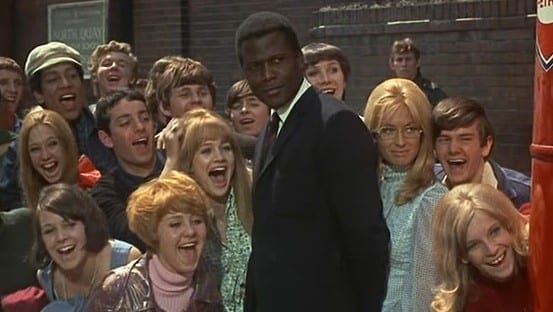
The image above shows Sidney Poitier and a gaggle of castmates in To Sir, with Love*.*
Previous Post

February 9, 2021
Of Kings and Prophets -- episode two

Browse Our Archives
Select a Category Anglican Planet Articles BC Christian News BC Report Bible Movies Bible Review Blog Books & Culture Campus Times CBC Radio Christianity Today ChristianWeek Essays Faith Today Festival Cinemas Guide Film Journals Georgia Straight Interviews MB Herald National Catholic Register Salvationist Today's Christian Two Chairs Ubyssey Uncategorized Vancouver Courier Vancouver Sun
Select a Month August 2025 April 2025 January 2025 December 2024 November 2024 May 2024 February 2024 December 2023 May 2023 March 2023 November 2022 July 2022 June 2022 May 2022 April 2022 February 2022 January 2022 December 2021 November 2021 October 2021 September 2021 August 2021 July 2021 June 2021 April 2021 March 2021 February 2021 January 2021 December 2020 November 2020 October 2020 August 2020 July 2020 June 2020 May 2020 March 2020 February 2020 January 2020 December 2019 November 2019 September 2019 July 2019 May 2019 April 2019 March 2019 February 2019 January 2019 December 2018 November 2018 October 2018 September 2018 July 2018 June 2018 May 2018 April 2018 March 2018 February 2018 January 2018 December 2017 November 2017 October 2017 September 2017 August 2017 July 2017 June 2017 May 2017 April 2017 March 2017 February 2017 January 2017 December 2016 November 2016 October 2016 September 2016 August 2016 July 2016 June 2016 May 2016 April 2016 March 2016 February 2016 January 2016 December 2015 November 2015 October 2015 September 2015 August 2015 July 2015 June 2015 May 2015 April 2015 March 2015 February 2015 January 2015 December 2014 November 2014 October 2014 September 2014 August 2014 July 2014 June 2014 May 2014 April 2014 March 2014 February 2014 January 2014 December 2013 November 2013 October 2013 September 2013 August 2013 July 2013 June 2013 May 2013 April 2013 March 2013 February 2013 January 2013 December 2012 November 2012 October 2012 September 2012 August 2012 July 2012 June 2012 April 2012 January 2012 January 2011 December 2010 November 2010 October 2010 September 2010 August 2010 July 2010 June 2010 May 2010 April 2010 March 2010 February 2010 January 2010 December 2009 November 2009 October 2009 September 2009 August 2009 July 2009 June 2009 May 2009 April 2009 March 2009 February 2009 January 2009 December 2008 November 2008 October 2008 September 2008 August 2008 July 2008 June 2008 May 2008 April 2008 March 2008 February 2008 January 2008 December 2007 November 2007 October 2007 September 2007 August 2007 July 2007 June 2007 May 2007 April 2007 March 2007 February 2007 January 2007 December 2006 November 2006 October 2006 September 2006 August 2006 July 2006 June 2006 May 2006 April 2006 March 2006 February 2006 January 2006 December 2005 November 2005 October 2005 September 2005 August 2005 July 2005 June 2005 May 2005 April 2005 March 2005 January 2005 December 2004 November 2004 October 2004 September 2004 August 2004 July 2004 June 2004 May 2004 April 2004 March 2004 February 2004 January 2004 November 2003 October 2003 August 2003 July 2003 June 2003 May 2003 January 2003 December 2002 November 2002 August 2002 July 2002 June 2002 May 2002 March 2002 January 2002 December 2001 November 2001 September 2001 August 2001 July 2001 June 2001 April 2001 March 2001 February 2001 December 2000 November 2000 October 2000 September 2000 August 2000 July 2000 June 2000 May 2000 April 2000 March 2000 January 2000 October 1999 August 1999 May 1999 April 1999 February 1999 January 1999 December 1998 November 1998 October 1998 August 1998 July 1998 June 1998 April 1998 March 1998 January 1998 November 1997 September 1997 July 1997 June 1997 April 1997 March 1997 February 1997 January 1997 December 1996 October 1996 September 1996 June 1996 March 1996 February 1996 January 1996 April 1995 November 1994 September 1994 September 1991
Follow Us!
TAKE THE
Religious Wisdom Quiz
Who betrayed Jesus for 30 pieces of silver?
Select your answer to see how you score.
Peter Judas Iscariot Barabbas James
Related posts from FilmChat

Joseph of Egypt – the Chosen spin-off announces...

Exclusive: A clip from Angel Studios' The King...

Exclusive: Watch a clip from Angel Studios' Brave...

Exclusive: Watch a clip from Angel Studios' Homestead
TRENDING AT PATHEOS Religious Music & Entertainment

"Les Diabolique" and Transgression
Alongside something like Arrival, Vertigo, or Charade, Les Diaboliques is a...

"The Plague Dogs" and Mortality
So, flashback to the late 70s, early 80s. Walt Disney Studios is...

With the recent and highly successful release of Christopher Nolan’s epic film,...

"L'avventura" and Human Weakness
Today's piece is going to be a little different for a few...

I first want to apologize for not posting or writing anything. I'm...

I've engaged in the multi-year project of reading through the Church Fathers,...
view all Religious Music & Entertainment blogs
Ad-Free & Subscriber Log-In Subscription Support
- About Us
- 2026 Calendar
- Videos
- Podcasts
- Library of World Religions
- Faith In Media Tracker
- Advertise With Us
- Write for Us
- Privacy Policy
- Terms of Service
- Do Not Sell My Data
- Contact Us
- Radiant Digital
- Manage Newsletter Subscriptions
- Unsubscribe From Notifications
- Sitemap
Copyright 2008-2026, Patheos. All rights reserved.
Subscription Support Ad-Free & Subscriber Log-In
Follow Patheos