
BuddhistCatholicContemplativeEvangelicalGeneral ChristianHinduJewishLatter-day SaintMuslimNew VisionsProgressive Christian
Beliefs
- Buddhist
- Catholic
- Contemplative
- Evangelical
- General Christian
- Hindu
- Jewish
- Latter-day Saint
- More Voices
- Muslim
- New Visions
- Pagan
- Progressive Christian
Topics
- Religion News
- Food and Religion
- Sports and Religion
- Religious Art
- Religious Music and Entertainment
- Religious Events
- History and Religion
- Style and Religion
- Politics and Religion
- Women in Religion
- Recreation Outdoors and Religion
- Business Finance and Religion
- Careers Workplace and Religion
- Education and Religion
- Family Parenting and Religion
- Health Fitness and Religion
- Home and Religion
- Relationships and Religion
- Technology and Religion
- Travel and Religion
Columnists
- Buddhist Columnists
- Business Finance and Religion Columnists
- Careers Workplace and Religion Columnists
- Catholic Columnists
- Contemplative Columnists
- Education and Religion Columnists
- Evangelists Columnists
- Family Parenting and Religion Columnists
- General Christian Columnists
- Health Fitness and Religion Columnists
- Hindu Columnists
- History and Religion Columnists
- Home and Religion Columnists
- Jewish Columnists
- More Voices Columnists
- Latter Day Columnists
- Muslim Columnists
- New Visions Columnists
- Nonreligious Columnists
- Pagan Columnists
- Politics and Religion Columnists
- Progressive Columnists
- Recreation Outdoors and Religion Columnists
- Relationships and Religion Columnists
- Religion News Columnists
- Religious Art Columnists
- Religious Events Columnists
- Religious Music and Entertainment Columnists
- Sports and Religion Columnists
- Style and Religion Columnists
- Technology and Religion Columnists
- Travel and Religion Columnists
- Women in Religion Columnists
Resource Library
- 2026 Calendar
- Library of World Religions
- The 100 Most Holy Places on Earth
- Patheos Answers
- Podcasts
- Videos
- Faith Leaders Database
- Anglican Episcopalian
- Bahai
- Baptist
- Buddhism
- Christianity
- Confucianism
- Eastern Orthodoxy
- Hinduism
- Holiness and Pentecostal
- ISKCON
- Islam
- Judaism
- Lutheran
- Methodist
- The Church of Jesus Christ of Latter-day Saints
- New Age
- Paganism
- Presbytarian and Reformed
- Protestantism
- Religion Behind the Scenes
- Roman Catholic
- Scientology
- Shia Islam
- Sikhism
- Sufism
- Sunni Islam
- Taoism
- Zen
- See all religions
Research Tools
 Ad-Free & Subscriber Log-In Subscription Support
Ad-Free & Subscriber Log-In Subscription Support
Follow Patheos 

- Trending:
- Forgiveness
- |
- Marriage
- |
- Consciousness
- |
- Death Penalty
- |
- Election
- |
- Halloween

-
Articles
- Home
- Religious Music & Entertainment
- Sidney Poitier marathon: The Defiant Ones (1958) – Our Virgin Island (1958) – Porgy and Bess (1959) – All the Young Men (1960)
Sidney Poitier marathon: The Defiant Ones (1958) – Our Virgin Island (1958) – Porgy and Bess (1959) – All the Young Men (1960)
Last updated on: February 6, 2021 at 7:50 am by Peter T. Chattaway
Sidney Poitier marathon: The Defiant Ones (1958) – Our Virgin Island (1958) – Porgy and Bess (1959) – All the Young Men (1960) 2021-02-06T07:50:12-08:00 Peter T. Chattaway
Patheos Explore the world's faith through different perspectives on religion and spirituality! Patheos has the views of the prevalent religions and spiritualities of the world.
The latest in a month-long series of re-posts from my Facebook marathon in April 2020.
–
Sidney Poitier marathon part 5 (1958):
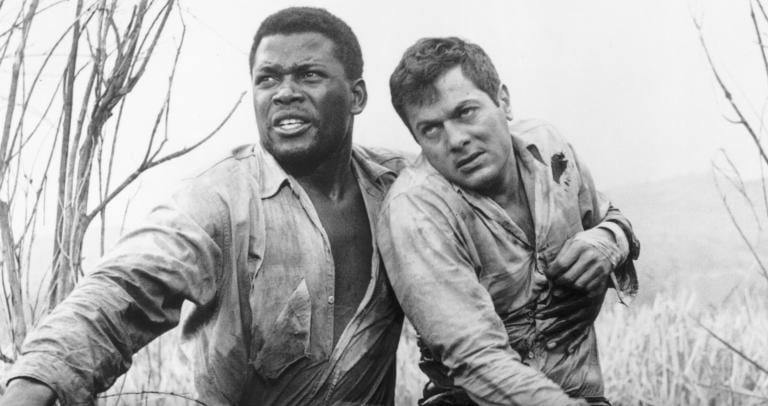
Poitier got the first of his two Oscar nominations for his co-starring role in The Defiant Ones (1958), and it’s not hard to see why. Poitier plays one of two escaped convicts — the other is played by Tony Curtis — who are chained together and have to overcome their mutual animosity, much of it fueled by racism, in order to survive. Because the two fugitives can’t get away from each other, they have plenty of opportunities to learn about each other, get on each other’s nerves and, eventually, find some kind of rapport, all of which makes for good drama — and both Poitier and Curtis rise to the occasion admirably.
It should be noted that Curtis was nominated for an Oscar, too — it was his only nomination ever — and in some ways his is the slightly larger role. About two-thirds of the way into the story, Curtis and Poitier meet an abandoned mother who gives them the tools they need to break free of the chain that binds them together, and Poitier fades from the story somewhat while the woman has a fling with Curtis. (There’s a close-up of the woman’s hand touching Curtis’s arm and chest that is very female-gaze-y.) But when Curtis learns that Poitier has left and the woman gave Poitier bad directions that will certainly lead to his doom (due to the swamps and such), Curtis angrily leaves the woman and goes to save Poitier, and so the two men are together again when the police finally catch up with them.
But if Curtis has the slightly larger role — commensurate, perhaps, with the fact that he was the more established movie star at the time (this film came out between 1957’s Sweet Smell of Success and 1959’s Some Like It Hot) — it was Poitier’s nomination that made history, as he became the first black man to be nominated for a competitive Oscar. (Hattie McDaniel had won best supporting actress for 1939’s Gone with the Wind, James Baskett had been given an honorary Oscar for playing Uncle Remus in 1946’s Song of the South, Ethel Waters had been nominated for best supporting actress for 1949’s Pinky, and Dorothy Dandrige had been nominated for best actress for 1954’s Carmen Jones.) Curtis and Poitier were both nominated in the lead-actor category, and they lost to David Niven for Separate Tables — but Poitier would get another shot at the trophy before long.
A few quick points:
— This was the first of three Poitier films (co-)directed by Stanley Kramer.
— Poitier’s character sings over the opening credits and sings again on one or two other occasions. Is that Poitier’s actual voice? I ask because Wikipedia says Poitier’s career suffered a bit at first because his tone deafness made it impossible for him to sing. If he is being dubbed here, it is much less obvious than it was in 1957’s Band of Angels.
— Love the look on Poitier’s face when Curtis tells the lynch mob, “You can’t lynch me, I’m a white man.” After all Poitier and Curtis have been through together…?
— The film famously ends with Poitier trying to help Curtis leap onto a moving train, and jumping/falling off the train when Curtis fails to grab his hand. I notice, though, that Curtis reaches for Poitier with his left hand, which seems odd because Curtis was shot in his left shoulder just a few scenes earlier. Is that really the arm that Poitier would have grabbed to hoist him up?
— The African-American film scholar who introduces the Poitier series on the Criterion Channel notes that the ending has always rung false for black Americans, who can’t believe that Poitier would have given up his chance for freedom to be with Curtis. It is not clear to me, though, that Poitier gets off the train intentionally; it seemed to me that he could have slipped off accidentally because he was reaching for Curtis. In any case, the film does establish a dramatic reciprocity here, because Curtis has already given up his own chance for freedom — driving off with the divorced mother — in order to save Poitier’s life. Is it realistic that Poitier would have returned the favour? Perhaps not, but it makes a dramatic kind of sense.
The only other Poitier film that year was Our Virgin Island (1958), which stars John Cassavetes and Virginia Maskell as an American man and a British woman who meet on a beach in the British Virgin Islands and decide, quite impulsively, to get married, buy an island and live on love. Poitier — who co-starred with Cassavetes in 1957’s Edge of the City — has a supporting role as a handyman of sorts who speaks with a thick Jamaican accent. Ruby Dee, who had been in three earlier movies with Poitier and would appear in two more, also pops up very, very briefly as Poitier’s significant other.
–
Sidney Poitier marathon part 6 (1959-1960):
After almost a decade of working his way up the Hollywood ladder, Sidney Poitier finally got top billing in a film — and it was a film he did not want to be in. Indeed, Wikipedia says the only reason Poitier agreed to star in Porgy and Bess (1959), an adaptation of the George Gershwin musical, is because the producers threatened him with a lawsuit. (Apparently Poitier’s agent told the producer she could convince him to do the movie, and the producer took this to be the equivalent of an oral contract.)
That’s just one of many behind-the-scenes stories that are far, far more interesting than the film itself. While on paper you might think that there was something progressive for that era about top Hollywood talent making a major musical with an all-black cast, Porgy and Bess was a troubled, controversial production — turned down by some black actors because the story was full of drugs, rape, murder and other things that cast the African-American community in a less-than-positive light, and resisted by others for much more personal reasons (e.g. leading lady Dorothy Dandridge was distressed when Otto Preminger took over as director because she had had an affair with him a few years earlier and had aborted their child under pressure from the studio, and possibly under pressure from Preminger himself; what was it like when she had to take direction from him during the film’s rape scene, I wonder…).
All of the sturm und drang behind the scenes resulted in a film that audiences didn’t want to see, and after the movie flopped, the Gershwin estate asked the producers to destroy all copies of the film, and to this day it is not known whether any quality prints survived. According to Wikipedia, the film has never had a home-video release, and it is widely considered one of the most expensive and prestigious “missing films”.
Poor-quality videos do exist online, though, and I was able to watch one of them, but I am not familiar with the original musical and I’m afraid I don’t have much to say about the film itself, especially given my current focus on Poitier. Once again, he didn’t do any of his own singing — that’s someone else’s voice we hear — and because his character is crippled and has limited mobility, there are entire sections of the film (such as a church picnic on an island) in which his character never appears.
I did recognize a few of the songs, though, and was struck by the fact that ‘It Ain’t Necessarily So’ — the song that questions the veracity of several Bible stories — is sung by a dope peddler played by Sammy Davis Jr who basically crashes the church picnic. Also, the guy who rapes Bess is played by future Starfleet admiral Brock Peters, who would go on to play a man who is falsely accused of rape in 1962’s To Kill a Mockingbird.
One year later, Poitier was back to second-billing status, this time behind Alan Ladd, in the Korean War movie All the Young Men (1960). The film concerns a platoon that needs to take and hold a mountain pass, and Poitier plays a sergeant who assumes command of the platoon after their lieutenant dies — and the sergeant’s job is made somewhat difficult by the fact that one or two of the troops serving under him are a wee bit racist.
All the Young Men is a fairly short, brisk film — only 82 minutes — and it’s got some really nice suspense and some striking camera angles. During one early battle scene, the camera is underwater and looking up at the ice when a face with a bloodied eye socket comes crashing through; and the film ends on an almost giddy note, with airplanes coming to the platoon’s rescue and Poitier firing a machine gun in the camera’s general direction as a jazzy version of ‘When the Saints Come Marching in’ starts playing on the soundtrack.
To be honest, I kind of like seeing how Poitier fared in these genre pics more than I like watching his Serious Social Message movies. But that’s not to say the film doesn’t have some serious social themes of its own: Like a lot of war movies, it revolves around an ethnically diverse military unit (the platoon counts a Navajo and a Swedish immigrant among its ranks), and the film does take place only two years after President Truman formally abolished racial segregation in the U.S. military. Near the end, one of the white marines needs a blood transfusion, and it turns out Poitier is the only surviving member of the team with a matching blood type — and so the point is made that our common humanity is more important than our differences in appearance.
It must be said, though, that as sensitive as the film is on racial matters, it is a little jarring how the film’s one major Korean character is played by an Argentinian woman with Vulcan eyebrows. I mean, we are told that this character is part-French, but still…
Other cast members include teen idol James Darren and comedian Mort Sahl, the latter of whom appears to be improvising a scene in which his character tells his fellow marines an amusing story.
Oh, and speaking of Star Trek: Apparently the film’s story was conceived with a bit of help from Gene Coon, who went on to be the showrunner on Star Trek and played a big part in creating the Klingons, Khan, the Prime Directive and so on. Also, the actor who plays the marine with medical training is played by Glenn Corbett, who went on to play Zefram Cochrane, inventor of the warp drive, in a 1967 episode of the original series.
–
The image above shows Sidney Poitier and Tony Curtis in The Defiant Ones*.*
Previous Post

February 3, 2021
Of Kings and Prophets -- episode one

Browse Our Archives
Select a Category Anglican Planet Articles BC Christian News BC Report Bible Movies Bible Review Blog Books & Culture Campus Times CBC Radio Christianity Today ChristianWeek Essays Faith Today Festival Cinemas Guide Film Journals Georgia Straight Interviews MB Herald National Catholic Register Salvationist Today's Christian Two Chairs Ubyssey Uncategorized Vancouver Courier Vancouver Sun
Select a Month August 2025 April 2025 January 2025 December 2024 November 2024 May 2024 February 2024 December 2023 May 2023 March 2023 November 2022 July 2022 June 2022 May 2022 April 2022 February 2022 January 2022 December 2021 November 2021 October 2021 September 2021 August 2021 July 2021 June 2021 April 2021 March 2021 February 2021 January 2021 December 2020 November 2020 October 2020 August 2020 July 2020 June 2020 May 2020 March 2020 February 2020 January 2020 December 2019 November 2019 September 2019 July 2019 May 2019 April 2019 March 2019 February 2019 January 2019 December 2018 November 2018 October 2018 September 2018 July 2018 June 2018 May 2018 April 2018 March 2018 February 2018 January 2018 December 2017 November 2017 October 2017 September 2017 August 2017 July 2017 June 2017 May 2017 April 2017 March 2017 February 2017 January 2017 December 2016 November 2016 October 2016 September 2016 August 2016 July 2016 June 2016 May 2016 April 2016 March 2016 February 2016 January 2016 December 2015 November 2015 October 2015 September 2015 August 2015 July 2015 June 2015 May 2015 April 2015 March 2015 February 2015 January 2015 December 2014 November 2014 October 2014 September 2014 August 2014 July 2014 June 2014 May 2014 April 2014 March 2014 February 2014 January 2014 December 2013 November 2013 October 2013 September 2013 August 2013 July 2013 June 2013 May 2013 April 2013 March 2013 February 2013 January 2013 December 2012 November 2012 October 2012 September 2012 August 2012 July 2012 June 2012 April 2012 January 2012 January 2011 December 2010 November 2010 October 2010 September 2010 August 2010 July 2010 June 2010 May 2010 April 2010 March 2010 February 2010 January 2010 December 2009 November 2009 October 2009 September 2009 August 2009 July 2009 June 2009 May 2009 April 2009 March 2009 February 2009 January 2009 December 2008 November 2008 October 2008 September 2008 August 2008 July 2008 June 2008 May 2008 April 2008 March 2008 February 2008 January 2008 December 2007 November 2007 October 2007 September 2007 August 2007 July 2007 June 2007 May 2007 April 2007 March 2007 February 2007 January 2007 December 2006 November 2006 October 2006 September 2006 August 2006 July 2006 June 2006 May 2006 April 2006 March 2006 February 2006 January 2006 December 2005 November 2005 October 2005 September 2005 August 2005 July 2005 June 2005 May 2005 April 2005 March 2005 January 2005 December 2004 November 2004 October 2004 September 2004 August 2004 July 2004 June 2004 May 2004 April 2004 March 2004 February 2004 January 2004 November 2003 October 2003 August 2003 July 2003 June 2003 May 2003 January 2003 December 2002 November 2002 August 2002 July 2002 June 2002 May 2002 March 2002 January 2002 December 2001 November 2001 September 2001 August 2001 July 2001 June 2001 April 2001 March 2001 February 2001 December 2000 November 2000 October 2000 September 2000 August 2000 July 2000 June 2000 May 2000 April 2000 March 2000 January 2000 October 1999 August 1999 May 1999 April 1999 February 1999 January 1999 December 1998 November 1998 October 1998 August 1998 July 1998 June 1998 April 1998 March 1998 January 1998 November 1997 September 1997 July 1997 June 1997 April 1997 March 1997 February 1997 January 1997 December 1996 October 1996 September 1996 June 1996 March 1996 February 1996 January 1996 April 1995 November 1994 September 1994 September 1991
Follow Us!
TAKE THE
Religious Wisdom Quiz
Who said, 'Let my people go'?
Select your answer to see how you score.
Aaron Moses Joshua Elijah
Related posts from FilmChat

Joseph of Egypt – the Chosen spin-off announces...

Exclusive: A clip from Angel Studios' The King...

Exclusive: Watch a clip from Angel Studios' Brave...

Exclusive: Watch a clip from Angel Studios' Homestead
TRENDING AT PATHEOS Religious Music & Entertainment

"Les Diabolique" and Transgression
Alongside something like Arrival, Vertigo, or Charade, Les Diaboliques is a...

"The Plague Dogs" and Mortality
So, flashback to the late 70s, early 80s. Walt Disney Studios is...

With the recent and highly successful release of Christopher Nolan’s epic film,...

"L'avventura" and Human Weakness
Today's piece is going to be a little different for a few...

I first want to apologize for not posting or writing anything. I'm...

I've engaged in the multi-year project of reading through the Church Fathers,...
view all Religious Music & Entertainment blogs
Ad-Free & Subscriber Log-In Subscription Support
- About Us
- 2026 Calendar
- Videos
- Podcasts
- Library of World Religions
- Faith In Media Tracker
- Advertise With Us
- Write for Us
- Privacy Policy
- Terms of Service
- Do Not Sell My Data
- Contact Us
- Radiant Digital
- Manage Newsletter Subscriptions
- Unsubscribe From Notifications
- Sitemap
Copyright 2008-2026, Patheos. All rights reserved.
Subscription Support Ad-Free & Subscriber Log-In
Follow Patheos