
BuddhistCatholicContemplativeEvangelicalGeneral ChristianHinduJewishLatter-day SaintMuslimNew VisionsProgressive Christian
Beliefs
- Buddhist
- Catholic
- Contemplative
- Evangelical
- General Christian
- Hindu
- Jewish
- Latter-day Saint
- More Voices
- Muslim
- New Visions
- Pagan
- Progressive Christian
Topics
- Religion News
- Food and Religion
- Sports and Religion
- Religious Art
- Religious Music and Entertainment
- Religious Events
- History and Religion
- Style and Religion
- Politics and Religion
- Women in Religion
- Recreation Outdoors and Religion
- Business Finance and Religion
- Careers Workplace and Religion
- Education and Religion
- Family Parenting and Religion
- Health Fitness and Religion
- Home and Religion
- Relationships and Religion
- Technology and Religion
- Travel and Religion
Columnists
- Buddhist Columnists
- Business Finance and Religion Columnists
- Careers Workplace and Religion Columnists
- Catholic Columnists
- Contemplative Columnists
- Education and Religion Columnists
- Evangelists Columnists
- Family Parenting and Religion Columnists
- General Christian Columnists
- Health Fitness and Religion Columnists
- Hindu Columnists
- History and Religion Columnists
- Home and Religion Columnists
- Jewish Columnists
- More Voices Columnists
- Latter Day Columnists
- Muslim Columnists
- New Visions Columnists
- Nonreligious Columnists
- Pagan Columnists
- Politics and Religion Columnists
- Progressive Columnists
- Recreation Outdoors and Religion Columnists
- Relationships and Religion Columnists
- Religion News Columnists
- Religious Art Columnists
- Religious Events Columnists
- Religious Music and Entertainment Columnists
- Sports and Religion Columnists
- Style and Religion Columnists
- Technology and Religion Columnists
- Travel and Religion Columnists
- Women in Religion Columnists
Resource Library
- 2026 Calendar
- Library of World Religions
- The 100 Most Holy Places on Earth
- Patheos Answers
- Podcasts
- Videos
- Faith Leaders Database
- Anglican Episcopalian
- Bahai
- Baptist
- Buddhism
- Christianity
- Confucianism
- Eastern Orthodoxy
- Hinduism
- Holiness and Pentecostal
- ISKCON
- Islam
- Judaism
- Lutheran
- Methodist
- The Church of Jesus Christ of Latter-day Saints
- New Age
- Paganism
- Presbytarian and Reformed
- Protestantism
- Religion Behind the Scenes
- Roman Catholic
- Scientology
- Shia Islam
- Sikhism
- Sufism
- Sunni Islam
- Taoism
- Zen
- See all religions
Research Tools
 Ad-Free & Subscriber Log-In Subscription Support
Ad-Free & Subscriber Log-In Subscription Support
Follow Patheos 

- Trending:
- Forgiveness
- |
- Marriage
- |
- Consciousness
- |
- Death Penalty
- |
- Election
- |
- Halloween

-
Articles
- Home
- Religious Music & Entertainment
- Sidney Poitier marathon: Stir Crazy (1980) – and two non-Poitier films that also co-starred Gene Wilder and Richard Pryor
Sidney Poitier marathon: Stir Crazy (1980) – and two non-Poitier films that also co-starred Gene Wilder and Richard Pryor
Last updated on: February 19, 2021 at 5:00 am by Peter T. Chattaway
Sidney Poitier marathon: Stir Crazy (1980) – and two non-Poitier films that also co-starred Gene Wilder and Richard Pryor 2021-02-13T11:34:02-08:00 Peter T. Chattaway
Patheos Explore the world's faith through different perspectives on religion and spirituality! Patheos has the views of the prevalent religions and spiritualities of the world.
The latest in a month-long series of re-posts from my Facebook marathon in April 2020.
–
Thirty years after his first big-screen role, and eight years after he directed a movie for the first time, Sidney Poitier finally made a film in which he himself did not appear — Stir Crazy (1980), starring Gene Wilder and Richard Pryor — and it turned out to be one of his biggest hits ever.
Indeed, it grossed $101.3 million in North America, a phenomenal amount at a time when only two or three movies a year crossed the century mark. It was the third-highest-grossing film of 1980, after The Empire Strikes Back and 9 to 5.
Stir Crazy was also the top-grossing film by a black director until Keenen Ivory Wayans’ Scary Movie came out twenty years later — and if you adjust for inflation, it was arguably the top-grossing film by a black director in North America until 2018’s Black Panther (though other films, such as 2017’s The Fate of the Furious, had presumably already beaten Stir Crazy internationally, even after adjusting for inflation).
My post on this film is going to be a little different from the other posts in my Sidney Poitier marathon. The rest of this marathon is based on a binge-watch that I did in April of last year. But before I did that binge-watch, I did a triple-bill of Wilder-Pryor collaborations, including this one. So the bulk of this post will consist of what I wrote at the time about that triple-bill, before I had seen most of Poitier’s earlier films.
–
Yesterday’s 1980s (and 1970s) catch-up: Silver Streak (1976), Stir Crazy (1980) and See No Evil, Hear No Evil (1989), the latter two of which are currently streaming on Netflix.
I’m not all that familiar with Gene Wilder and Richard Pryor, so I don’t know what sort of relationship they had outside of the films that they made together, but when I saw that the two films they made in the 1980s were streaming on Netflix (one of which was directed by Sidney Poitier, which was interesting in and of itself), I figured I’d check them out, along with the 1970s film that first put them together onscreen. (Note: onscreen. The first film that they both worked on was 1974’s Blazing Saddles, which starred Wilder and was co-written by Pryor.)
And… well, the law of diminishing returns certainly applies here. Blazing Saddles is an all-time classic, Silver Streak is a solid if unexceptional blockbuster, Stir Crazy is mildly interesting, and See No Evil is dull, contrived and gimmicky. (Wilder and Pryor went on to co-star in one more movie together — 1991’s Another You — but I don’t think I had even heard of that film until I scanned the IMDb for Wilder-Pryor collaborations, and I couldn’t find it on any streaming or VOD services.)
Anyway. Silver Streak is actually a decent bit of popcorn entertainment, and I am not at all surprised to learn that it was one of the top five box-office hits in 1976 (behind Rocky, the A Star Is Born remake and, um, the King Kong remake). It’s a sort of Hitchcockian thriller-comedy — Gene Wilder witnesses a murder on a train, nobody believes him at first, and then he becomes the chief suspect — and it’s got a bit of romance and a bit of climactic disaster-movie footage at the end to go with the other genre elements. Plus it has some notable supporting actors, including Ned Beatty as a fellow passenger, Scatman Crothers as a porter, and Patrick McGoohan as the main villain. (I happened to watch 1979’s Escape from Alcatraz a couple nights earlier, and McGoohan was in that, too!) So it feels very much like a movie that the studio had some sort of confidence in.
I was a bit surprised, given that Pryor is one of the three top-billed actors (along with Wilder and Jill Clayburgh), to see that Pryor doesn’t actually appear until over an hour into the film — and one of the first things he does is encourage Wilder to pretend to be black in order to sneak back aboard the train. (Pryor even cites the Al Jolson precedent when telling Wilder to put shoe polish all over his face.) I’m curious as to how audiences, including black audiences, responded to this at the time, and how the response might have paralleled or differed from the response such a bit might get nowadays.
Weirdly, Silver Streak plugs into the James Bond films of that era. It features a sheriff played by Clifton James, who had previously played Sheriff Pepper in 1973’s Live and Let Die and 1974’s The Man with the Golden Gun (and who would go on to play another sheriff in 1980’s Superman II), and it also features Richard Kiel as a killer with metal teeth, before Kiel played Jaws in 1977’s The Spy Who Loved Me (which also features fight scenes on a train!) and 1979’s Moonraker. One other face I was happy to spot was a very young Fred Willard, as a guy who has to help evacuate the train station at the very end of the film.
I also liked some of the time-capsule elements in Silver Streak, e.g. the multiple jokes about those damn hippies, and the shot that begins by lingering on a passenger’s bottle of Tab. Apparently Tab had been around since 1963 — and it’s still made today! — but it largely faded from the market after the Coca-Cola company introduced Diet Coke in 1982.
One niggly nit-pick: When McGoohan’s character is leaning out of the train and sees another train rushing towards his head, the point-of-view shots of the oncoming train are clearly taken by a stationary camera and not by a camera that is rushing towards the train like McGoohan’s character would have been.
As for the other two movies…
Not surprisingly, they recycle some bits from Silver Streak. Stir Crazy and See No Evil both feature Wilder being accused of crimes he didn’t commit, and this time Pryor is blamed for the crimes too. In Stir Crazy, after Wilder and Pryor are thrown in jail, Wilder tries to act “tough” around the other prisoners in a way that recalls his dorky attempts to pass himself off as a black man in Silver Streak, and See No Evil recycles the plot device where Wilder sees a front-page newspaper story accusing him (and Pryor) of the crime. (See No Evil was directed by Arthur Hiller, who also directed Silver Streak.)
Stir Crazy was directed by Poitier, the first black man to win an Oscar for acting (in 1963’s Lilies of the Field), and it is interesting to watch nowadays in light of the recent push towards “diversity” in film. Wilder and Pryor both plan to escape their imprisonment — in a manner that, for me, recalls the World War II POW film Victory, which came out one year later (both films involve escape attempts that take place when prisoners are taken out of the prison to participate in sporting events) — and Wilder and Pryor are joined in their plan by an Hispanic prisoner and a gay black prisoner.
The gay prisoner’s story arc is particularly interesting: he flirts with Pryor at first, and Pryor finds it super awkward, but by the end, when the escapees are putting on their disguises, Pryor has no trouble letting the gay prisoner dress as a woman and pretend to be his partner as part of the escape plan. It is only after they have all escaped that things get awkward again for Pryor, as the gay prisoner gives him a quick farewell kiss on the lips. But the humour here is essentially at Pryor’s expense, even if one assumes that many in the audience would have identified with Pryor as he tries to wipe his lips clean. At no point is the gay prisoner “punished” or chastised or anything like that; the film is essentially happy to let that character be who he is. (I do wonder, though, if anyone back in the day objected to the fact that the white man “gets the girl” in the end, i.e. a lawyer played by JoBeth Williams, while the black man has to deal with another man’s attraction to him.)
See No Evil, meanwhile, has its own issues. The gimmick here is that Wilder plays a deaf man and Pryor plays a blind man, and between the two of them they “witness” a murder but have a hard time convincing anyone else of that; and both of these characters insist on “passing” as able-bodied people, which Pryor’s sister says is just as bad as a black person trying to “pass” as white. The film’s credits indicate that the movie was made with input from the disabled community, but I wonder if the movie’s release 31 years ago was greeted by the sort of op-eds that one routinely sees nowadays which insist that only disabled actors should be allowed to play disabled characters.
On a completely different culturally-touchy front, Pryor speaks in exaggerated foreign accents while pretending to be Swedish and “Middle Eastern”, as the closed captioning puts it. (The latter scene takes place during an anti-Khomeini, pro-democracy-in-Iran protest outside a police station; for context, the film came out one year after the Iran-Iraq War came to an end, and just a few months after the Ayatollah Khomeini issued a fatwa against Salman Rushdie for writing The Satanic Verses.)
See No Evil also goes out of its way to make a sexual spectacle of the female villain. In one scene, after she has stepped out of a shower, Wilder tricks her into dropping her towel by sticking his hand in his pocket, pretending his erection is a gun, and telling her to put her hands up. The scene makes absolutely no sense: Why would a hardened killer be fooled by this? Usually, when someone pretends to have a gun in his or her pocket, it’s because they’re out in public and everyone assumes the person wants the gun to stay hidden. But this is a movie in which the bad guys have already pointed their guns at people on an open sidewalk, and have openly said that they don’t have to wait until they’re in an alley before killing their captives. So why would the hand-in-the-pocket trick work in a private hotel room? Answer: Because Wilder needs the sexy lady to be naked, exposed and vulnerable so that he can kiss her without her consent.
Anyway. From Silver Streak to Stir Crazy and See No Evil, you can see the filmmakers’ ambitions getting smaller, with smaller setpieces and fewer recognizable supporting actors. But it’s fun to spot now-familiar actors at earlier stages of their careers. Craig T. Nelson makes one of his earliest big-screen appearances as a prison guard in Stir Crazy, and Kevin Spacey makes his fourth big-screen appearance ever as a villain with a moustache and a British accent in See No Evil.
–
Thus endeth my original Facebook post about the Wilder-Pryor triple-bill.
When I got to Stir Crazy in my Poitier marathon last year, I linked to my earlier post and added two extra notes, in addition to the box-office data that I mention above:
— This was the second Poitier-directed film to feature Richard Pryor, after the latter’s bit part in 1974’s Uptown Saturday Night.
— This is the only Poitier-directed film that was rated R, mainly it seems because it is also the first Poitier film in which anyone uses the f-word (and it is used several times).
–
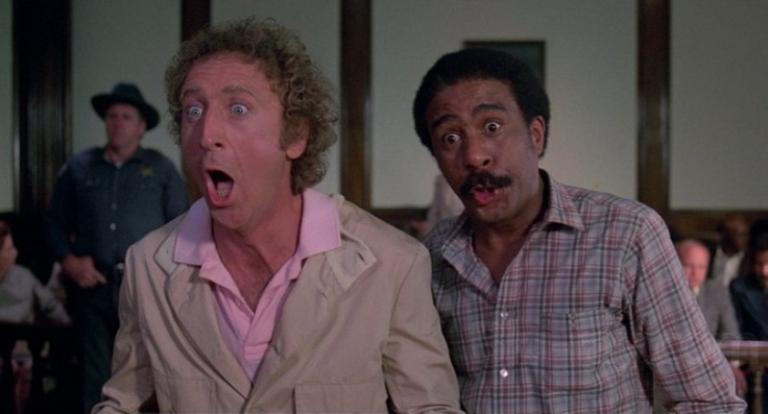
The image above shows Gene Wilder and Richard Pryor in Stir Crazy*.*

Next Post

February 19, 2021 Covenant to depict modernized, dystopic Bible stories
Browse Our Archives
Select a Category Anglican Planet Articles BC Christian News BC Report Bible Movies Bible Review Blog Books & Culture Campus Times CBC Radio Christianity Today ChristianWeek Essays Faith Today Festival Cinemas Guide Film Journals Georgia Straight Interviews MB Herald National Catholic Register Salvationist Today's Christian Two Chairs Ubyssey Uncategorized Vancouver Courier Vancouver Sun
Select a Month August 2025 April 2025 January 2025 December 2024 November 2024 May 2024 February 2024 December 2023 May 2023 March 2023 November 2022 July 2022 June 2022 May 2022 April 2022 February 2022 January 2022 December 2021 November 2021 October 2021 September 2021 August 2021 July 2021 June 2021 April 2021 March 2021 February 2021 January 2021 December 2020 November 2020 October 2020 August 2020 July 2020 June 2020 May 2020 March 2020 February 2020 January 2020 December 2019 November 2019 September 2019 July 2019 May 2019 April 2019 March 2019 February 2019 January 2019 December 2018 November 2018 October 2018 September 2018 July 2018 June 2018 May 2018 April 2018 March 2018 February 2018 January 2018 December 2017 November 2017 October 2017 September 2017 August 2017 July 2017 June 2017 May 2017 April 2017 March 2017 February 2017 January 2017 December 2016 November 2016 October 2016 September 2016 August 2016 July 2016 June 2016 May 2016 April 2016 March 2016 February 2016 January 2016 December 2015 November 2015 October 2015 September 2015 August 2015 July 2015 June 2015 May 2015 April 2015 March 2015 February 2015 January 2015 December 2014 November 2014 October 2014 September 2014 August 2014 July 2014 June 2014 May 2014 April 2014 March 2014 February 2014 January 2014 December 2013 November 2013 October 2013 September 2013 August 2013 July 2013 June 2013 May 2013 April 2013 March 2013 February 2013 January 2013 December 2012 November 2012 October 2012 September 2012 August 2012 July 2012 June 2012 April 2012 January 2012 January 2011 December 2010 November 2010 October 2010 September 2010 August 2010 July 2010 June 2010 May 2010 April 2010 March 2010 February 2010 January 2010 December 2009 November 2009 October 2009 September 2009 August 2009 July 2009 June 2009 May 2009 April 2009 March 2009 February 2009 January 2009 December 2008 November 2008 October 2008 September 2008 August 2008 July 2008 June 2008 May 2008 April 2008 March 2008 February 2008 January 2008 December 2007 November 2007 October 2007 September 2007 August 2007 July 2007 June 2007 May 2007 April 2007 March 2007 February 2007 January 2007 December 2006 November 2006 October 2006 September 2006 August 2006 July 2006 June 2006 May 2006 April 2006 March 2006 February 2006 January 2006 December 2005 November 2005 October 2005 September 2005 August 2005 July 2005 June 2005 May 2005 April 2005 March 2005 January 2005 December 2004 November 2004 October 2004 September 2004 August 2004 July 2004 June 2004 May 2004 April 2004 March 2004 February 2004 January 2004 November 2003 October 2003 August 2003 July 2003 June 2003 May 2003 January 2003 December 2002 November 2002 August 2002 July 2002 June 2002 May 2002 March 2002 January 2002 December 2001 November 2001 September 2001 August 2001 July 2001 June 2001 April 2001 March 2001 February 2001 December 2000 November 2000 October 2000 September 2000 August 2000 July 2000 June 2000 May 2000 April 2000 March 2000 January 2000 October 1999 August 1999 May 1999 April 1999 February 1999 January 1999 December 1998 November 1998 October 1998 August 1998 July 1998 June 1998 April 1998 March 1998 January 1998 November 1997 September 1997 July 1997 June 1997 April 1997 March 1997 February 1997 January 1997 December 1996 October 1996 September 1996 June 1996 March 1996 February 1996 January 1996 April 1995 November 1994 September 1994 September 1991
Follow Us!
TAKE THE
Religious Wisdom Quiz
Who visited Job and tried to explain his suffering?
Select your answer to see how you score.
His brothers Three friends His servants His sons
Related posts from FilmChat

Joseph of Egypt – the Chosen spin-off announces...

Exclusive: A clip from Angel Studios' The King...

Exclusive: Watch a clip from Angel Studios' Brave...

Exclusive: Watch a clip from Angel Studios' Homestead
TRENDING AT PATHEOS Religious Music & Entertainment

"Les Diabolique" and Transgression
Alongside something like Arrival, Vertigo, or Charade, Les Diaboliques is a...

"The Plague Dogs" and Mortality
So, flashback to the late 70s, early 80s. Walt Disney Studios is...

With the recent and highly successful release of Christopher Nolan’s epic film,...

"L'avventura" and Human Weakness
Today's piece is going to be a little different for a few...

I first want to apologize for not posting or writing anything. I'm...

I've engaged in the multi-year project of reading through the Church Fathers,...
view all Religious Music & Entertainment blogs
Ad-Free & Subscriber Log-In Subscription Support
- About Us
- 2026 Calendar
- Videos
- Podcasts
- Library of World Religions
- Faith In Media Tracker
- Advertise With Us
- Write for Us
- Privacy Policy
- Terms of Service
- Do Not Sell My Data
- Contact Us
- Radiant Digital
- Manage Newsletter Subscriptions
- Unsubscribe From Notifications
- Sitemap
Copyright 2008-2026, Patheos. All rights reserved.
Subscription Support Ad-Free & Subscriber Log-In
Follow Patheos