
BuddhistCatholicContemplativeEvangelicalGeneral ChristianHinduJewishLatter-day SaintMuslimNew VisionsProgressive Christian
Beliefs
- Buddhist
- Catholic
- Contemplative
- Evangelical
- General Christian
- Hindu
- Jewish
- Latter-day Saint
- More Voices
- Muslim
- New Visions
- Pagan
- Progressive Christian
Topics
- Religion News
- Food and Religion
- Sports and Religion
- Religious Art
- Religious Music and Entertainment
- Religious Events
- History and Religion
- Style and Religion
- Politics and Religion
- Women in Religion
- Recreation Outdoors and Religion
- Business Finance and Religion
- Careers Workplace and Religion
- Education and Religion
- Family Parenting and Religion
- Health Fitness and Religion
- Home and Religion
- Relationships and Religion
- Technology and Religion
- Travel and Religion
Columnists
- Buddhist Columnists
- Business Finance and Religion Columnists
- Careers Workplace and Religion Columnists
- Catholic Columnists
- Contemplative Columnists
- Education and Religion Columnists
- Evangelists Columnists
- Family Parenting and Religion Columnists
- General Christian Columnists
- Health Fitness and Religion Columnists
- Hindu Columnists
- History and Religion Columnists
- Home and Religion Columnists
- Jewish Columnists
- More Voices Columnists
- Latter Day Columnists
- Muslim Columnists
- New Visions Columnists
- Nonreligious Columnists
- Pagan Columnists
- Politics and Religion Columnists
- Progressive Columnists
- Recreation Outdoors and Religion Columnists
- Relationships and Religion Columnists
- Religion News Columnists
- Religious Art Columnists
- Religious Events Columnists
- Religious Music and Entertainment Columnists
- Sports and Religion Columnists
- Style and Religion Columnists
- Technology and Religion Columnists
- Travel and Religion Columnists
- Women in Religion Columnists
Resource Library
- 2026 Calendar
- Library of World Religions
- The 100 Most Holy Places on Earth
- Patheos Answers
- Podcasts
- Videos
- Faith Leaders Database
- Anglican Episcopalian
- Bahai
- Baptist
- Buddhism
- Christianity
- Confucianism
- Eastern Orthodoxy
- Hinduism
- Holiness and Pentecostal
- ISKCON
- Islam
- Judaism
- Lutheran
- Methodist
- The Church of Jesus Christ of Latter-day Saints
- New Age
- Paganism
- Presbytarian and Reformed
- Protestantism
- Religion Behind the Scenes
- Roman Catholic
- Scientology
- Shia Islam
- Sikhism
- Sufism
- Sunni Islam
- Taoism
- Zen
- See all religions
Research Tools
 Ad-Free & Subscriber Log-In Subscription Support
Ad-Free & Subscriber Log-In Subscription Support
Follow Patheos 

- Trending:
- Forgiveness
- |
- Marriage
- |
- Consciousness
- |
- Death Penalty
- |
- Election
- |
- Halloween

-
Articles
- Home
- Religious Music & Entertainment
- Sidney Poitier marathon: Shoot to Kill (1988) – Little Nikita (1988)
Sidney Poitier marathon: Shoot to Kill (1988) – Little Nikita (1988)
Last updated on: February 23, 2021 at 5:00 am by Peter T. Chattaway
Sidney Poitier marathon: Shoot to Kill (1988) – Little Nikita (1988) 2021-02-15T13:38:05-08:00 Peter T. Chattaway
Patheos Explore the world's faith through different perspectives on religion and spirituality! Patheos has the views of the prevalent religions and spiritualities of the world.
The latest in a month-long series of re-posts from my Facebook marathon in April 2020.
–
Sidney Poitier marathon part 19 (1988):
After taking a break from acting for more than a decade, Sidney Poitier returned to the big screen in two movies — both of which, coincidentally, cast him as an FBI agent.
Alas, the first of these films, Shoot to Kill (1988), is an utterly generic cop-chases-criminal movie with none of the social significance of Poitier’s earlier films. The villain is a guy who has stolen some diamonds and killed some people, and that’s it; he’s not motivated by politics or racism or anything else that might give the film a little more oomph.
The film is more interested in setting up a contrast of sorts between city people and country people. The villain infiltrates a group of hikers near the Canadian border, and Poitier teams up with a mountain guide played by Tom Berenger to try to catch the killer before he gets away — and of course, the big-city cop and the country-dwelling mountain guide get on each other’s nerves. Poitier is constantly surprised by the animals he encounters, both wild and domesticated, while Berenger, who has his own reasons for wanting to catch up with the hikers, thinks the cop is just slowing him down.
Shoot to Kill may be a run-of-the-mill potboiler, but it’s a special film for people in my neck of the woods because it’s one of the very few American movies that was not only shot in Vancouver but allows Vancouver to play itself — albeit with some cosmetic changes.
The film also holds a special place in my heart because the script for this film was the first screenplay I ever read before the movie in question came out. (I worked at Regent College as a video-camera operator in the summer of 1987, and my supervisor did the video playback on this film.)
If memory serves, the script I read was called Mountain King, and I remember noticing how different pages were printed on different-coloured paper, to signify which sections of the script came from which rewrites. I also remember that there was a note in the script announcing that “RCMP” or “Royal Canadian Mounted Police” had been changed to the fictitious “BCPF” or “British Columbia Police Force” — and sure enough, that’s what we see in the film. (Apparently the real-life RCMP objected to the way the film depicted them as “bungling idiots” participating in “illegal activities”.)
As it happens, the film came out while I was going to Bible school in Saskatchewan, and I remember going into Saskatoon just to see this movie, and enjoying the glimpses of my home city. I did not see the film again until now, for this marathon. In the interim, I had totally remembered that the film climaxes with a shoot-out at Robson Square, which I still think about whenever I walk through that block. But I had forgotten that the shoot-out is followed by a car chase which leads to the Seabus terminal — you can see Canada Place very clearly in one shot (this movie was filmed mere months after Expo 86) — and that the cars then end up at the BC Ferries terminal in Tsawwassen, which is ridiculous, as that would easily be up to an hour’s drive away, depending on traffic. I guess someone figured, “Eh, boats are boats”? I will concede at least that the final foot-chase and shoot-out on the ferry needed a lot more space than the Seabus would have provided. (Incidentally, the ferry we see is the Queen of Vancouver, which has been in service since 1962.)
Anyway. If watching the film 32 years ago gave me a glimpse of home, watching it now gave me a glimpse of my city’s past, as the car chase zips past the storefronts for Odyssey Imports and Albion Books (the latter of which still exists, but in a different location I think).
Other fun Vancouver bits: We see (and hear) the 12 O’Clock Horns, which blare the first four notes of ‘O Canada’ every day at 12 noon; when the film was made, the horns sat on top of what was then called the BC Hydro building, but since 1994 they have sat on top of the Pan Pacific hotel at Canada Place. A police chief also says that someone they want to interrogate lives in “British Properties. Very expensive neighbourhood.”
(Incidentally, the police chief is Asian-Canadian, and Wikipedia notes that British Properties — which is in West Vancouver, not Vancouver itself — used to explicitly prohibit people of Asian descent from living there, but it has since become so valuable that it has attracted a lot of investors from China and Iran. I wonder when the RCMP got its first superintendent of Asian descent? Before or after this film was made?)
A few other quick points:
— The film wasn’t merely shot in Canada; at least some of the key creative personnel came from here too, including director Roger Spottiswoode (who went on to direct the James Bond movie Tomorrow Never Dies) and co-writer Daniel Petrie Jr (whose father directed Poitier in 1961’s A Raisin in the Sun — is that why Poitier agreed to star in this movie?). Wikipedia says the younger Petrie “is best known for pioneering the sub-genres of action comedy and buddy cop films through films like Beverly Hills Cop and Turner & Hooch,” and, well, this film certainly qualifies.
— This is at least the second Poitier film to take place in the Pacific Northwest, following 1965’s The Slender Thread, which was set in Seattle and featured a fisherman who sometimes worked near the BC coast.
— The opening scenes are set in San Francisco, which is also where the last two Mister Tibbs movies took place. For some reason the villain heads all the way north to Canada instead of going south to Mexico, and the FBI traces him because he has a habit of shooting people in the eye.
— The mountain section of the movie begins near a place called “Bishop’s Falls, northwest of Spokane”. Does such a place exist? Google indicates that there is a place called Bishop’s Falls in the state of Washington, but it is in Lewis County, south of Seattle. Most of the search results for “Bishop’s Falls” refer to a place in Newfoundland.
— We’re not supposed to know which of the hikers is the villain until about an hour into the movie. It turns out to be Clancy Brown, who had previously played the bad guy in 1986’s Highlander. But another strong contender is the guy played by Richard Masur, a veteran of 1982’s The Thing (which was also filmed in British Columbia!).
— Berenger’s girlfriend — and Brown’s hostage — is played by Kirstie Alley, who had just joined the TV show Cheers a few months before this film came out. She, too, starred in other Vancouver-made movies, including 1983’s Runaway and 1989’s Look Who’s Talking and its sequel.
— One of the mountain-dwelling characters says Alley is Berenger’s “partner, I guess you’d call them.” So terminology like that was still kind of new, still took some getting adjusted to, back then. Poitier’s character, for his part, has a “girlfriend”.
— Berenger is practically offended by all the trappings of city life that Poitier brings with him, including “battery-powered heated socks, the latest thing,” as one character calls them. I have no idea when they first came on the market.
— Poitier scares off a bear by making a lot of weird faces, and then tells Berenger, “Everyone else around here acts like they’ve never seen a black man before. Why should a bear be different?” But we never really saw anyone act weird around Poitier because of his race prior to that scene — unless the guy who kept asking if Poitier was “really a G-man” was asking because of Poitier’s race? (I assumed he was asking because he was a living in a remote part of the country and had never seen a federal agent before.)
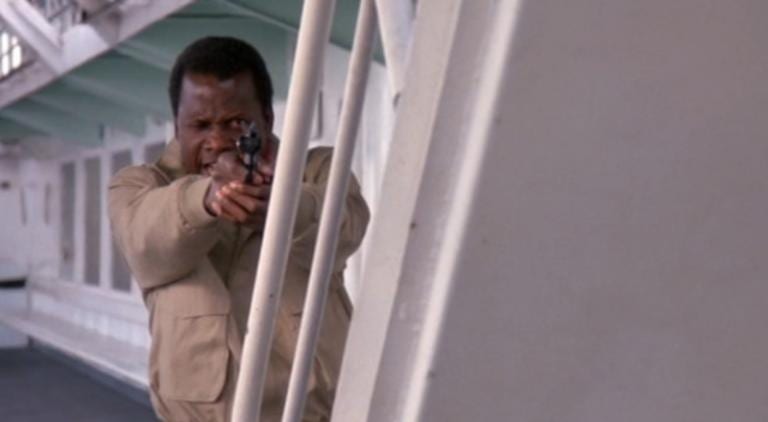
— Poitier and Brown get into a fight on the ferry and accidentally knock open a gate, which leads to them falling off the boat and into the water. I would hope that those gates are locked a lot more securely in real life!
— Is this the first movie in which Poitier says “shit”? (The word had been used in other films that he starred in and directed, but not, I think, by him.)
— Poitier turned 61 the week after this film came out. His character’s age is never given, but he says he’s been with the FBI for 22 years.
— This time in LGBT references, maybe: Poitier and Berenger stay warm in the snow by huddling together in a sleeping bag, and Berenger teases him by saying, “You heard about us country boys, right?”
Poitier then played another FBI agent in Little Nikita (1988), which was the first of two movies he made with River Phoenix.
In this film, the FBI agent played by Poitier befriends Phoenix because a Russian assassin has gone rogue and started bumping off Russian sleeper agents in the United States — and Phoenix’s parents, unbeknownst to Phoenix, are two of the agents the assassin is coming for.
The film is kind of fading from my mind already, but I’ll give it this much: Thanks to the Cold War premise, it has a real-world resonance that is missing from Shoot to Kill.
A few other quick points:
— Little Nikita was actually filmed before Shoot to Kill, but it arrived in theatres about one month later. So Little Nikita was arguably Poitier’s true “comeback” movie.
— Going by release dates, this was the last theatrical feature to give Poitier top billing.
— Little Nikita has other parallels to Shoot to Kill, besides casting Poitier as an FBI agent: there is a fight on a boat, a glimpse of the American border (on the Mexican side this time), a reference to Spokane (Phoenix’s parents took their American names from headstones on a cemetery there), a reference to Vancouver (when a Russian refers to “our man” there), etc.
— Poitier’s FBI agent is based in San Francisco in Shoot to Kill, and in San Diego in Little Nikita.
— This was only the second Poitier film to have the Cold War as its central premise, following 1965’s The Bedford Incident. (I guess 1960’s All the Young Men arguably fits the bill too, inasmuch as it’s a Korean War movie, and the Korean War was part of the Cold War.) At one point Gorbachev, who began leading the Soviet Union in 1985, appears on TV, and one of the Russian characters says Gorbachev is an improvement on Breshnev, who died in 1982.
— This was one of two 1988 movies in which Phoenix played the son of someone being tracked by the authorities. In Running on Empty, which came out six months later, Phoenix’s parents were radical 1960s activists.
— Phoenix’s father in this film is played by Richard Jenkins, who has been in lots of movies but did not become particularly famous until the last couple decades; he was nominated for an Oscar for 2007’s The Visitor.
— At one point Phoenix walks in on Poitier while the latter is in bed with one of Phoenix’s high-school teachers. Poitier was 61 when the film came out, while the actress who played the teacher, Loretta Devine, was 39.
— Phoenix’s character is 17 years old. Phoenix himself was 16 when the film was shot in late 1986 and early 1987, but he was 17 by the time the film came out in 1988.
— This time in LGBT references: Phoenix tells Poitier the last guy who kept running into him “accidentally” was a gay country-club waiter named Maurice, and he asks if Poitier is gay, too. The last time someone asked if a Poitier character was gay was in 1968’s For Love of Ivy.
–
The image above shows Sidney Poitier on the Queen of Vancouver in Shoot to Kill*.*
Previous Post
February 22, 2021
Sidney Poitier marathon: Hanky Panky (1982) - Fast Forward (1985)
Next Post
February 24, 2021 Sidney Poitier marathon: Ghost Dad (1990) - Separate but Equal (1991)
Browse Our Archives
Select a Category Anglican Planet Articles BC Christian News BC Report Bible Movies Bible Review Blog Books & Culture Campus Times CBC Radio Christianity Today ChristianWeek Essays Faith Today Festival Cinemas Guide Film Journals Georgia Straight Interviews MB Herald National Catholic Register Salvationist Today's Christian Two Chairs Ubyssey Uncategorized Vancouver Courier Vancouver Sun
Select a Month August 2025 April 2025 January 2025 December 2024 November 2024 May 2024 February 2024 December 2023 May 2023 March 2023 November 2022 July 2022 June 2022 May 2022 April 2022 February 2022 January 2022 December 2021 November 2021 October 2021 September 2021 August 2021 July 2021 June 2021 April 2021 March 2021 February 2021 January 2021 December 2020 November 2020 October 2020 August 2020 July 2020 June 2020 May 2020 March 2020 February 2020 January 2020 December 2019 November 2019 September 2019 July 2019 May 2019 April 2019 March 2019 February 2019 January 2019 December 2018 November 2018 October 2018 September 2018 July 2018 June 2018 May 2018 April 2018 March 2018 February 2018 January 2018 December 2017 November 2017 October 2017 September 2017 August 2017 July 2017 June 2017 May 2017 April 2017 March 2017 February 2017 January 2017 December 2016 November 2016 October 2016 September 2016 August 2016 July 2016 June 2016 May 2016 April 2016 March 2016 February 2016 January 2016 December 2015 November 2015 October 2015 September 2015 August 2015 July 2015 June 2015 May 2015 April 2015 March 2015 February 2015 January 2015 December 2014 November 2014 October 2014 September 2014 August 2014 July 2014 June 2014 May 2014 April 2014 March 2014 February 2014 January 2014 December 2013 November 2013 October 2013 September 2013 August 2013 July 2013 June 2013 May 2013 April 2013 March 2013 February 2013 January 2013 December 2012 November 2012 October 2012 September 2012 August 2012 July 2012 June 2012 April 2012 January 2012 January 2011 December 2010 November 2010 October 2010 September 2010 August 2010 July 2010 June 2010 May 2010 April 2010 March 2010 February 2010 January 2010 December 2009 November 2009 October 2009 September 2009 August 2009 July 2009 June 2009 May 2009 April 2009 March 2009 February 2009 January 2009 December 2008 November 2008 October 2008 September 2008 August 2008 July 2008 June 2008 May 2008 April 2008 March 2008 February 2008 January 2008 December 2007 November 2007 October 2007 September 2007 August 2007 July 2007 June 2007 May 2007 April 2007 March 2007 February 2007 January 2007 December 2006 November 2006 October 2006 September 2006 August 2006 July 2006 June 2006 May 2006 April 2006 March 2006 February 2006 January 2006 December 2005 November 2005 October 2005 September 2005 August 2005 July 2005 June 2005 May 2005 April 2005 March 2005 January 2005 December 2004 November 2004 October 2004 September 2004 August 2004 July 2004 June 2004 May 2004 April 2004 March 2004 February 2004 January 2004 November 2003 October 2003 August 2003 July 2003 June 2003 May 2003 January 2003 December 2002 November 2002 August 2002 July 2002 June 2002 May 2002 March 2002 January 2002 December 2001 November 2001 September 2001 August 2001 July 2001 June 2001 April 2001 March 2001 February 2001 December 2000 November 2000 October 2000 September 2000 August 2000 July 2000 June 2000 May 2000 April 2000 March 2000 January 2000 October 1999 August 1999 May 1999 April 1999 February 1999 January 1999 December 1998 November 1998 October 1998 August 1998 July 1998 June 1998 April 1998 March 1998 January 1998 November 1997 September 1997 July 1997 June 1997 April 1997 March 1997 February 1997 January 1997 December 1996 October 1996 September 1996 June 1996 March 1996 February 1996 January 1996 April 1995 November 1994 September 1994 September 1991
Follow Us!
TAKE THE
Religious Wisdom Quiz
But you, Bethlehem Ephrathah, though you are small, out of you will come a ruler over Israel. What makes this town significant?
Select your answer to see how you score.
A place of prophecy The birthplace of the Messiah David's hometown A holy city
Related posts from FilmChat

Joseph of Egypt – the Chosen spin-off announces...

Exclusive: A clip from Angel Studios' The King...

Exclusive: Watch a clip from Angel Studios' Brave...

Exclusive: Watch a clip from Angel Studios' Homestead
TRENDING AT PATHEOS Religious Music & Entertainment

"Les Diabolique" and Transgression
Alongside something like Arrival, Vertigo, or Charade, Les Diaboliques is a...

"The Plague Dogs" and Mortality
So, flashback to the late 70s, early 80s. Walt Disney Studios is...

With the recent and highly successful release of Christopher Nolan’s epic film,...

"L'avventura" and Human Weakness
Today's piece is going to be a little different for a few...

I first want to apologize for not posting or writing anything. I'm...

I've engaged in the multi-year project of reading through the Church Fathers,...
view all Religious Music & Entertainment blogs
Ad-Free & Subscriber Log-In Subscription Support
- About Us
- 2026 Calendar
- Videos
- Podcasts
- Library of World Religions
- Faith In Media Tracker
- Advertise With Us
- Write for Us
- Privacy Policy
- Terms of Service
- Do Not Sell My Data
- Contact Us
- Radiant Digital
- Manage Newsletter Subscriptions
- Unsubscribe From Notifications
- Sitemap
Copyright 2008-2026, Patheos. All rights reserved.
Subscription Support Ad-Free & Subscriber Log-In
Follow Patheos