
BuddhistCatholicContemplativeEvangelicalGeneral ChristianHinduJewishLatter-day SaintMuslimNew VisionsProgressive Christian
Beliefs
- Buddhist
- Catholic
- Contemplative
- Evangelical
- General Christian
- Hindu
- Jewish
- Latter-day Saint
- More Voices
- Muslim
- New Visions
- Pagan
- Progressive Christian
Topics
- Religion News
- Food and Religion
- Sports and Religion
- Religious Art
- Religious Music and Entertainment
- Religious Events
- History and Religion
- Style and Religion
- Politics and Religion
- Women in Religion
- Recreation Outdoors and Religion
- Business Finance and Religion
- Careers Workplace and Religion
- Education and Religion
- Family Parenting and Religion
- Health Fitness and Religion
- Home and Religion
- Relationships and Religion
- Technology and Religion
- Travel and Religion
Columnists
- Buddhist Columnists
- Business Finance and Religion Columnists
- Careers Workplace and Religion Columnists
- Catholic Columnists
- Contemplative Columnists
- Education and Religion Columnists
- Evangelists Columnists
- Family Parenting and Religion Columnists
- General Christian Columnists
- Health Fitness and Religion Columnists
- Hindu Columnists
- History and Religion Columnists
- Home and Religion Columnists
- Jewish Columnists
- More Voices Columnists
- Latter Day Columnists
- Muslim Columnists
- New Visions Columnists
- Nonreligious Columnists
- Pagan Columnists
- Politics and Religion Columnists
- Progressive Columnists
- Recreation Outdoors and Religion Columnists
- Relationships and Religion Columnists
- Religion News Columnists
- Religious Art Columnists
- Religious Events Columnists
- Religious Music and Entertainment Columnists
- Sports and Religion Columnists
- Style and Religion Columnists
- Technology and Religion Columnists
- Travel and Religion Columnists
- Women in Religion Columnists
Resource Library
- 2026 Calendar
- Library of World Religions
- The 100 Most Holy Places on Earth
- Patheos Answers
- Podcasts
- Videos
- Faith Leaders Database
- Anglican Episcopalian
- Bahai
- Baptist
- Buddhism
- Christianity
- Confucianism
- Eastern Orthodoxy
- Hinduism
- Holiness and Pentecostal
- ISKCON
- Islam
- Judaism
- Lutheran
- Methodist
- The Church of Jesus Christ of Latter-day Saints
- New Age
- Paganism
- Presbytarian and Reformed
- Protestantism
- Religion Behind the Scenes
- Roman Catholic
- Scientology
- Shia Islam
- Sikhism
- Sufism
- Sunni Islam
- Taoism
- Zen
- See all religions
Research Tools
 Ad-Free & Subscriber Log-In Subscription Support
Ad-Free & Subscriber Log-In Subscription Support
Follow Patheos 

- Trending:
- Forgiveness
- |
- Marriage
- |
- Consciousness
- |
- Death Penalty
- |
- Election
- |
- Halloween

-
Articles
- Home
- Religious Music & Entertainment
- Sidney Poitier marathon: No Way Out (1950) – Cry, the Beloved Country (1951) – Red Ball Express (1952) – Go Man Go (1954)
Sidney Poitier marathon: No Way Out (1950) – Cry, the Beloved Country (1951) – Red Ball Express (1952) – Go Man Go (1954)
Last updated on: February 1, 2021 at 9:52 am by Peter T. Chattaway
Sidney Poitier marathon: No Way Out (1950) – Cry, the Beloved Country (1951) – Red Ball Express (1952) – Go Man Go (1954) 2021-02-01T09:52:42-08:00 Peter T. Chattaway
Patheos Explore the world's faith through different perspectives on religion and spirituality! Patheos has the views of the prevalent religions and spiritualities of the world.
Like many other people, I’ve been watching a lot of stuff online since the pandemic began one year ago. For me, this has meant watching a lot of films grouped around different actors or directors — and one of my very first projects consisted of an almost-complete marathon of the films of Sidney Poitier, the first black man to win the Oscar for best actor and also the first black man to direct a $100-million-grossing movie.
At the time, I wrote short notes about all of these films on Facebook, noting how the films reflected some very pivotal decades in the history of race relations, both in the United States and around the world. (Poitier grew up in the Bahamas; his first film took place in the United States; his second film took place in South Africa; and in one of his most famous films, To Sir with Love, he played a South American working in Europe.)
I watched most of these films in April of last year, at a time when many of them were about to leave the Criterion Channel. Now, for Black History Month, I figured it might be a good idea to dust off my notes and post them to this blog. These notes are pretty informal, but they do cover nearly half a century of film, from Poitier’s first credited role in 1950 to his final big-screen appearance in 1997. (He appeared in a few more TV productions after that, but I could not find most of those films online.)
I will be posting these notes every weekday in February. Here is the first batch:
–
Sidney Poitier marathon part 1 (1950):
The Criterion Channel is going to be losing a whole bunch of Sidney Poitier movies at the end of the month, so I figured I might try to see as many as I can, in chronological order. But they don’t have his first film, No Way Out (1950) — so I tracked it down on YouTube and watched it today.
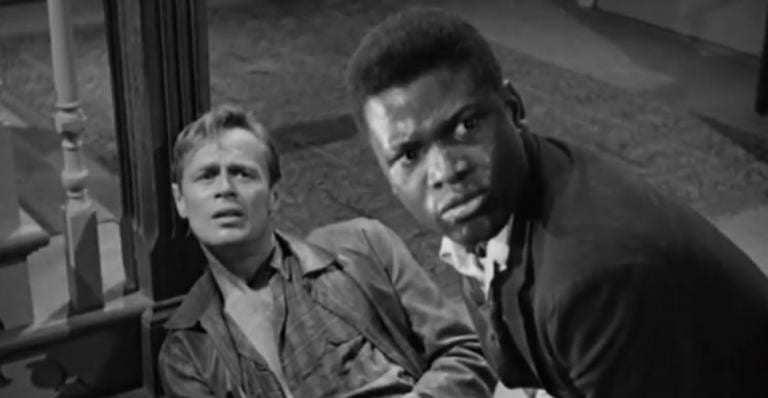
It’s an interesting film. Poitier gets fourth billing or something like that, but he’s actually the main character: a young doctor at the beginning of his career (Poitier was 23 when the film came out) who is accused of murdering a white patient by the patient’s super-racist brother. Absolutely nobody at the hospital believes the racist — they all accept Poitier’s claim that the patient died from a pre-existing condition — but Poitier wonders if he might have made the wrong diagnosis because he was reacting to the brother’s racism subconsciously, and he wants to perform an autopsy to prove to everyone, including himself, that he made the right call. But Poitier can’t perform an autopsy without the family’s permission, and in this case “family” means the patient’s racist brother, who rejects the autopsy while promising to whip up the equivalent of a lynch mob.
(I can’t recall if the film ever specifies which city it is set in, but I assume it couldn’t have been in the South if a black doctor is so easily accepted at a non-black hospital. And that’s one of the interesting things about the film: how there is no racism at all among the hospital staff, which seems a bit idealized — the doctors care only about science and whether a doctor can get the job done! — although one of the administrators does express concern about the effects that a racially-charged controversy might have on his fundraising efforts. And there’s a black elevator operator who assumes that Poitier has been subjected to more racism than he lets on, and who whips up a mob of his own — against Poitier’s protests — when he hears what the patient’s racist brother is planning.)
As always, I’m curious to know what sort of reception this film got back in the day. In a video that accompanies the Criterion series, a film critic compares Poitier’s significance as a movie star to that of Jackie Robinson as a baseball star; Robinson became the first black baseball player to play for a Major League Baseball team in 1947, just three years before this movie came out. (And then Robinson played himself in The Jackie Robinson Story, which came out in 1950, the same year as No Way Out.) No Way Out was also produced by 20th Century Fox, which had tackled anti-Semitism in Gentleman’s Agreement, which also came out in 1947; so a film that addressed this other form of racism would seem to have been very much on-brand for that studio at that time.
I’m not very familiar with Poitier’s ouevre, but I have seen the three classics that he made in 1967 — In the Heat of the Night, Guess Who’s Coming to Dinner and To Sir with Love (I watched that last film many times when I was a kid; it was one of the first movies my dad taped on our big bulky VCR in the late 1970s) — and Poitier has always seemed so authoritative to me that it’s kind of bracing to see how much verbal abuse he has to endure in this 1950 film. He’s still very much in turn-the-other-cheek mode; neither he nor the wider culture have quite gotten to the point yet where he can slap a man back (as he very famously does in In the Heat of the Night). But seeing how he gets from Point A to Point B is one of the reasons I’m interested in going through his filmography. The question now is how far I’ll get over the next not-quite-four weeks…
–
Sidney Poitier marathon part 2 (1951-1954):
Following his debut in No Way Out, where he basically played the central character even if he only got fourth billing, Poitier went on to play supporting roles in a handful of films that offer an interesting window onto mid-20th-century history.
Cry, the Beloved Country (1951) is one of the few Poitier films that I had already seen, and I owe my familiarity with the film to two things: One, my father — who grew up in Zambia and was deported from South Africa after taking part in some anti-apartheid protests as a university student — loved the film and taped it off TV when I was a kid; and two, I watched this film (and read the 1948 novel on which it is based) as research before writing my review of the remake in 1995.
Cry is the first film in the Criterion Channel’s Poitier collection, but Poitier himself doesn’t make much of an impression in it. The film’s central character is an old black priest from the country who travels to the big city, Johannesburg, to find his sister and his son — and who discovers, among other things, that his sister has turned to prostitution and his son has murdered a white racial-justice activist who happened to be the son of a rich white man from their village. (The novel was published several months before apartheid became the law of the land, and the movie was made just a few years later, so apartheid is very much a part of the film’s subtext even if it is not part of the text, per se.) Poitier plays a priest from the city who helps the country priest find his way around, and there’s not much more to his role than that. (When the script calls for a black priest to protest the division that exists even between white and black priests, it is another character, not Poitier’s, who makes this point.)
Poitier has an even smaller role in Red Ball Express (1952), which is all about the truck convoys that brought supplies to the Allied troops in France after D-Day (which was only eight years before the movie was made!). Wikipedia says the real-life Red Ball Express was about 75% African-American, but the convoy we see in this film is a lot whiter than that. Still, there are three black characters of note, and it’s particularly interesting — given Poitier’s reputation later on for playing perfect, flawless characters who made white audiences feel safe — that Poitier plays the one black character who has a significant chip on his shoulder: he gets into fights with a white soldier who jokes about “minstrel shows”, and he asks to be transferred from his unit because he assumes that the main reason his lieutenant doesn’t want to chat with him on their long drives through France is because the lieutenant is racist. (“He outranks us the way we’ve been outranked all our lives,” says Poitier to the other black troops at one point.) It’s the other black soldiers who get along well with their white comrades, and who lead them in song as they load and unload the trucks, etc.
And then there is Go Man Go (1954), a film about the origins of the Harlem Globetrotters, which focuses primarily on Jewish team manager Abe Saperstein but also includes Poitier as basketball player Inman Jackson, who, according to one online encyclopedia I found, was “second only to Abe Saperstein in creating the phenomenon known as the Harlem Globetrotters.” Poitier’s Jackson isn’t the player we see walking side-by-side with Saperstein at the very end of the film, though! (Inman’s wife Irma is played by Ruby Dee, who had previously appeared with Poitier in No Way Out and had also played Jackie Robinson’s wife in The Jackie Robinson Story, both in 1950.)
Go Man Go might be the first Poitier film in which race is not a significant theme, or at any rate is not addressed directly in the dialogue. The film is also noteworthy for being directed by legendary Chinese-American cinematographer James Wong Howe; indeed, it may be the only non-documentary feature on which Wong Howe had the sole directorial credit. And the fact that he did direct documentaries is reflected, I think, in the basketball-game scenes, which look almost like newsreel footage (and for all I know might be newsreel footage; I do know that some of the Globetrotters played themselves in this film).
Anyway. Red Ball Express and Go Man Go are not on the Criterion Channel, but they sounded interesting enough that I looked them up online. I can’t promise I’ll be this exhaustive with the rest of Poitier’s filmography, though! (Poitier also appeared in a few TV shows during this period, but I certainly have no intention of tracking those down.)
–
The image at the top of this post shows Richard Widmark and Sidney Poitier in No Way Out*.*
Previous Post

January 23, 2021
Magdala looks at the last days of Mary Magdalene

Browse Our Archives
Select a Category Anglican Planet Articles BC Christian News BC Report Bible Movies Bible Review Blog Books & Culture Campus Times CBC Radio Christianity Today ChristianWeek Essays Faith Today Festival Cinemas Guide Film Journals Georgia Straight Interviews MB Herald National Catholic Register Salvationist Today's Christian Two Chairs Ubyssey Uncategorized Vancouver Courier Vancouver Sun
Select a Month August 2025 April 2025 January 2025 December 2024 November 2024 May 2024 February 2024 December 2023 May 2023 March 2023 November 2022 July 2022 June 2022 May 2022 April 2022 February 2022 January 2022 December 2021 November 2021 October 2021 September 2021 August 2021 July 2021 June 2021 April 2021 March 2021 February 2021 January 2021 December 2020 November 2020 October 2020 August 2020 July 2020 June 2020 May 2020 March 2020 February 2020 January 2020 December 2019 November 2019 September 2019 July 2019 May 2019 April 2019 March 2019 February 2019 January 2019 December 2018 November 2018 October 2018 September 2018 July 2018 June 2018 May 2018 April 2018 March 2018 February 2018 January 2018 December 2017 November 2017 October 2017 September 2017 August 2017 July 2017 June 2017 May 2017 April 2017 March 2017 February 2017 January 2017 December 2016 November 2016 October 2016 September 2016 August 2016 July 2016 June 2016 May 2016 April 2016 March 2016 February 2016 January 2016 December 2015 November 2015 October 2015 September 2015 August 2015 July 2015 June 2015 May 2015 April 2015 March 2015 February 2015 January 2015 December 2014 November 2014 October 2014 September 2014 August 2014 July 2014 June 2014 May 2014 April 2014 March 2014 February 2014 January 2014 December 2013 November 2013 October 2013 September 2013 August 2013 July 2013 June 2013 May 2013 April 2013 March 2013 February 2013 January 2013 December 2012 November 2012 October 2012 September 2012 August 2012 July 2012 June 2012 April 2012 January 2012 January 2011 December 2010 November 2010 October 2010 September 2010 August 2010 July 2010 June 2010 May 2010 April 2010 March 2010 February 2010 January 2010 December 2009 November 2009 October 2009 September 2009 August 2009 July 2009 June 2009 May 2009 April 2009 March 2009 February 2009 January 2009 December 2008 November 2008 October 2008 September 2008 August 2008 July 2008 June 2008 May 2008 April 2008 March 2008 February 2008 January 2008 December 2007 November 2007 October 2007 September 2007 August 2007 July 2007 June 2007 May 2007 April 2007 March 2007 February 2007 January 2007 December 2006 November 2006 October 2006 September 2006 August 2006 July 2006 June 2006 May 2006 April 2006 March 2006 February 2006 January 2006 December 2005 November 2005 October 2005 September 2005 August 2005 July 2005 June 2005 May 2005 April 2005 March 2005 January 2005 December 2004 November 2004 October 2004 September 2004 August 2004 July 2004 June 2004 May 2004 April 2004 March 2004 February 2004 January 2004 November 2003 October 2003 August 2003 July 2003 June 2003 May 2003 January 2003 December 2002 November 2002 August 2002 July 2002 June 2002 May 2002 March 2002 January 2002 December 2001 November 2001 September 2001 August 2001 July 2001 June 2001 April 2001 March 2001 February 2001 December 2000 November 2000 October 2000 September 2000 August 2000 July 2000 June 2000 May 2000 April 2000 March 2000 January 2000 October 1999 August 1999 May 1999 April 1999 February 1999 January 1999 December 1998 November 1998 October 1998 August 1998 July 1998 June 1998 April 1998 March 1998 January 1998 November 1997 September 1997 July 1997 June 1997 April 1997 March 1997 February 1997 January 1997 December 1996 October 1996 September 1996 June 1996 March 1996 February 1996 January 1996 April 1995 November 1994 September 1994 September 1991
Follow Us!
TAKE THE
Religious Wisdom Quiz
What does "Selah," found often in Psalms, likely mean?
Select your answer to see how you score.
Give thanks Pause or reflect Sing loudly Forever
Related posts from FilmChat

Joseph of Egypt – the Chosen spin-off announces...

Exclusive: A clip from Angel Studios' The King...

Exclusive: Watch a clip from Angel Studios' Brave...

Exclusive: Watch a clip from Angel Studios' Homestead
TRENDING AT PATHEOS Religious Music & Entertainment

"Les Diabolique" and Transgression
Alongside something like Arrival, Vertigo, or Charade, Les Diaboliques is a...

"The Plague Dogs" and Mortality
So, flashback to the late 70s, early 80s. Walt Disney Studios is...

With the recent and highly successful release of Christopher Nolan’s epic film,...

"L'avventura" and Human Weakness
Today's piece is going to be a little different for a few...

I first want to apologize for not posting or writing anything. I'm...

I've engaged in the multi-year project of reading through the Church Fathers,...
view all Religious Music & Entertainment blogs
Ad-Free & Subscriber Log-In Subscription Support
- About Us
- 2026 Calendar
- Videos
- Podcasts
- Library of World Religions
- Faith In Media Tracker
- Advertise With Us
- Write for Us
- Privacy Policy
- Terms of Service
- Do Not Sell My Data
- Contact Us
- Radiant Digital
- Manage Newsletter Subscriptions
- Unsubscribe From Notifications
- Sitemap
Copyright 2008-2026, Patheos. All rights reserved.
Subscription Support Ad-Free & Subscriber Log-In
Follow Patheos