
BuddhistCatholicContemplativeEvangelicalGeneral ChristianHinduJewishLatter-day SaintMuslimNew VisionsProgressive Christian
Beliefs
- Buddhist
- Catholic
- Contemplative
- Evangelical
- General Christian
- Hindu
- Jewish
- Latter-day Saint
- More Voices
- Muslim
- New Visions
- Pagan
- Progressive Christian
Topics
- Religion News
- Food and Religion
- Sports and Religion
- Religious Art
- Religious Music and Entertainment
- Religious Events
- History and Religion
- Style and Religion
- Politics and Religion
- Women in Religion
- Recreation Outdoors and Religion
- Business Finance and Religion
- Careers Workplace and Religion
- Education and Religion
- Family Parenting and Religion
- Health Fitness and Religion
- Home and Religion
- Relationships and Religion
- Technology and Religion
- Travel and Religion
Columnists
- Buddhist Columnists
- Business Finance and Religion Columnists
- Careers Workplace and Religion Columnists
- Catholic Columnists
- Contemplative Columnists
- Education and Religion Columnists
- Evangelists Columnists
- Family Parenting and Religion Columnists
- General Christian Columnists
- Health Fitness and Religion Columnists
- Hindu Columnists
- History and Religion Columnists
- Home and Religion Columnists
- Jewish Columnists
- More Voices Columnists
- Latter Day Columnists
- Muslim Columnists
- New Visions Columnists
- Nonreligious Columnists
- Pagan Columnists
- Politics and Religion Columnists
- Progressive Columnists
- Recreation Outdoors and Religion Columnists
- Relationships and Religion Columnists
- Religion News Columnists
- Religious Art Columnists
- Religious Events Columnists
- Religious Music and Entertainment Columnists
- Sports and Religion Columnists
- Style and Religion Columnists
- Technology and Religion Columnists
- Travel and Religion Columnists
- Women in Religion Columnists
Resource Library
- 2026 Calendar
- Library of World Religions
- The 100 Most Holy Places on Earth
- Patheos Answers
- Podcasts
- Videos
- Faith Leaders Database
- Anglican Episcopalian
- Bahai
- Baptist
- Buddhism
- Christianity
- Confucianism
- Eastern Orthodoxy
- Hinduism
- Holiness and Pentecostal
- ISKCON
- Islam
- Judaism
- Lutheran
- Methodist
- The Church of Jesus Christ of Latter-day Saints
- New Age
- Paganism
- Presbytarian and Reformed
- Protestantism
- Religion Behind the Scenes
- Roman Catholic
- Scientology
- Shia Islam
- Sikhism
- Sufism
- Sunni Islam
- Taoism
- Zen
- See all religions
Research Tools
 Ad-Free & Subscriber Log-In Subscription Support
Ad-Free & Subscriber Log-In Subscription Support
Follow Patheos 

- Trending:
- Forgiveness
- |
- Marriage
- |
- Consciousness
- |
- Death Penalty
- |
- Election
- |
- Halloween

-
Articles
- Home
- Religious Music & Entertainment
- Sidney Poitier marathon: Mandela and De Klerk (1997) – The Jackal (1997)
Sidney Poitier marathon: Mandela and De Klerk (1997) – The Jackal (1997)
Last updated on: February 26, 2021 at 5:00 am by Peter T. Chattaway
Sidney Poitier marathon: Mandela and De Klerk (1997) – The Jackal (1997) 2021-02-19T12:00:41-08:00 Peter T. Chattaway
Patheos Explore the world's faith through different perspectives on religion and spirituality! Patheos has the views of the prevalent religions and spiritualities of the world.
The last in a month-long series of re-posts from my Facebook marathon in April 2020.
–
Sidney Poitier marathon part 22 (1997):
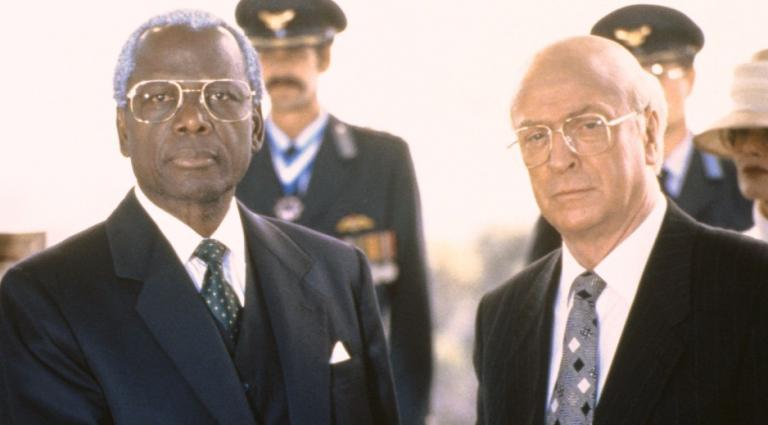
Mandela and De Klerk (1997) wasn’t quite the first TV-movie about Nelson Mandela, but it was, I believe, the first one to be made after he was released from prison in 1990.
Danny Glover had starred in a 1987 TV-movie called Mandela, but, at that time, there had been no new public images of Mandela himself since his imprisonment in the early 1960s. So Poitier was the first actor to play Mandela after the public had gotten a chance to familiarize itself with the way Mandela looked and spoke “today” — and Poitier took the role mere months after Mandela was elected president of South Africa in 1994.
The two-hour film spans the 30-plus years from Mandela’s imprisonment to his eventual election, but it compresses the bulk of that period into the first half of its runtime so it can devote the second half to the years immediately before and after Mandela’s release. And there’s an interesting shift in the movie’s tone between those two halves.
For the first hour, Mandela adjusts to life in prison and is treated fairly well by the guards etc., while politician F. W. De Klerk (played by Michael Caine) kind of admires him from afar and quietly opposes the more draconian measures inflicted on the populace by President Botha. But once De Klerk becomes president himself and begins to negotiate with Mandela on how to end apartheid and set him free, things grow tense.
As in most movies of this sort, the main focus is on the dialogue, as characters lay out the various political issues that are at stake. It feels a bit like a history lesson cobbled together from newspaper editorials and the like. (The repeated use of archival news footage contributes to this feeling.) But Poitier and Caine deliver the dialogue as well as can be expected.
As they say, journalism is the first draft of history, and, while this movie isn’t a work of journalism per se, it makes sense that this early attempt to dramatize the end of apartheid feels more like a journalistic summary of recent events than the deeper plunge that could have come from having more of a perspective on this moment in history.
A few other quick points:
— This was the third time Poitier played a contemporary real-life person, following his portrayals of Inman Jackson in 1954’s Go Man Go and Thurgood Marshall in 1991’s Separate but Equal.
— This was also the third time Poitier played a South African, following 1951’s Cry, the Beloved Country, in which he played a priest, and 1975’s The Wilby Conspiracy, in which he played a revolutionary. (Cry, the Beloved Country was based on a book that came out shortly before apartheid began in 1948, so you could say that Poitier starred in films that take place before, during, and after that period in South African history.) He also played a Kenyan revolutionary in 1957’s Something of Value, and a political leader in an unspecified African country in 1957’s The Mark of the Hawk.
— This might be the first film in which Poitier played older than his actual age. The second half of the film takes place when Mandela is in his 70s — he was 71 when he was released from prison and 76 when he was elected president — and Poitier was 69 when the film was shot. (Reportedly Poitier lied about his age when auditioning for the part of the young doctor in 1950’s No Way Out; he was 23 at the time, but I don’t believe the doctor’s age is specified within the film.)
— Earlier Poitier films, like 1973’s A Warm December and 1975’s The Wilby Conspiracy, underlined the Marxist and/or Soviet element in revolutionary and post-colonial African movements. This film makes a point of noting that the South African government thought the Western countries would tolerate South Africa’s policies if South Africa was an ally in the fight against Communism — and the film hints that apartheid finally ended because the Cold War ended. Without the Soviet threat, the South African government could no longer use anti-Communism to justify its treatment of Mandela and his movement.
— The real-life Mandela was president of South Africa from 1994 to 1999. Curiously, this appears to have been the only major film about him made during that time. But there were several films about him afterwards, most notably between 2009 and 2013, when he and his wife Winnie were the subject of no fewer than six films starring the likes of Morgan Freeman (2009’s Invictus), David Harewood (2010’s Mrs Mandela), Terrence Howard (2011’s Winnie Mandela), Idris Elba (2013’s Mandela: Long Walk to Freedom) and Clarke Peters (2009’s Endgame and 2013’s Mandela: The Prison Years). Other actors who have played Mandela include Lindane Nkosi (2004’s Drum), Dennis Haysbert (2007’s Goodbye Bafana) and Laurence Fishburne (2017’s Madiba).
— Reunions: Poitier and Caine previously co-starred in 1975’s The Wilby Conspiracy, which was also set in South Africa. Also, this film was directed by Joseph Sargent, who had been the original director on 1972’s Buck and the Preacher before Poitier replaced him. (This film also marked the third time that Caine and Sargent worked together, following 1987’s Jaws: The Revenge and 1994’s World War II: When Lions Roared, in which Caine played Josef Stalin!)
After this, Poitier made one last appearance on the big screen.
The Jackal (1997) is a very loose remake of 1973’s The Day of the Jackal, in which Bruce Willis is hired by some Russian mafia guys to assassinate an American, and Richard Gere is a prisoner with ties to the IRA who once met Willis and is hired by the FBI to help track Willis down.
Poitier plays the FBI deputy director who gets Gere involved, and there’s not much more to his role than that. Poitier got his career off to a great start as the central figure in 1950’s No Way Out — an unusually strong role for a big-screen debut — but his big-screen career ended with this virtually anonymous paycheque gig. He still had a few TV-movies in his future, but that was it.
A few other quick points:
— This might be the first Poitier film since 1965’s The Greatest Story Ever Told that did not put his face on the movie poster. And he had only a cameo in that other film.
— Time capsule, politics edition: The opening credits play out over a montage that covers the rise and fall of the Soviet Union. The film also came out three years after the IRA ceasefire in 1994. And Poitier’s character comments that a female Russian colleague of his is so good at what she does that she ends the debate on women in combat, as far as he’s concerned; this film came out just one year before 1998’s G.I. Jane, which also reflected the debate around that issue.
— Time capsule, technology edition: Willis tells the guy who hired him not to communicate with him by phone or fax. He later visits an internet cafe (remember those?) and uses its dial-up modem to check his messages. He later buys a boat, and the salesman notes that the boat “even has a cellular phone. You can call your wife if you want to!” I got my own first cell phone in 1999, two years after the movie came out, and before most of my friends had gotten one.
— One scene focuses on the fact that security at the Canadian-American border is very lax. One agent says something like, “You don’t need a Houdini to get into Canada, he could probably walk in!” As I recall, the first time border agents started insisting on seeing my passport when I made short trips south of the border was after 9/11 happened, four years after this movie came out.
— Up-and-coming actors: J.K. Simmons plays an FBI agent, Jack Black plays a black-market merchant of sorts who is killed rather gruesomely after he tries to extort some extra money out of Willis, Daniel Dae Kim plays a sniper, and Sophie Okonedo plays an anonymous “Jamaican Girl”.
— This time in LGBT references: Willis meets a guy at a gay bar, kisses him (which was unusual for a star of Willis’s stature at the time), and uses his home as a base of sorts, after killing him.
— As in 1988’s Shoot to Kill, so here: Poitier plays an FBI man who pursues a criminal on both sides of the Canadian-American border — this time on the east coast, rather than the west.
— I happened to visit Montreal and Washington, DC for the first time just a month or two before this film came out, so I was kind of tickled to see that the story itself straddles those two cities. Even better, I remember really, really liking the Washington subway stations when I visited that city, and the film’s final chase scene takes place there. (Poitier, alas, does not play a part in that scene. If he had, it might have been a nice callback to the chase through an unfinished San Francisco station in 1971’s The Organization.)
— The gaps between Poitier’s final feature films were fairly long. After the one-two comeback punch of Shoot to Kill and Little Nikita in 1988, the next big-screen Poitier film, 1992’s Sneakers, did not come out until four and a half years later. Another five years passed before Poitier made The Jackal, which turned out to be his final big-screen film.
–
And that was the end of my Sidney Poitier marathon in April 2020.
Poitier starred in four more films, all for television — Free of Eden (1998), David and Lisa (1998), The Simple Life of Noah Dearborn (1999) and The Last Brickmaker in America (2001) — but I could not find three of them anywhere online, so, since I hadn’t checked out any of Poitier’s TV work in the 1950s either, I figured I would let the marathon end with his final feature film.
Poitier went on to receive an Honorary Oscar in 2002 — and that, coincidentally, happened to be the same year that Denzel Washington followed in Poitier’s footsteps by becoming the second black man to win the Oscar for lead actor (for Training Day*), and it was also the same year that Halle Berry became the first black woman to win the Oscar for lead actress (for* Monster’s Ball*).*
Poitier made history in his half-century on the big screen. And history continues to be made.
–
The image above shows Sidney Poitier and Michael Caine in Mandela and De Klerk*.*

Next Post

March 17, 2021 The Chosen announces its Season 2 release plans
Browse Our Archives
Select a Category Anglican Planet Articles BC Christian News BC Report Bible Movies Bible Review Blog Books & Culture Campus Times CBC Radio Christianity Today ChristianWeek Essays Faith Today Festival Cinemas Guide Film Journals Georgia Straight Interviews MB Herald National Catholic Register Salvationist Today's Christian Two Chairs Ubyssey Uncategorized Vancouver Courier Vancouver Sun
Select a Month August 2025 April 2025 January 2025 December 2024 November 2024 May 2024 February 2024 December 2023 May 2023 March 2023 November 2022 July 2022 June 2022 May 2022 April 2022 February 2022 January 2022 December 2021 November 2021 October 2021 September 2021 August 2021 July 2021 June 2021 April 2021 March 2021 February 2021 January 2021 December 2020 November 2020 October 2020 August 2020 July 2020 June 2020 May 2020 March 2020 February 2020 January 2020 December 2019 November 2019 September 2019 July 2019 May 2019 April 2019 March 2019 February 2019 January 2019 December 2018 November 2018 October 2018 September 2018 July 2018 June 2018 May 2018 April 2018 March 2018 February 2018 January 2018 December 2017 November 2017 October 2017 September 2017 August 2017 July 2017 June 2017 May 2017 April 2017 March 2017 February 2017 January 2017 December 2016 November 2016 October 2016 September 2016 August 2016 July 2016 June 2016 May 2016 April 2016 March 2016 February 2016 January 2016 December 2015 November 2015 October 2015 September 2015 August 2015 July 2015 June 2015 May 2015 April 2015 March 2015 February 2015 January 2015 December 2014 November 2014 October 2014 September 2014 August 2014 July 2014 June 2014 May 2014 April 2014 March 2014 February 2014 January 2014 December 2013 November 2013 October 2013 September 2013 August 2013 July 2013 June 2013 May 2013 April 2013 March 2013 February 2013 January 2013 December 2012 November 2012 October 2012 September 2012 August 2012 July 2012 June 2012 April 2012 January 2012 January 2011 December 2010 November 2010 October 2010 September 2010 August 2010 July 2010 June 2010 May 2010 April 2010 March 2010 February 2010 January 2010 December 2009 November 2009 October 2009 September 2009 August 2009 July 2009 June 2009 May 2009 April 2009 March 2009 February 2009 January 2009 December 2008 November 2008 October 2008 September 2008 August 2008 July 2008 June 2008 May 2008 April 2008 March 2008 February 2008 January 2008 December 2007 November 2007 October 2007 September 2007 August 2007 July 2007 June 2007 May 2007 April 2007 March 2007 February 2007 January 2007 December 2006 November 2006 October 2006 September 2006 August 2006 July 2006 June 2006 May 2006 April 2006 March 2006 February 2006 January 2006 December 2005 November 2005 October 2005 September 2005 August 2005 July 2005 June 2005 May 2005 April 2005 March 2005 January 2005 December 2004 November 2004 October 2004 September 2004 August 2004 July 2004 June 2004 May 2004 April 2004 March 2004 February 2004 January 2004 November 2003 October 2003 August 2003 July 2003 June 2003 May 2003 January 2003 December 2002 November 2002 August 2002 July 2002 June 2002 May 2002 March 2002 January 2002 December 2001 November 2001 September 2001 August 2001 July 2001 June 2001 April 2001 March 2001 February 2001 December 2000 November 2000 October 2000 September 2000 August 2000 July 2000 June 2000 May 2000 April 2000 March 2000 January 2000 October 1999 August 1999 May 1999 April 1999 February 1999 January 1999 December 1998 November 1998 October 1998 August 1998 July 1998 June 1998 April 1998 March 1998 January 1998 November 1997 September 1997 July 1997 June 1997 April 1997 March 1997 February 1997 January 1997 December 1996 October 1996 September 1996 June 1996 March 1996 February 1996 January 1996 April 1995 November 1994 September 1994 September 1991
Follow Us!
TAKE THE
Religious Wisdom Quiz
Which prophet confronted David about his sin with Bathsheba?
Select your answer to see how you score.
Nathan Abiathar Samuel Gad
Related posts from FilmChat

Joseph of Egypt – the Chosen spin-off announces...

Exclusive: A clip from Angel Studios' The King...

Exclusive: Watch a clip from Angel Studios' Brave...

Exclusive: Watch a clip from Angel Studios' Homestead
TRENDING AT PATHEOS Religious Music & Entertainment

"Les Diabolique" and Transgression
Alongside something like Arrival, Vertigo, or Charade, Les Diaboliques is a...

"The Plague Dogs" and Mortality
So, flashback to the late 70s, early 80s. Walt Disney Studios is...

With the recent and highly successful release of Christopher Nolan’s epic film,...

"L'avventura" and Human Weakness
Today's piece is going to be a little different for a few...

I first want to apologize for not posting or writing anything. I'm...

I've engaged in the multi-year project of reading through the Church Fathers,...
view all Religious Music & Entertainment blogs
Ad-Free & Subscriber Log-In Subscription Support
- About Us
- 2026 Calendar
- Videos
- Podcasts
- Library of World Religions
- Faith In Media Tracker
- Advertise With Us
- Write for Us
- Privacy Policy
- Terms of Service
- Do Not Sell My Data
- Contact Us
- Radiant Digital
- Manage Newsletter Subscriptions
- Unsubscribe From Notifications
- Sitemap
Copyright 2008-2026, Patheos. All rights reserved.
Subscription Support Ad-Free & Subscriber Log-In
Follow Patheos