
BuddhistCatholicContemplativeEvangelicalGeneral ChristianHinduJewishLatter-day SaintMuslimNew VisionsProgressive Christian
Beliefs
- Buddhist
- Catholic
- Contemplative
- Evangelical
- General Christian
- Hindu
- Jewish
- Latter-day Saint
- More Voices
- Muslim
- New Visions
- Pagan
- Progressive Christian
Topics
- Religion News
- Food and Religion
- Sports and Religion
- Religious Art
- Religious Music and Entertainment
- Religious Events
- History and Religion
- Style and Religion
- Politics and Religion
- Women in Religion
- Recreation Outdoors and Religion
- Business Finance and Religion
- Careers Workplace and Religion
- Education and Religion
- Family Parenting and Religion
- Health Fitness and Religion
- Home and Religion
- Relationships and Religion
- Technology and Religion
- Travel and Religion
Columnists
- Buddhist Columnists
- Business Finance and Religion Columnists
- Careers Workplace and Religion Columnists
- Catholic Columnists
- Contemplative Columnists
- Education and Religion Columnists
- Evangelists Columnists
- Family Parenting and Religion Columnists
- General Christian Columnists
- Health Fitness and Religion Columnists
- Hindu Columnists
- History and Religion Columnists
- Home and Religion Columnists
- Jewish Columnists
- More Voices Columnists
- Latter Day Columnists
- Muslim Columnists
- New Visions Columnists
- Nonreligious Columnists
- Pagan Columnists
- Politics and Religion Columnists
- Progressive Columnists
- Recreation Outdoors and Religion Columnists
- Relationships and Religion Columnists
- Religion News Columnists
- Religious Art Columnists
- Religious Events Columnists
- Religious Music and Entertainment Columnists
- Sports and Religion Columnists
- Style and Religion Columnists
- Technology and Religion Columnists
- Travel and Religion Columnists
- Women in Religion Columnists
Resource Library
- 2026 Calendar
- Library of World Religions
- The 100 Most Holy Places on Earth
- Patheos Answers
- Podcasts
- Videos
- Faith Leaders Database
- Anglican Episcopalian
- Bahai
- Baptist
- Buddhism
- Christianity
- Confucianism
- Eastern Orthodoxy
- Hinduism
- Holiness and Pentecostal
- ISKCON
- Islam
- Judaism
- Lutheran
- Methodist
- The Church of Jesus Christ of Latter-day Saints
- New Age
- Paganism
- Presbytarian and Reformed
- Protestantism
- Religion Behind the Scenes
- Roman Catholic
- Scientology
- Shia Islam
- Sikhism
- Sufism
- Sunni Islam
- Taoism
- Zen
- See all religions
Research Tools
 Ad-Free & Subscriber Log-In Subscription Support
Ad-Free & Subscriber Log-In Subscription Support
Follow Patheos 

- Trending:
- Forgiveness
- |
- Marriage
- |
- Consciousness
- |
- Death Penalty
- |
- Election
- |
- Halloween

-
Articles
- Home
- Religious Music & Entertainment
- Sidney Poitier marathon: In the Heat of the Night (1967) – They Call Me Mister Tibbs! (1970) – The Organization (1971)
Sidney Poitier marathon: In the Heat of the Night (1967) – They Call Me Mister Tibbs! (1970) – The Organization (1971)
Last updated on: February 11, 2021 at 5:00 am by Peter T. Chattaway
Sidney Poitier marathon: In the Heat of the Night (1967) – They Call Me Mister Tibbs! (1970) – The Organization (1971) 2021-02-06T07:48:53-08:00 Peter T. Chattaway
Patheos Explore the world's faith through different perspectives on religion and spirituality! Patheos has the views of the prevalent religions and spiritualities of the world.
The latest in a month-long series of re-posts from my Facebook marathon in April 2020.
–
Sidney Poitier marathon part 12 (1967b + 1970 + 1971b):
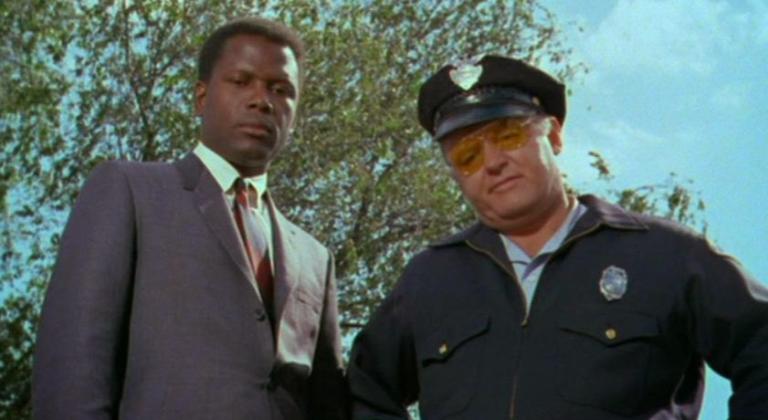
In the Heat of the Night (1967) plays like a fusion of the social-commentary movies that Sidney Poitier made earlier in his career and the more straightforward genre movies that he began to focus on in the mid-1960s. On the one hand, it’s a police procedural and a murder mystery — but it uses the trappings of those genres to explore race relations in the United States. And it tosses in a few other issues, besides.
Poitier plays a Philadelphia cop who happens to be between trains at a small-town Mississippi station when a local cop — not knowing that he and Poitier are in the same profession — accuses him of killing a white man and takes him in to the local police station. (Poitier is black and an outsider, and therefore, from the local cop’s point of view, the perfect scapegoat.)
Fortunately, it doesn’t take long for the police chief (a gum-chewing Rod Steiger) to acknowledge that Poitier isn’t the man they’re looking for, and the chief ends up putting his own bigotry aside, sort of, when he realizes that Poitier is not only a cop but a homicide expert who can help him with the case.
Once again, Poitier is called upon to play a character who challenges racism partly by being so perfect, so dignified, so flawless at what he does, that the only way someone could have a problem with him is if that someone really is a racist. But Poitier’s character has an inner life, too, and part of the genius of Poitier’s performance is that he never lets you forget that his character is outraged and seething with resentment at the way he has been treated, no matter how well he suppresses those emotions.
For example, Poitier is initially reluctant to help Steiger and the others when his chief in Philadelphia tells him, over the phone, to do so. (We don’t hear the chief’s side of the phone conversation, but there’s an amusing bit where Poitier, still resisting his orders, says, “No sir, I’m not prejudiced…”)
And of course, there’s the famous moment where a rich white man slaps Poitier across the face for asking him if he has an alibi, and Poitier slaps the man right back. (The second slap was Poitier’s idea, and he says he refused to be in the movie if his character couldn’t slap the guy back. Poitier says he intended this not as a social comment but as a reflection of the character’s humanity; it was how the cop would have reacted to anyone who treated him that way.)
Interestingly, the Poitier character’s detachment from the Mississippi setting extends to the local black people, too. The scene where he and Steiger drive through a cotton field underscores how Poitier, a northerner, has never had to think about living that kind of life (shades of a similar scene in 2018’s Green Book); and in another scene, Steiger tells Poitier the local black people could suffer economically if the murder isn’t solved (the murder victim was going to build a factory there), and when Steiger says, “They’re your people,” Poitier replies, “Not mine, yours! You made this scene!”
But the Poitier character does take advantage of his racial background when it is helpful to the case. It turns out that, as a black man, he can go “where whitey ain’t allowed” and speak to the black people there — and so he gets results that Steiger and the others can’t, or wouldn’t think to get.
The movie cycles through a few suspects before revealing who the actual killer was, and it turns out not to be a particularly big reveal — but that’s because this film is far more interested in its social milieu than it is in the plot, per se. Presumably a modern screenwriter would feel the need to throw in a big twist or something, and to make the movie’s Big Statement hinge on that, but the film is better off without that kind of gimmick.
A few other quick points:
— The Steiger character comes to appreciate the Poitier character over the course of the movie, but he doesn’t follow a completely linear redemptive trajectory. Late in the film, when Steiger and Poitier begin to bond over the fact that neither of them ever got married, Steiger suddenly feels that Poitier is beginning to “pity” him, and he reacts by throwing a racist slur Poitier’s way. Change doesn’t happen overnight, and it might never be complete, but you work with what you can.
— Director Norman Jewison and cinematographer Haskell Wexler underscore the racial aspects of the story quite cinematically when, e.g., Poitier examines the body of the murder victim, and we see his skin probing the victim’s skin, his hands removing the victim’s shoes, etc.
— Racism isn’t the only social issue that comes up in this film: It turns out the plot was motivated by someone’s need to get money for an abortion. Wikipedia says Mississippi made abortion legal in cases of rape in 1966, one year before the film came out. The pregnant woman in the film is only 16 years old, and one of the other characters says that the man who impregnated her committed “statutory rape” — but the age of consent in Mississippi is 16 nowadays, so when did it change? Or was it actually 16 back then, and the film got its facts wrong?
— I’ve been wondering when Poitier’s films would begin to reflect the loosening of the Production Code when it came to sex, violence, language and so on. This film edges in that direction when one of the cops drives past a house to spy on the naked teenaged girl within — though the truly naughty bits are obscured by the window frame. (The teenaged character is 16, but the actress who plays her turned 23 the year the film came out.)
— There has been much talk about the fact that In the Heat of the Night was a film about a black protagonist made by a white director (in the bonus features, John Singleton says Norman Jewison is “three for three” as far as he’s concerned, his other successful black-protagonist films being 1984’s A Soldier’s Story and 1999’s The Hurricane). I find myself thinking that it was also a movie about American racism in the deep south made by a Canadian. Which, in turn, gets me thinking about how 1961’s A Raisin in the Sun was also directed by a Canadian.
— Reunions: One of the local racists is played by William Schallert, who previously played a Union Army officer in 1957’s Band of Angels. (You might not know his name, but you’d recognize him if you saw him; among other things, he played an annoying administrator in Star Trek’s ‘The Trouble with Tribbles’ the same year this movie came out.) This is also the second of six Poitier films to be scored by Quincy Jones, following 1965’s The Slender Thread.
— Four Poitier films were nominated for best picture; this is the only one that won. (The others were: 1958’s The Defiant Ones, which lost to Gigi; 1963’s Lilies of the Field, which lost to Tom Jones; and 1967’s Guess Who’s Coming to Dinner, which lost to In the Heat of the Night.)
— In the Heat of the Night also won Oscars for film editing (Hal Ashby!), sound, screenplay and best actor (Rod Steiger). It was also nominated for best director and sound effects but lost in those categories to The Graduate (Mike Nichols) and The Dirty Dozen, respectively.
The ceremony where In the Heat of the Night won best picture was originally scheduled for April 8, 1968, but alas, it had to be postponed after Martin Luther King, Jr was assassinated a few days earlier. So the ceremony that honoured a film about civil-rights issues was overshadowed by one of the darkest moments of the civil-rights era.
It has been said that Poitier’s movie-star status began to fade after MLK’s death, too, as black Americans turned to heroes who embodied their frustrations, gave them catharsis, and were generally perceived as more “dangerous” than Poitier’s characters had been.
This shift in the culture would soon be reflected in the blaxploitation films of the early 1970s, which revolved around heroes who were more overtly sexual and violent than the characters Poitier had played. But Poitier tried to nudge his persona in that direction, too — and you can see this in the two sequels that were made to In the Heat of the Night, though the sequels also lost a lot of what made the original film so potent and relevant.
Truth be told, the sequels don’t have a lot in common with the original film.
For starters, They Call Me Mister Tibbs! (1970), which concerns the murder of a prostitute, and The Organization (1971), which concerns drug smuggling, take place in San Francisco. They thus have nothing to say about the politics of the American south, and they also ignore the fact that Tibbs, the Poitier character, was supposed to be from Philadelphia.
The sequels also depict Tibbs as a married father of two — the older child is played by a boy who was born in 1958 — even though Tibbs clearly told the Steiger character in the 1967 film that he had never been married. You can argue, if you want, that Tibbs moved from Philadelphia to San Francisco between movies, but this other retcon is a bit harder to explain away.
The sequels are also basically just straightforward cop-genre movies. They do touch on social issues of one sort or another, but not racism — and so the Poitier character seems less personally invested in these cases.
The writers certainly try to make the stories more personally relevant to the Poitier character. One of the prime suspects in They Call Me Mister Tibbs! is a “political preacher”, played by Martin Landau, who is a personal friend of Tibbs’. And in The Organization, Tibbs offers to help a group of urban revolutionaries who are trying to expose a heroin-dealing mob.
But the movies themselves feel increasingly irrelevant — and that slide towards irrelevance is reflected in the movies’ credits: They Call Me Mister Tibbs! keeps Quincy Jones as the composer, and it co-stars Martin Landau; it was also directed by Gordon Douglas, who was nearing the end of a career that included films like 1954’s Them!, 1967’s In Like Flint and 1968’s The Detective. So it still feels kind of like a big deal, movie-industry-wise, if not quite as top-tier as the original film. But The Organization feels like a film made with fewer resources at its disposal: Jones did not take part in the film at all; the director was a guy who worked almost exclusively in television; and the only actor who stands out now, in hindsight, is a young Raul Julia, in one of his very first movies, as one of the urban revolutionaries.
Meanwhile, Tibbs himself is less of an icon and more of a character, warts and all — and some of those warts are pretty ugly. On the one hand, he enjoys a healthy sexual relationship with his wife, which is good (is They Call Me Mister Tibbs! the first Poitier film with a bed scene? I haven’t seen his 1968 or 1969 films yet). On the other hand, he hits his son and tells his daughter she was “asking for it” when her brother hit her. (He even tells his son he’s hitting him for his own good, to prevent him from becoming “sullen and rebellious”.)
So Poitier was evidently trying to shake things up, by not only subverting his persona in general but subverting one of his most famous characters. Or at any rate, it feels like a subversion to me. It may or may not have felt like that to the audiences who saw these sequels back in the day.
A few other quick points:
— Neither of the sequels is as remotely “cinematic” as In the Heat of the Night. I found it particularly off-putting how They Call Me Mister Tibbs! kept using alternating head-on close-ups of people’s faces, speaking to the camera, in some of the conversation scenes.
— They Call Me Mister Tibbs! begins with a naked woman being strangled to death after she mocks one of her clients’ sexual deficiencies, and the entire scene is shot from the killer’s point of view. This is the first R-rated nudity that I have seen in a Poitier film (though again, I have not yet seen his films from 1968 or 1969), and it feels rather typical of the early 1970s.
— The only other sign I can see of the loosening of the Production Code is the occasional use of “for Christ’s sake” in both sequels.
— Both of the sequels feature religious leaders of one sort or another. Landau’s character in They Call Me Mister Tibbs! is a politically-active preacher who is campaigning for greater local community control (“neighbourhood city halls” and the like), while one of the multi-ethnic urban revolutionaries in The Organization self-identifies as a “minister” of some sort.
— In They Call Me Mister Tibbs!, a woman calls her pimp a “switch-hitter”, which I believe is meant to refer to his bisexuality, though I can’t recall if the film actually demonstrated any bisexual tendencies on his part. A couple of Poitier’s earlier films (1961’s A Raisin in the Sun, 1967’s To Sir with Love) have featured gay slurs, but none have featured any gay characters, as far as I can tell.
— The big chase scene in The Organization runs through the Montgomery Street Station, which was still under construction at the time. (It opened in November 1973, a little over two years after the film came out.) If I was remotely familiar with San Francisco geography, I’m sure I would find this sequence tremendously exciting. I love how even the most conventional dramatic films can end up becoming “documentaries” of the past like this.
— Reunions: One of the suspects in They Call Me Mister Tibbs! is played by Ed Asner, who played a cop in 1965’s The Slender Thread, and the janitor who discovers the prostitute’s body is played by Juano Hernández, who appeared in 1957’s Something of Value and The Mark of the Hawk. Pointing in the other direction: One of the cops in The Organization is played by Daniel J. Travanti, who would eventually co-star with Poitier in 1996’s To Sir with Love II (another sequel!).
–
The image above shows Sidney Poitier and Rod Steiger in In the Heat of the Night*.*

Next Post

February 11, 2021 Watch: The trailer for Resurrection, coming soon to Discovery+
Browse Our Archives
Select a Category Anglican Planet Articles BC Christian News BC Report Bible Movies Bible Review Blog Books & Culture Campus Times CBC Radio Christianity Today ChristianWeek Essays Faith Today Festival Cinemas Guide Film Journals Georgia Straight Interviews MB Herald National Catholic Register Salvationist Today's Christian Two Chairs Ubyssey Uncategorized Vancouver Courier Vancouver Sun
Select a Month August 2025 April 2025 January 2025 December 2024 November 2024 May 2024 February 2024 December 2023 May 2023 March 2023 November 2022 July 2022 June 2022 May 2022 April 2022 February 2022 January 2022 December 2021 November 2021 October 2021 September 2021 August 2021 July 2021 June 2021 April 2021 March 2021 February 2021 January 2021 December 2020 November 2020 October 2020 August 2020 July 2020 June 2020 May 2020 March 2020 February 2020 January 2020 December 2019 November 2019 September 2019 July 2019 May 2019 April 2019 March 2019 February 2019 January 2019 December 2018 November 2018 October 2018 September 2018 July 2018 June 2018 May 2018 April 2018 March 2018 February 2018 January 2018 December 2017 November 2017 October 2017 September 2017 August 2017 July 2017 June 2017 May 2017 April 2017 March 2017 February 2017 January 2017 December 2016 November 2016 October 2016 September 2016 August 2016 July 2016 June 2016 May 2016 April 2016 March 2016 February 2016 January 2016 December 2015 November 2015 October 2015 September 2015 August 2015 July 2015 June 2015 May 2015 April 2015 March 2015 February 2015 January 2015 December 2014 November 2014 October 2014 September 2014 August 2014 July 2014 June 2014 May 2014 April 2014 March 2014 February 2014 January 2014 December 2013 November 2013 October 2013 September 2013 August 2013 July 2013 June 2013 May 2013 April 2013 March 2013 February 2013 January 2013 December 2012 November 2012 October 2012 September 2012 August 2012 July 2012 June 2012 April 2012 January 2012 January 2011 December 2010 November 2010 October 2010 September 2010 August 2010 July 2010 June 2010 May 2010 April 2010 March 2010 February 2010 January 2010 December 2009 November 2009 October 2009 September 2009 August 2009 July 2009 June 2009 May 2009 April 2009 March 2009 February 2009 January 2009 December 2008 November 2008 October 2008 September 2008 August 2008 July 2008 June 2008 May 2008 April 2008 March 2008 February 2008 January 2008 December 2007 November 2007 October 2007 September 2007 August 2007 July 2007 June 2007 May 2007 April 2007 March 2007 February 2007 January 2007 December 2006 November 2006 October 2006 September 2006 August 2006 July 2006 June 2006 May 2006 April 2006 March 2006 February 2006 January 2006 December 2005 November 2005 October 2005 September 2005 August 2005 July 2005 June 2005 May 2005 April 2005 March 2005 January 2005 December 2004 November 2004 October 2004 September 2004 August 2004 July 2004 June 2004 May 2004 April 2004 March 2004 February 2004 January 2004 November 2003 October 2003 August 2003 July 2003 June 2003 May 2003 January 2003 December 2002 November 2002 August 2002 July 2002 June 2002 May 2002 March 2002 January 2002 December 2001 November 2001 September 2001 August 2001 July 2001 June 2001 April 2001 March 2001 February 2001 December 2000 November 2000 October 2000 September 2000 August 2000 July 2000 June 2000 May 2000 April 2000 March 2000 January 2000 October 1999 August 1999 May 1999 April 1999 February 1999 January 1999 December 1998 November 1998 October 1998 August 1998 July 1998 June 1998 April 1998 March 1998 January 1998 November 1997 September 1997 July 1997 June 1997 April 1997 March 1997 February 1997 January 1997 December 1996 October 1996 September 1996 June 1996 March 1996 February 1996 January 1996 April 1995 November 1994 September 1994 September 1991
Follow Us!
TAKE THE
Religious Wisdom Quiz
What does the Bible say about "bearing each other's burdens"?
Select your answer to see how you score.
Ignore troubles Help each other Complain Only help yourself
Related posts from FilmChat

Joseph of Egypt – the Chosen spin-off announces...

Exclusive: A clip from Angel Studios' The King...

Exclusive: Watch a clip from Angel Studios' Brave...

Exclusive: Watch a clip from Angel Studios' Homestead
TRENDING AT PATHEOS Religious Music & Entertainment

"Les Diabolique" and Transgression
Alongside something like Arrival, Vertigo, or Charade, Les Diaboliques is a...

"The Plague Dogs" and Mortality
So, flashback to the late 70s, early 80s. Walt Disney Studios is...

With the recent and highly successful release of Christopher Nolan’s epic film,...

"L'avventura" and Human Weakness
Today's piece is going to be a little different for a few...

I first want to apologize for not posting or writing anything. I'm...

I've engaged in the multi-year project of reading through the Church Fathers,...
view all Religious Music & Entertainment blogs
Ad-Free & Subscriber Log-In Subscription Support
- About Us
- 2026 Calendar
- Videos
- Podcasts
- Library of World Religions
- Faith In Media Tracker
- Advertise With Us
- Write for Us
- Privacy Policy
- Terms of Service
- Do Not Sell My Data
- Contact Us
- Radiant Digital
- Manage Newsletter Subscriptions
- Unsubscribe From Notifications
- Sitemap
Copyright 2008-2026, Patheos. All rights reserved.
Subscription Support Ad-Free & Subscriber Log-In
Follow Patheos