
BuddhistCatholicContemplativeEvangelicalGeneral ChristianHinduJewishLatter-day SaintMuslimNew VisionsProgressive Christian
Beliefs
- Buddhist
- Catholic
- Contemplative
- Evangelical
- General Christian
- Hindu
- Jewish
- Latter-day Saint
- More Voices
- Muslim
- New Visions
- Pagan
- Progressive Christian
Topics
- Religion News
- Food and Religion
- Sports and Religion
- Religious Art
- Religious Music and Entertainment
- Religious Events
- History and Religion
- Style and Religion
- Politics and Religion
- Women in Religion
- Recreation Outdoors and Religion
- Business Finance and Religion
- Careers Workplace and Religion
- Education and Religion
- Family Parenting and Religion
- Health Fitness and Religion
- Home and Religion
- Relationships and Religion
- Technology and Religion
- Travel and Religion
Columnists
- Buddhist Columnists
- Business Finance and Religion Columnists
- Careers Workplace and Religion Columnists
- Catholic Columnists
- Contemplative Columnists
- Education and Religion Columnists
- Evangelists Columnists
- Family Parenting and Religion Columnists
- General Christian Columnists
- Health Fitness and Religion Columnists
- Hindu Columnists
- History and Religion Columnists
- Home and Religion Columnists
- Jewish Columnists
- More Voices Columnists
- Latter Day Columnists
- Muslim Columnists
- New Visions Columnists
- Nonreligious Columnists
- Pagan Columnists
- Politics and Religion Columnists
- Progressive Columnists
- Recreation Outdoors and Religion Columnists
- Relationships and Religion Columnists
- Religion News Columnists
- Religious Art Columnists
- Religious Events Columnists
- Religious Music and Entertainment Columnists
- Sports and Religion Columnists
- Style and Religion Columnists
- Technology and Religion Columnists
- Travel and Religion Columnists
- Women in Religion Columnists
Resource Library
- 2026 Calendar
- Library of World Religions
- The 100 Most Holy Places on Earth
- Patheos Answers
- Podcasts
- Videos
- Faith Leaders Database
- Anglican Episcopalian
- Bahai
- Baptist
- Buddhism
- Christianity
- Confucianism
- Eastern Orthodoxy
- Hinduism
- Holiness and Pentecostal
- ISKCON
- Islam
- Judaism
- Lutheran
- Methodist
- The Church of Jesus Christ of Latter-day Saints
- New Age
- Paganism
- Presbytarian and Reformed
- Protestantism
- Religion Behind the Scenes
- Roman Catholic
- Scientology
- Shia Islam
- Sikhism
- Sufism
- Sunni Islam
- Taoism
- Zen
- See all religions
Research Tools
 Ad-Free & Subscriber Log-In Subscription Support
Ad-Free & Subscriber Log-In Subscription Support
Follow Patheos 

- Trending:
- Forgiveness
- |
- Marriage
- |
- Consciousness
- |
- Death Penalty
- |
- Election
- |
- Halloween

-
Articles
- Home
- Religious Music & Entertainment
- Sidney Poitier marathon: Ghost Dad (1990) – Separate but Equal (1991)
Sidney Poitier marathon: Ghost Dad (1990) – Separate but Equal (1991)
Last updated on: February 24, 2021 at 5:00 am by Peter T. Chattaway
Sidney Poitier marathon: Ghost Dad (1990) – Separate but Equal (1991) 2021-02-15T14:26:19-08:00 Peter T. Chattaway
Patheos Explore the world's faith through different perspectives on religion and spirituality! Patheos has the views of the prevalent religions and spiritualities of the world.
The latest in a month-long series of re-posts from my Facebook marathon in April 2020.
–
Sidney Poitier marathon part 20 (1990-1991):
The end of one era, and the beginning of another.
Two years after he returned to the big screen as an actor, Sidney Poitier sat in the director’s chair for one last film, and then he starred in a TV production for the first time in decades, thereby kicking off a new television-oriented phase in his career.
The last film Poitier directed was Ghost Dad (1990), which reunited him with Bill Cosby, who had co-starred with Poitier in three films between 1974’s Uptown Saturday Night and 1977’s A Piece of the Action.
In the earlier films, Cosby had played a hustler in his late 30s. But by this point in his career, Cosby was in his early 50s and had become known as “America’s father”, thanks to the success of The Cosby Show (which premiered in 1984) and books like Fatherhood (which came out in 1986). So it made sense that he would play a dad in this comedy.
Weirdly, though, the film has some elements that don’t make it quite as family-friendly as one might have expected.
For one thing, there’s the whole premise: The film is about a widower who gets along with his kids better after he dies, or at least after he is presumed dead. (It’s a little like how 1993’s Mrs Doubtfire begins with a divorce. Both films are family comedies that start with children enduring some sort of family-disrupting trauma.)
The dad’s “death” follows an encounter with a Satanist taxi driver.
The dad is having an affair with one of the family’s neighbours, who invites him over for some “afternoon delight” and has sex with him even after he becomes a ghost (though she does not know that he is a ghost at that point in the story).
At one point a bus drives right through the ghost dad and his face heads straight for an old female passenger’s crotch. A cop urinates by the side of the road, oblivious to the fact that the ghost dad is standing right in front of him.
When the dad tries to tell his kids that he’s a ghost — before he has figured out how to speak audibly — one of them interprets his sign language to mean that he has a small penis, and another assumes that he is calling himself “a big sissy”, i.e. a gay stereotype.
And there are some crude gags involving the teenaged daughter’s would-be boyfriend.
The weirdest thing about the film is how the dad’s presumed death doesn’t really seem to affect his life at all. He still worries about losing his job, for one thing! (I am vaguely reminded of how the title character in Bruce Almighty is given the powers of God himself — and uses them to get a promotion.)
And the movie isn’t even remotely consistent when it comes to the question of how physical or visible the dad is or isn’t. You have to give movies like this some leeway when they show people falling through floors but not through the ground, etc., but they should at least aim for consistency in other areas, and in this film, the ghost can’t eat or drink because everything passes right through his body, but he can still wear clothes or, alternately, take them off and have sex with someone, and while an X-ray machine can’t detect him at all, the doctor can still rest his hand on him and examine him. Etc., etc.
I also wonder if some of the visual effects looked as bad then as they do now. In some scenes, the dad simply “blinks” onscreen for some reason — he’s visible for a few frames, then not visible, then visible again, etc. — and it’s such a cheap visual effect that you keep thinking it would be done very, very differently in this computer-generated era. But did it look cheap at the time? I suspect so, given that this movie came out the same year as Ghost, which I haven’t seen in 30 years but I remember it being state-of-the-art as far as the effects went; I imagine Ghost Dad suffered by comparison with that film.
So, in a nutshell, this is not a very funny or family-appropriate film on the one hand, and not a particularly satisfying film on the aesthetic or world-building level on the other hand.
A few other quick points:
— Cosby tells the taxi driver, “I am Satan! I command you to stop this cab!” Cosby had actually played the devil a few years earlier in a 1981 Disney movie, of all things, called The Devil and Max Devlin.
— One of the kids in Cosby’s neighbourhood brags about how expensive his bike is, and Cosby says, “You’re a Republican, aren’t you?” This film came out nine years into the 12-year Reagan-Bush era, which was the longest uninterrupted Republican tenure in the White House since the beginning of the Great Depression in the early 1930s.
— Parts of this movie play less like a ghost movie and more like a riff on The Invisible Man. Cosby has some sort of physical presence, at least some of the time, but he is only visible under dark lighting conditions, so when he’s out and about in normal light he wears sunglasses as well as bandages or scarves around his face.
— This time in LGBT references: See the note above about the “big sissy” stereotype. On a related note, there are repeated jokes about a man named Edith who insists he does not have a lady’s name because he pronounces the first syllable the same way we pronounce the first syllable in Edward.
— Ghost Dad grossed $24.7 million and ranked 52nd for the year at the North American box office. That was better than the grosses for Poitier’s previous two directorial efforts (1982’s Hanky Panky and 1985’s Fast Forward) combined — it was also a lot better than the $4.6 million that Cosby’s previous film, Leonard Part 6, grossed in 1987 — but it was well, well behind the grosses for 1980’s Stir Crazy. (Box Office Mojo does not have figures for the films that Poitier directed in the 1970s.)
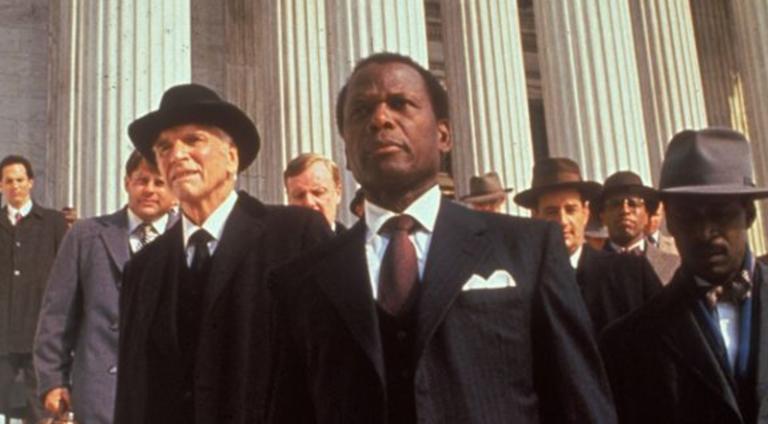
Poitier then launched the final phase of his career by starring in Separate but Equal (1991), a TV miniseries about the Brown v Board of Education case, which ended segregation in American public schools in the early 1950s.
Poitier plays Thurgood Marshall, the lawyer who argued in favour of desegregation before the Supreme Court and was eventually appointed to the court himself. It was the first TV production that Poitier had starred in since 1955 — 36 years earlier — but nearly everything he did after this was for television rather than the big screen.
Separate but Equal is a pretty standard production of its sort, and I don’t have a whole lot to say about it, except that I was intrigued by some of the tactical debates that take place among the civil-rights lawyers, some of whom don’t want to attack segregation itself lest they lose the case and set the cause back several decades. Instead, they feel it would be better to focus on enforcing the “equal” part of the “separate but equal” laws, e.g. by making sure that black schools get the same funding that white schools have. And at least some state politicians are eager to play along with this by providing extra funding for black schools, if it will help to preserve the segregated system.
Marshall, of course, ends up going after segregation itself — and then the miniseries focuses on the debates within the Supreme Court, as the justices argue amongst themselves over the merits of the case, while Marshall and his associates dig deep into the historical archives to see if they can find any evidence to prove that the legislators who passed the 14th Amendment in the 1860s would have argued against segregation as well.
It might not be the most dramatic of films, but it all works well in a high-school-history-class sort of way. And I’m sure some high-school teachers have shown this miniseries in class.
A few other quick points:
— This miniseries marked the first time that Poitier had played a contemporary real-life character since playing one of the Harlem Globetrotters in 1954’s Go Man Go. (The real-life Marshall died in 1993, two years after the miniseries aired.) He would do it at least once more after this.
— The miniseries takes place between 1950 and 1954, when the real-life Marshall was 42 to 46 years old. Poitier was 64 when the miniseries aired. (The 2017 film Marshall took place in 1940, when Marshall was 32, and starred Chadwick Boseman, who was around 40.)
— This was the last film in any medium to star Burt Lancaster. He plays John W. Davis, the lawyer who argued in defense of segregation. Davis was 81 when the Supreme Court rendered its verdict; Lancaster was 77 when the miniseries aired.
— Reunions: The miniseries was written and directed by George Stevens Jr., whose father had directed Poitier in 1965’s The Greatest Story Ever Told. Also, Supreme Court Chief Justice Earl Warren is played by Richard Kiley, who played a high-school teacher opposite Poitier’s high-school student in 1955’s Blackboard Jungle. (Kiley was only five years older than Poitier in real life.)
— Other actors you may recognize: Marshall’s wife is played by Gloria Foster, now best-known for playing the Oracle in 1999’s The Matrix and 2003’s The Matrix Reloaded. And members of the NAACP legal team are played by Cleavon Little (1974’s Blazing Saddles) and Jeffrey Wright (this was only his second onscreen acting credit!).
–
The image above shows Burt Lancaster and Sidney Poitier in Separate but Equal*.*
Previous Post

February 23, 2021
Sidney Poitier marathon: Shoot to Kill (1988) - Little Nikita (1988)
Next Post

February 25, 2021 Sidney Poitier marathon: Sneakers (1992) - Children of the Dust (1995)
Browse Our Archives
Select a Category Anglican Planet Articles BC Christian News BC Report Bible Movies Bible Review Blog Books & Culture Campus Times CBC Radio Christianity Today ChristianWeek Essays Faith Today Festival Cinemas Guide Film Journals Georgia Straight Interviews MB Herald National Catholic Register Salvationist Today's Christian Two Chairs Ubyssey Uncategorized Vancouver Courier Vancouver Sun
Select a Month August 2025 April 2025 January 2025 December 2024 November 2024 May 2024 February 2024 December 2023 May 2023 March 2023 November 2022 July 2022 June 2022 May 2022 April 2022 February 2022 January 2022 December 2021 November 2021 October 2021 September 2021 August 2021 July 2021 June 2021 April 2021 March 2021 February 2021 January 2021 December 2020 November 2020 October 2020 August 2020 July 2020 June 2020 May 2020 March 2020 February 2020 January 2020 December 2019 November 2019 September 2019 July 2019 May 2019 April 2019 March 2019 February 2019 January 2019 December 2018 November 2018 October 2018 September 2018 July 2018 June 2018 May 2018 April 2018 March 2018 February 2018 January 2018 December 2017 November 2017 October 2017 September 2017 August 2017 July 2017 June 2017 May 2017 April 2017 March 2017 February 2017 January 2017 December 2016 November 2016 October 2016 September 2016 August 2016 July 2016 June 2016 May 2016 April 2016 March 2016 February 2016 January 2016 December 2015 November 2015 October 2015 September 2015 August 2015 July 2015 June 2015 May 2015 April 2015 March 2015 February 2015 January 2015 December 2014 November 2014 October 2014 September 2014 August 2014 July 2014 June 2014 May 2014 April 2014 March 2014 February 2014 January 2014 December 2013 November 2013 October 2013 September 2013 August 2013 July 2013 June 2013 May 2013 April 2013 March 2013 February 2013 January 2013 December 2012 November 2012 October 2012 September 2012 August 2012 July 2012 June 2012 April 2012 January 2012 January 2011 December 2010 November 2010 October 2010 September 2010 August 2010 July 2010 June 2010 May 2010 April 2010 March 2010 February 2010 January 2010 December 2009 November 2009 October 2009 September 2009 August 2009 July 2009 June 2009 May 2009 April 2009 March 2009 February 2009 January 2009 December 2008 November 2008 October 2008 September 2008 August 2008 July 2008 June 2008 May 2008 April 2008 March 2008 February 2008 January 2008 December 2007 November 2007 October 2007 September 2007 August 2007 July 2007 June 2007 May 2007 April 2007 March 2007 February 2007 January 2007 December 2006 November 2006 October 2006 September 2006 August 2006 July 2006 June 2006 May 2006 April 2006 March 2006 February 2006 January 2006 December 2005 November 2005 October 2005 September 2005 August 2005 July 2005 June 2005 May 2005 April 2005 March 2005 January 2005 December 2004 November 2004 October 2004 September 2004 August 2004 July 2004 June 2004 May 2004 April 2004 March 2004 February 2004 January 2004 November 2003 October 2003 August 2003 July 2003 June 2003 May 2003 January 2003 December 2002 November 2002 August 2002 July 2002 June 2002 May 2002 March 2002 January 2002 December 2001 November 2001 September 2001 August 2001 July 2001 June 2001 April 2001 March 2001 February 2001 December 2000 November 2000 October 2000 September 2000 August 2000 July 2000 June 2000 May 2000 April 2000 March 2000 January 2000 October 1999 August 1999 May 1999 April 1999 February 1999 January 1999 December 1998 November 1998 October 1998 August 1998 July 1998 June 1998 April 1998 March 1998 January 1998 November 1997 September 1997 July 1997 June 1997 April 1997 March 1997 February 1997 January 1997 December 1996 October 1996 September 1996 June 1996 March 1996 February 1996 January 1996 April 1995 November 1994 September 1994 September 1991
Follow Us!
TAKE THE
Religious Wisdom Quiz
What Christian group uses the term "synod" for its governing body?
Select your answer to see how you score.
Baptists Lutherans Pentecostals Methodists
Related posts from FilmChat

Joseph of Egypt – the Chosen spin-off announces...

Exclusive: A clip from Angel Studios' The King...

Exclusive: Watch a clip from Angel Studios' Brave...

Exclusive: Watch a clip from Angel Studios' Homestead
TRENDING AT PATHEOS Religious Music & Entertainment

"Les Diabolique" and Transgression
Alongside something like Arrival, Vertigo, or Charade, Les Diaboliques is a...

"The Plague Dogs" and Mortality
So, flashback to the late 70s, early 80s. Walt Disney Studios is...

With the recent and highly successful release of Christopher Nolan’s epic film,...

"L'avventura" and Human Weakness
Today's piece is going to be a little different for a few...

I first want to apologize for not posting or writing anything. I'm...

I've engaged in the multi-year project of reading through the Church Fathers,...
view all Religious Music & Entertainment blogs
Ad-Free & Subscriber Log-In Subscription Support
- About Us
- 2026 Calendar
- Videos
- Podcasts
- Library of World Religions
- Faith In Media Tracker
- Advertise With Us
- Write for Us
- Privacy Policy
- Terms of Service
- Do Not Sell My Data
- Contact Us
- Radiant Digital
- Manage Newsletter Subscriptions
- Unsubscribe From Notifications
- Sitemap
Copyright 2008-2026, Patheos. All rights reserved.
Subscription Support Ad-Free & Subscriber Log-In
Follow Patheos