
BuddhistCatholicContemplativeEvangelicalGeneral ChristianHinduJewishLatter-day SaintMuslimNew VisionsProgressive Christian
Beliefs
- Buddhist
- Catholic
- Contemplative
- Evangelical
- General Christian
- Hindu
- Jewish
- Latter-day Saint
- More Voices
- Muslim
- New Visions
- Pagan
- Progressive Christian
Topics
- Religion News
- Food and Religion
- Sports and Religion
- Religious Art
- Religious Music and Entertainment
- Religious Events
- History and Religion
- Style and Religion
- Politics and Religion
- Women in Religion
- Recreation Outdoors and Religion
- Business Finance and Religion
- Careers Workplace and Religion
- Education and Religion
- Family Parenting and Religion
- Health Fitness and Religion
- Home and Religion
- Relationships and Religion
- Technology and Religion
- Travel and Religion
Columnists
- Buddhist Columnists
- Business Finance and Religion Columnists
- Careers Workplace and Religion Columnists
- Catholic Columnists
- Contemplative Columnists
- Education and Religion Columnists
- Evangelists Columnists
- Family Parenting and Religion Columnists
- General Christian Columnists
- Health Fitness and Religion Columnists
- Hindu Columnists
- History and Religion Columnists
- Home and Religion Columnists
- Jewish Columnists
- More Voices Columnists
- Latter Day Columnists
- Muslim Columnists
- New Visions Columnists
- Nonreligious Columnists
- Pagan Columnists
- Politics and Religion Columnists
- Progressive Columnists
- Recreation Outdoors and Religion Columnists
- Relationships and Religion Columnists
- Religion News Columnists
- Religious Art Columnists
- Religious Events Columnists
- Religious Music and Entertainment Columnists
- Sports and Religion Columnists
- Style and Religion Columnists
- Technology and Religion Columnists
- Travel and Religion Columnists
- Women in Religion Columnists
Resource Library
- 2026 Calendar
- Library of World Religions
- The 100 Most Holy Places on Earth
- Patheos Answers
- Podcasts
- Videos
- Faith Leaders Database
- Anglican Episcopalian
- Bahai
- Baptist
- Buddhism
- Christianity
- Confucianism
- Eastern Orthodoxy
- Hinduism
- Holiness and Pentecostal
- ISKCON
- Islam
- Judaism
- Lutheran
- Methodist
- The Church of Jesus Christ of Latter-day Saints
- New Age
- Paganism
- Presbytarian and Reformed
- Protestantism
- Religion Behind the Scenes
- Roman Catholic
- Scientology
- Shia Islam
- Sikhism
- Sufism
- Sunni Islam
- Taoism
- Zen
- See all religions
Research Tools
 Ad-Free & Subscriber Log-In Subscription Support
Ad-Free & Subscriber Log-In Subscription Support
Follow Patheos 

- Trending:
- Forgiveness
- |
- Marriage
- |
- Consciousness
- |
- Death Penalty
- |
- Election
- |
- Halloween

-
Articles
- Home
- Religious Music & Entertainment
- Sidney Poitier marathon: A Warm December (1973) – Uptown Saturday Night (1974)
Sidney Poitier marathon: A Warm December (1973) – Uptown Saturday Night (1974)
Last updated on: February 17, 2021 at 5:00 am by Peter T. Chattaway
Sidney Poitier marathon: A Warm December (1973) – Uptown Saturday Night (1974) 2021-02-10T09:26:54-08:00 Peter T. Chattaway
Patheos Explore the world's faith through different perspectives on religion and spirituality! Patheos has the views of the prevalent religions and spiritualities of the world.
The latest in a month-long series of re-posts from my Facebook marathon in April 2020.
–
Sidney Poitier marathon part 16 (1973-1974):
Sidney Poitier spent the 1950s paying his dues and the 1960s solidifying his status as a mainstream Hollywood movie star — and in that capacity, he was usually cast as the one black character who lives and works in a mostly-white environment.
In 1967 alone, he played the black teacher in a mostly-white British high school, the black cop who helps a white small-town police force find the white killer of a white murder victim, and the black man who meets his white fiancee’s white parents for the first time. In 1963’s Lilies of the Field, for which he won the best-actor Oscar, the white characters were arguably outnumbered by the Hispanic characters, but Poitier remained the only black character of any significance.
So it’s striking to see how, by the 1970s, Poitier had taken his stardom and used it to (a) launch his career as a movie director and (b) focus on stories with all- or mostly-black casts. 1972’s Buck and the Preacher, his first directorial effort, put a different spin on the western by focusing on a wagon train of ex-slaves looking for a new home. Poitier’s next two films were in different genres, but continued to express a particular interest in African and/or African-American culture.
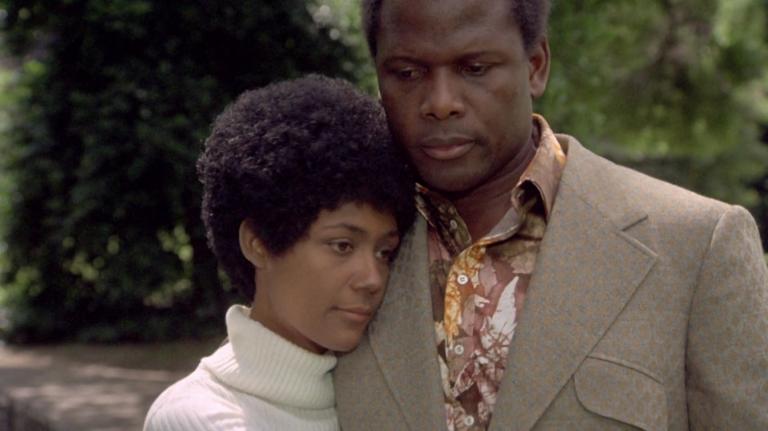
A Warm December (1973), for example, is a romance between a widowed African-American man who goes to England for a vacation and falls in love with an African princess/diplomat.
At first, you might think that there is some sort of Hitchcockian intrigue going on here — the woman first meets Poitier when she tries to hide behind him from a man who is following her on the sidewalk — but no, it turns out that there are no villains here, and no big conspiracy. She’s just the kind of person who likes to play mysterious games. (I will confess that the phrase “manic pixie dream girl” flashed through my mind once or twice, though she’s not quite as flighty as all that.)
And the reason she’s playing these games is because (spoiler alert!) she’s sick and doesn’t know how much longer she’ll have to live. So when she and Poitier do get serious about each other, it’s with the knowledge that their affair could be cut very short. (Between her political position and her illness, the fact that their relationship has a time limit attached to it is reminiscent of both Roman Holiday and any of a number of man-falls-for-sick-woman movies, from Love Story to I Still Believe — though it tilts more towards the former kind of movie.)
Along the way, there are glimpses of African culture including a fantastic performance of Miriam Makeba’s ‘Nonqonqo’ by Letta Mbulu. The film is also remarkably casual about the fact that the princess is chummy with representatives of the Soviet Union, who are planning to sell her country a hydroelectric plant. I am sure that that subplot reflects the political reality of post-colonial Africa on some level, but I do wonder how the film’s treatment of it played in the early 1970s.
A few other quick points:
— The Poitier character’s last name is Younger, just like his character in 1961’s A Raisin in the Sun.
— The princess is played by Esther Anderson, a Jamaican actress and filmmaker who (according to her Wikipedia page, though the IMDb does not confirm this) had already served as a producer on 1972’s The Harder They Fall. (The two lead characters are from the United States and Africa, respectively, but — given that Poitier was from the Bahamas — both of the actors playing them were from the West Indies.)
— The first time Poitier and Anderson are about to sleep together, there’s an amusing bit where she nervously rattles off a list of facts about her nation and its resources while he begins to stroke her, and finally she says, “So if you don’t stop doing that, I’m going to fall apart.”
— Anderson was 27 when the film came out, just like her character. Poitier was 46; I don’t believe his character’s age is ever specified, though he is a widower with a young daughter.
— Poitier tells his daughter that Anderson is suffering from sickle cell anemia, a genetic disorder that he characterizes as “a black disease” because it affects people of African descent far more often than other demographic groups. Wikipedia says it also occurs “relatively frequently” in parts of India and the Arabian Peninsula.
— Anderson is 27 and worried that she could die at any time; her mother died of the disease at 22, and the only reassurance Poitier can give her is that some patients have been known to live into their 30s. Does that reflect the actual life expectancy at that time? A quick bit of Googling indicates that a 1994 study found that the median life expectancy for women with sickle cell anemia was 48 — did it get better over the years?
— Anderson’s character befriends Poitier’s daughter, and there is a scene where they go for a walk and talk about brassieres and how you know when you’re in love, etc. So does this film pass the Bechdel test? It’s another striking example, in any case, of the agency or breathing room that Poitier gives to his female co-stars.
All but one of Poitier’s subsequent directorial efforts were comedies, starting with Uptown Saturday Night (1974), which was the first of four collaborations with Bill Cosby.
Poitier and Cosby play friends who pay a visit to an illegal, after-hours nightclub on the night that it just happens to be robbed. Poitier and Cosby lose their wallets in the robbery, which is bad enough, but Poitier discovers afterwards that his wallet had a winning lottery ticket — so he gets Cosby to help him track down the thieves who robbed the club.
The plot is basically an excuse for a series of cameos, some of which, like Richard Pryor’s as a private detective, are kind of pointless, but others, like Roscoe Lee Browne’s as a code-switching congressman or Flip Wilson’s as a preacher who goes on and on about “loose lips”, are hilarious. (Browne’s scene is easily the funniest in the whole film. I sat up and paid attention in a way that I never did during any other scene.) Harry Belafonte also turns up as a mobster whose raspy voice and padded cheeks are an obvious riff on 1972’s The Godfather.
I can’t say the film is particularly funny where the two leads are concerned, though. Poitier, in particular, seems to be trying too hard to prove that he can be a funny guy — and you can’t help wondering how he might have fared in a role like this if he had been directed by someone other than himself.
A few other quick points:
— When someone says that President Truman coined the expression “If you can’t stand the heat, get out of the kitchen” in 1952, Cosby replies, “That’s right, I was in the kitchen when he said it.” Cosby was born in 1937 and would have been 15 in 1952 — but Truman was quoted using that expression, or versions of it, as early as 1942, when he was just a senator (and Cosby was 5).
— This time in LGBT references: Poitier studies some of the men walking down the street to see if any of them might be the robbers. Most of the men frown at him in reply, but one sticks out his tongue and waves coquettishly, which prompts Poitier to do a double-take.
— One gangster does a karate chop through a table, reflecting perhaps the increased visibility of martial-arts movies during this period (Bruce Lee’s most popular films came out 1971-1973).
— Reunions: This was the last Poitier film to co-star Belafonte (after 1972’s Buck and the Preacher) and Lincoln Kilpatrick (after 1969’s The Lost Man and 1971’s Brother John), and it was the first Poitier film to co-star Bill Cosby, Calvin Lockhart and Richard Pryor, all of whom would work with him again (though Poitier stayed behind the camera for his only other collaboration with Pryor).
–
The image above shows Esther Anderson and Sidney Poitier in A Warm December*.*


Browse Our Archives
Select a Category Anglican Planet Articles BC Christian News BC Report Bible Movies Bible Review Blog Books & Culture Campus Times CBC Radio Christianity Today ChristianWeek Essays Faith Today Festival Cinemas Guide Film Journals Georgia Straight Interviews MB Herald National Catholic Register Salvationist Today's Christian Two Chairs Ubyssey Uncategorized Vancouver Courier Vancouver Sun
Select a Month August 2025 April 2025 January 2025 December 2024 November 2024 May 2024 February 2024 December 2023 May 2023 March 2023 November 2022 July 2022 June 2022 May 2022 April 2022 February 2022 January 2022 December 2021 November 2021 October 2021 September 2021 August 2021 July 2021 June 2021 April 2021 March 2021 February 2021 January 2021 December 2020 November 2020 October 2020 August 2020 July 2020 June 2020 May 2020 March 2020 February 2020 January 2020 December 2019 November 2019 September 2019 July 2019 May 2019 April 2019 March 2019 February 2019 January 2019 December 2018 November 2018 October 2018 September 2018 July 2018 June 2018 May 2018 April 2018 March 2018 February 2018 January 2018 December 2017 November 2017 October 2017 September 2017 August 2017 July 2017 June 2017 May 2017 April 2017 March 2017 February 2017 January 2017 December 2016 November 2016 October 2016 September 2016 August 2016 July 2016 June 2016 May 2016 April 2016 March 2016 February 2016 January 2016 December 2015 November 2015 October 2015 September 2015 August 2015 July 2015 June 2015 May 2015 April 2015 March 2015 February 2015 January 2015 December 2014 November 2014 October 2014 September 2014 August 2014 July 2014 June 2014 May 2014 April 2014 March 2014 February 2014 January 2014 December 2013 November 2013 October 2013 September 2013 August 2013 July 2013 June 2013 May 2013 April 2013 March 2013 February 2013 January 2013 December 2012 November 2012 October 2012 September 2012 August 2012 July 2012 June 2012 April 2012 January 2012 January 2011 December 2010 November 2010 October 2010 September 2010 August 2010 July 2010 June 2010 May 2010 April 2010 March 2010 February 2010 January 2010 December 2009 November 2009 October 2009 September 2009 August 2009 July 2009 June 2009 May 2009 April 2009 March 2009 February 2009 January 2009 December 2008 November 2008 October 2008 September 2008 August 2008 July 2008 June 2008 May 2008 April 2008 March 2008 February 2008 January 2008 December 2007 November 2007 October 2007 September 2007 August 2007 July 2007 June 2007 May 2007 April 2007 March 2007 February 2007 January 2007 December 2006 November 2006 October 2006 September 2006 August 2006 July 2006 June 2006 May 2006 April 2006 March 2006 February 2006 January 2006 December 2005 November 2005 October 2005 September 2005 August 2005 July 2005 June 2005 May 2005 April 2005 March 2005 January 2005 December 2004 November 2004 October 2004 September 2004 August 2004 July 2004 June 2004 May 2004 April 2004 March 2004 February 2004 January 2004 November 2003 October 2003 August 2003 July 2003 June 2003 May 2003 January 2003 December 2002 November 2002 August 2002 July 2002 June 2002 May 2002 March 2002 January 2002 December 2001 November 2001 September 2001 August 2001 July 2001 June 2001 April 2001 March 2001 February 2001 December 2000 November 2000 October 2000 September 2000 August 2000 July 2000 June 2000 May 2000 April 2000 March 2000 January 2000 October 1999 August 1999 May 1999 April 1999 February 1999 January 1999 December 1998 November 1998 October 1998 August 1998 July 1998 June 1998 April 1998 March 1998 January 1998 November 1997 September 1997 July 1997 June 1997 April 1997 March 1997 February 1997 January 1997 December 1996 October 1996 September 1996 June 1996 March 1996 February 1996 January 1996 April 1995 November 1994 September 1994 September 1991
Follow Us!
TAKE THE
Religious Wisdom Quiz
What does "Gideon" mean in Hebrew?
Select your answer to see how you score.
God is my Strength Warrior Hewer Redeemer
Related posts from FilmChat

Joseph of Egypt – the Chosen spin-off announces...

Exclusive: A clip from Angel Studios' The King...

Exclusive: Watch a clip from Angel Studios' Brave...

Exclusive: Watch a clip from Angel Studios' Homestead
TRENDING AT PATHEOS Religious Music & Entertainment

"Les Diabolique" and Transgression
Alongside something like Arrival, Vertigo, or Charade, Les Diaboliques is a...

"The Plague Dogs" and Mortality
So, flashback to the late 70s, early 80s. Walt Disney Studios is...

With the recent and highly successful release of Christopher Nolan’s epic film,...

"L'avventura" and Human Weakness
Today's piece is going to be a little different for a few...

I first want to apologize for not posting or writing anything. I'm...

I've engaged in the multi-year project of reading through the Church Fathers,...
view all Religious Music & Entertainment blogs
Ad-Free & Subscriber Log-In Subscription Support
- About Us
- 2026 Calendar
- Videos
- Podcasts
- Library of World Religions
- Faith In Media Tracker
- Advertise With Us
- Write for Us
- Privacy Policy
- Terms of Service
- Do Not Sell My Data
- Contact Us
- Radiant Digital
- Manage Newsletter Subscriptions
- Unsubscribe From Notifications
- Sitemap
Copyright 2008-2026, Patheos. All rights reserved.
Subscription Support Ad-Free & Subscriber Log-In
Follow Patheos