
BuddhistCatholicContemplativeEvangelicalGeneral ChristianHinduJewishLatter-day SaintMuslimNew VisionsProgressive Christian
Beliefs
- Buddhist
- Catholic
- Contemplative
- Evangelical
- General Christian
- Hindu
- Jewish
- Latter-day Saint
- More Voices
- Muslim
- New Visions
- Pagan
- Progressive Christian
Topics
- Religion News
- Food and Religion
- Sports and Religion
- Religious Art
- Religious Music and Entertainment
- Religious Events
- History and Religion
- Style and Religion
- Politics and Religion
- Women in Religion
- Recreation Outdoors and Religion
- Business Finance and Religion
- Careers Workplace and Religion
- Education and Religion
- Family Parenting and Religion
- Health Fitness and Religion
- Home and Religion
- Relationships and Religion
- Technology and Religion
- Travel and Religion
Columnists
- Buddhist Columnists
- Business Finance and Religion Columnists
- Careers Workplace and Religion Columnists
- Catholic Columnists
- Contemplative Columnists
- Education and Religion Columnists
- Evangelists Columnists
- Family Parenting and Religion Columnists
- General Christian Columnists
- Health Fitness and Religion Columnists
- Hindu Columnists
- History and Religion Columnists
- Home and Religion Columnists
- Jewish Columnists
- More Voices Columnists
- Latter Day Columnists
- Muslim Columnists
- New Visions Columnists
- Nonreligious Columnists
- Pagan Columnists
- Politics and Religion Columnists
- Progressive Columnists
- Recreation Outdoors and Religion Columnists
- Relationships and Religion Columnists
- Religion News Columnists
- Religious Art Columnists
- Religious Events Columnists
- Religious Music and Entertainment Columnists
- Sports and Religion Columnists
- Style and Religion Columnists
- Technology and Religion Columnists
- Travel and Religion Columnists
- Women in Religion Columnists
Resource Library
- 2026 Calendar
- Library of World Religions
- The 100 Most Holy Places on Earth
- Patheos Answers
- Podcasts
- Videos
- Faith Leaders Database
- Anglican Episcopalian
- Bahai
- Baptist
- Buddhism
- Christianity
- Confucianism
- Eastern Orthodoxy
- Hinduism
- Holiness and Pentecostal
- ISKCON
- Islam
- Judaism
- Lutheran
- Methodist
- The Church of Jesus Christ of Latter-day Saints
- New Age
- Paganism
- Presbytarian and Reformed
- Protestantism
- Religion Behind the Scenes
- Roman Catholic
- Scientology
- Shia Islam
- Sikhism
- Sufism
- Sunni Islam
- Taoism
- Zen
- See all religions
Research Tools
 Ad-Free & Subscriber Log-In Subscription Support
Ad-Free & Subscriber Log-In Subscription Support
Follow Patheos 

- Trending:
- Forgiveness
- |
- Marriage
- |
- Consciousness
- |
- Death Penalty
- |
- Election
- |
- Halloween

-
Articles
- Home
- Religious Music & Entertainment
- Sidney Poitier marathon: A Raisin in the Sun (1961) – Paris Blues (1961) – Pressure Point (1962)
Sidney Poitier marathon: A Raisin in the Sun (1961) – Paris Blues (1961) – Pressure Point (1962)
Last updated on: February 5, 2021 at 5:00 am by Peter T. Chattaway
Sidney Poitier marathon: A Raisin in the Sun (1961) – Paris Blues (1961) – Pressure Point (1962) 2021-02-04T07:55:05-08:00 Peter T. Chattaway
Patheos Explore the world's faith through different perspectives on religion and spirituality! Patheos has the views of the prevalent religions and spiritualities of the world.
The latest in a month-long series of re-posts from my Facebook marathon in April 2020.
–
Sidney Poitier marathon part 7 (1961):
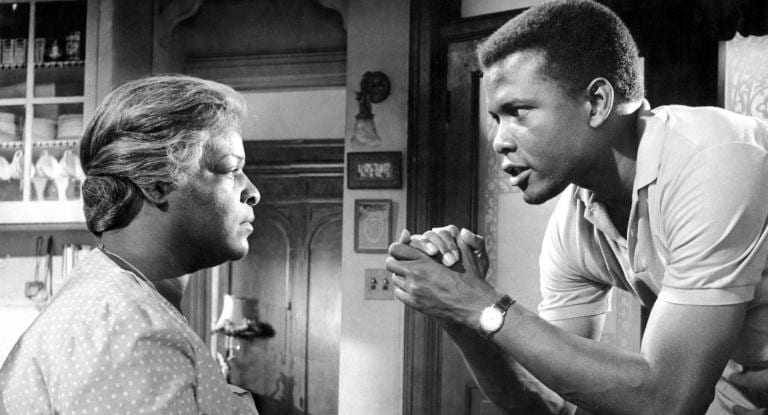
If Sidney Poitier’s filmography thins out a bit after that burst of activity in the mid- to late 1950s, it’s partly because he was starring in a very successful play, A Raisin in the Sun, that went on to become a film in 1961. The play was noteworthy for being the first Broadway production written by a black woman, as well as the first Broadway production directed by a black man, and the film brings back most of the nearly all-black cast from the stage production, including Poitier.
Alas, while playwright Lorraine Hansberry got to adapt her own script, the directing job was given to Daniel Petrie, a white Canadian who had spent over a decade in television and had directed only one other film before this. (The only other film of his I have seen is 1988’s Cocoon: The Return.) Still, directing for the camera is different from directing for the stage, so you can understand why the producers might have wanted someone else to handle the screen adaptation.
In any case, A Raisin in the Sun is such an incredibly full meal of socially significant drama that I can’t really tackle it all in a Facebook post such as this. Suffice it to say that the film deals with race (obviously), gender roles (Poitier’s character lives with his wife, mother and sister, and he thinks his sister should train to become a nurse instead of a doctor), class issues (Poitier resents being a chauffeur — he wants to open a bar with his friends — but he also looks down on his sister’s college-educated classmates), religion (Poitier’s sister shocks their mother by declaring she’s an atheist), abortion, the relationship between cold hard cash and intangible things like pride and heritage (Poitier’s mother has been expecting a life-insurance payout ever since his father “worked himself to death”, and different members of the family have different ideas as to how that money should be used), and so on.
The film does feel very much like a play that has been caught on film; when the characters go for a drive to an all-white neighbourhood about 82 minutes into the film, you really notice the fact that the camera is now outdoors. (There were a few outdoors shots earlier, too, but no real dialogue in them; just glimpses of Poitier’s character doing his chauffeur thing.)
Anyway, there is lots and lots of stuff to chew on here. A few other quick, and perhaps trivial, points:
— This is the second film, following 1959’s Porgy and Bess, to give Poitier top billing. It also marks the fifth time that Poitier worked onscreen with Ruby Dee (who plays his wife, again). Future Oscar winner Louis Gossett, Jr. also makes his film debut in this movie as a guy who has been dating Poitier’s sister.
— Poitier’s character keeps saying that he is 35 years old, and that he is afraid that he is running out of time to make something of himself. Poitier was 32 when the play premiered in 1959 and 34 when the film came out in 1961. (He had played a high school student in Blackboard Jungle only four years before starring in the play.)
— Poitier’s sister dismisses jazz as a form of “assimilationist junk”, preferring the tribal music of Nigeria instead.
— When Poitier joins his sister in celebrating African culture, he has a line about “my man, you know, Kenyatta”. Jomo Kenyatta was imprisoned and/or exiled between 1952 and 1961 for allegedly masterminding the Mau Mau Uprising, which was the subject of an earlier Poitier film, 1957’s Something of Value. Kenyatta became the first president of Kenya after it gained its independence in 1964, three years after this film came out.
— Following up on those last two points: It bears mentioning, perhaps, that Nigeria is in west Africa and Kenya is in east Africa, and they should perhaps be seen as two different cultures rather than as one single culture. How, I wonder, would Nigerian and Kenyan characters respond to an American character who complains about “assimilation” at home but treats their countries as one and the same thing?
— The one white member of the cast is John Fiedler, who went on to provide the voice of Piglet in Disney’s Winnie-the-Pooh movies (from 1968 to his death in 2005) as well as play a man possessed by the spirit of Jack the Ripper in a 1967 episode of Star Trek.
The other film Poitier made that year was Paris Blues (1961), in which he and Paul Newman play jazz musicians living in Paris who spend a couple weeks hanging out and falling in love with a couple of female American tourists.
The film actually flirts, in its early scenes, with the possibility of interracial romance — or so it seemed to me, at any rate. The opening montage includes a shot of a white man and a black woman sitting together at the jazz club where Newman and Poitier are playing. Later, when Newman meets the female tourists, the first one he meets is played by Diahann Carroll, and he tells her she’s pretty; when she tells him that the friend she’s waiting for is white, he says dismissively that it’ll be hard to pick her friend out of the crowd because white women all look alike. Later, after the women come to his jazz club, Newman assumes that Carroll was the one who wanted to see him, and it is only after he states this assumption that he is told it was actually her friend, played by Joanne Woodward, who wanted to see him — and from that point on, Newman and Woodward form one of the film’s central couples while Poitier and Carroll form the other. For a moment, I wondered if the film might beat Guess Who’s Coming to Dinner? to the punch by showing Poitier in a relationship with a white woman. But oh well.
Eventually, of course, the women have to go home to America, and the question that hangs over the film’s final scenes is whether the men will go back with them. Newman’s character is reluctant to do so because he has ambitions for his musical career, while Poitier’s character has no interest in returning to the racist culture that he left behind five years ago; Paris, he says, has been so much better. (Carroll replies that America has gotten better too in five years, and she says America owes that improvement to the black people who stayed home, not the ones who went away.)
This film marks the second time that Poitier worked with Carroll (who co-starred with Poitier in Porgy and Bess) and director Martin Ritt (who made his big-screen debut directing Poitier in 1957’s Edge of the City). But the film really belongs to real-life couple Newman and Woodward. Not only do they get top billing (this was their fourth movie together in as many years), they also have a genuine chemistry, or heat, that Poitier never quite finds with Carroll. Poitier doesn’t sound all that convincing when he tells Carroll he loves her — indeed, he says he might love her enough to go back to America with her — and I wonder if he was really all that convinced by the dialogue himself.
The music is great, of course. The film is scored by Duke Ellington — I’m happy to say that, while I don’t know much about jazz, I actually recognized most of the tunes in this film — and Louis Armstrong plays a musician that Newman’s character really looks up to named Wild Man Moore. (This is one of the few films in which Armstrong played someone other than himself or some sort of anonymous band leader.)
Incidentally, the posters advertising Wild Man Moore’s concert are a recurring visual motif in this film, and I liked how, at the very end, as certain characters are saying their goodbyes, we can see the posters in the background being papered over by a new set of advertisements. It’s yet another reminder that the special time these characters had together has come to an end, as all good things must. Life goes on, etc.
One quick trivia note: Poitier was nominated for Oscars twice — for 1958’s The Defiant Ones and 1963’s Lilies of the Field — and he competed against Newman both times. (Newman was nominated in those years for Cat on a Hot Tin Roof and Hud, the latter of which was, like Paris Blues, directed by Martin Ritt.) While Poitier won on his second try, Newman wouldn’t win an Oscar until 1986’s The Color of Money, which was a sequel to The Hustler — the other film Newman made the year he starred in Paris Blues.
–
Sidney Poitier marathon part 8a (1962):
In Pressure Point (1962), Sidney Poitier plays a psychiatrist, working in a federal penitentiary, who has to deal with an American Nazi inmate (played by Bobby Darin!) in the early 1940s.
In some ways, this film is a throwback to Poitier’s very first movie, but in others, it marks the beginning of a new phase in his onscreen persona. On the one hand, the set-up is reminiscent of 1950’s No Way Out, in which Poitier played a doctor who had to deal with a racist patient in a hospital’s emergency ward. But when Poitier expresses concern that Darin is a “leader type” among the inmates, you can’t help thinking that this film also acts as a bridge of sorts between 1955’s Blackboard Jungle — in which Poitier was described as a “leader” among his classmates — and 1967’s To Sir with Love, in which Poitier becomes a different sort of authority figure to yet another class of rowdy students and juvenile delinquents.
Pressure Point is largely about the Darin character’s upbringing and the psychological factors that made him a Nazi. We don’t get any equivalent insight into Poitier’s character, though — I don’t believe we ever see him at home or anywhere else besides his place of work — and, given that previous films of Poitier’s like 1961’s A Raisin in the Sun had focused so heavily on the class struggles, educational opportunities and social-mobility issues faced by African-Americans in the late 1950s and early 1960s, I kept wondering about the social hurdles that Poitier’s character in this film would have had to overcome to be an established psychiatrist by the early 1940s. Poitier was 35 when the movie came out, so if his character was the same age, he presumably began his college education in the 1920s. And psychiatrists generally need to get medical degrees first, right? What sort of hurdles did black students face when they pursued careers in medicine or psychiatry back then? What effect did the stock market crash in 1929 have on this character’s education, or his ability to pay for it? Earlier Poitier films gave a nod to the fact that the U.S. military was still racially segregated during World War II; what was the situation like in prisons at that time? (Poitier’s boss — the prison warden — does say at one point that he was fighting a “noble cause” when he “insisted” on hiring Poitier, and the Poitier character isn’t entirely happy about the burden that’s being placed on him, both as a representative of his race and as a test of the warden’s cause. It’s impossible to watch that scene and not imagine how Poitier felt about the various filmmakers and studio chiefs he had dealt with over the years, many of whom presumably saw him not just (or even primarily) as a talented actor but as the face of their causes, too.)
Anyway. The depiction of the Darin character’s troubled past and racist indoctrination is conveyed through a number of techniques: straightforward dramatization, abstract theatrical setpieces (a few characters and props against a stark black background, that sort of thing), surreal dream imagery (a man trying to crawl out of a sink’s drain), and actual documentary footage (including footage of a 1939 American Nazi rally at New York’s Madison Square Garden, which was the subject of an Oscar-nominated documentary short just two years ago). I also liked the split-screen effect that is used when Darin gets ready for a date; he’s shaving on one side of the screen and doing something else on the other, but the two sides are facing each other so that it looks like he’s looking in a mirror (which he is, actually, but the split-screen effect gives it a twist).
While the bulk of the story is set in the early 1940s, it is framed by scenes set in the present day (i.e. the early 1960s), when Poitier has become a boss of sorts and is telling his story to a younger, white psychiatrist (played by “guest star” Peter Falk) who is frustrated with a black patient that has been assigned to him. (Poitier has grey hair in these scenes, which is a first.) The movie ends with Falk accepting his assignment and suggesting that he will conduct his next session in blackface, to which Poitier replies, “Good idea.” Um, okay… (Poitier then says, “Only don’t let me down because you’re a white man.” The first part of that sentence is what Poitier’s own boss once said to him, and the second part of that sentence is a variation on what Poitier’s boss did not say but Poitier could feel him thinking it. So the implication here is that we have now progressed to a place where we can be more open about this stuff and, perhaps, defuse any potential tension with humour, I guess…?)
Two other quick points about this film:
— Poitier shares top billing with Darin, but Poitier’s name comes first. I believe that makes this the third time that Poitier’s name came first in a movie’s credits (following 1959’s Porgy and Bess and 1961’s A Raisin in the Sun), and the first time his name came first in a film that did not have an (almost) all-black cast.
— This film was produced by Stanley Kramer, who directed Poitier in 1958’s The Defiant Ones and would do so again in 1967’s Guess Who’s Coming to Dinner. Kramer reportedly directed the framing-device scenes too, though the rest of the film was directed by someone named Hubert Cornfield.
–
The image above shows Claudia McNeil and Sidney Poitier in A Raisin in the Sun*.*


Browse Our Archives
Select a Category Anglican Planet Articles BC Christian News BC Report Bible Movies Bible Review Blog Books & Culture Campus Times CBC Radio Christianity Today ChristianWeek Essays Faith Today Festival Cinemas Guide Film Journals Georgia Straight Interviews MB Herald National Catholic Register Salvationist Today's Christian Two Chairs Ubyssey Uncategorized Vancouver Courier Vancouver Sun
Select a Month August 2025 April 2025 January 2025 December 2024 November 2024 May 2024 February 2024 December 2023 May 2023 March 2023 November 2022 July 2022 June 2022 May 2022 April 2022 February 2022 January 2022 December 2021 November 2021 October 2021 September 2021 August 2021 July 2021 June 2021 April 2021 March 2021 February 2021 January 2021 December 2020 November 2020 October 2020 August 2020 July 2020 June 2020 May 2020 March 2020 February 2020 January 2020 December 2019 November 2019 September 2019 July 2019 May 2019 April 2019 March 2019 February 2019 January 2019 December 2018 November 2018 October 2018 September 2018 July 2018 June 2018 May 2018 April 2018 March 2018 February 2018 January 2018 December 2017 November 2017 October 2017 September 2017 August 2017 July 2017 June 2017 May 2017 April 2017 March 2017 February 2017 January 2017 December 2016 November 2016 October 2016 September 2016 August 2016 July 2016 June 2016 May 2016 April 2016 March 2016 February 2016 January 2016 December 2015 November 2015 October 2015 September 2015 August 2015 July 2015 June 2015 May 2015 April 2015 March 2015 February 2015 January 2015 December 2014 November 2014 October 2014 September 2014 August 2014 July 2014 June 2014 May 2014 April 2014 March 2014 February 2014 January 2014 December 2013 November 2013 October 2013 September 2013 August 2013 July 2013 June 2013 May 2013 April 2013 March 2013 February 2013 January 2013 December 2012 November 2012 October 2012 September 2012 August 2012 July 2012 June 2012 April 2012 January 2012 January 2011 December 2010 November 2010 October 2010 September 2010 August 2010 July 2010 June 2010 May 2010 April 2010 March 2010 February 2010 January 2010 December 2009 November 2009 October 2009 September 2009 August 2009 July 2009 June 2009 May 2009 April 2009 March 2009 February 2009 January 2009 December 2008 November 2008 October 2008 September 2008 August 2008 July 2008 June 2008 May 2008 April 2008 March 2008 February 2008 January 2008 December 2007 November 2007 October 2007 September 2007 August 2007 July 2007 June 2007 May 2007 April 2007 March 2007 February 2007 January 2007 December 2006 November 2006 October 2006 September 2006 August 2006 July 2006 June 2006 May 2006 April 2006 March 2006 February 2006 January 2006 December 2005 November 2005 October 2005 September 2005 August 2005 July 2005 June 2005 May 2005 April 2005 March 2005 January 2005 December 2004 November 2004 October 2004 September 2004 August 2004 July 2004 June 2004 May 2004 April 2004 March 2004 February 2004 January 2004 November 2003 October 2003 August 2003 July 2003 June 2003 May 2003 January 2003 December 2002 November 2002 August 2002 July 2002 June 2002 May 2002 March 2002 January 2002 December 2001 November 2001 September 2001 August 2001 July 2001 June 2001 April 2001 March 2001 February 2001 December 2000 November 2000 October 2000 September 2000 August 2000 July 2000 June 2000 May 2000 April 2000 March 2000 January 2000 October 1999 August 1999 May 1999 April 1999 February 1999 January 1999 December 1998 November 1998 October 1998 August 1998 July 1998 June 1998 April 1998 March 1998 January 1998 November 1997 September 1997 July 1997 June 1997 April 1997 March 1997 February 1997 January 1997 December 1996 October 1996 September 1996 June 1996 March 1996 February 1996 January 1996 April 1995 November 1994 September 1994 September 1991
Follow Us!
TAKE THE
Religious Wisdom Quiz
Who was the youngest son of Jacob?
Select your answer to see how you score.
Dan Benjamin Joseph Levi
Related posts from FilmChat

Joseph of Egypt – the Chosen spin-off announces...

Exclusive: A clip from Angel Studios' The King...

Exclusive: Watch a clip from Angel Studios' Brave...

Exclusive: Watch a clip from Angel Studios' Homestead
TRENDING AT PATHEOS Religious Music & Entertainment

"Les Diabolique" and Transgression
Alongside something like Arrival, Vertigo, or Charade, Les Diaboliques is a...

"The Plague Dogs" and Mortality
So, flashback to the late 70s, early 80s. Walt Disney Studios is...

With the recent and highly successful release of Christopher Nolan’s epic film,...

"L'avventura" and Human Weakness
Today's piece is going to be a little different for a few...

I first want to apologize for not posting or writing anything. I'm...

I've engaged in the multi-year project of reading through the Church Fathers,...
view all Religious Music & Entertainment blogs
Ad-Free & Subscriber Log-In Subscription Support
- About Us
- 2026 Calendar
- Videos
- Podcasts
- Library of World Religions
- Faith In Media Tracker
- Advertise With Us
- Write for Us
- Privacy Policy
- Terms of Service
- Do Not Sell My Data
- Contact Us
- Radiant Digital
- Manage Newsletter Subscriptions
- Unsubscribe From Notifications
- Sitemap
Copyright 2008-2026, Patheos. All rights reserved.
Subscription Support Ad-Free & Subscriber Log-In
Follow Patheos