
BuddhistCatholicContemplativeEvangelicalGeneral ChristianHinduJewishLatter-day SaintMuslimNew VisionsProgressive Christian
Beliefs
- Buddhist
- Catholic
- Contemplative
- Evangelical
- General Christian
- Hindu
- Jewish
- Latter-day Saint
- More Voices
- Muslim
- New Visions
- Pagan
- Progressive Christian
Topics
- Religion News
- Food and Religion
- Sports and Religion
- Religious Art
- Religious Music and Entertainment
- Religious Events
- History and Religion
- Style and Religion
- Politics and Religion
- Women in Religion
- Recreation Outdoors and Religion
- Business Finance and Religion
- Careers Workplace and Religion
- Education and Religion
- Family Parenting and Religion
- Health Fitness and Religion
- Home and Religion
- Relationships and Religion
- Technology and Religion
- Travel and Religion
Columnists
- Buddhist Columnists
- Business Finance and Religion Columnists
- Careers Workplace and Religion Columnists
- Catholic Columnists
- Contemplative Columnists
- Education and Religion Columnists
- Evangelists Columnists
- Family Parenting and Religion Columnists
- General Christian Columnists
- Health Fitness and Religion Columnists
- Hindu Columnists
- History and Religion Columnists
- Home and Religion Columnists
- Jewish Columnists
- More Voices Columnists
- Latter Day Columnists
- Muslim Columnists
- New Visions Columnists
- Nonreligious Columnists
- Pagan Columnists
- Politics and Religion Columnists
- Progressive Columnists
- Recreation Outdoors and Religion Columnists
- Relationships and Religion Columnists
- Religion News Columnists
- Religious Art Columnists
- Religious Events Columnists
- Religious Music and Entertainment Columnists
- Sports and Religion Columnists
- Style and Religion Columnists
- Technology and Religion Columnists
- Travel and Religion Columnists
- Women in Religion Columnists
Resource Library
- 2026 Calendar
- Library of World Religions
- The 100 Most Holy Places on Earth
- Patheos Answers
- Podcasts
- Videos
- Faith Leaders Database
- Anglican Episcopalian
- Bahai
- Baptist
- Buddhism
- Christianity
- Confucianism
- Eastern Orthodoxy
- Hinduism
- Holiness and Pentecostal
- ISKCON
- Islam
- Judaism
- Lutheran
- Methodist
- The Church of Jesus Christ of Latter-day Saints
- New Age
- Paganism
- Presbytarian and Reformed
- Protestantism
- Religion Behind the Scenes
- Roman Catholic
- Scientology
- Shia Islam
- Sikhism
- Sufism
- Sunni Islam
- Taoism
- Zen
- See all religions
Research Tools
 Ad-Free & Subscriber Log-In Subscription Support
Ad-Free & Subscriber Log-In Subscription Support
Follow Patheos 

- Trending:
- Forgiveness
- |
- Marriage
- |
- Consciousness
- |
- Death Penalty
- |
- Election
- |
- Halloween

-
Articles
- Home
- Religious Music & Entertainment
- Sidney Poitier marathon: A Patch of Blue (1965) – The Slender Thread (1965) – Duel at Diablo (1966)
Sidney Poitier marathon: A Patch of Blue (1965) – The Slender Thread (1965) – Duel at Diablo (1966)
Last updated on: February 9, 2021 at 5:00 am by Peter T. Chattaway
Sidney Poitier marathon: A Patch of Blue (1965) – The Slender Thread (1965) – Duel at Diablo (1966) 2021-02-02T15:53:39-08:00 Peter T. Chattaway
Patheos Explore the world's faith through different perspectives on religion and spirituality! Patheos has the views of the prevalent religions and spiritualities of the world.
The latest in a month-long series of re-posts from my Facebook marathon in April 2020.
–
Sidney Poitier marathon part 10 (1965b-1966):
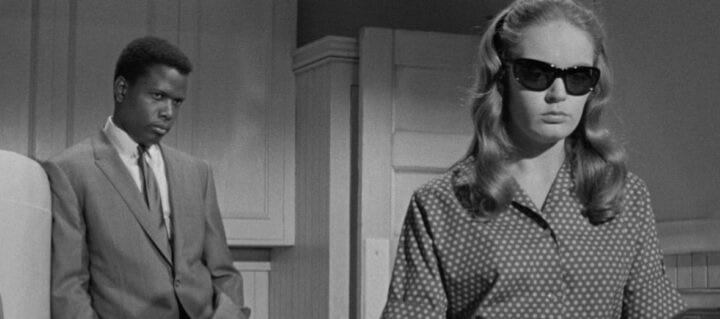
Oh dear. I think I’m in love. A Patch of Blue (1965) is easily one of the best films I have seen as part of this marathon, and it’s certainly the most emotionally engaging of the bunch (so far). I was shedding real tears by the end of this one.
The story concerns an 18-year-old girl named Selina who was accidentally blinded by her mother, a prostitute, at the age of five, and who has been not-so-accidentally abused by her mother ever since. One day Selina’s frequently-drunk grandfather takes her outside to a park and leaves her there, and Sidney Poitier walks by and befriends her… and, as the two of them get to know each other (over the course of multiple meetings), he decides to help her become more independent, and she, in turn, falls in love, not knowing that he is black — which could be a problem, given her mother’s racism.
There are so, so many ways this story could have gone wrong, but the movie steers clear of all those pitfalls. It could have lapsed into cheap sentiment, but it’s wiser than that — and so, too, are its characters, who certainly feel the lure of sentiment but are ultimately self-aware enough to rise above it.
Selina, for example, is naive and uneducated about many things, because she has never known life outside of her mother’s apartment — but she has also experienced terrible things that catch Poitier by surprise when she mentions them. She also has real human agency, which expresses itself in small ways at first — like when she tells Poitier not to buy a tomato because it’s too soft — but those moments hint at her potential to be even more assertive. (I love the tomato bit because Poitier is in the middle of trying to “teach” Selina about grocery shopping and other Outside World things, and her reply shows that she already knows some things, and indeed that he might be able to learn a thing or two from her. She’s not just a blank slate that he can project things onto.)
As for Poitier’s character, it would be so easy for his chivalry to morph into something more toxic and self-gratifying, but he catches himself in time — he is aware that he cannot allow his laudible concern for Selina to bleed into a romantic fling, and he knows that any sort of sexual relationship between them at this stage would basically be a form of exploitation. Selina needs a chance to heal, to experience more of life, to become a truly whole person before he can even consider getting involved with her. And if he doesn’t get involved with her down the road, because she has grown in a different direction from him, then he is smart enough to know that that’s okay, too.
I also really appreciate the way the film gives Poitier a brother (played by Ivan Dixon, who co-starred with Poitier in 1959’s Porgy and Bess and 1961’s A Raisin in the Sun). Just the fact that the brother exists makes Poitier a more-defined character in his own right, rather than someone who exists only for Selina’s sake; if Selina is more than a blank slate, then Poitier is more than a blank slate, too. The brother also challenges some of Poitier’s actions in a way that underscores the fact that Poitier’s character is making active choices and not just slipping into some sort of predefined role in Selina’s life. (The brother, incidentally, is an intern at a hospital; this is 15 years after Poitier played a doctor in his first film, 1950’s No Way Out.)
Poitier also gives one of his best, most natural, performances to date here. The joy he takes in getting to know Selina is infectious, but you can also sense his repressed irritation when he catches people in the park looking at them — a black man and a white woman walking together — a little funny.
Those hints of racism in the park give a real suspense to the scene in which Poitier and Selina’s mother finally confront each other, in public, over Selina’s future. And the final scene between Poitier’s character and Selina is so beautifully written, and beautifully performed, I’m getting a little choked up just thinking about it (and I watched the movie yesterday).
Anyway. This movie is a real gem. I have been impressed by a number of the Poitier films I have seen so far, but none have moved me like this one. Indeed, I’m not entirely sure how long it’s been since any movie moved me like this one.
A few other quick points about this film:
— Selina is played by Elizabeth Hartman, who had never been in a movie before. She was nominated for an Oscar for this film and, at the time, she was the youngest best actress nominee ever. (She was 22. Her record was beaten by 20-year-old Isabelle Adjani in 1976, then by 13-year-old Keisha Castle-Hughes in 2004, and then by 9-year-old Quvenzhané Wallis in 2013.) Hartman’s last movie was 1982’s The Secret of NIMH, in which she provided the voice of Mrs Brisby.
— Selina’s mother is played by Shelley Winters, who won her second Oscar, for best supporting actress, for this role. (She won her first for 1959’s The Diary of Anne Frank.) Winters and Poitier both had cameos in 1965’s The Greatest Story Ever Told, but they did not share any scenes in that film.
— I believe this movie has Poitier’s first onscreen interracial kiss. Guess Who’s Coming to Dinner was still two years away.
— Once again, a Poitier character is called upon to sing (and whistle). I assume the fact that Poitier is tone-deaf in real life means he was dubbed again in those scenes.
— The piano-based score, by Jerry Goldsmith, is a huge part of why this movie worked for me. It reminded me at times of Michael Giacchino’s score for Pixar’s Inside Out.
After this, Poitier dabbled in straightforward genre films again — films in which his race was not an issue, i.e. films in which his character could have been played by an actor of any race.
The Slender Thread (1965) is one of those suspenseful films in which there’s a race against time to save someone’s life but the protagonist spends the entire film on the phone — which, in the pre-mobile age, means he spends the entire film in a single room.
In this case, Poitier is the protagonist, who works at a crisis call centre, and Anne Bancroft is a suicidal woman who calls the hotline after swallowing a bunch of pills — and as Bancroft tells her story, we get flashbacks to the crisis in her marriage that brought her to this point. (Some of the scenes between Bancroft and her husband are handled really well. You find yourself really hoping that things go in a positive direction even though you know that, because she ends up attempting suicide, they won’t.)
One curious thing about this movie is the way Bancroft’s voice plays on the soundtrack like she’s narrating the movie even when what we’re supposed to be hearing is the sound of her voice coming through the speakers in the call-centre office. The sound mix is more non-diegetic than diegetic, if I can put it that way; it lacks the distortion that we would expect to hear from a voice coming over the phone line.
But the fact that Bancroft’s voice sounds so detached from the movie does give a little extra oomph, for lack of a better word, to her ruminations about death etc. (At one point she comments on the fact that some of the people we hear on TV laugh tracks are probably dead by now, but they go right on laughing — a point Orson Welles made in a 1979 appearance on the Dinah Shore talk show that has circulated on social media in recent years.)
A few other quick points:
— Bancroft happened to be the presenter who gave Poitier his best actor award at the Oscars in 1964. She had won best actress the year before for The Miracle Worker.
— This was the first movie directed by Sydney Pollack. It also marks the first time Dabney Coleman appeared on the big screen (he’s unrecognizable without his moustache), and the third time Ed Asner appeared on the big screen.
— The guy who runs the call centre is played by Telly Savalas, who had an actual role (as Pontius Pilate) and not just a cameo in 1965’s The Greatest Story Ever Told.
— This was the fourth movie to be scored by Quincy Jones. It also features a scene at a discotheque called The Go-Go House, which might make this the first Poitier film to feature some form of rock’n’roll since 1955’s Blackboard Jungle (the intervening films have had plenty of jazz, but not rock, I think). Or did we hear some rock’n’roll in A Patch of Blue?
— The IMDb says The Slender Thread and A Patch of Blue opened within a week of each other in December 1965. I’m not sure if any other Poitier films opened that close together.
— Poitier’s character is a college student. Poitier himself was 38 when the film came out. Not impossible, but still… (Meanwhile, Bancroft’s character is 30; Bancroft herself was 34 when the film came out.)
— I love the old-fashioned switchboards and phone numbers (“Maine 2-1454” and so on).
— The film is set in Seattle and begins with aerial shots of the city. (The Space Needle had been built only three years earlier, in 1962.) Later, we learn that Bancroft’s husband has sailed past Victoria on a fishing trip to Hecate Strait. (This is not the last Poitier film that will straddle the Washington/BC border!)
Finally, Poitier co-starred in Duel at Diablo (1966), his first Western.
The film, which concerns a cavalry unit attacked by Apaches, is mainly about James Garner’s character, a scout who wants revenge against the white man who killed his Comanche wife, as well as Bibi Andersson’s character, whose husband has rejected her ever since she was abducted by the Apaches. Poitier, who gets second billing, plays a former cavalryman who sold some horses to the army and is obliged to travel with the unit because the horses aren’t fully broken in yet.
It’s an okay film but nothing to write home about. A few quick points:
— The beginning and end of the film both feature a cavalry sabre that cuts an X through the screen, to reveal the dramatic action behind the titles and vice versa.
— Andersson appeared in this film the same year she appeared in Ingmar Bergman’s Persona (!).
— This was the second of three films that Poitier worked on with director Ralph Nelson, who previously directed Poitier in his Oscar-winning role in 1963’s Lilies of the Field.
— The Apache chief is played by John Hoyt, who previously played the high-school principal who chews Glenn Ford out over his supposedly racist comments in 1955’s Blackboard Jungle.
— The film gives Garner at least two brief lines of dialogue to the effect that the Apaches have a reason to be antagonistic towards the white Americans. But the first of these lines is quickly rebutted by an officer who says the Apaches go too far by killing women and children.
–
The image above shows Sidney Poitier and Elizabeth Hartman in A Patch of Blue*.*

Next Post

February 9, 2021 Of Kings and Prophets -- episode two
Browse Our Archives
Select a Category Anglican Planet Articles BC Christian News BC Report Bible Movies Bible Review Blog Books & Culture Campus Times CBC Radio Christianity Today ChristianWeek Essays Faith Today Festival Cinemas Guide Film Journals Georgia Straight Interviews MB Herald National Catholic Register Salvationist Today's Christian Two Chairs Ubyssey Uncategorized Vancouver Courier Vancouver Sun
Select a Month August 2025 April 2025 January 2025 December 2024 November 2024 May 2024 February 2024 December 2023 May 2023 March 2023 November 2022 July 2022 June 2022 May 2022 April 2022 February 2022 January 2022 December 2021 November 2021 October 2021 September 2021 August 2021 July 2021 June 2021 April 2021 March 2021 February 2021 January 2021 December 2020 November 2020 October 2020 August 2020 July 2020 June 2020 May 2020 March 2020 February 2020 January 2020 December 2019 November 2019 September 2019 July 2019 May 2019 April 2019 March 2019 February 2019 January 2019 December 2018 November 2018 October 2018 September 2018 July 2018 June 2018 May 2018 April 2018 March 2018 February 2018 January 2018 December 2017 November 2017 October 2017 September 2017 August 2017 July 2017 June 2017 May 2017 April 2017 March 2017 February 2017 January 2017 December 2016 November 2016 October 2016 September 2016 August 2016 July 2016 June 2016 May 2016 April 2016 March 2016 February 2016 January 2016 December 2015 November 2015 October 2015 September 2015 August 2015 July 2015 June 2015 May 2015 April 2015 March 2015 February 2015 January 2015 December 2014 November 2014 October 2014 September 2014 August 2014 July 2014 June 2014 May 2014 April 2014 March 2014 February 2014 January 2014 December 2013 November 2013 October 2013 September 2013 August 2013 July 2013 June 2013 May 2013 April 2013 March 2013 February 2013 January 2013 December 2012 November 2012 October 2012 September 2012 August 2012 July 2012 June 2012 April 2012 January 2012 January 2011 December 2010 November 2010 October 2010 September 2010 August 2010 July 2010 June 2010 May 2010 April 2010 March 2010 February 2010 January 2010 December 2009 November 2009 October 2009 September 2009 August 2009 July 2009 June 2009 May 2009 April 2009 March 2009 February 2009 January 2009 December 2008 November 2008 October 2008 September 2008 August 2008 July 2008 June 2008 May 2008 April 2008 March 2008 February 2008 January 2008 December 2007 November 2007 October 2007 September 2007 August 2007 July 2007 June 2007 May 2007 April 2007 March 2007 February 2007 January 2007 December 2006 November 2006 October 2006 September 2006 August 2006 July 2006 June 2006 May 2006 April 2006 March 2006 February 2006 January 2006 December 2005 November 2005 October 2005 September 2005 August 2005 July 2005 June 2005 May 2005 April 2005 March 2005 January 2005 December 2004 November 2004 October 2004 September 2004 August 2004 July 2004 June 2004 May 2004 April 2004 March 2004 February 2004 January 2004 November 2003 October 2003 August 2003 July 2003 June 2003 May 2003 January 2003 December 2002 November 2002 August 2002 July 2002 June 2002 May 2002 March 2002 January 2002 December 2001 November 2001 September 2001 August 2001 July 2001 June 2001 April 2001 March 2001 February 2001 December 2000 November 2000 October 2000 September 2000 August 2000 July 2000 June 2000 May 2000 April 2000 March 2000 January 2000 October 1999 August 1999 May 1999 April 1999 February 1999 January 1999 December 1998 November 1998 October 1998 August 1998 July 1998 June 1998 April 1998 March 1998 January 1998 November 1997 September 1997 July 1997 June 1997 April 1997 March 1997 February 1997 January 1997 December 1996 October 1996 September 1996 June 1996 March 1996 February 1996 January 1996 April 1995 November 1994 September 1994 September 1991
Follow Us!
TAKE THE
Religious Wisdom Quiz
Who said "as for me and my house, we will serve the Lord"?
Select your answer to see how you score.
Paul Joshua Peter Abraham
Related posts from FilmChat

Joseph of Egypt – the Chosen spin-off announces...

Exclusive: A clip from Angel Studios' The King...

Exclusive: Watch a clip from Angel Studios' Brave...

Exclusive: Watch a clip from Angel Studios' Homestead
TRENDING AT PATHEOS Religious Music & Entertainment

"Les Diabolique" and Transgression
Alongside something like Arrival, Vertigo, or Charade, Les Diaboliques is a...

"The Plague Dogs" and Mortality
So, flashback to the late 70s, early 80s. Walt Disney Studios is...

With the recent and highly successful release of Christopher Nolan’s epic film,...

"L'avventura" and Human Weakness
Today's piece is going to be a little different for a few...

I first want to apologize for not posting or writing anything. I'm...

I've engaged in the multi-year project of reading through the Church Fathers,...
view all Religious Music & Entertainment blogs
Ad-Free & Subscriber Log-In Subscription Support
- About Us
- 2026 Calendar
- Videos
- Podcasts
- Library of World Religions
- Faith In Media Tracker
- Advertise With Us
- Write for Us
- Privacy Policy
- Terms of Service
- Do Not Sell My Data
- Contact Us
- Radiant Digital
- Manage Newsletter Subscriptions
- Unsubscribe From Notifications
- Sitemap
Copyright 2008-2026, Patheos. All rights reserved.
Subscription Support Ad-Free & Subscriber Log-In
Follow Patheos