
BuddhistCatholicContemplativeEvangelicalGeneral ChristianHinduJewishLatter-day SaintMuslimNew VisionsProgressive Christian
Beliefs
- Buddhist
- Catholic
- Contemplative
- Evangelical
- General Christian
- Hindu
- Jewish
- Latter-day Saint
- More Voices
- Muslim
- New Visions
- Pagan
- Progressive Christian
Topics
- Religion News
- Food and Religion
- Sports and Religion
- Religious Art
- Religious Music and Entertainment
- Religious Events
- History and Religion
- Style and Religion
- Politics and Religion
- Women in Religion
- Recreation Outdoors and Religion
- Business Finance and Religion
- Careers Workplace and Religion
- Education and Religion
- Family Parenting and Religion
- Health Fitness and Religion
- Home and Religion
- Relationships and Religion
- Technology and Religion
- Travel and Religion
Columnists
- Buddhist Columnists
- Business Finance and Religion Columnists
- Careers Workplace and Religion Columnists
- Catholic Columnists
- Contemplative Columnists
- Education and Religion Columnists
- Evangelists Columnists
- Family Parenting and Religion Columnists
- General Christian Columnists
- Health Fitness and Religion Columnists
- Hindu Columnists
- History and Religion Columnists
- Home and Religion Columnists
- Jewish Columnists
- More Voices Columnists
- Latter Day Columnists
- Muslim Columnists
- New Visions Columnists
- Nonreligious Columnists
- Pagan Columnists
- Politics and Religion Columnists
- Progressive Columnists
- Recreation Outdoors and Religion Columnists
- Relationships and Religion Columnists
- Religion News Columnists
- Religious Art Columnists
- Religious Events Columnists
- Religious Music and Entertainment Columnists
- Sports and Religion Columnists
- Style and Religion Columnists
- Technology and Religion Columnists
- Travel and Religion Columnists
- Women in Religion Columnists
Resource Library
- 2026 Calendar
- Library of World Religions
- The 100 Most Holy Places on Earth
- Patheos Answers
- Podcasts
- Videos
- Faith Leaders Database
- Anglican Episcopalian
- Bahai
- Baptist
- Buddhism
- Christianity
- Confucianism
- Eastern Orthodoxy
- Hinduism
- Holiness and Pentecostal
- ISKCON
- Islam
- Judaism
- Lutheran
- Methodist
- The Church of Jesus Christ of Latter-day Saints
- New Age
- Paganism
- Presbytarian and Reformed
- Protestantism
- Religion Behind the Scenes
- Roman Catholic
- Scientology
- Shia Islam
- Sikhism
- Sufism
- Sunni Islam
- Taoism
- Zen
- See all religions
Research Tools
 Ad-Free & Subscriber Log-In Subscription Support
Ad-Free & Subscriber Log-In Subscription Support
Follow Patheos 

- Trending:
- Forgiveness
- |
- Marriage
- |
- Consciousness
- |
- Death Penalty
- |
- Election
- |
- Halloween

-
Articles
- Home
- Religious Music & Entertainment
- Tanner ’88 — some notes on a political comedy from 32 years ago
Tanner ’88 — some notes on a political comedy from 32 years ago
Last updated on: July 26, 2020 at 8:49 am by Peter T. Chattaway
Tanner ’88 — some notes on a political comedy from 32 years ago 2020-07-26T08:49:38-07:00 Peter T. Chattaway
Patheos Explore the world's faith through different perspectives on religion and spirituality! Patheos has the views of the prevalent religions and spiritualities of the world.
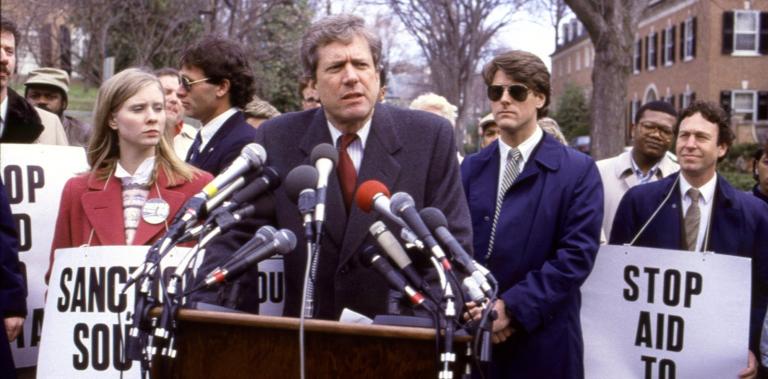
I’ve been watching a lot of old movies and TV shows since the COVID-19 lockdown began. One of the more interesting things I’ve discovered is Tanner ’88, a mockumentary about the months leading up to the 1988 presidential election, written by Doonesbury cartoonist Garry Trudeau and directed by Robert Altman (of M*A*S*H and The Player fame).
The series, which first aired on HBO and is now streaming on the Criterion Channel, follows former Congressman Jack Tanner (Michael Murphy) as he runs for president, and one of the things that makes it such a fascinating time capsule is how it blends footage of Tanner’s fictitious campaign with footage of the actual campaigns of that time.
The first episode — filmed before the New Hampshire primaries, when the Democratic race was wide open — even makes a couple of disparaging references to Joe Biden! Interestingly, though, the series never refers to Bill or Hillary Clinton, who would come to dominate Democratic politics for most of the subsequent election cycles.
The first episode lasts about one hour, and the ten episodes after that are half an hour each, so I watched the series one hour at a time and posted some comments to my personal Facebook page after each viewing. And since this year’s election is now just 100 days away, I figured I would re-post those comments here at my blog.
Incidentally, just to put this series in its historical context: the 1988 election, which was ultimately won by Republican sitting Vice President George H. W. Bush, was:
- the first time Americans voted for the same party three times in a row since Franklin D. Roosevelt won his third election in 1940,
- the first time a sitting member of the President’s cabinet was elected president since Secretary of Commerce Herbert Hoover won the presidency in 1928, and
- the first time a sitting Vice President was elected to the presidency since Martin Van Buren was elected in 1836 (other Vice Presidents had become President since then, but usually after their predecessors died or resigned mid-term, with the exception of Richard Nixon, who lost his first presidential bid in 1960 but then won on his second attempt in 1968… when his opponent was the new sitting Vice President).
So it was by no means a foregone conclusion that George H. W. Bush would win the 1988 election. The Democrats stood a very good chance of winning that election, which makes this series’ depiction of the Democratic race for the presidential nomination just that much more interesting. Things were arguably very up-in-the-air at that time.
And now, my episode-by-episode comments:
–
Tanner ’88 episode 1: Oh, what a blast from the past. The ’80s hair. The big glasses. The Kaypro portable computers. The styrofoam McDonald’s packaging.
And the politics. Tanner ’88 is a political mockumentary directed by Robert Altman and written by Doonesbury’s Garry B. Trudeau, about a former congressman running for president, and it drops lots of names that I remember hearing back in the day, including some that continue to loom large on the political scene. The first episode even features cameos by Gary Hart (who had recently re-entered the Democratic race, following the Donna Rice scandal), Bob Dole (who went on to be the Republican nominee eight years later) and Pat Robertson (who ran for the Republican nomination back then, and still does the televangelist thing on The 700 Club).
I hadn’t realized, until I looked up the miniseries’ Wikipedia page, that it was produced over a six-month span, essentially covering the Democratic nomination process in real time, and sometimes going for almost a month without a new episode. (There are 11 episodes in total, all released between February and August of 1988 — basically spanning the period from before the New Hampshire primaries to the Democratic National Convention.)
The series was produced for HBO in 1988, and then it was aired again, with new one- or two-minute intros for each episode, on the Sundance Channel in 2004 — and the Criterion Channel has the intros as well as the original episodes. So the characters are looking back on the 1988 campaign after a 16-year gap, and I am now watching the series 16 years after those intros were recorded, which is nicely symmetrical. And the intros do draw attention to the coarsening of American culture — pop culture and political culture alike — in the years between 1988 and 2004. Tanner himself, in his intro to Episode 1, comments on the fact that Johnny Carson may have told a few discrete jokes about Gary Hart’s sex scandal in 1988, but Jay Leno was doing six blowjob jokes a night ten years later during the Bill Clinton scandal. (And now, of course, Trump is president after bragging about the size of his penis during a Republican primary debate.) Tanner also talks about the fact that George W. Bush hired someone to dig up dirt on himself in 2000 as a sort of pre-emptive move, which was apparently not a common thing before that.
From today’s perspective, possibly the most interesting thing is the references to Joe Biden. Much of Episode 1 revolves around a focus group that has been asked to watch a political ad, and the focus group complains that the ad has too many references to other people’s ideas, so much so that one person compares it to the plagiarizing that Biden was accused of at the time (“It’s almost like Biden. Instead of coming out and just plagiarizing, he puts these old faces around him. It’s the same thing. He’s not saying anything. He’s letting other people speak for him”). And at the end of the episode, Tanner complains about how Biden dodged a “Who’s your favorite Beatle?” question by saying he always preferred jazz. (Tanner says something like, I’m ten years older than Biden but I was paying attention in the ’60s and he wasn’t.)
We also see campaign posters for Al Gore (who got elected vice president four years later), Michael Dukakis (who did get the 1988 nomination in the end) and Paul Simon (no, not the singer, the other guy, the one who always wore a bowtie).
It’s fun to see Pamela Reed as one of the campaign staff; I don’t think I’ve seen her in anything since 2000’s Proof of Life, but she popped up in a few things I saw back in the early ’90s. And a very young Cynthia Nixon is here as Tanner’s daughter; the character is 19 (and her father is surprised to learn that she has a driver’s license!), and the actress turned 22 while the series was being produced.
So, a very interesting watch, especially in an election year.
–
Tanner ’88 episodes 2-3: These episodes aired almost a month apart — in March and April 1988 — but they seem to take place (at least partly) on the same night, at a Nashville concert for Tanner featuring Waylon Jennings and a few other musical acts. (Politics and country music in Nashville? Sounds right up director Robert Altman’s alley!)
Amusingly, a fight breaks out while Tanner is speaking to the audience and it is assumed that an attempt was being made on Tanner’s life. It turns out that this assumption was incorrect, but Tanner’s staff say it’s great news either way, because — in addition to the free publicity — it now qualifies him for Secret Service protection.
It is mentioned a few times that Tanner has beaten Al Gore in the primary in Gore’s home state of Tennessee. In reality, Gore won his home state (and six other states) but ended up withdrawing from the race on April 21, nine days after Episode 3 aired. That left Michael Dukakis and Jesse Jackson as the only major contenders left for the Democratic nomination.
(Both names — Dukakis and Jackson — were mentioned in Episode 1 but I don’t recall them coming up in these two episodes. Incidentally, in Episode 1 there was a scene where someone said the voters were looking for “a white Jesse Jackson”, and someone else replied, dimwittedly, “Or a black Bruce Babbitt!” I know nothing about Babbitt — who withdrew from the race on February 16, just a few days after Episode 1 aired — so I have no idea if there was any deeper subtext to that line aside from the race-reversal and, I dunno, the alliterated name or whatever.)
(On another side note, I remember reading an article in Time magazine back then about how George Bush’s success against Dukakis in the election was partly due to their differences in dealing with the religious leaders who had run against them in the primaries, i.e. Bush knew how to corral the support of Pat Robertson and his constituency, but Dukakis did not know what to do with Jackson and his constituency.)
(By the way, you know whose name hasn’t come up at all so far? Bill Clinton. And he’s the guy who actually won the nomination — and the election — just four years later. I’m aware that Clinton didn’t campaign at all in 1988, but it’s kind of funny how this snapshot of Democratic politics in one election cycle sheds absolutely no light — so far, at any rate — on the person who ended up winning the next cycle.)
One bit I found rather interesting in these episodes is a scene where Tanner’s staff tell him to avoid being seen carrying his own suit bags, like regular folk. It doesn’t look good, they say, if a politician carries his own stuff like regular people do. Voters want a politician who is so comfortable with power that he shares it, by delegating jobs to people! And to prove the point, they play back Bob Dole’s cameo from Episode 1 and show how Dole, when handed one of Tanner’s campaign buttons, immediately passed it to a member of his entourage — a designated button-catcher! You might think that being surrounded by an entourage would make a person look out of touch, etc., but the idea that voters want a leader who can delegate puts an interesting and more positive-sounding spin on that.
Side note: Veronica Cartwright has joined the cast, as one of the reporters following Tanner! And Cleavon Little appears as a civil rights activist who is an old friend of Tanner’s but is rightfully wary of their friendship being exploited for political gain.
–
Tanner ’88 episodes 4-5: In which Tanner gets arrested while taking part in an anti-apartheid protest — which immediately gets spun by some as a possible boost to his campaign, though Tanner himself is not convinced.
One of the cute ironies of the arrest, though it’s not dwelled on particularly, is the fact that Tanner recently qualified for Secret Service protection — so he’s got Secret Service agents declaring that they can’t let the cops arrest him.
Meanwhile, Tanner’s daughter (the 19-year-old Cynthia Nixon character) gets really excited by the fact that the arrest gives her a platform to speak out against apartheid (not just in front of an audience, but on TV, where her speech is broadcast). Tanner, for his part, seems embarrassed by the whole thing and tells his team to get “Amy Carter” off the stage.
(Among other things, the Cynthia Nixon character demands to know why Jesse Jackson wasn’t at the protest. We are also informed that Tanner’s civil-rights-leader friend — the one whose friendship with him was awkwardly exploited by the campaign staff at the end of episode 3 — came out in support of Jackson the next day.)
In the 2004 intro to one of these episodes, Tanner comments that getting arrested for political reasons might work as part of your narrative if you’re a politician in Argentina or some such place, but not in America. He then says the kind of arrest that works for an American politician is the DUI charges that surfaced during George W. Bush’s campaign in 2000, because they show he’s a regular manly guy. I’m not sure that that’s fair, though, as my recollection is that those DUI charges came up very late in the campaign and were thought — by some, at least — to be the reason Bush lost the popular vote and came very close to losing the Electoral College as well. The DUI charges cost Bush rather than helped him.
Meanwhile, we get a sea of cameos at a campaign party in episode 4, but the only face that jumped out at me was Chris Matthews (he had apparently become the Washington, DC bureau chief for the San Francisco Examiner one year earlier; he published his first book, Hardball, the same year this miniseries aired but wouldn’t launch the TV show of that name until 1997). Even after seeing the list of “as themselves” names in the credits at the end of the episode, I still didn’t recognize anyone but Matthews. Meanwhile, Bruce Babbitt has an extended cameo in episode 5 as he goes for a walk with Tanner and gives him some advice.
Meanwhile, two possible scandals emerge:
First, Tanner’s videographer snoops around in his journals and creates a political campaign ad that would reveal Tanner’s use of drugs during the ’60s, as part of a “get real” approach encouraging the legalization of drugs. Tanner and the rest of his campaign staff are shocked by this. But of course, it was an issue that everyone knew was lurking right around the corner: the baby boomers were on the verge of moving into the White House, and everyone knew that many/most of them had used drugs at some point, so finding a boomer candidate who hadn’t used drugs would have been very very difficult, but there were still a lot of older voters who would have rejected out-of-hand any candidate who had used them. And thus, four years after this miniseries aired, Bill Clinton had to do that whole song-and-dance about how he once put a joint in his mouth but supposedly didn’t inhale. (Things were a lot different in 2008 — twenty years after this miniseries — when Obama got elected and nobody cared that he had talked in one of his memoirs about doing various drugs including cocaine.)
Second, previous episodes have hinted at the fact that Tanner has a… girlfriend? mistress? what’s the word we should use here? Lover, maybe. (Tanner isn’t married.) Anyway, episode 5 reveals that his lover happens to be working on the Dukakis campaign, which apparently comes as a shock to a member of Tanner’s staff who is thinking of defecting to the Dukakis team. I’m not sure how long it’s been since a major American candidate was unmarried, but it’s hard to imagine that a candidate these days would have to keep his lover secret from the world, if indeed he (or she) had one. The fact that Tanner’s lover works for the other side is also interesting in light of the fact that, just four years later, the Bush and Clinton campaigns would be run by real-life lovers Mary Matalin and James Carville (who got married after Clinton beat Bush in the polls), and there was no attempt to keep their aisle-crossing relationship a secret.
Edited to add: The videographer mentions that his Handicam cost $2,700. That’s in 1988 dollars. Converted to today’s dollars, that would be about $5,800. Can you imagine spending that much for a handheld video camera nowadays — let alone one with such low picture resolution?
–
Tanner ’88 episodes 6-7: These episodes aired in June, by which point the Democratic race had long since narrowed to Michael Dukakis and Jesse Jackson — so the series can no longer keep those guys off-screen, treating them as just two more candidates, like Tanner, in a wide-open race. Instead, the series has to incorporate them into the action somehow — or, perhaps more accurately, the series has to incorporate Tanner into the action, by making him one of three Democratic contenders who have refused to throw in the towel (even though a weak candidate like Tanner almost certainly would have withdrawn from the race for real by now).
And so, we get a scene in which Tanner takes part in a televised debate with Dukakis and Jackson. We see the debate entirely from backstage, as it were, as the reporters and the campaign staff watch from the sidelines and the actual debaters appear only on the monitors. (I assume the series uses footage of an actual debate between Jackson and Dukakis and throws in a few clips of Tanner as well.) Tanner gets a few zingers in there and comments afterwards that he might have offended some of his own staff, and he worries that the debate format is more about “great television” than anything else — which is an interesting comment to make in a series like Tanner ’88 which is partly a Democratic wish-fulfillment fantasy (what if a candidate openly endorsed drug legalization?) and is also nothing if not, well, television.
Episode 7 also concludes with the media exposing Tanner’s affair with Dukakis’s campaign co-chair. This really upsets Tanner’s (female) campaign leader, who accuses him of being another Gary Hart (but Hart committed adultery, whereas Tanner is divorced and, thus, available) and of embarrassing two campaigns, both his and Dukakis’s. Again, this whole subplot seems very strange in hindsight, given that James Carville and Mary Matalin were quite open about their own relationship — and they worked for entirely different parties! — just four years later. Maybe the fact that Tanner is the actual candidate changes things, but then, that raises another point: When was the last time the Democrats or Republicans nominated — or even seriously considered nominating — someone who wasn’t married? And, given that no one expects couples to wait for marriage these days, what sort of expectations would there be for an unmarried president and the kind of relationships he might have? I imagine there would be security concerns, and diplomacy concerns, etc., etc.
Meanwhile, along the way, Tanner stops at a daycare centre and starts talking to the preschoolers about “tax abatements”, and Rebecca De Mornay hosts a get-out-the-vote rally and Tanner’s staffer tries to fill him in on pop-culture references and box-office statistics. (When she mentions that Tom Cruise starred in Top Gun — the top-grossing movie of 1986, which was only two years earlier — Tanner replies that he thought they weren’t making Westerns any more. Tanner, remember, is the guy who complained at the beginning of this series that Joe Biden wasn’t paying attention to pop culture in the ’60s.) The movie-biz stuff is kind of funny to watch, now, given that director Robert Altman went on to revive his big-screen career with the cameo-filled Hollywood satire The Player just four years later.
–
Tanner ’88 episodes 8-9: Things get serious when Tanner pays a visit to the black community in Detroit.
I could be wrong, but I assume that much of the conversation here is essentially improvised. Tanner says he’s there to listen, not to speak, and it certainly feels like the filmmakers wanted to give members of the black community an opportunity to express their pain and frustration. The thing is, the people doing all the speaking are speaking to a fictitious candidate for president — and the fictitious candidate in question also happens to be a bland white man at a time when a black civil rights leader, Jesse Jackson, was the only real-life contender giving Michael Dukakis a run for his money. So it’s not like any of these people would have pinned any real-life hopes on Tanner.
In fact, one thing that stands out about the scene is how Tanner repeats what he said in the debate a couple episodes ago, about the need to legalize drugs. The vast majority of the black people he speaks to are against legalizing drugs because of what drugs has done to their community. So that’s another reason why it seems unlikely that Tanner could be building any sort of bridge between his campaign and this community. It just underscores the fact that, in real life, a weak candidate like Tanner simply wouldn’t be in the race any more — he’s not making any headway here — and it leaves you wondering if maybe the series should have expended its dramatic energies elsewhere…
…but then you get to the next episode, which focuses more on the purely dramatic/fictitious side of things, and it’s hard to buy into the reality of this episode, too, because this is the one in which Tanner and his lover, the former Dukakis campaigner, decide to get married — right in the middle of his campaign! Mere days, if that, after he proposes to her offscreen!
Admittedly, I have no idea how the American public would react now — much less 32 years ago — to the discovery that a candidate for president had a secret girlfriend, and whether the public would expect the couple to get married at all, and whether it would matter to the public whether the marriage took place before or after he was nominated by his party. But the decision looks pretty rash, and when it falls apart on the wedding day itself, Tanner and his girlfriend decide to get married in November instead, i.e. after the election. (I do like how Tanner’s daughter has made napkins for the wedding that feature the couple’s names and the campaign slogan “For real.”)
Meanwhile, Tanner — who hasn’t picked a VP yet — announces his cabinet, and so we get cameos from Ralph Nader, Gloria Steinem, Art Buchwald and others. (Tanner’s campaign chief exclaims at one point, “What a coup! Do you know how many people have been trying to talk Nader out of his political virginity?” Nader, of course, would eventually be widely blamed for stealing just enough votes from Al Gore twelve years later to cost Gore the Electoral College, thus throwing the 2000 election to George W. Bush, the son of the Republican who was running for president when this series aired.)
There’s also a funny scene where Tanner’s very grumpy father (played by E.G. Marshall) talks about how he proposed to Tanner’s mother, and it has something to do with giving Tanner’s mother a diabetes shot on their first date. Something to do with the trust it took the mom to let a boyfriend do that, and the love it took the dad to be willing to do that so early in the relationship.
Also: Jeff Daniels has a bit part in one of these episodes as a park ranger. It’s a bit odd seeing an actor of Daniels’ stature in such a tiny role (he had already starred in 1983’s Terms of Endearment, 1985’s The Purple Rose of Cairo and 1986’s Something Wild by this point), but anyhoo.
Episode 9 ends with Tanner checking out the stadium where the Democratic National Convention is going to happen, and the set is being built as he walks around in there. It’s a nice “documentary” moment in a generally fictitious storyline. (This episode aired July 17. The actual convention began July 18.)
–
Tanner ’88 episodes 10-11: The Democratic National Convention!
It’s kind of fascinating to see how the series weaves fiction and reality together here. For the episode set during the Convention itself, the series pretty much limits itself to backroom shenanigans as Tanner’s crew work the phones and try to get as many delegates and/or superdelegates as possible to do whatever it takes to give their candidate a shot. So the episode blends documentary footage of votes being counted on the floor with dramatic footage of things happening behind closed doors, and it all feels very urgent and dynamic.
Then, after the Convention is over and Michael Dukakis has secured the party’s nomination, the final episode turns to whether Tanner will openly support Dukakis or continue to run as an independent, thus possibly splitting the Democratic vote and guaranteeing the election of George Bush. And in the middle of all this, Tanner’s girlfriend — the former Dukakis campaign worker — has a meeting with the actual Kitty Dukakis (!) who assures her that the split between Tanner’s girlfriend and the Dukakis campaign is water under the bridge, and that family is important but so is party unity… So the series ends with Tanner’s girlfriend asking him if he’ll endorse Dukakis, and Tanner looking away and leaving the question hanging there — which is really kind of amazing to see in an episode that, on some level, bears the Dukakis family’s imprimatur!
These two episodes aired in August, over two months before the actual election in November, and in the bonus feature, Garry Trudeau and Robert Altman talk about how they were hoping to do another three or four episodes following Tanner’s independent run for the presidency — but they were still working on this episode when they heard that HBO was going to end the series here. Personally, I think the series ends on a perfectly ambiguous note, but I must admit I am curious to see how they would have kept their candidate in the race long after the real world had passed him by. (We saw the series insert Tanner into an intra-party debate between Dukakis and Jesse Jackson; would they have tried something similar with the inter-party debate between Dukakis and Bush?)
Incidentally, the reason we are given for Tanner’s possible independent run is that his campaign chief spoke to all the Democratic Party higher-ups and sensed that they were so “unenthusiastic” about their candidate that Bush could win the election — so perhaps a third-party candidate like Tanner, who is even more liberal than Dukakis, could have a chance. That matches what I remember about the mood during that election season; I have a vivid memory of my first-year university professor talking about how the American political process had resulted in two candidates — Dukakis and Bush — that no one really wanted to vote for, but everyone knew the presidency would end up going to one of those two guys.
Meanwhile, for the time capsule: The Convention chair tells the delegates that a woman is going to come and explain to them the “new process” that will allow them to cast their votes using “electronic devices”. One of the women working the phones says she’s speaking to someone who is pregnant and going to the hospital, and she has to clarify for her boss that the woman she’s speaking to is using a “car phone”. We see what looks like a Confederate flag hanging next to the U.S. flag, but it’s actually the state flag of Georgia (which is where the Convention took place) — and I learn from Wikipedia that the Confederate flag was added to the state flag of Georgia in 1956, and it stayed there until 2001.
And in the bonus feature, Altman says shooting the episode with the representatives from the black community a few episodes back marked the first time he had ever heard of rap — which is striking, to me, as I was a big fan of Christian pop singer Steve Taylor at the time, and Taylor had done his own version of a rap song (‘Bad Rap (Who You Tryin’ to Kid, Kid?)’), which mentions other rap artists like Grandmaster Flash by name, way back in 1983, five years before this series was produced.
So, that was a fun watch. There was a sequel miniseries in 2004 called Tanner on Tanner, but I’m not sure if it’s available anywhere. If I can find it, though, I’ll try to watch it — even though it won’t be quite the blast from the past that the 1988 series was.
–
One extra comment: It was only while prepping this blog post that I realized the actors who play Tanner and his lover — Michael Murphy and Wendy Crewson — were a real-life couple who got married the same year the series aired! I wonder which came first, the relationship or their work on the miniseries? (I interviewed Crewson in 2002, and she mentioned her marriage to Murphy during our chat. The couple divorced in 2009.)
Previous Post

July 24, 2020
The Chosen starts shooting its second season this fall
Next Post

August 3, 2020 Queen Esther musical coming to live-streaming in September
Browse Our Archives
Select a Category Anglican Planet Articles BC Christian News BC Report Bible Movies Bible Review Blog Books & Culture Campus Times CBC Radio Christianity Today ChristianWeek Essays Faith Today Festival Cinemas Guide Film Journals Georgia Straight Interviews MB Herald National Catholic Register Salvationist Today's Christian Two Chairs Ubyssey Uncategorized Vancouver Courier Vancouver Sun
Select a Month August 2025 April 2025 January 2025 December 2024 November 2024 May 2024 February 2024 December 2023 May 2023 March 2023 November 2022 July 2022 June 2022 May 2022 April 2022 February 2022 January 2022 December 2021 November 2021 October 2021 September 2021 August 2021 July 2021 June 2021 April 2021 March 2021 February 2021 January 2021 December 2020 November 2020 October 2020 August 2020 July 2020 June 2020 May 2020 March 2020 February 2020 January 2020 December 2019 November 2019 September 2019 July 2019 May 2019 April 2019 March 2019 February 2019 January 2019 December 2018 November 2018 October 2018 September 2018 July 2018 June 2018 May 2018 April 2018 March 2018 February 2018 January 2018 December 2017 November 2017 October 2017 September 2017 August 2017 July 2017 June 2017 May 2017 April 2017 March 2017 February 2017 January 2017 December 2016 November 2016 October 2016 September 2016 August 2016 July 2016 June 2016 May 2016 April 2016 March 2016 February 2016 January 2016 December 2015 November 2015 October 2015 September 2015 August 2015 July 2015 June 2015 May 2015 April 2015 March 2015 February 2015 January 2015 December 2014 November 2014 October 2014 September 2014 August 2014 July 2014 June 2014 May 2014 April 2014 March 2014 February 2014 January 2014 December 2013 November 2013 October 2013 September 2013 August 2013 July 2013 June 2013 May 2013 April 2013 March 2013 February 2013 January 2013 December 2012 November 2012 October 2012 September 2012 August 2012 July 2012 June 2012 April 2012 January 2012 January 2011 December 2010 November 2010 October 2010 September 2010 August 2010 July 2010 June 2010 May 2010 April 2010 March 2010 February 2010 January 2010 December 2009 November 2009 October 2009 September 2009 August 2009 July 2009 June 2009 May 2009 April 2009 March 2009 February 2009 January 2009 December 2008 November 2008 October 2008 September 2008 August 2008 July 2008 June 2008 May 2008 April 2008 March 2008 February 2008 January 2008 December 2007 November 2007 October 2007 September 2007 August 2007 July 2007 June 2007 May 2007 April 2007 March 2007 February 2007 January 2007 December 2006 November 2006 October 2006 September 2006 August 2006 July 2006 June 2006 May 2006 April 2006 March 2006 February 2006 January 2006 December 2005 November 2005 October 2005 September 2005 August 2005 July 2005 June 2005 May 2005 April 2005 March 2005 January 2005 December 2004 November 2004 October 2004 September 2004 August 2004 July 2004 June 2004 May 2004 April 2004 March 2004 February 2004 January 2004 November 2003 October 2003 August 2003 July 2003 June 2003 May 2003 January 2003 December 2002 November 2002 August 2002 July 2002 June 2002 May 2002 March 2002 January 2002 December 2001 November 2001 September 2001 August 2001 July 2001 June 2001 April 2001 March 2001 February 2001 December 2000 November 2000 October 2000 September 2000 August 2000 July 2000 June 2000 May 2000 April 2000 March 2000 January 2000 October 1999 August 1999 May 1999 April 1999 February 1999 January 1999 December 1998 November 1998 October 1998 August 1998 July 1998 June 1998 April 1998 March 1998 January 1998 November 1997 September 1997 July 1997 June 1997 April 1997 March 1997 February 1997 January 1997 December 1996 October 1996 September 1996 June 1996 March 1996 February 1996 January 1996 April 1995 November 1994 September 1994 September 1991
Follow Us!
TAKE THE
Religious Wisdom Quiz
What weapon did David use to defeat Goliath?
Select your answer to see how you score.
A bow and arrow A sword A spear A sling and a stone
Related posts from FilmChat

Joseph of Egypt – the Chosen spin-off announces...

Exclusive: A clip from Angel Studios' The King...

Exclusive: Watch a clip from Angel Studios' Brave...

Exclusive: Watch a clip from Angel Studios' Homestead
TRENDING AT PATHEOS Religious Music & Entertainment

"Les Diabolique" and Transgression
Alongside something like Arrival, Vertigo, or Charade, Les Diaboliques is a...

"The Plague Dogs" and Mortality
So, flashback to the late 70s, early 80s. Walt Disney Studios is...

With the recent and highly successful release of Christopher Nolan’s epic film,...

"L'avventura" and Human Weakness
Today's piece is going to be a little different for a few...

I first want to apologize for not posting or writing anything. I'm...

I've engaged in the multi-year project of reading through the Church Fathers,...
view all Religious Music & Entertainment blogs
Ad-Free & Subscriber Log-In Subscription Support
- About Us
- 2026 Calendar
- Videos
- Podcasts
- Library of World Religions
- Faith In Media Tracker
- Advertise With Us
- Write for Us
- Privacy Policy
- Terms of Service
- Do Not Sell My Data
- Contact Us
- Radiant Digital
- Manage Newsletter Subscriptions
- Unsubscribe From Notifications
- Sitemap
Copyright 2008-2026, Patheos. All rights reserved.
Subscription Support Ad-Free & Subscriber Log-In
Follow Patheos