
BuddhistCatholicContemplativeEvangelicalGeneral ChristianHinduJewishLatter-day SaintMuslimNew VisionsProgressive Christian
Beliefs
- Buddhist
- Catholic
- Contemplative
- Evangelical
- General Christian
- Hindu
- Jewish
- Latter-day Saint
- More Voices
- Muslim
- New Visions
- Pagan
- Progressive Christian
Topics
- Religion News
- Food and Religion
- Sports and Religion
- Religious Art
- Religious Music and Entertainment
- Religious Events
- History and Religion
- Style and Religion
- Politics and Religion
- Women in Religion
- Recreation Outdoors and Religion
- Business Finance and Religion
- Careers Workplace and Religion
- Education and Religion
- Family Parenting and Religion
- Health Fitness and Religion
- Home and Religion
- Relationships and Religion
- Technology and Religion
- Travel and Religion
Columnists
- Buddhist Columnists
- Business Finance and Religion Columnists
- Careers Workplace and Religion Columnists
- Catholic Columnists
- Contemplative Columnists
- Education and Religion Columnists
- Evangelists Columnists
- Family Parenting and Religion Columnists
- General Christian Columnists
- Health Fitness and Religion Columnists
- Hindu Columnists
- History and Religion Columnists
- Home and Religion Columnists
- Jewish Columnists
- More Voices Columnists
- Latter Day Columnists
- Muslim Columnists
- New Visions Columnists
- Nonreligious Columnists
- Pagan Columnists
- Politics and Religion Columnists
- Progressive Columnists
- Recreation Outdoors and Religion Columnists
- Relationships and Religion Columnists
- Religion News Columnists
- Religious Art Columnists
- Religious Events Columnists
- Religious Music and Entertainment Columnists
- Sports and Religion Columnists
- Style and Religion Columnists
- Technology and Religion Columnists
- Travel and Religion Columnists
- Women in Religion Columnists
Resource Library
- 2026 Calendar
- Library of World Religions
- The 100 Most Holy Places on Earth
- Patheos Answers
- Podcasts
- Videos
- Faith Leaders Database
- Anglican Episcopalian
- Bahai
- Baptist
- Buddhism
- Christianity
- Confucianism
- Eastern Orthodoxy
- Hinduism
- Holiness and Pentecostal
- ISKCON
- Islam
- Judaism
- Lutheran
- Methodist
- The Church of Jesus Christ of Latter-day Saints
- New Age
- Paganism
- Presbytarian and Reformed
- Protestantism
- Religion Behind the Scenes
- Roman Catholic
- Scientology
- Shia Islam
- Sikhism
- Sufism
- Sunni Islam
- Taoism
- Zen
- See all religions
Research Tools
 Ad-Free & Subscriber Log-In Subscription Support
Ad-Free & Subscriber Log-In Subscription Support
Follow Patheos 

- Trending:
- Forgiveness
- |
- Marriage
- |
- Consciousness
- |
- Death Penalty
- |
- Election
- |
- Halloween

-
Articles
- Home
- Religious Music & Entertainment
- The Chosen — season one, episode three
The Chosen — season one, episode three
Last updated on: August 25, 2022 at 5:35 pm by Peter T. Chattaway
The Chosen — season one, episode three 2022-08-25T17:35:48-07:00 Peter T. Chattaway
Patheos Explore the world's faith through different perspectives on religion and spirituality! Patheos has the views of the prevalent religions and spiritualities of the world.
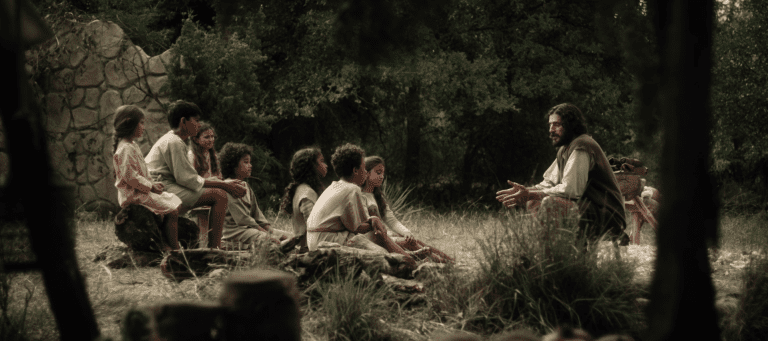
Season 1, Episode 3 — ‘Jesus Loves the Little Children’
Synopsis. Jesus is living in a tent on the outskirts of Capernaum. He cooks his own food, he bandages his arm, he plies his trade as a craftsman, and he says his prayers. A young girl named Abigail discovers his tent and plays with some of the objects she finds, but she runs away when he returns. The next day she comes back with a boy, and they introduce themselves to Jesus. The two children return the next day with other children, and as time goes by, Jesus tells them stories and teaches them how to pray. Eventually Jesus packs up and goes, but not before leaving some toys and a note behind, just for Abigail.
–
Gospels. This episode does not dramatize any stories from the gospels. However, it does feature several teachings of Jesus’ that come, directly or indirectly, from the gospels:
- Abigail says her family isn’t wealthy, and Jesus says, “Many times, that’s better.” This echoes how Jesus said it is difficult for rich people to enter the kingdom of heaven (Mark 10:17-25, Matthew 19:16-24, Luke 18:18-25).
- Jesus says his Father provides everything he needs. This echoes how Jesus told his followers not to worry about food and clothes because their heavenly Father knows what they need (Matthew 6:25-34, Luke 12:22-31).
- Jesus gets the children to recite the Shema, which the biblical Jesus identified as the most important commandment in the Hebrew Bible (Mark 12:29-30).
- Jesus teaches the children to recite Matthew’s version of the Lord’s Prayer (Matthew 6:9-13; there is a slightly different version in Luke 11:2-4).
- When one boy quotes the biblical principle of “an eye for an eye”, Jesus cautions against seeking revenge against other people (Matthew 5:38-42).
- Jesus tells the children parents and teachers should be honoured even though they are not always wise. This may parallel how Jesus told his followers to do what the Pharisees preached but not what they practiced (Matthew 23:1-3).
- Jesus quotes a pastiche of Isaiah 61:1-2 and 58:6 to explain his reason for being there, just as the biblical Jesus quoted those verses as a mission statement of sorts while visiting a synagogue at the start of his ministry in Luke 4:16-21.
- Jesus says many adults need the faith of children, and he hopes his next students (i.e. the disciples) will ask him questions and understand his answers the same way the children did. This echoes how Jesus said his followers should be like little children (Mark 10:13-16; Matthew 18:1-5, 19:13-15; Luke 18:15-17), God has hidden things from the wise and revealed them to children (Matthew 11:25, Luke 10:21), and God has called forth praise from the lips of children (Matthew 21:15-16).
Other things Jesus says in this episode hark back to the gospels in interesting ways:
- The episode begins with Jesus praying, “Father, glorify me with yourself. Father, speak through me.” This echoes the way Jesus often speaks about himself being glorified with God in John’s gospel (John 8:54, 13:31-32, 16:14, 17:1-5), but the fact that he delivers the prayer with such emotion — and at night, no less — brings to mind how he was full of sorrow and anguish while begging God to save him from crucifixion in the Synoptic gospels (Mark 14:35-36, Matthew 26:36-39, Luke 22:39-44).
- At one point, the children wake Jesus up in the morning, and he says, “You couldn’t have waited half an hour, eh?” This line plays on the scene in the gospels where Jesus chided his disciples for falling asleep while he was praying in Gethsemane — “Couldn’t you keep watch for one hour?” — in Mark 14:37 and Matthew 26:40.
- Jesus says he likes many different foods but especially bread. The biblical Jesus never expressed any opinion on the subject, but of course he performed miracles with bread (Mark 6:35-44, 8:1-10; Matthew 14:13-21, 15:32-38; Luke 9:12-17; John 6:5-13), he called himself “the bread of life” (John 6:35, 48) and “the living bread that came down from heaven” (John 6:51, 58), and he instituted the sharing of bread and wine at communion (Mark 14:22, Matthew 26:26, Luke 22:19, I Corinthians 11:23-24).
–
The way Abigail brings her friends to see Jesus and speculates that Jesus might be a new prophet is reminiscent of the Samaritan woman, who called Jesus a prophet and brought the people from her town out to see Jesus for themselves (John 4:19, 28-30, 39-42).
–
Abigail asks Jesus if he is a “carpenter”, and he replies that he is a “craftsman” who makes all sorts of things. The idea that Jesus was a carpenter comes from a single verse — Mark 6:3 — in which the people of Nazareth call him a tekton, a Greek word that refers to someone who works with wood, stone and other construction materials.
John Dominic Crossan has argued that the word also had social connotations, because peasants who have land of their own tend to look down on peasants who don’t — so tekton may have been less a description of the kind of work that Jesus did and more of a quasi-insulting “euphemism for a dispossessed peasant, for a landless laborer.”
–
Old Testament. Jesus and the children quote several Old Testament passages:
- “An eye for an eye.” (Exodus 21:24, Leviticus 24:20, Deuteronomy 19:21)
- “Hear, Israel. The Lord is our God. The Lord is one. You shall love the lord your God with all your heart, all your soul, and all your might. And it shall come to pass, if you surely listen to the commandments I command you today, that you may gather in your grain, your wine, and your oil, and you will eat, and you will be satisfied. I am the Lord your God, who led you from the land of Egypt to be a God to you. I am the Lord your God. Amen.” (Deuteronomy 6:4-5, 11:13-15; Numbers 15:41)
- “Vengeance is mine.” (Deuteronomy 32:35)
- “God says he will have compassion on his people when their strength is gone.” (Deuteronomy 32:36)
- “Behold how good and how pleasing if brothers could sit together in unity.” (Psalm 133:1)
And then there is the pastiche of Isaiah 61 and 58 that I mentioned above.
–
Jesus and the children also refer to a few characters from the Hebrew Bible. One boy says Jesus is stronger than Samson (Judges 13-16), while Jesus cites the story about David refusing to kill King Saul (I Samuel 24, 26), and he tells the children the story about the young men who were killed by bears for insulting Elisha (II Kings 2:23-24).
–
Jesus asks the children, “Is there anything in scripture that says Messiah will be a great military leader?” He seems to be implying that the answer to his question is “no”, but, as we saw in our recap of the pilot episode, there are prophecies in the scriptures about messianic figures defeating Israel’s enemies and ruling them with the sword. Christians tend to skip those bits when we quote the prophecies, but they’re definitely there.
–
When Jesus finishes one of his carpentry projects, he looks at it and says, “It is good.” This echoes how God repeatedly saw that what he created was good in Genesis 1.
–
Themes. The children agree amongst themselves not to tell anyone — or at least not any adults — about Jesus. But at the end of the episode, Jesus says he hopes the adult followers he is about to have will tell people about him, the way the children have.
This curiously echoes the tension within the gospels between the passages (primarily in Mark) in which Jesus tells people to keep his identity a secret and the other passages (primarily in John) in which he speaks quite openly about who and what he is.
–
As with the previous episode, which saw Jesus attend the modest Shabbat dinner hosted by Mary Magdalene rather than the fancier dinner hosted by Nicodemus, this episode emphasizes Jesus’ outreach to the humble — including not just children generally but the children of the poor specifically. As Jesus says, “I did not come only for the wealthy.”
–
Historical quibbles. Jesus points out that the girls don’t go to Torah class, but he also leaves a note for Abigail in which he says he knows that she can read. Suffice it to say that historians are divided on the question of whether the average male peasant would have been able to read in Jesus’ day. Girls almost certainly would not have been.
–
When Abigail says Jesus might be a new prophet, one of her friends says the local rabbi has said that there aren’t any new prophets. This feels like an anachronism, inasmuch as it echoes the pilot episode’s claim that the prophets had been “silent” for centuries. To the Jews of Jesus’ day — including Jesus himself — this was far from obvious.
–
The children wake Jesus up after the sun has come up, but Mark 1:35 indicates that Jesus tended to get up “very early in the morning, while it was still dark” to say his prayers.
–
The particular kind of prayers Jesus says in this episode may be a bit anachronistic. For example, before going to sleep, he recites the Bedtime Shema, which comes from the rabbinic period, some time after the period in which this series is set.
–
Jesus lives in a tent, which may reflect how the biblical Jesus said during his ministry that he had “no place to lay his head” (Matthew 8:20, Luke 9:58), but we do know that Jesus lived in a house — his own or someone else’s, perhaps Simon’s — for at least part of his stay in Capernaum (Mark 1:35; cf. the reference to Simon’s home in Mark 1:29).
–
Humanization. This episode emphasizes the emotions Jesus feels — how deeply moved he is — when he prays to God and when he hears the children recite the Shema.
The episode also shows Jesus making playful, farty raspberry noises when he tries to lure Abigail and her friend out from hiding before he meets them for the first time.
–
Timeline. This is the first episode that takes place entirely in AD 26, without a prologue. It is not entirely clear, however, where this episode fits next to the first two episodes.
Episode 1 seems to happen somewhere in the middle of this episode, since Jesus tells the children he was gone for a while because he needed to go into town to help a woman, which is presumably a reference to Mary Magdalene’s exorcism in Episode 1.
But he also says that he is not a teacher yet — but he “will be soon” — even though we saw him with two adult “students” (Thaddaeus and James, who addressed him as “rabbi”) in Episode 2, which seemed to be happening more or less right after Episode 1.
Jesus does say in this episode that he has “a few” friends already, “and more to come,” which might refer to the fact that he has already begun to acquire some disciples — but if that is the case, where are those “friends” during the events of this episode?
–
Language issues. The series is so committed to casual, colloquial dialogue that it comes as a bit of a surprise when Jesus teaches the children how to say the Lord’s Prayer in 17th-century English (i.e. the English found in the King James Version of the Bible).
–
Miscellaneous. The episode takes its title from a children’s song written by C. Herbert Woolston in the late 19th century. The song is noteworthy for emphasizing that Jesus loves children of all racial and ethnic backgrounds (“Red and yellow, black and white / They are precious in his sight / Jesus loves the little children of the world”).
–
Jesus tells the children they shouldn’t stray too far from home on their own, as there might be “bad men” around. In the roundtable discussion of this episode, director Dallas Jenkins and the show’s Catholic advisor, Fr David Guffey, talk about how Jesus was given these lines of dialogue partly out of concern over how this episode would play at a time when there have been many reports of child abuse within churches.
–
In his book Jesus at the Movies, W. Barnes Tatum notes that filmmakers have had a difficult time harmonizing the gospels in a way that makes dramatic sense because the gospels portray Jesus in very different, and seemingly contradictory, ways.
In Mark, for example, Jesus tries to keep his identity a secret, but in John, Jesus flaunts his divinity nearly every chance he gets. Mark also tends to emphasize the frailty of Jesus — he falls to the ground in Gethsemane, he needs someone else’s help to carry his cross, he cries out in despair before dying — whereas John tends to leave those bits out so he can focus on Jesus as a divine figure who is always in control of himself and others.
It is interesting, then, to see how this episode brings Mark and John together in its very first scene, by having Jesus recite Johannine dialogue with Marcan emotion.
–
The Chosen recaps:
Season 1: review | scripture index
Episode recaps: The Shepherd | one | two | three | four | five | six | seven | eight
Season 2: The Messengers review | scripture index
Episode recaps: one | two | three | four | five | six | seven | eight | The Messengers
–
The Chosen can be streamed in full via VidAngel or the show’s app (Android | Apple).
Clip: Jesus’ bedtime prayer:
Clip: Jesus loves the little children:
The entire episode was also livestreamed on March 31, with an intro by director Dallas Jenkins and a chat with his wife Amanda, who is writing a tie-in children’s book:
https://www.youtube.com/watch?v=0xMfU-YY3Eo
–
TV show recaps:
Prophet Joseph | The Bible | A.D. The Bible Continues | Of Kings and Prophets
Movie scene guides:
Risen | The Young Messiah | Paul, Apostle of Christ | Mary Magdalene
Previous Post

June 2, 2020
The Chosen -- season one, episode two
Next Post
June 17, 2020 The Chosen — season one, episode four
Browse Our Archives
Select a Category Anglican Planet Articles BC Christian News BC Report Bible Movies Bible Review Blog Books & Culture Campus Times CBC Radio Christianity Today ChristianWeek Essays Faith Today Festival Cinemas Guide Film Journals Georgia Straight Interviews MB Herald National Catholic Register Salvationist Today's Christian Two Chairs Ubyssey Uncategorized Vancouver Courier Vancouver Sun
Select a Month August 2025 April 2025 January 2025 December 2024 November 2024 May 2024 February 2024 December 2023 May 2023 March 2023 November 2022 July 2022 June 2022 May 2022 April 2022 February 2022 January 2022 December 2021 November 2021 October 2021 September 2021 August 2021 July 2021 June 2021 April 2021 March 2021 February 2021 January 2021 December 2020 November 2020 October 2020 August 2020 July 2020 June 2020 May 2020 March 2020 February 2020 January 2020 December 2019 November 2019 September 2019 July 2019 May 2019 April 2019 March 2019 February 2019 January 2019 December 2018 November 2018 October 2018 September 2018 July 2018 June 2018 May 2018 April 2018 March 2018 February 2018 January 2018 December 2017 November 2017 October 2017 September 2017 August 2017 July 2017 June 2017 May 2017 April 2017 March 2017 February 2017 January 2017 December 2016 November 2016 October 2016 September 2016 August 2016 July 2016 June 2016 May 2016 April 2016 March 2016 February 2016 January 2016 December 2015 November 2015 October 2015 September 2015 August 2015 July 2015 June 2015 May 2015 April 2015 March 2015 February 2015 January 2015 December 2014 November 2014 October 2014 September 2014 August 2014 July 2014 June 2014 May 2014 April 2014 March 2014 February 2014 January 2014 December 2013 November 2013 October 2013 September 2013 August 2013 July 2013 June 2013 May 2013 April 2013 March 2013 February 2013 January 2013 December 2012 November 2012 October 2012 September 2012 August 2012 July 2012 June 2012 April 2012 January 2012 January 2011 December 2010 November 2010 October 2010 September 2010 August 2010 July 2010 June 2010 May 2010 April 2010 March 2010 February 2010 January 2010 December 2009 November 2009 October 2009 September 2009 August 2009 July 2009 June 2009 May 2009 April 2009 March 2009 February 2009 January 2009 December 2008 November 2008 October 2008 September 2008 August 2008 July 2008 June 2008 May 2008 April 2008 March 2008 February 2008 January 2008 December 2007 November 2007 October 2007 September 2007 August 2007 July 2007 June 2007 May 2007 April 2007 March 2007 February 2007 January 2007 December 2006 November 2006 October 2006 September 2006 August 2006 July 2006 June 2006 May 2006 April 2006 March 2006 February 2006 January 2006 December 2005 November 2005 October 2005 September 2005 August 2005 July 2005 June 2005 May 2005 April 2005 March 2005 January 2005 December 2004 November 2004 October 2004 September 2004 August 2004 July 2004 June 2004 May 2004 April 2004 March 2004 February 2004 January 2004 November 2003 October 2003 August 2003 July 2003 June 2003 May 2003 January 2003 December 2002 November 2002 August 2002 July 2002 June 2002 May 2002 March 2002 January 2002 December 2001 November 2001 September 2001 August 2001 July 2001 June 2001 April 2001 March 2001 February 2001 December 2000 November 2000 October 2000 September 2000 August 2000 July 2000 June 2000 May 2000 April 2000 March 2000 January 2000 October 1999 August 1999 May 1999 April 1999 February 1999 January 1999 December 1998 November 1998 October 1998 August 1998 July 1998 June 1998 April 1998 March 1998 January 1998 November 1997 September 1997 July 1997 June 1997 April 1997 March 1997 February 1997 January 1997 December 1996 October 1996 September 1996 June 1996 March 1996 February 1996 January 1996 April 1995 November 1994 September 1994 September 1991
Follow Us!
TAKE THE
Religious Wisdom Quiz
Why did God reject Saul as king?
Select your answer to see how you score.
He was tricked by David He lost in battle He was too old He disobeyed God
Related posts from FilmChat

Joseph of Egypt – the Chosen spin-off announces...

Exclusive: A clip from Angel Studios' The King...

Exclusive: Watch a clip from Angel Studios' Brave...

Exclusive: Watch a clip from Angel Studios' Homestead
TRENDING AT PATHEOS Religious Music & Entertainment

"Les Diabolique" and Transgression
Alongside something like Arrival, Vertigo, or Charade, Les Diaboliques is a...

"The Plague Dogs" and Mortality
So, flashback to the late 70s, early 80s. Walt Disney Studios is...

With the recent and highly successful release of Christopher Nolan’s epic film,...

"L'avventura" and Human Weakness
Today's piece is going to be a little different for a few...

I first want to apologize for not posting or writing anything. I'm...

I've engaged in the multi-year project of reading through the Church Fathers,...
view all Religious Music & Entertainment blogs
Ad-Free & Subscriber Log-In Subscription Support
- About Us
- 2026 Calendar
- Videos
- Podcasts
- Library of World Religions
- Faith In Media Tracker
- Advertise With Us
- Write for Us
- Privacy Policy
- Terms of Service
- Do Not Sell My Data
- Contact Us
- Radiant Digital
- Manage Newsletter Subscriptions
- Unsubscribe From Notifications
- Sitemap
Copyright 2008-2026, Patheos. All rights reserved.
Subscription Support Ad-Free & Subscriber Log-In
Follow Patheos