
BuddhistCatholicContemplativeEvangelicalGeneral ChristianHinduJewishLatter-day SaintMuslimNew VisionsProgressive Christian
Beliefs
- Buddhist
- Catholic
- Contemplative
- Evangelical
- General Christian
- Hindu
- Jewish
- Latter-day Saint
- More Voices
- Muslim
- New Visions
- Pagan
- Progressive Christian
Topics
- Religion News
- Food and Religion
- Sports and Religion
- Religious Art
- Religious Music and Entertainment
- Religious Events
- History and Religion
- Style and Religion
- Politics and Religion
- Women in Religion
- Recreation Outdoors and Religion
- Business Finance and Religion
- Careers Workplace and Religion
- Education and Religion
- Family Parenting and Religion
- Health Fitness and Religion
- Home and Religion
- Relationships and Religion
- Technology and Religion
- Travel and Religion
Columnists
- Buddhist Columnists
- Business Finance and Religion Columnists
- Careers Workplace and Religion Columnists
- Catholic Columnists
- Contemplative Columnists
- Education and Religion Columnists
- Evangelists Columnists
- Family Parenting and Religion Columnists
- General Christian Columnists
- Health Fitness and Religion Columnists
- Hindu Columnists
- History and Religion Columnists
- Home and Religion Columnists
- Jewish Columnists
- More Voices Columnists
- Latter Day Columnists
- Muslim Columnists
- New Visions Columnists
- Nonreligious Columnists
- Pagan Columnists
- Politics and Religion Columnists
- Progressive Columnists
- Recreation Outdoors and Religion Columnists
- Relationships and Religion Columnists
- Religion News Columnists
- Religious Art Columnists
- Religious Events Columnists
- Religious Music and Entertainment Columnists
- Sports and Religion Columnists
- Style and Religion Columnists
- Technology and Religion Columnists
- Travel and Religion Columnists
- Women in Religion Columnists
Resource Library
- 2026 Calendar
- Library of World Religions
- The 100 Most Holy Places on Earth
- Patheos Answers
- Podcasts
- Videos
- Faith Leaders Database
- Anglican Episcopalian
- Bahai
- Baptist
- Buddhism
- Christianity
- Confucianism
- Eastern Orthodoxy
- Hinduism
- Holiness and Pentecostal
- ISKCON
- Islam
- Judaism
- Lutheran
- Methodist
- The Church of Jesus Christ of Latter-day Saints
- New Age
- Paganism
- Presbytarian and Reformed
- Protestantism
- Religion Behind the Scenes
- Roman Catholic
- Scientology
- Shia Islam
- Sikhism
- Sufism
- Sunni Islam
- Taoism
- Zen
- See all religions
Research Tools
 Ad-Free & Subscriber Log-In Subscription Support
Ad-Free & Subscriber Log-In Subscription Support
Follow Patheos 

- Trending:
- Forgiveness
- |
- Marriage
- |
- Consciousness
- |
- Death Penalty
- |
- Election
- |
- Halloween

-
Articles
- Home
- Religious Music & Entertainment
- Exclusive: Mister Rogers chronicler Tom Junod on prayer, minutes of silence, and seeing a fictionalized version of his relationship with Fred Rogers in A Beautiful Day in the Neighborhood
Exclusive: Mister Rogers chronicler Tom Junod on prayer, minutes of silence, and seeing a fictionalized version of his relationship with Fred Rogers in A Beautiful Day in the Neighborhood
Last updated on: November 7, 2019 at 6:28 am by Peter T. Chattaway
Exclusive: Mister Rogers chronicler Tom Junod on prayer, minutes of silence, and seeing a fictionalized version of his relationship with Fred Rogers in A Beautiful Day in the Neighborhood 2019-11-07T06:28:20-08:00 Peter T. Chattaway
Patheos Explore the world's faith through different perspectives on religion and spirituality! Patheos has the views of the prevalent religions and spiritualities of the world.
Fred Rogers, the Presbyterian minister turned children’s TV host who hosted Mister Rogers’ Neighborhood for over three decades, is having something of a moment right now.
Rogers himself passed away in 2003, but two movies have popped up in the past two years that have brought renewed attention to his work and his legacy: last year, Won’t You Be My Neighbor? became one of the highest-grossing non-musical, non-nature documentaries of all time; and now, Tom Hanks is playing Rogers in a dramatic film, A Beautiful Day in the Neighborhood, which premiered at the Toronto International Film Festival in September and is set to open across North America on November 22.
The new film is based, in part, on ‘Can You Say… Hero?’, a 1998 Esquire article written by Tom Junod — and unlike the documentary, which explored Rogers’ personal background and the social implications of his work, the new film focuses on Rogers’ relationship with a fictitious journalist (played by Matthew Rhys and loosely based on Junod) and how the journalist finds healing through Rogers’ message of empathy and kindness.
I had a chance to speak to Junod by phone a few weeks before the new film comes out. What follows is a lightly edited transcript of our conversation.
–
I didn’t read your article until after I had seen the film. In the film, the character, Lloyd Vogel, is clearly not technically you, but I’ve read that he’s sort of based on you or a version of you, but there’s actually not a lot about you in the article, and the film kind of led me to think that there might be. Can you talk about how involved you were in developing the film, if at all? And to what extent the character in the film might actually resemble you or be based on you, and to what degree he might be sort of purely fictitious?
Junod: Yeah, I mean, the story that I wrote is essentially plotless, right? And other than Old Rabbit, I don’t know if there’s any back-story, really, provided at all. It’s all pretty much in the moment. So in order for there to be a back-story, Micah [Fitzerman-Blue] and Noah [Harpster], the screenwriters, approached me, and I went out to California and spent two solid days with them, basically, just talking about my life. So in terms of the character, I would say that the character is based on me, even to the extent that– Last year, I went to the set in Pittsburgh and met with Matthew Rhys, and we talked for a couple of hours, and seeing Matthew on the screen is to realize that when he is playing Lloyd Vogel, he is playing me.
So there’s definitely aspects of my character and my back-story that are in the movie, and I definitely consulted with the screenwriters and the producers on all of the drafts for the story, but I asked them to change my name for a reason, because some very essential facts, especially those regarding my family, have been changed in the plot. So I had a complicated relationship with my dad, but I never got into a fight with my dad at my sister’s wedding. My wife and I adopted our daughter Nia the same year that Fred died – Fred died in February 2003, and we adopted Nia in January of 2004 – whereas Lloyd and Andrea in the movie have a two-year-old son named Gavin. So those things are pretty basic, and that’s what led me to ask for the Tom Junod character to be Lloyd Vogel.
I’ve read other interviews with Mister Rogers where something very similar to what comes up in your article comes up – his tendency to want to interview the person who is interviewing him. So is it safe to assume that these aspects of your life story were something he was aware of?
Junod: They were the things that he got to know. We didn’t only meet each other for the story and interact with each other for the story. This past summer I went to my attic and I got an old laptop that had been baking up there for 20 years, and I went to a place that does data recovery and found 70 e-mails from the first year that I knew Fred alone, that were exchanged between Fred and I. Those were 70 e-mails from him, and I’m sure I wrote him 70 in return. But we’d talk about those things. We’d talk about a lot of different things and a lot of different aspects of my life, including my dad. So, yeah, you mentioned that with a lot of people he acted like this, and that has made it kind of easier for me to just say there are some variations in my life and in Lloyd Vogel’s life, but it still sort of represented me, and I look at that character as representative not just of me but of a lot of people that he had those relationships with. I’m certainly not the only one.
There’s a scene where he is praying at his bedside and is mentioning a bunch of different people by name, and I know that he did that, because he told me he did that. He prayed not only for me, he prayed for my wife, he prayed for my niece who was going through some difficult times back then, and he kept open this ministerial relationship with me, but he also kept open a ministerial relationship with a lot of other people as well.
You mentioned that you were speaking to the screenwriters for a couple of days. How would you compare being interviewed by them to having Fred interview you, as it were, about your personal story?
Junod: Well, you know, they’re not Presbyterian ministers! So there’s a difference there. The outcome that they were looking for was a film script. The outcome that Fred was looking for is still a little bit vague to me, but I think ultimately Fred wanted me to see something in myself, maybe something that he saw. I know why Micah and Noah interviewed me, and I know why we got along, and I love the script that they wound up writing. But I don’t know exactly why Fred took such an interest in me, and I don’t know of anybody who has had that experience with Fred and knew why Fred took an interest in them, other than that’s kind of what he did. I mean, one of the things that really struck me when I read all the e-mails this summer – and I was fantastically moved by them, because they brought me back to that time – but the other thing is that he was tireless when it came to that. So his purposes were somewhat obscure, but I would say that they were obscure to everybody but him. He did what he knew, and kind of worked his magic accordingly.
What do you make of the fact that the film is so much about the journalist who’s covering him? Some people might come to the film expecting a more traditional sort of biopic. Would you even say that Fred is necessarily the main character in the film, or is it perhaps the Lloyd Vogel character – do you know what I mean? Whose story is it?
Junod: I know exactly what you mean. I mean, the film doesn’t exist without Fred, but I think that the story that moves the viewer through it is the Lloyd story. So, yeah, you’re right.
How do you feel about that? As one who wrote about Fred and reported on him, do you feel there should have been more about Fred in the film? How do you feel about the balance, the mixture of the two?
Junod: Two things: Number one, just as a genre, I can’t stand biopics. I think that the percentage of biopics that don’t quite hit the mark is probably greater than the percentage of biopics that do. I can name a handful of disappointing biopics, so I think that avoiding that is probably a wise course, because the intensity of Fred’s life, within his relationships with people, it wasn’t a back-story. And he didn’t talk about himself. He really didn’t. He took me to Latrobe, and he showed me his parents’ grave – he showed me his family mausoleum – and it felt like he talked about his childhood that much. He was really, in his own really quiet way, he was a demonstrative person, and everything that he did, thought about, to the maximum extent of his beliefs, were found in his relationships with people, not in his back-story. So I think that they made a really wise choice, when it comes to this movie. The other thing is that there is – and nobody of course knew this when they were in pre-production for A Beautiful Day in the Neighborhood – but Won’t You Be My Neighbor? was a brilliant documentary that came out in the summer of 2018, and it sort of serves as a bookend to this movie. It’s the biopic that A Beautiful Day isn’t. And I think they work sort of extraordinarily well together.
I was going to ask about that. You are interviewed in that film as well. Certainly for me, watching the documentary brought up some aspects of Mister Rogers that I was not aware of before – things that I found intriguing – and some of those things do not come up in the new film, some things that might have seemed a little odd, like the 143 for example. [Rogers claimed that he had been 143 lbs nearly every day of his adult life, and that the numbers 1, 4, 3 stood for ‘I Love You’.] Is there anything about Mister Rogers that isn’t in the new film that you kind of wish had been put in there?
Junod: Hmmm, no, because, I mean, meeting Fred was, like, disorienting. The 143 thing, you rubbed your eyes because you couldn’t quite believe it. It seemed like a superpower, you know? And there are so many things that happened in my time with Fred that— I was continually thrown off-stride, and he seemed continually a step ahead, or a move ahead, and that was my experience with Fred. Would I have liked to see the 143 thing in this movie? I mean, yes and no. Yes, in that I think it’s amazing, but at the same time, the experience of 143 was part and parcel of the experience that is so well documented in the movie that’s so part of its grain, which is of Lloyd being thrown off-stride and being moved very very purposefully by Fred towards a certain end. And to me that’s what the movie is about, and that’s what my experience was about. It wasn’t about the particulars, it was everything.
In the documentary, you raise the question about whether or not Fred succeeded in changing the world or in getting the world to slow down and so forth. Are these films trying to help achieve or continue his success, or at least work toward the success he was working towards?
Junod: I think that they are reminders – both films – and you have to ask yourself, “Why Fred? Why now?” And I think that he is a reminder of so much that we’ve lost. So you can look at that in two ways: You can say, okay, he is a reminder that we have lost so much, but he is also a reminder of what can be gained, and what’s good enough. I have an essay on Fred coming out in The Atlantic – I guess it’s going to be in their December issue in print, but I think it’s coming out around November 7 online – but that’s what I wrote about, is this question of “Why Fred? Why now?” And how would Fred respond to Twitter, and how would Fred respond to the political polarization, and all those questions. So those are the things I take on in that essay. But I think the answer is what I just said: the answer is he’s a reminder of what we’ve lost, and he’s also a reminder of what can be gained.
Do you have a favorite moment in the film – a moment that really captures what Mister Rogers was all about?
Junod: Well, there’s remarkable moments in the film all around. I’ve seen the film twice. When I saw it the first time in the summer, I saw it completely by myself at a screening room in New York, and I was overwhelmed. I was overwhelmed with the experience of it, I was overwhelmed by seeing some version of myself on the screen, I was overwhelmed by being thrown back into that world and being thrown back into who I was back then, so all those things really really hit me super super hard. But I don’t know if I really took in the film as much as I did just recently when I saw the film with an audience, and when I saw the film with an audience, I was struck by how much the film asked of its audience, how quietly audacious it is, and the risks that it takes. And so of all of those things, the thing that really affected me the most is the minute of silence, because not only does the character of Fred ask the character of Lloyd Vogel for a minute of silence, but the character of Fred asks the audience for a minute of silence. And when you see the movie with an audience, you feel each tick of the clock. So just as a feat of moviemaking and interactive moviemaking, that just kind of blew me away.
The minute of silence was definitely a standout for me, too. Comparing the two films, it seemed to me that the documentary was very concerned with the social effects of the TV show and so forth, but the dramatic film seemed a lot more personal. Does that make sense to you? Is there a difference of emphasis there?
Junod: Yes, I think that makes a lot of sense, but I think the thing with Fred is that he really dealt with one person at a time. I think that all of his social goals and objectives were attained one person at a time. So I think that the personal is the foundation of everything that Fred did. That’s what I think the movie really excels at.
The film is getting a push towards religious audiences through Affirm Films and so forth, and your article ends with the prayer, and there is prayer in the film, but do you feel that that element could have been more pronounced in the film? Or how do you feel about its representation in the film?
Junod: I knew Fred and talked with Fred a lot over the four years that I knew him, and we corresponded a lot, and his correspondence with me was much more spiritual in nature than my face-to-face discussions with him. But he never proselytized. I don’t think that he ever— He mentioned God a lot, but he never mentioned — and I might be not remembering something — but I don’t remember him ever mentioning Jesus. As far as the spirituality of Fred, the movie is completely, completely representative of that, and accurately representative. And to the question of whether the movie goes there enough, I can’t think of the last movie that shows anybody kneeling beside their bed and looking at scripture and saying, “Thank you, God.” It’s one of my favorite things in the movie because I think it definitely witnesses to the very essence of Fred’s spirituality and his love for God. So yeah, I think it’s extremely accurate that way.
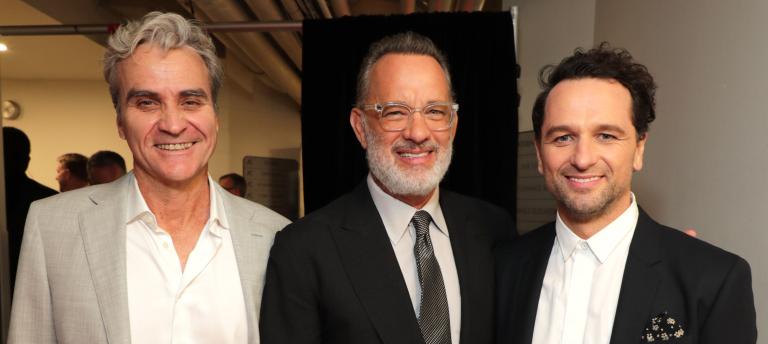
— The photo above shows Tom Junod, Tom Hanks and Matthew Rhys at the world premiere of A Beautiful Day in the Neighborhood in Toronto. The film comes to theatres across North America November 22.
beautiful day in the neighborhood
Previous Post

September 28, 2019
VIFF capsule reviews: Adam, Young Ahmed
Next Post

November 19, 2019 The Star is returning to theatres for two days only next month
Browse Our Archives
Select a Category Anglican Planet Articles BC Christian News BC Report Bible Movies Bible Review Blog Books & Culture Campus Times CBC Radio Christianity Today ChristianWeek Essays Faith Today Festival Cinemas Guide Film Journals Georgia Straight Interviews MB Herald National Catholic Register Salvationist Today's Christian Two Chairs Ubyssey Uncategorized Vancouver Courier Vancouver Sun
Select a Month August 2025 April 2025 January 2025 December 2024 November 2024 May 2024 February 2024 December 2023 May 2023 March 2023 November 2022 July 2022 June 2022 May 2022 April 2022 February 2022 January 2022 December 2021 November 2021 October 2021 September 2021 August 2021 July 2021 June 2021 April 2021 March 2021 February 2021 January 2021 December 2020 November 2020 October 2020 August 2020 July 2020 June 2020 May 2020 March 2020 February 2020 January 2020 December 2019 November 2019 September 2019 July 2019 May 2019 April 2019 March 2019 February 2019 January 2019 December 2018 November 2018 October 2018 September 2018 July 2018 June 2018 May 2018 April 2018 March 2018 February 2018 January 2018 December 2017 November 2017 October 2017 September 2017 August 2017 July 2017 June 2017 May 2017 April 2017 March 2017 February 2017 January 2017 December 2016 November 2016 October 2016 September 2016 August 2016 July 2016 June 2016 May 2016 April 2016 March 2016 February 2016 January 2016 December 2015 November 2015 October 2015 September 2015 August 2015 July 2015 June 2015 May 2015 April 2015 March 2015 February 2015 January 2015 December 2014 November 2014 October 2014 September 2014 August 2014 July 2014 June 2014 May 2014 April 2014 March 2014 February 2014 January 2014 December 2013 November 2013 October 2013 September 2013 August 2013 July 2013 June 2013 May 2013 April 2013 March 2013 February 2013 January 2013 December 2012 November 2012 October 2012 September 2012 August 2012 July 2012 June 2012 April 2012 January 2012 January 2011 December 2010 November 2010 October 2010 September 2010 August 2010 July 2010 June 2010 May 2010 April 2010 March 2010 February 2010 January 2010 December 2009 November 2009 October 2009 September 2009 August 2009 July 2009 June 2009 May 2009 April 2009 March 2009 February 2009 January 2009 December 2008 November 2008 October 2008 September 2008 August 2008 July 2008 June 2008 May 2008 April 2008 March 2008 February 2008 January 2008 December 2007 November 2007 October 2007 September 2007 August 2007 July 2007 June 2007 May 2007 April 2007 March 2007 February 2007 January 2007 December 2006 November 2006 October 2006 September 2006 August 2006 July 2006 June 2006 May 2006 April 2006 March 2006 February 2006 January 2006 December 2005 November 2005 October 2005 September 2005 August 2005 July 2005 June 2005 May 2005 April 2005 March 2005 January 2005 December 2004 November 2004 October 2004 September 2004 August 2004 July 2004 June 2004 May 2004 April 2004 March 2004 February 2004 January 2004 November 2003 October 2003 August 2003 July 2003 June 2003 May 2003 January 2003 December 2002 November 2002 August 2002 July 2002 June 2002 May 2002 March 2002 January 2002 December 2001 November 2001 September 2001 August 2001 July 2001 June 2001 April 2001 March 2001 February 2001 December 2000 November 2000 October 2000 September 2000 August 2000 July 2000 June 2000 May 2000 April 2000 March 2000 January 2000 October 1999 August 1999 May 1999 April 1999 February 1999 January 1999 December 1998 November 1998 October 1998 August 1998 July 1998 June 1998 April 1998 March 1998 January 1998 November 1997 September 1997 July 1997 June 1997 April 1997 March 1997 February 1997 January 1997 December 1996 October 1996 September 1996 June 1996 March 1996 February 1996 January 1996 April 1995 November 1994 September 1994 September 1991
Follow Us!
TAKE THE
Religious Wisdom Quiz
What did the Israelites carry through the wilderness that symbolized God's presence?
Select your answer to see how you score.
Golden Calf Ark of the Covenant Scroll of Moses Burning torch
Related posts from FilmChat

Joseph of Egypt – the Chosen spin-off announces...

Exclusive: A clip from Angel Studios' The King...

Exclusive: Watch a clip from Angel Studios' Brave...

Exclusive: Watch a clip from Angel Studios' Homestead
TRENDING AT PATHEOS Religious Music & Entertainment

"Les Diabolique" and Transgression
Alongside something like Arrival, Vertigo, or Charade, Les Diaboliques is a...

"The Plague Dogs" and Mortality
So, flashback to the late 70s, early 80s. Walt Disney Studios is...

With the recent and highly successful release of Christopher Nolan’s epic film,...

"L'avventura" and Human Weakness
Today's piece is going to be a little different for a few...

I first want to apologize for not posting or writing anything. I'm...

I've engaged in the multi-year project of reading through the Church Fathers,...
view all Religious Music & Entertainment blogs
Ad-Free & Subscriber Log-In Subscription Support
- About Us
- 2026 Calendar
- Videos
- Podcasts
- Library of World Religions
- Faith In Media Tracker
- Advertise With Us
- Write for Us
- Privacy Policy
- Terms of Service
- Do Not Sell My Data
- Contact Us
- Radiant Digital
- Manage Newsletter Subscriptions
- Unsubscribe From Notifications
- Sitemap
Copyright 2008-2026, Patheos. All rights reserved.
Subscription Support Ad-Free & Subscriber Log-In
Follow Patheos