
BuddhistCatholicContemplativeEvangelicalGeneral ChristianHinduJewishLatter-day SaintMuslimNew VisionsProgressive Christian
Beliefs
- Buddhist
- Catholic
- Contemplative
- Evangelical
- General Christian
- Hindu
- Jewish
- Latter-day Saint
- More Voices
- Muslim
- New Visions
- Pagan
- Progressive Christian
Topics
- Religion News
- Food and Religion
- Sports and Religion
- Religious Art
- Religious Music and Entertainment
- Religious Events
- History and Religion
- Style and Religion
- Politics and Religion
- Women in Religion
- Recreation Outdoors and Religion
- Business Finance and Religion
- Careers Workplace and Religion
- Education and Religion
- Family Parenting and Religion
- Health Fitness and Religion
- Home and Religion
- Relationships and Religion
- Technology and Religion
- Travel and Religion
Columnists
- Buddhist Columnists
- Business Finance and Religion Columnists
- Careers Workplace and Religion Columnists
- Catholic Columnists
- Contemplative Columnists
- Education and Religion Columnists
- Evangelists Columnists
- Family Parenting and Religion Columnists
- General Christian Columnists
- Health Fitness and Religion Columnists
- Hindu Columnists
- History and Religion Columnists
- Home and Religion Columnists
- Jewish Columnists
- More Voices Columnists
- Latter Day Columnists
- Muslim Columnists
- New Visions Columnists
- Nonreligious Columnists
- Pagan Columnists
- Politics and Religion Columnists
- Progressive Columnists
- Recreation Outdoors and Religion Columnists
- Relationships and Religion Columnists
- Religion News Columnists
- Religious Art Columnists
- Religious Events Columnists
- Religious Music and Entertainment Columnists
- Sports and Religion Columnists
- Style and Religion Columnists
- Technology and Religion Columnists
- Travel and Religion Columnists
- Women in Religion Columnists
Resource Library
- 2026 Calendar
- Library of World Religions
- The 100 Most Holy Places on Earth
- Patheos Answers
- Podcasts
- Videos
- Faith Leaders Database
- Anglican Episcopalian
- Bahai
- Baptist
- Buddhism
- Christianity
- Confucianism
- Eastern Orthodoxy
- Hinduism
- Holiness and Pentecostal
- ISKCON
- Islam
- Judaism
- Lutheran
- Methodist
- The Church of Jesus Christ of Latter-day Saints
- New Age
- Paganism
- Presbytarian and Reformed
- Protestantism
- Religion Behind the Scenes
- Roman Catholic
- Scientology
- Shia Islam
- Sikhism
- Sufism
- Sunni Islam
- Taoism
- Zen
- See all religions
Research Tools
 Ad-Free & Subscriber Log-In Subscription Support
Ad-Free & Subscriber Log-In Subscription Support
Follow Patheos 

- Trending:
- Forgiveness
- |
- Marriage
- |
- Consciousness
- |
- Death Penalty
- |
- Election
- |
- Halloween

-
Articles
- Home
- Religious Music & Entertainment
- The Birth of a Nation and the problem of religious violence
The Birth of a Nation and the problem of religious violence
Last updated on: October 8, 2016 at 12:21 pm by Peter T. Chattaway
The Birth of a Nation and the problem of religious violence 2016-10-08T12:21:07-07:00 Peter T. Chattaway
Patheos Explore the world's faith through different perspectives on religion and spirituality! Patheos has the views of the prevalent religions and spiritualities of the world.
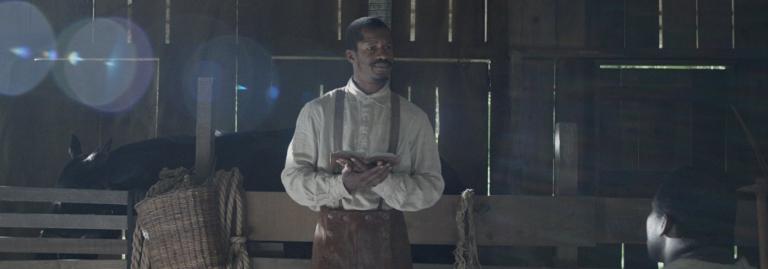
Just a few quick thoughts about the depiction of violence and religion in Nate Parker’s The Birth of a Nation, which tells the story of Nat Turner’s slave rebellion in 1830s Virginia.
Turner was a slave who knew how to read, and — as depicted in the film, at least — the only book he is allowed to read is the Bible. He gets to know the Bible so well that his master rents him out to other slave-owners, so that he can preach a message of obedience, telling other slaves to obey their masters.
The first time Turner preaches one of these messages, he cites I Peter 2:18, which tells slaves to submit to their masters, “not only to those who are good and considerate, but also to those who are harsh.”1 As Turner finishes the quote, he looks back over his shoulder somewhat nervously, as if he’s afraid the slave-owners standing behind him will think he has just criticized them for being “harsh” — but it turns out the slave-owners either didn’t notice or didn’t care how the verse ended. They’re just happy to see that one slave is telling the other slaves to obey them.
(I’ll come back to that passage in a moment.)
Later on, Nat Turner’s wife Cherry is raped and beaten. (Reportedly there was a rape scene in this film when it premiered at Sundance, but now the rape takes place offscreen.) Nat is seething with a desire for revenge, but Cherry reminds him of what Nat taught her: that those who live by the sword will die by the sword (as Jesus said in Matthew 26:52).
Eventually Nat gets into an argument with a white preacher, and they quote scripture at each other, each man using verses that appear to support his side of the argument. For his insolence, Nat is whipped. At the end of his punishment, he has a vision of an angel.
And then, in another scene, he reads a Bible passage that confirms for him that he should lead an armed rebellion against the slave-owners. The Bible passage in question — which the camera does linger on — is I Samuel 15, in which the prophet Samuel tells King Saul to commit an act of genocide against the Amalekites.
This is one of the most problematic passages in the entire Bible.2 And this is the passage that, according to the film, convinces Nat Turner to become a Braveheart-like hero.
Is the film aware of how problematic this passage is, or indeed of how problematic Nat Turner’s entire campaign of violence was? I’m not so sure.
There are moments in the film that could be interpreted as ambiguous or even potentially critical of Nat Turner’s rebellion, such as when a slave enthusiastically beheads his master — an act of violence that is now typically associated with terrorism.
But for the most part, the film wants us to take Nat Turner’s side. Indeed, it mythologizes Nat Turner and depicts him as a “chosen one” who does God’s will.
The film begins with a prologue in which Nat Turner is a boy with a birthmark on his chest, and some older female slaves hail him as a prophet because he bears the “holy marks” of their ancestors. “We should listen to him,” says one of the women.
When Nat begins his rebellion some years later, he is hailed by women once again: his mother tells him, “I’m proud of you,” while his wife — who had previously tried to talk him out of getting revenge by reminding of his own pacifist preaching — now tells him, “Fight for us all.”
And then there is the (female) angel who appears to him when he is whipped, and who appears to him again when he is about to be executed.
Other directorial touches signal the filmmakers’ approval of Nat Turner and his actions. Light pours into his prison cell as he awaits execution, and then, in the film’s final shot (spoiler alert!), a boy who betrayed Nat Turner watches him die and then morphs into his adult self, wearing a Northern uniform and fighting in the Civil War. Thus the film connects Nat Turner’s unauthorized but sanctified violence to the authorized violence that was needed to end slavery for good in the United States.3
The film does not depict how the historical Turner and his rebels killed white children, and it only barely depicts the killing of one woman (when slaves attack a married couple in their bedroom). If the film had shown the full scale of Turner’s violence, it could have painted a more ambiguous, complex portrait of the cycle of violence, and how scripture was used to justify atrocities on both sides.
But that isn’t what writer-director Nate Parker, who also plays Nat Turner, wanted to do here. In multiple interviews (with Alissa Wilkinson, Steve Harvey and others), Parker has argued that Nat Turner was a heroic “man of faith”, and he has suggested that there are two kinds of Christian: “Nat Turner Christians” on the one hand, and the kind of Christians who killed Nat Turner and oppressed the slaves on the other hand. Parker has even suggested that Nat Turner was “Christlike”.
And, um, well, wow.
Here’s where I’d like to take another look at that passage in I Peter, an epistle that is traditionally believed to have been written by the very same man that Jesus was addressing when he said that those who take up the sword shall perish by the sword.
When the author of that epistle wrote that slaves should submit themselves to their masters — and that Christians in general should submit themselves to human authorities — he was addressing people who lived in a pagan society that was actively persecuting Christians. The assumption the author made was that the masters were pagan and the slaves were Christian. No one at the time thought that slave-owners would ever use those passages to justify their own cruelty.4
Instead, the whole point of the passage in I Peter 2 is that we are called to follow Christ’s example when we suffer unjustly. In the film, Nat Turner quotes just verse 18. But in the verses that follow, the epistle says, among other things:
21To this you were called, because Christ suffered for you, leaving you an example, that you should follow in his steps. 22“He committed no sin, and no deceit was found in his mouth.” 23When they hurled their insults at him, he did not retaliate; when he suffered, he made no threats. Instead, he entrusted himself to him who judges justly.
So it is not just the slave-owners who missed the point of that passage (and its criticism of “harsh” slave-owners) when Nat Turner preached it to their slaves. Nat Turner himself missed the point of that passage when he embarked on his retaliatory rebellion.
Instead of following in Christ’s footsteps, the Nat Turner of this film deliberately sets aside the words of Jesus and embraces a message of violence based on an Old Testament passage that explicitly calls for genocide. That is the character arc followed by this film’s version of Nat Turner. That is what the filmmakers depict their “hero” doing.
I have been fortunate to live in a time and place where neither I nor anyone I know has ever been a slave or had to live under the brutality of an empire like Rome’s. So I don’t want to pretend that I know what it would be like to live under the sort of oppression that Peter or Nat Turner had to endure. I know how easy it is to say the words of Jesus and Paul; I do not know how hard it would have been to have to live those particular words.
But if we’re going to talk about “Christlike” behaviour, then this is what we need to be talking about. If we’re going to talk about the different kinds of Christians out there, then we need a third, non-violent option — an option that rejects the violence of the slave-owners and the violence of rebel slaves who, as depicted in this film, deliberately set the words of Jesus aside when they set out to kill men, women and children.
To be clear, the film didn’t have to give us that third option. I don’t believe films always have to provide positive answers; sometimes it’s enough to shine a light on the problem, and a film that consciously explored how both sides distorted scripture to suit their violent ends could have given us plenty of food for thought.
The problem here is that this film, by mythologizing Nat Turner the way it does, and by literally putting him on the side of the angels, obscures these issues. And that makes the film something of a missed opportunity.
–
1. I’m quoting the NIV version of the passage. I assume Turner, in the film, quotes the KJV.
2. Saul’s attack against the Amalekites was given a sensitive treatment in Of Kings and Prophets.
3. In a film brimming with Braveheart parallels, this closing shot is perhaps the most Braveheart-y of all: it recalls how Robert the Bruce abandoned William Wallace in the earlier film, only to be motivated by Wallace’s death to take the fight to the English once more — and this time succeed.
4. To be sure, there were some Christians in the early church who owned slaves, but in Paul’s letter to Philemon, you can see how the apostles tried to steer Christian slave-owners away from thinking of people as property and towards seeing slaves as “brothers”.
Previous Post

October 6, 2016
Watch: Two new TV spots for Mel Gibson's Hacksaw Ridge
Next Post
October 9, 2016 Box office: Girl on the Train speeds past Birth of a Nation
Browse Our Archives
Select a Category Anglican Planet Articles BC Christian News BC Report Bible Movies Bible Review Blog Books & Culture Campus Times CBC Radio Christianity Today ChristianWeek Essays Faith Today Festival Cinemas Guide Film Journals Georgia Straight Interviews MB Herald National Catholic Register Salvationist Today's Christian Two Chairs Ubyssey Uncategorized Vancouver Courier Vancouver Sun
Select a Month August 2025 April 2025 January 2025 December 2024 November 2024 May 2024 February 2024 December 2023 May 2023 March 2023 November 2022 July 2022 June 2022 May 2022 April 2022 February 2022 January 2022 December 2021 November 2021 October 2021 September 2021 August 2021 July 2021 June 2021 April 2021 March 2021 February 2021 January 2021 December 2020 November 2020 October 2020 August 2020 July 2020 June 2020 May 2020 March 2020 February 2020 January 2020 December 2019 November 2019 September 2019 July 2019 May 2019 April 2019 March 2019 February 2019 January 2019 December 2018 November 2018 October 2018 September 2018 July 2018 June 2018 May 2018 April 2018 March 2018 February 2018 January 2018 December 2017 November 2017 October 2017 September 2017 August 2017 July 2017 June 2017 May 2017 April 2017 March 2017 February 2017 January 2017 December 2016 November 2016 October 2016 September 2016 August 2016 July 2016 June 2016 May 2016 April 2016 March 2016 February 2016 January 2016 December 2015 November 2015 October 2015 September 2015 August 2015 July 2015 June 2015 May 2015 April 2015 March 2015 February 2015 January 2015 December 2014 November 2014 October 2014 September 2014 August 2014 July 2014 June 2014 May 2014 April 2014 March 2014 February 2014 January 2014 December 2013 November 2013 October 2013 September 2013 August 2013 July 2013 June 2013 May 2013 April 2013 March 2013 February 2013 January 2013 December 2012 November 2012 October 2012 September 2012 August 2012 July 2012 June 2012 April 2012 January 2012 January 2011 December 2010 November 2010 October 2010 September 2010 August 2010 July 2010 June 2010 May 2010 April 2010 March 2010 February 2010 January 2010 December 2009 November 2009 October 2009 September 2009 August 2009 July 2009 June 2009 May 2009 April 2009 March 2009 February 2009 January 2009 December 2008 November 2008 October 2008 September 2008 August 2008 July 2008 June 2008 May 2008 April 2008 March 2008 February 2008 January 2008 December 2007 November 2007 October 2007 September 2007 August 2007 July 2007 June 2007 May 2007 April 2007 March 2007 February 2007 January 2007 December 2006 November 2006 October 2006 September 2006 August 2006 July 2006 June 2006 May 2006 April 2006 March 2006 February 2006 January 2006 December 2005 November 2005 October 2005 September 2005 August 2005 July 2005 June 2005 May 2005 April 2005 March 2005 January 2005 December 2004 November 2004 October 2004 September 2004 August 2004 July 2004 June 2004 May 2004 April 2004 March 2004 February 2004 January 2004 November 2003 October 2003 August 2003 July 2003 June 2003 May 2003 January 2003 December 2002 November 2002 August 2002 July 2002 June 2002 May 2002 March 2002 January 2002 December 2001 November 2001 September 2001 August 2001 July 2001 June 2001 April 2001 March 2001 February 2001 December 2000 November 2000 October 2000 September 2000 August 2000 July 2000 June 2000 May 2000 April 2000 March 2000 January 2000 October 1999 August 1999 May 1999 April 1999 February 1999 January 1999 December 1998 November 1998 October 1998 August 1998 July 1998 June 1998 April 1998 March 1998 January 1998 November 1997 September 1997 July 1997 June 1997 April 1997 March 1997 February 1997 January 1997 December 1996 October 1996 September 1996 June 1996 March 1996 February 1996 January 1996 April 1995 November 1994 September 1994 September 1991
Follow Us!
TAKE THE
Religious Wisdom Quiz
What do the Shoes of the Gospel of Peace allow believers to do?
Select your answer to see how you score.
Run into battle Stand firm Dance Walk in darkness
Related posts from FilmChat

Joseph of Egypt – the Chosen spin-off announces...

Exclusive: A clip from Angel Studios' The King...

Exclusive: Watch a clip from Angel Studios' Brave...

Exclusive: Watch a clip from Angel Studios' Homestead
TRENDING AT PATHEOS Religious Music & Entertainment

"Les Diabolique" and Transgression
Alongside something like Arrival, Vertigo, or Charade, Les Diaboliques is a...

"The Plague Dogs" and Mortality
So, flashback to the late 70s, early 80s. Walt Disney Studios is...

With the recent and highly successful release of Christopher Nolan’s epic film,...

"L'avventura" and Human Weakness
Today's piece is going to be a little different for a few...

I first want to apologize for not posting or writing anything. I'm...

I've engaged in the multi-year project of reading through the Church Fathers,...
view all Religious Music & Entertainment blogs
Ad-Free & Subscriber Log-In Subscription Support
- About Us
- 2026 Calendar
- Videos
- Podcasts
- Library of World Religions
- Faith In Media Tracker
- Advertise With Us
- Write for Us
- Privacy Policy
- Terms of Service
- Do Not Sell My Data
- Contact Us
- Radiant Digital
- Manage Newsletter Subscriptions
- Unsubscribe From Notifications
- Sitemap
Copyright 2008-2026, Patheos. All rights reserved.
Subscription Support Ad-Free & Subscriber Log-In
Follow Patheos