
BuddhistCatholicContemplativeEvangelicalGeneral ChristianHinduJewishLatter-day SaintMuslimNew VisionsProgressive Christian
Beliefs
- Buddhist
- Catholic
- Contemplative
- Evangelical
- General Christian
- Hindu
- Jewish
- Latter-day Saint
- More Voices
- Muslim
- New Visions
- Pagan
- Progressive Christian
Topics
- Religion News
- Food and Religion
- Sports and Religion
- Religious Art
- Religious Music and Entertainment
- Religious Events
- History and Religion
- Style and Religion
- Politics and Religion
- Women in Religion
- Recreation Outdoors and Religion
- Business Finance and Religion
- Careers Workplace and Religion
- Education and Religion
- Family Parenting and Religion
- Health Fitness and Religion
- Home and Religion
- Relationships and Religion
- Technology and Religion
- Travel and Religion
Columnists
- Buddhist Columnists
- Business Finance and Religion Columnists
- Careers Workplace and Religion Columnists
- Catholic Columnists
- Contemplative Columnists
- Education and Religion Columnists
- Evangelists Columnists
- Family Parenting and Religion Columnists
- General Christian Columnists
- Health Fitness and Religion Columnists
- Hindu Columnists
- History and Religion Columnists
- Home and Religion Columnists
- Jewish Columnists
- More Voices Columnists
- Latter Day Columnists
- Muslim Columnists
- New Visions Columnists
- Nonreligious Columnists
- Pagan Columnists
- Politics and Religion Columnists
- Progressive Columnists
- Recreation Outdoors and Religion Columnists
- Relationships and Religion Columnists
- Religion News Columnists
- Religious Art Columnists
- Religious Events Columnists
- Religious Music and Entertainment Columnists
- Sports and Religion Columnists
- Style and Religion Columnists
- Technology and Religion Columnists
- Travel and Religion Columnists
- Women in Religion Columnists
Resource Library
- 2026 Calendar
- Library of World Religions
- The 100 Most Holy Places on Earth
- Patheos Answers
- Podcasts
- Videos
- Faith Leaders Database
- Anglican Episcopalian
- Bahai
- Baptist
- Buddhism
- Christianity
- Confucianism
- Eastern Orthodoxy
- Hinduism
- Holiness and Pentecostal
- ISKCON
- Islam
- Judaism
- Lutheran
- Methodist
- The Church of Jesus Christ of Latter-day Saints
- New Age
- Paganism
- Presbytarian and Reformed
- Protestantism
- Religion Behind the Scenes
- Roman Catholic
- Scientology
- Shia Islam
- Sikhism
- Sufism
- Sunni Islam
- Taoism
- Zen
- See all religions
Research Tools
 Ad-Free & Subscriber Log-In Subscription Support
Ad-Free & Subscriber Log-In Subscription Support
Follow Patheos 

- Trending:
- Forgiveness
- |
- Marriage
- |
- Consciousness
- |
- Death Penalty
- |
- Election
- |
- Halloween

-
Articles
- Home
- Religious Music & Entertainment
- Prophet Joseph — episodes thirty-three and thirty-four
Prophet Joseph — episodes thirty-three and thirty-four
Last updated on: October 27, 2016 at 10:23 pm by Peter T. Chattaway
Prophet Joseph — episodes thirty-three and thirty-four 2016-10-27T22:23:57-07:00 Peter T. Chattaway
Patheos Explore the world's faith through different perspectives on religion and spirituality! Patheos has the views of the prevalent religions and spiritualities of the world.
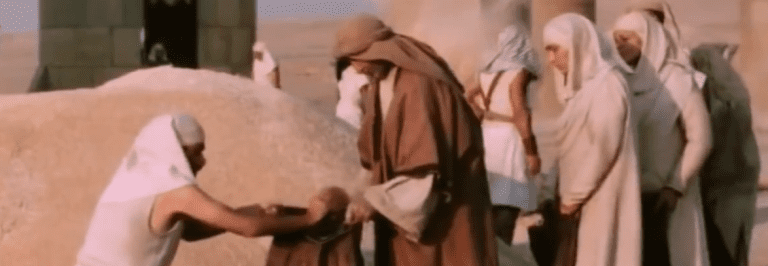
Synopsis. The seven years of famine have begun. People across Egypt are wondering why they woke up hungry in the middle of the night, and why their plants have begun to wilt. Zuleikha, in addition to all her other recent losses, is beginning to go blind and finds it difficult to walk without falling. In Canaan, Jacob’s eyes have begun to dim, too, but he hears that the Egyptians are benefiting under a leader whose name sounds similar to Joseph. Back in Egypt, Zuleikha’s servants are unable to get grain for their mistress, because only the poor can get grain for free — so Zuleikha sets her servants free so that they will at least be able to get grain for themselves. Zuleikha, all alone in her palace, works through her tortured emotions in a long, long monologue.
As the 34th episode begins, the priests of Amon come before the Pharaoh to insist that they be given wheat for free, or at least that they not be charged exorbitant rates for it. Joseph tells them to buy wheat from other countries — and then privately tells the Pharaoh that the other countries are beginning to experience famine too. In Canaan, Joseph’s brothers notice that the crops are not what they used to be. Back in Egypt, the queen mother Tiye tells her son she hopes the palace will be ruined for its offenses against the god Amon. Once she’s gone, Akhenaten and Nefertiti say they hope monotheism will become the official religion of Egypt. Two of Zuleikha’s former servants get some grain and find themselves walking back to her palace, so they offer to share their grain with her. Zuleikha calls the curse of Joseph’s God against Amon, then asks if her servants saw what she did. One of them says Amon deserved it.
Differences from Genesis. The biblical Joseph reduced the population of Egypt to slavery and took possession of all their property during the famine, while giving the priests of Egypt a regular allotment of free food (Genesis 47:13-26). But the Joseph of this series uses the famine to undermine the Egyptian priests and the public’s support for them, and he lets the farmers keep the animals and the property that they are supposedly giving to the government in exchange for grain. Malek remarks that it is odd to give wheat in exchange for things but not seize the actual things, and the Joseph of this series replies that they need to “revolutionize Egypt” by taking power away from the rich and boosting the status of the lower classes — which is precisely the opposite of what happened during the famine under the biblical Joseph.
The biblical Joseph was given the name Zaphenath-Paneah by the Pharaoh (Genesis 41:45), but the Joseph of this series has been called “Yuzarsif” ever since he was purchased by Potiphar, and that is the name he continues to use as Egypt’s governor. The difference between his Egyptian name and his birth name becomes a point of minor significance on two occasions in these episodes: in one scene, Jacob hears that Egypt is being governed by a man named Yuzarsif, and he smiles at the name’s similarity to Joseph; and in another, Zuleikha is standing in the crowd and shouts Joseph’s birth name as his chariot goes by, thinking — correctly — that she will stand out from all the other people who are shouting his Egyptian name. (And then she hides her face when Joseph scans the crowd to see who used his birth name.)
Pious Joseph. Joseph chastises his charioteer when the chariot rides a little roughly through the streets and endangers the pedestrians. Joseph reminds him that they are the people’s servants, and they should not be imperious like the soldiers of Amon.
The supernatural. People across Egypt wake up hungry in the middle of the night, and various plants wilt overnight, because the seven years of famine have started.
God versus the gods. As Joseph puts it, the fight against idolatry is “entering a new level” now that the famine has begun. Some of the people in charge of distributing the grain mock the priests because Amon isn’t looking after them. And the priests notice that people don’t believe in Amon like they used to. In a similar vein, Zuleikha berates the idol of Amon in her palace and calls the curse of Joseph’s God down on it.
Family dynamics. It seems that Jacob is still not on speaking terms with any of his sons except for his youngest son Benjamin — but Jacob might be on speaking terms with the children of those sons, since there is one scene in which Jacob teaches a group of about a dozen kids the history of their family (how Abraham came to Canaan, how there were other people already living in Canaan when Abraham arrived, and how he, Jacob, is also known as Israel and therefore all of his descendants are known as “Israelites”). Then again, Genesis 46:21 says Benjamin had ten sons, and Benjamin might have had daughters as well… so perhaps these kids are all Benjamin’s?
In another scene, Jacob talks to one of Benjamin’s sons named Eshpir (as the subtitles spell it). Genesis 46:21 says one of Benjamin’s sons was named Ashbel. Same guy?
Other tribes. People from Khaberia come to Egypt to buy wheat. I don’t know exactly where that is, but a quick bit of Googling indicates they might be from India.
Egypt. Nefertiti says she hopes the thousand-year sovereignty of Amon will soon be over when Egypt becomes monotheistic. That makes more sense than the three thousand years that Tiye said Amon had been worshiped for three episodes earlier.
Timeline issues. Tiye seems to indicate in one scene that there are five years left in Joseph’s prophesied seven years of famine. Are we already two years in?
In another scene, Jacob says it has been 30 years since Joseph went missing. Joseph is 37 when the famine starts, and he was 10 or 11 when his brothers sold him into slavery, so at least 26 years have passed since then, and possibly more. So Jacob has been mourning Joseph’s absence for close to 30 years, if not exactly 30 years.
Themes. There’s a curious parallel between Jacob and Zuleikha, both of whom have been mourning Joseph’s absence for years and now have servants or relatives telling them that they would have better eyesight if only they didn’t cry so much — but of course, neither Jacob nor Zuleikha listen to the advice that they are given.
The depiction of women. When Joseph learns that hundreds of slaves have been freed by their masters in Thebes, Joseph tells his staff to feed the ex-slaves for free, and Joseph’s wife Asenath immediately pipes up and suggests getting the ex-slaves to work for their food in the grain silos instead. Joseph likes the idea and tells Asenath he should thank the Pharaoh and his queen for choosing her to become his wife.
–
Episodes: 1-2 | 3-4 | 5-6 | 7-8 | 9-10 | 11-12 | 13-14 | 15-16 | 17-18 | 19-20 | 21-22 | 23-24 | 25-26 | 27-28 | 29-30 | 31-32 | 33-34 | 35-36 | 37-38 | 39-40 | 41-42 | 43-45
–
The subtitled version of these episodes runs from about 2:24:44 to 4:02:10 in this video:
https://www.youtube.com/watch?v=TOaAcJfqn1c&t=2h24m44s
Here are the English-dubbed versions of these episodes:
https://www.youtube.com/watch?v=58_YniMfj7M
https://www.youtube.com/watch?v=98QXFHLKNz0
Next Post

August 17, 2016 Ben-Hur -- the first reviews are in, and they're not that good
Browse Our Archives
Select a Category Anglican Planet Articles BC Christian News BC Report Bible Movies Bible Review Blog Books & Culture Campus Times CBC Radio Christianity Today ChristianWeek Essays Faith Today Festival Cinemas Guide Film Journals Georgia Straight Interviews MB Herald National Catholic Register Salvationist Today's Christian Two Chairs Ubyssey Uncategorized Vancouver Courier Vancouver Sun
Select a Month August 2025 April 2025 January 2025 December 2024 November 2024 May 2024 February 2024 December 2023 May 2023 March 2023 November 2022 July 2022 June 2022 May 2022 April 2022 February 2022 January 2022 December 2021 November 2021 October 2021 September 2021 August 2021 July 2021 June 2021 April 2021 March 2021 February 2021 January 2021 December 2020 November 2020 October 2020 August 2020 July 2020 June 2020 May 2020 March 2020 February 2020 January 2020 December 2019 November 2019 September 2019 July 2019 May 2019 April 2019 March 2019 February 2019 January 2019 December 2018 November 2018 October 2018 September 2018 July 2018 June 2018 May 2018 April 2018 March 2018 February 2018 January 2018 December 2017 November 2017 October 2017 September 2017 August 2017 July 2017 June 2017 May 2017 April 2017 March 2017 February 2017 January 2017 December 2016 November 2016 October 2016 September 2016 August 2016 July 2016 June 2016 May 2016 April 2016 March 2016 February 2016 January 2016 December 2015 November 2015 October 2015 September 2015 August 2015 July 2015 June 2015 May 2015 April 2015 March 2015 February 2015 January 2015 December 2014 November 2014 October 2014 September 2014 August 2014 July 2014 June 2014 May 2014 April 2014 March 2014 February 2014 January 2014 December 2013 November 2013 October 2013 September 2013 August 2013 July 2013 June 2013 May 2013 April 2013 March 2013 February 2013 January 2013 December 2012 November 2012 October 2012 September 2012 August 2012 July 2012 June 2012 April 2012 January 2012 January 2011 December 2010 November 2010 October 2010 September 2010 August 2010 July 2010 June 2010 May 2010 April 2010 March 2010 February 2010 January 2010 December 2009 November 2009 October 2009 September 2009 August 2009 July 2009 June 2009 May 2009 April 2009 March 2009 February 2009 January 2009 December 2008 November 2008 October 2008 September 2008 August 2008 July 2008 June 2008 May 2008 April 2008 March 2008 February 2008 January 2008 December 2007 November 2007 October 2007 September 2007 August 2007 July 2007 June 2007 May 2007 April 2007 March 2007 February 2007 January 2007 December 2006 November 2006 October 2006 September 2006 August 2006 July 2006 June 2006 May 2006 April 2006 March 2006 February 2006 January 2006 December 2005 November 2005 October 2005 September 2005 August 2005 July 2005 June 2005 May 2005 April 2005 March 2005 January 2005 December 2004 November 2004 October 2004 September 2004 August 2004 July 2004 June 2004 May 2004 April 2004 March 2004 February 2004 January 2004 November 2003 October 2003 August 2003 July 2003 June 2003 May 2003 January 2003 December 2002 November 2002 August 2002 July 2002 June 2002 May 2002 March 2002 January 2002 December 2001 November 2001 September 2001 August 2001 July 2001 June 2001 April 2001 March 2001 February 2001 December 2000 November 2000 October 2000 September 2000 August 2000 July 2000 June 2000 May 2000 April 2000 March 2000 January 2000 October 1999 August 1999 May 1999 April 1999 February 1999 January 1999 December 1998 November 1998 October 1998 August 1998 July 1998 June 1998 April 1998 March 1998 January 1998 November 1997 September 1997 July 1997 June 1997 April 1997 March 1997 February 1997 January 1997 December 1996 October 1996 September 1996 June 1996 March 1996 February 1996 January 1996 April 1995 November 1994 September 1994 September 1991
Follow Us!
TAKE THE
Religious Wisdom Quiz
Who said, “I am the way and the truth and the life”?
Select your answer to see how you score.
Peter Paul John Jesus
Related posts from FilmChat

Joseph of Egypt – the Chosen spin-off announces...

Exclusive: A clip from Angel Studios' The King...

Exclusive: Watch a clip from Angel Studios' Brave...

Exclusive: Watch a clip from Angel Studios' Homestead
TRENDING AT PATHEOS Religious Music & Entertainment

"Les Diabolique" and Transgression
Alongside something like Arrival, Vertigo, or Charade, Les Diaboliques is a...

"The Plague Dogs" and Mortality
So, flashback to the late 70s, early 80s. Walt Disney Studios is...

With the recent and highly successful release of Christopher Nolan’s epic film,...

"L'avventura" and Human Weakness
Today's piece is going to be a little different for a few...

I first want to apologize for not posting or writing anything. I'm...

I've engaged in the multi-year project of reading through the Church Fathers,...
view all Religious Music & Entertainment blogs
Ad-Free & Subscriber Log-In Subscription Support
- About Us
- 2026 Calendar
- Videos
- Podcasts
- Library of World Religions
- Faith In Media Tracker
- Advertise With Us
- Write for Us
- Privacy Policy
- Terms of Service
- Do Not Sell My Data
- Contact Us
- Radiant Digital
- Manage Newsletter Subscriptions
- Unsubscribe From Notifications
- Sitemap
Copyright 2008-2026, Patheos. All rights reserved.
Subscription Support Ad-Free & Subscriber Log-In
Follow Patheos