
BuddhistCatholicContemplativeEvangelicalGeneral ChristianHinduJewishLatter-day SaintMuslimNew VisionsProgressive Christian
Beliefs
- Buddhist
- Catholic
- Contemplative
- Evangelical
- General Christian
- Hindu
- Jewish
- Latter-day Saint
- More Voices
- Muslim
- New Visions
- Pagan
- Progressive Christian
Topics
- Religion News
- Food and Religion
- Sports and Religion
- Religious Art
- Religious Music and Entertainment
- Religious Events
- History and Religion
- Style and Religion
- Politics and Religion
- Women in Religion
- Recreation Outdoors and Religion
- Business Finance and Religion
- Careers Workplace and Religion
- Education and Religion
- Family Parenting and Religion
- Health Fitness and Religion
- Home and Religion
- Relationships and Religion
- Technology and Religion
- Travel and Religion
Columnists
- Buddhist Columnists
- Business Finance and Religion Columnists
- Careers Workplace and Religion Columnists
- Catholic Columnists
- Contemplative Columnists
- Education and Religion Columnists
- Evangelists Columnists
- Family Parenting and Religion Columnists
- General Christian Columnists
- Health Fitness and Religion Columnists
- Hindu Columnists
- History and Religion Columnists
- Home and Religion Columnists
- Jewish Columnists
- More Voices Columnists
- Latter Day Columnists
- Muslim Columnists
- New Visions Columnists
- Nonreligious Columnists
- Pagan Columnists
- Politics and Religion Columnists
- Progressive Columnists
- Recreation Outdoors and Religion Columnists
- Relationships and Religion Columnists
- Religion News Columnists
- Religious Art Columnists
- Religious Events Columnists
- Religious Music and Entertainment Columnists
- Sports and Religion Columnists
- Style and Religion Columnists
- Technology and Religion Columnists
- Travel and Religion Columnists
- Women in Religion Columnists
Resource Library
- 2026 Calendar
- Library of World Religions
- The 100 Most Holy Places on Earth
- Patheos Answers
- Podcasts
- Videos
- Faith Leaders Database
- Anglican Episcopalian
- Bahai
- Baptist
- Buddhism
- Christianity
- Confucianism
- Eastern Orthodoxy
- Hinduism
- Holiness and Pentecostal
- ISKCON
- Islam
- Judaism
- Lutheran
- Methodist
- The Church of Jesus Christ of Latter-day Saints
- New Age
- Paganism
- Presbytarian and Reformed
- Protestantism
- Religion Behind the Scenes
- Roman Catholic
- Scientology
- Shia Islam
- Sikhism
- Sufism
- Sunni Islam
- Taoism
- Zen
- See all religions
Research Tools
 Ad-Free & Subscriber Log-In Subscription Support
Ad-Free & Subscriber Log-In Subscription Support
Follow Patheos 

- Trending:
- Forgiveness
- |
- Marriage
- |
- Consciousness
- |
- Death Penalty
- |
- Election
- |
- Halloween

-
Articles
- Home
- Religious Music & Entertainment
- Prophet Joseph — episodes thirty-five and thirty-six
Prophet Joseph — episodes thirty-five and thirty-six
Last updated on: October 27, 2016 at 10:24 pm by Peter T. Chattaway
Prophet Joseph — episodes thirty-five and thirty-six 2016-10-27T22:24:38-07:00 Peter T. Chattaway
Patheos Explore the world's faith through different perspectives on religion and spirituality! Patheos has the views of the prevalent religions and spiritualities of the world.
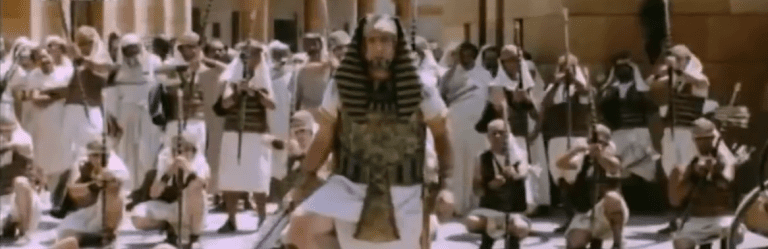
Synopsis. The Egyptian army, led by Horemheb, returns home after years of fighting against the Amorites. The priests of Amon get into an argument with Joseph while lining up for grain and inadvertently reveal that the temple of Amon has less wealth than it used to. In Canaan, Jacob teaches his grandchildren about the prophets. Back in Egypt, Joseph says it is time to act against the priests and make monotheism the official religion of Egypt. Egyptians begin arguing in the street about Joseph’s reforms and a fight breaks out, resulting in the death of a monotheist. Joseph teaches an Egyptian crowd that they should worship a God who is superior to them, and he says gods made of stone and wood cannot be superior to humans. Padiamun, one of the priests, leads an attack against one of the granaries but it is thwarted by Joseph, who wounds Padiamun personally. The priests retreat to their temple in the city.
As the 36th episode begins, Padiamun confines the chief priest to his room for daring to say that he will apologize to the Pharaoh for Padiamun’s actions. The priests offer food to any average Egyptian who joins them in defense of Amon. Zuleikha listens to the arguments in the street, keen to see which side will win the battle of the gods. Akhenaten sends Horemheb and his troops to the temple to seize all the priests. A battle ensues in which soldiers on both sides are killed, and Horemheb himself kills Padiamun after a lengthy swordfight. Joseph arrives and discovers that the idol of Amon has vanished from its cabinet — but then he discovers a trapdoor beneath the cabinet, and two priests hiding with the idol beneath it. The priests are all arrested and sent to prison. Meanwhile, in Canaan, Jacob speaks to his older sons for the first time in years, and tells them to go buy food in Egypt, lest their families starve.
Differences from Genesis. The biblical Jacob sent his sons to Egypt at some point during the first two years of the famine (Genesis 45:6), but if my calculations are correct, the Jacob of this series does not send his sons to Egypt until the fifth or sixth year. (See ‘Timeline issues’ below.) The biblical Jacob did, however, chastise his sons when he sent them, just as the Jacob of this series does (Genesis 42:1-2).
The biblical Levi had three sons named Gershon, Kohath and Merari (Genesis 46:11). The Levi of this series has a son named Ghahad, and presumably other children as well. Is “Ghahad” a different name or a transliteration of “Kohath”, perhaps?
Muslim tradition. Jacob tells his grandchildren that some prophets are superior to others. For example, he says that some prophets, like himself, are responsible for only their part of the world, but the greatest prophet of them all will be the last one (i.e. Mohammed), because he will be followed by people from all over the world.
Jacob also says that the last prophet before him was “Ahmad”, the son of his uncle Ishmael, but I see no sons of Ishmael in the list of Islamic prophets here.
Pious Joseph. In these episodes, Joseph goes beyond mere preaching to becoming something of a holy warrior, not least when he wounds Padiamun.
God versus the gods. In previous episodes, Joseph told the Pharaoh to let people come to monotheism on their own, without being forced into it — but now that the priests of Amon have been weakened by the famine, Joseph tells the Pharaoh to make monotheism the official religion of Egypt, even if it leads to violence.
Interestingly, despite the fact that the monotheists are becoming more assertive, Malek tells one of the regular Egyptians not to insult the Egyptian gods because doing so will prompt a backlash, as followers of those gods insult the one true God.
Zuleikha, for her part, says she can’t side with a temple that is plotting against Joseph. Her servants tease her for worshiping Joseph himself rather than his God.
Family dynamics. The other sons of Jacob are surprised when Benjamin — the only son that Jacob still speaks to — approaches them and says that their father wants to speak to them. Judah, who led the plot against Joseph years ago, says he doesn’t feel like listening to Jacob’s insults, but Levi, who came to Joseph’s defense way back when, assures Benjamin that he and the others will answer Jacob’s summons.
One of the brothers’ wives says Jacob’s request that they go to Egypt is a test to see if his sons deserve to be considered his children again, so they had better go.
These episodes clarify that when Jacob is teaching his grandchildren, he is speaking not only to Benjamin’s children but to the children of at least some of his other sons — even though he has apparently been shunning those sons for decades.
Other tribes. We hear about the Egyptians fighting the Amorites and Sumerians, both of whom had actually been absorbed or conquered by the Assyrian or Babylonian kingdoms by the time this series takes place (i.e. the mid-14th century BC).
Also, “the tribe of Abel” comes from the north to buy grain. It is not clear to me which particular tribe or nation this is meant to be, but Joseph reminds the priests that the tribe of Abel has been paying tribute to the Egyptian government for years, so it is only right that they now be allowed to buy some grain just like the Egyptians do.
Egypt. Horemheb has been the leader of the Egyptian army ever since Potiphar died, and he enforces the Pharaoh’s will even though he privately thinks the Pharaoh is a “wayward son”. (Ironically, Horemheb enforces Akhenaten’s monotheistic edicts because he believes Akhenaten is the gods’ representative on Earth.) I suspect that the Horemheb of this series is meant to be identical to the historical Horemheb who commanded the army under Akhenaten’s son Tutankhamun and went on to become Pharaoh himself. The historical Horemheb was the last Pharaoh of the 18th Dynasty and the first to undo the religious reforms of the historical Akhenaten.
Interestingly, the Akhenaten of this series tells Joseph he will erase the name of Amon from the country’s inscriptions and replace it with the name of Joseph’s God. The historical Akhenaten himself suffered a fate like this after his own death, and was largely forgotten until his capital city was discovered in the 19th century.
In one scene, Nefertiti seems to be ushering a child out of the room, but she and the child are mainly seen from a distance. Is the child her son Tutankhamun?
A man says Joseph doesn’t have the right to reject the religion that Egyptians have been following for “thousands of years”. In another scene, Zuleikha says that the priests of Amon have inherited a 3,000-year history and are now beggars. The queen mother Tiye made similar comments a few episodes ago, which seemed a bit debatable to me, but in a later episode Queen Nefertiti said Egyptians had been worshiping Amon for only a thousand years (unless the subtitles mistranslated her).
Geography. One of Jacob’s sons says the journey to Egypt will take 20 days. Google Maps says the trip from Beersheba to Thebes (the capital city in this series) would take about 250 hours on foot, which would be 32 days at eight hours of walking per day, 25 days at 10 hours of walking per day, or 21 days at 12 hours of walking per day.
Timeline issues. Zuleikha says Joseph has been ruling Egypt for the past 12 years. If we assume that the seven years of plenty began right after Akhenaten made Joseph his second in command, then the battle between the Pharaoh’s army and the priests of Amon must be taking place about five years into the seven years of famine.
This supposition is supported by the fact that Joseph’s daughter was born about one year before the famine began, and she appears to be about five or six now.
Themes. Violence is a major theme in these episodes. Akhenaten is bothered by the killings that Horemheb describes in his report on the war against the Amorites, and when Akhenaten orders Inarus to pour a drink for Horemheb, the camera lingers on the wine being poured as though it were symbolic of blood. When Joseph says it’s time to act against the priests of Amon, Akhenaten says he doesn’t like violence but sometimes there is no other choice, and Joseph replies that he hopes no one will die, but any blood that is shed for a noble cause like this will gladden people’s hearts.
Theological issues. Joseph tells the Egyptians to follow his God because his God sent seven years of rain to help prepare for the famine, but no one makes the obvious reply that his God also seems to be sending the seven years of famine.
–
Episodes: 1-2 | 3-4 | 5-6 | 7-8 | 9-10 | 11-12 | 13-14 | 15-16 | 17-18 | 19-20 | 21-22 | 23-24 | 25-26 | 27-28 | 29-30 | 31-32 | 33-34 | 35-36 | 37-38 | 39-40 | 41-42 | 43-45
–
The subtitled version of these episodes starts at the 4:02:09 mark in this video…
https://www.youtube.com/watch?v=TOaAcJfqn1c&t=4h2m9s
…and concludes in the first 71 minutes of this video:
https://www.youtube.com/watch?v=0I4O59hMWdc
Here are the English-dubbed versions of these episodes:
https://www.youtube.com/watch?v=nWy28rFMxlA
https://www.youtube.com/watch?v=yUp09VWU2OU
Previous Post

August 22, 2016
Ben-Hur news round-up: Many more cast & crew interviews!
Browse Our Archives
Select a Category Anglican Planet Articles BC Christian News BC Report Bible Movies Bible Review Blog Books & Culture Campus Times CBC Radio Christianity Today ChristianWeek Essays Faith Today Festival Cinemas Guide Film Journals Georgia Straight Interviews MB Herald National Catholic Register Salvationist Today's Christian Two Chairs Ubyssey Uncategorized Vancouver Courier Vancouver Sun
Select a Month August 2025 April 2025 January 2025 December 2024 November 2024 May 2024 February 2024 December 2023 May 2023 March 2023 November 2022 July 2022 June 2022 May 2022 April 2022 February 2022 January 2022 December 2021 November 2021 October 2021 September 2021 August 2021 July 2021 June 2021 April 2021 March 2021 February 2021 January 2021 December 2020 November 2020 October 2020 August 2020 July 2020 June 2020 May 2020 March 2020 February 2020 January 2020 December 2019 November 2019 September 2019 July 2019 May 2019 April 2019 March 2019 February 2019 January 2019 December 2018 November 2018 October 2018 September 2018 July 2018 June 2018 May 2018 April 2018 March 2018 February 2018 January 2018 December 2017 November 2017 October 2017 September 2017 August 2017 July 2017 June 2017 May 2017 April 2017 March 2017 February 2017 January 2017 December 2016 November 2016 October 2016 September 2016 August 2016 July 2016 June 2016 May 2016 April 2016 March 2016 February 2016 January 2016 December 2015 November 2015 October 2015 September 2015 August 2015 July 2015 June 2015 May 2015 April 2015 March 2015 February 2015 January 2015 December 2014 November 2014 October 2014 September 2014 August 2014 July 2014 June 2014 May 2014 April 2014 March 2014 February 2014 January 2014 December 2013 November 2013 October 2013 September 2013 August 2013 July 2013 June 2013 May 2013 April 2013 March 2013 February 2013 January 2013 December 2012 November 2012 October 2012 September 2012 August 2012 July 2012 June 2012 April 2012 January 2012 January 2011 December 2010 November 2010 October 2010 September 2010 August 2010 July 2010 June 2010 May 2010 April 2010 March 2010 February 2010 January 2010 December 2009 November 2009 October 2009 September 2009 August 2009 July 2009 June 2009 May 2009 April 2009 March 2009 February 2009 January 2009 December 2008 November 2008 October 2008 September 2008 August 2008 July 2008 June 2008 May 2008 April 2008 March 2008 February 2008 January 2008 December 2007 November 2007 October 2007 September 2007 August 2007 July 2007 June 2007 May 2007 April 2007 March 2007 February 2007 January 2007 December 2006 November 2006 October 2006 September 2006 August 2006 July 2006 June 2006 May 2006 April 2006 March 2006 February 2006 January 2006 December 2005 November 2005 October 2005 September 2005 August 2005 July 2005 June 2005 May 2005 April 2005 March 2005 January 2005 December 2004 November 2004 October 2004 September 2004 August 2004 July 2004 June 2004 May 2004 April 2004 March 2004 February 2004 January 2004 November 2003 October 2003 August 2003 July 2003 June 2003 May 2003 January 2003 December 2002 November 2002 August 2002 July 2002 June 2002 May 2002 March 2002 January 2002 December 2001 November 2001 September 2001 August 2001 July 2001 June 2001 April 2001 March 2001 February 2001 December 2000 November 2000 October 2000 September 2000 August 2000 July 2000 June 2000 May 2000 April 2000 March 2000 January 2000 October 1999 August 1999 May 1999 April 1999 February 1999 January 1999 December 1998 November 1998 October 1998 August 1998 July 1998 June 1998 April 1998 March 1998 January 1998 November 1997 September 1997 July 1997 June 1997 April 1997 March 1997 February 1997 January 1997 December 1996 October 1996 September 1996 June 1996 March 1996 February 1996 January 1996 April 1995 November 1994 September 1994 September 1991
Follow Us!
TAKE THE
Religious Wisdom Quiz
Who built the first temple in Jerusalem?
Select your answer to see how you score.
Solomon Moses Joshua David
Related posts from FilmChat

Joseph of Egypt – the Chosen spin-off announces...

Exclusive: A clip from Angel Studios' The King...

Exclusive: Watch a clip from Angel Studios' Brave...

Exclusive: Watch a clip from Angel Studios' Homestead
TRENDING AT PATHEOS Religious Music & Entertainment

"Les Diabolique" and Transgression
Alongside something like Arrival, Vertigo, or Charade, Les Diaboliques is a...

"The Plague Dogs" and Mortality
So, flashback to the late 70s, early 80s. Walt Disney Studios is...

With the recent and highly successful release of Christopher Nolan’s epic film,...

"L'avventura" and Human Weakness
Today's piece is going to be a little different for a few...

I first want to apologize for not posting or writing anything. I'm...

I've engaged in the multi-year project of reading through the Church Fathers,...
view all Religious Music & Entertainment blogs
Ad-Free & Subscriber Log-In Subscription Support
- About Us
- 2026 Calendar
- Videos
- Podcasts
- Library of World Religions
- Faith In Media Tracker
- Advertise With Us
- Write for Us
- Privacy Policy
- Terms of Service
- Do Not Sell My Data
- Contact Us
- Radiant Digital
- Manage Newsletter Subscriptions
- Unsubscribe From Notifications
- Sitemap
Copyright 2008-2026, Patheos. All rights reserved.
Subscription Support Ad-Free & Subscriber Log-In
Follow Patheos