
BuddhistCatholicContemplativeEvangelicalGeneral ChristianHinduJewishLatter-day SaintMuslimNew VisionsProgressive Christian
Beliefs
- Buddhist
- Catholic
- Contemplative
- Evangelical
- General Christian
- Hindu
- Jewish
- Latter-day Saint
- More Voices
- Muslim
- New Visions
- Pagan
- Progressive Christian
Topics
- Religion News
- Food and Religion
- Sports and Religion
- Religious Art
- Religious Music and Entertainment
- Religious Events
- History and Religion
- Style and Religion
- Politics and Religion
- Women in Religion
- Recreation Outdoors and Religion
- Business Finance and Religion
- Careers Workplace and Religion
- Education and Religion
- Family Parenting and Religion
- Health Fitness and Religion
- Home and Religion
- Relationships and Religion
- Technology and Religion
- Travel and Religion
Columnists
- Buddhist Columnists
- Business Finance and Religion Columnists
- Careers Workplace and Religion Columnists
- Catholic Columnists
- Contemplative Columnists
- Education and Religion Columnists
- Evangelists Columnists
- Family Parenting and Religion Columnists
- General Christian Columnists
- Health Fitness and Religion Columnists
- Hindu Columnists
- History and Religion Columnists
- Home and Religion Columnists
- Jewish Columnists
- More Voices Columnists
- Latter Day Columnists
- Muslim Columnists
- New Visions Columnists
- Nonreligious Columnists
- Pagan Columnists
- Politics and Religion Columnists
- Progressive Columnists
- Recreation Outdoors and Religion Columnists
- Relationships and Religion Columnists
- Religion News Columnists
- Religious Art Columnists
- Religious Events Columnists
- Religious Music and Entertainment Columnists
- Sports and Religion Columnists
- Style and Religion Columnists
- Technology and Religion Columnists
- Travel and Religion Columnists
- Women in Religion Columnists
Resource Library
- 2026 Calendar
- Library of World Religions
- The 100 Most Holy Places on Earth
- Patheos Answers
- Podcasts
- Videos
- Faith Leaders Database
- Anglican Episcopalian
- Bahai
- Baptist
- Buddhism
- Christianity
- Confucianism
- Eastern Orthodoxy
- Hinduism
- Holiness and Pentecostal
- ISKCON
- Islam
- Judaism
- Lutheran
- Methodist
- The Church of Jesus Christ of Latter-day Saints
- New Age
- Paganism
- Presbytarian and Reformed
- Protestantism
- Religion Behind the Scenes
- Roman Catholic
- Scientology
- Shia Islam
- Sikhism
- Sufism
- Sunni Islam
- Taoism
- Zen
- See all religions
Research Tools
 Ad-Free & Subscriber Log-In Subscription Support
Ad-Free & Subscriber Log-In Subscription Support
Follow Patheos 

- Trending:
- Forgiveness
- |
- Marriage
- |
- Consciousness
- |
- Death Penalty
- |
- Election
- |
- Halloween

-
Articles
- Home
- Religious Music & Entertainment
- Review: Last Days in the Desert (dir. Rodrigo García, 2015)
Review: Last Days in the Desert (dir. Rodrigo García, 2015)
Last updated on: May 13, 2016 at 3:06 pm by Peter T. Chattaway
Review: Last Days in the Desert (dir. Rodrigo García, 2015) 2016-05-13T15:06:22-07:00 Peter T. Chattaway
Patheos Explore the world's faith through different perspectives on religion and spirituality! Patheos has the views of the prevalent religions and spiritualities of the world.
People go to movies for many reasons, but what I look for most is some sort of experience. I want to feel what it’s like to live in another world, and I want to get a sense of what it’s like to live inside someone else’s head.
This gets tricky when we’re discussing a movie about Jesus. Most films about Jesus have treated him as an icon that we are meant to look at from the outside; it is very rare that a film invites us to experience his thoughts, his dreams, his emotions from the inside. And when films do take a highly subjective approach to Jesus, they tend to lose sight of his divinity. They might acknowledge it verbally, but they don’t necessarily allow us to experience it the way we do his humanity.
So it’s worth noting when a film like Last Days in the Desert comes along and finds a way to explore the humanity of Jesus while acknowledging, respecting and occasionally even hinting at his divinity as well.
The film starts by offering the audience the sort of experience I outlined above. Before we get our first glimpse of Jesus, we see a few shots of the desert, captured in all its stark barren beauty by Oscar-winning cinematographer Emmanuel Lubezki. We hear the faint sound of thunder crashing somewhere in the distance, and we feel ourselves entering a world very different from the air-conditioned theatre in which we are sitting.
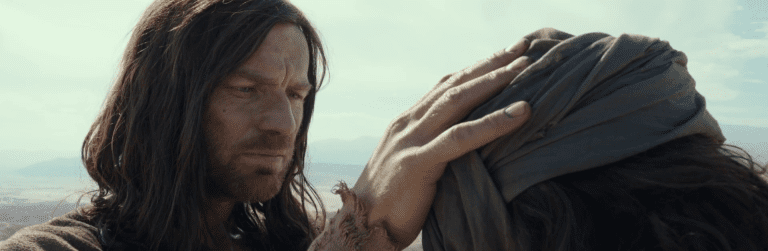
And then, the first time we see Jesus (Ewan McGregor), he is sitting alone in that wilderness, praying simple prayers: “Father, where are you?” “Father, speak to me.” He sleeps on the hard ground; he shakes a pebble out of his shoe; he laughs as he plucks dead twigs out of his windblown hair; he sheds quiet tears in the midst of his prayer.
Eventually he encounters the Devil — and, for the most part, the Devil looks just like him, albeit with a bit of jewelry to signify the Devil’s vanity. And then, Jesus encounters a family living in the desert: a father (Ciaran Hinds), his terminally ill wife (Ayelet Zurer), and their son (Tye Sheridan), who longs to live in the city but is held back by his father’s love of isolation.
The dramatic thrust of the movie is that Jesus, who has been fasting in the desert for over a month, isn’t quite ready to go back to civilization yet — he hasn’t quite found himself yet — and he thinks he can find what he’s looking for by helping this family.
You could call Jesus’ actions here a trial run for the ministry that he’s about to launch. But there are clearly meant to be parallels, too, between the strained father-son relationship within this family and Jesus’ own sense of distance from his own heavenly Father. (One of the daring things about this film is that it not only asks us to identify with Jesus, but it imagines Jesus himself identifying with someone else, namely the boy.)
Interestingly, for all the “fathers and sons” talk within and around this film, there is very little mention of Jesus’ earthly parents, each of whom is mentioned precisely once.
The Devil mentions Mary when he first addresses Jesus as “Yeshua” — the Hebrew name for Jesus that is used throughout the film — and says, “That’s what your mother calls you, isn’t it? Any name that’s good enough for Mary is good enough for me.” (Note: Mary, not her Hebrew name Miriam.)
And Joseph is alluded to when the boy asks Jesus what his own father does for a living, and Jesus replies that his father is a carpenter (present tense, apparently; most other films imagine that Joseph had died before Jesus started his ministry).
Interestingly, the boy — who knows that Jesus is a carpenter too — asks if Jesus wanted to be a carpenter like his father, and Jesus shakes his head no. Like many other moments in the film, this one teases you into wondering what’s behind the gesture: Did Jesus not want to be a carpenter because he wanted some other sort of livelihood, like fishing or farming? Or did Jesus not want an earthly job of any sort because he was itching to follow his spiritual destiny? Was this one of the ways he learned patience, while he was living with his earthly parents?
The Devil taunts Jesus in several different ways. He says God is so obsessed with the smallest details of his universe that he has no time to think about people, not even his own Son. He says God has destroyed and re-created the world multiple times. He says God has other children besides Jesus. (Jesus might not know how to answer some of the Devil’s other claims, but he firmly rejects this last one.)
The Devil makes particularly creepy use of the boy’s ailing mother. He wakes her up with a predatory stroke of her leg. And at one point he assumes her form, exposes “her” naked breasts to Jesus, and visually mocks the suffering that Jesus will endure on the cross — and then, when Jesus turns away, he whispers harsh, belittling words into Jesus’ ears.
But the Devil can be rattled too. When Jesus reminds him of the pride that led to his expulsion from heaven, the Devil replies, indignantly, “I am not proud. I am not proud!” in a way that unintentionally confirms that, yeah, he’s a little proud. And the Devil is caught staring at a shooting star, which he promptly — but not entirely convincingly — says he found boring.
Many of the things the Devil says can be dismissed, of course, because he is a liar — by his own ironic admission. (“I am a liar, that’s the truth.”) But Jesus is still eager to hear the Devil describe things that Jesus has not seen: what it’s like to be in God’s presence without the filters of a mortal material life, or what the future holds for certain characters (at one point Satan conveys this information through a bowl full of water, not unlike the prophetic basins one finds in The Lord of the Rings or The Chronicles of Prydain).
There are hints of things to come in Jesus’ own future throughout this film, from foot-washing to walking on the water. But the film’s narrative doesn’t really mesh all that well with the biblical narrative, once you start thinking about it.
In the gospels of Matthew and Luke, Jesus responds to each of the Devil’s temptations by quoting scripture — and the Devil himself tries to tempt Jesus by quoting scripture, too. But there are no scripture quotations in this film.
Nor is there any reference to the fact that Jesus was baptized by John immediately prior to his 40 days in the desert, and that at that baptism God himself declared that he was pleased with his beloved Son. Does the Jesus of this film have any memory of that event? Is he feeling the absence of God acutely now — the way he will at his crucifixion, perhaps — because he felt the presence of God so vividly just days before? Or has he just never heard God’s voice clearly, the way most of us haven’t?
Curiously, when writer-director Rodrigo Garcia does engage with the more familiar parts of the story — particularly in the epilogue, which jumps ahead to the end of Jesus’ life — he deviates from the traditional iconography. Jesus’ side is pierced with a spear while he is still alive, and not to prove that he is already dead; and Jesus’ tomb is sealed off by a pile of rocks, rather than a single stone that can be rolled away.
The film’s thematic emphases are also notably different than the gospels’ in some ways.
When Jesus bids farewell to the boy, he says, “Love God above all things. Love life.” The first sentence is remarkably close to what Jesus identified as the greatest commandment. But the second sentence is noticeably different from what Jesus identified as the second greatest commandment — to love your neighbour as yourself. There’s nothing wrong with the second sentence, and it’s appropriate to the film, but there’s still a difference of emphasis worth noting there, I think.
The film does acknowledge the divinity of Jesus in interesting ways. Jesus and the Devil both allude to it, of course, and something of the divine lurks behind the dreams that Jesus has. Most interestingly, there is a scene in which a dying person — someone who had rejected the very idea of a life beyond death — seems to glimpse something that the audience cannot see, and the person looks at Jesus as though this person has just seen Jesus in a whole new light.
There is a lot to like here. The desert is a place full of death — birds attacking birds in the air, dead animals rotting out in the open — but the characters who live in it are full of life, whether laughing at a fart (and no, this isn’t the first Jesus movie to have one), caring for each other’s needs or arguing over their plans for the future.
Other bits, I’m not so sure about. There has been a lot of talk about how the movie makes Jesus “relatable”, but I’m not very fond of that word, with its implicit suggestion that what matters in a story is how it reminds us of ourselves, and not how it takes us out of ourselves and exposes us to other ways of thinking and being.
Still, the word does get at one of the critical issues surrounding this film: does it simply show us that Jesus was a lot like us (chastising himself for speaking in spiritual clichés, for example), or — given that it’s a film about the Son of God, after all — does it draw us out of ourselves and towards something better than us?
The final shot of the movie, which was apparently meant to remind us that Jesus lived in a real place that really exists, exacerbates the problem, by suggesting — perhaps inadvertently — just how trivializing “relatability” can be. Yes, in theory, we moderns can say that we’ve been to the same desert that Jesus went to, but what do we gain from learning that a place of pilgrimage and spiritual testing has become just another spot where sightseeing tourists can snap pretty pictures?
Still, whatever quibbles I may have with the film, I do respect it, and I’m glad it exists. St Athanasius famously said that God became man so that men might become God, and if the film is stronger on the first half of that equation than the second, well, at least it teases our minds into active thought about these issues. It’s not easy to strike a balance between human familiarity and divine mystery in the story of Jesus, but this film meets that challenge in some genuinely thought-provoking ways.
Next Post

May 15, 2016 Last Days in the Desert: the final interview round-up
Browse Our Archives
Select a Category Anglican Planet Articles BC Christian News BC Report Bible Movies Bible Review Blog Books & Culture Campus Times CBC Radio Christianity Today ChristianWeek Essays Faith Today Festival Cinemas Guide Film Journals Georgia Straight Interviews MB Herald National Catholic Register Salvationist Today's Christian Two Chairs Ubyssey Uncategorized Vancouver Courier Vancouver Sun
Select a Month August 2025 April 2025 January 2025 December 2024 November 2024 May 2024 February 2024 December 2023 May 2023 March 2023 November 2022 July 2022 June 2022 May 2022 April 2022 February 2022 January 2022 December 2021 November 2021 October 2021 September 2021 August 2021 July 2021 June 2021 April 2021 March 2021 February 2021 January 2021 December 2020 November 2020 October 2020 August 2020 July 2020 June 2020 May 2020 March 2020 February 2020 January 2020 December 2019 November 2019 September 2019 July 2019 May 2019 April 2019 March 2019 February 2019 January 2019 December 2018 November 2018 October 2018 September 2018 July 2018 June 2018 May 2018 April 2018 March 2018 February 2018 January 2018 December 2017 November 2017 October 2017 September 2017 August 2017 July 2017 June 2017 May 2017 April 2017 March 2017 February 2017 January 2017 December 2016 November 2016 October 2016 September 2016 August 2016 July 2016 June 2016 May 2016 April 2016 March 2016 February 2016 January 2016 December 2015 November 2015 October 2015 September 2015 August 2015 July 2015 June 2015 May 2015 April 2015 March 2015 February 2015 January 2015 December 2014 November 2014 October 2014 September 2014 August 2014 July 2014 June 2014 May 2014 April 2014 March 2014 February 2014 January 2014 December 2013 November 2013 October 2013 September 2013 August 2013 July 2013 June 2013 May 2013 April 2013 March 2013 February 2013 January 2013 December 2012 November 2012 October 2012 September 2012 August 2012 July 2012 June 2012 April 2012 January 2012 January 2011 December 2010 November 2010 October 2010 September 2010 August 2010 July 2010 June 2010 May 2010 April 2010 March 2010 February 2010 January 2010 December 2009 November 2009 October 2009 September 2009 August 2009 July 2009 June 2009 May 2009 April 2009 March 2009 February 2009 January 2009 December 2008 November 2008 October 2008 September 2008 August 2008 July 2008 June 2008 May 2008 April 2008 March 2008 February 2008 January 2008 December 2007 November 2007 October 2007 September 2007 August 2007 July 2007 June 2007 May 2007 April 2007 March 2007 February 2007 January 2007 December 2006 November 2006 October 2006 September 2006 August 2006 July 2006 June 2006 May 2006 April 2006 March 2006 February 2006 January 2006 December 2005 November 2005 October 2005 September 2005 August 2005 July 2005 June 2005 May 2005 April 2005 March 2005 January 2005 December 2004 November 2004 October 2004 September 2004 August 2004 July 2004 June 2004 May 2004 April 2004 March 2004 February 2004 January 2004 November 2003 October 2003 August 2003 July 2003 June 2003 May 2003 January 2003 December 2002 November 2002 August 2002 July 2002 June 2002 May 2002 March 2002 January 2002 December 2001 November 2001 September 2001 August 2001 July 2001 June 2001 April 2001 March 2001 February 2001 December 2000 November 2000 October 2000 September 2000 August 2000 July 2000 June 2000 May 2000 April 2000 March 2000 January 2000 October 1999 August 1999 May 1999 April 1999 February 1999 January 1999 December 1998 November 1998 October 1998 August 1998 July 1998 June 1998 April 1998 March 1998 January 1998 November 1997 September 1997 July 1997 June 1997 April 1997 March 1997 February 1997 January 1997 December 1996 October 1996 September 1996 June 1996 March 1996 February 1996 January 1996 April 1995 November 1994 September 1994 September 1991
Follow Us!
TAKE THE
Religious Wisdom Quiz
What book comes directly after Lamentations?
Select your answer to see how you score.
Hosea Jeremiah Daniel Ezekiel
Related posts from FilmChat

Joseph of Egypt – the Chosen spin-off announces...

Exclusive: A clip from Angel Studios' The King...

Exclusive: Watch a clip from Angel Studios' Brave...

Exclusive: Watch a clip from Angel Studios' Homestead
TRENDING AT PATHEOS Religious Music & Entertainment

"Les Diabolique" and Transgression
Alongside something like Arrival, Vertigo, or Charade, Les Diaboliques is a...

"The Plague Dogs" and Mortality
So, flashback to the late 70s, early 80s. Walt Disney Studios is...

With the recent and highly successful release of Christopher Nolan’s epic film,...

"L'avventura" and Human Weakness
Today's piece is going to be a little different for a few...

I first want to apologize for not posting or writing anything. I'm...

I've engaged in the multi-year project of reading through the Church Fathers,...
view all Religious Music & Entertainment blogs
Ad-Free & Subscriber Log-In Subscription Support
- About Us
- 2026 Calendar
- Videos
- Podcasts
- Library of World Religions
- Faith In Media Tracker
- Advertise With Us
- Write for Us
- Privacy Policy
- Terms of Service
- Do Not Sell My Data
- Contact Us
- Radiant Digital
- Manage Newsletter Subscriptions
- Unsubscribe From Notifications
- Sitemap
Copyright 2008-2026, Patheos. All rights reserved.
Subscription Support Ad-Free & Subscriber Log-In
Follow Patheos