
BuddhistCatholicContemplativeEvangelicalGeneral ChristianHinduJewishLatter-day SaintMuslimNew VisionsProgressive Christian
Beliefs
- Buddhist
- Catholic
- Contemplative
- Evangelical
- General Christian
- Hindu
- Jewish
- Latter-day Saint
- More Voices
- Muslim
- New Visions
- Pagan
- Progressive Christian
Topics
- Religion News
- Food and Religion
- Sports and Religion
- Religious Art
- Religious Music and Entertainment
- Religious Events
- History and Religion
- Style and Religion
- Politics and Religion
- Women in Religion
- Recreation Outdoors and Religion
- Business Finance and Religion
- Careers Workplace and Religion
- Education and Religion
- Family Parenting and Religion
- Health Fitness and Religion
- Home and Religion
- Relationships and Religion
- Technology and Religion
- Travel and Religion
Columnists
- Buddhist Columnists
- Business Finance and Religion Columnists
- Careers Workplace and Religion Columnists
- Catholic Columnists
- Contemplative Columnists
- Education and Religion Columnists
- Evangelists Columnists
- Family Parenting and Religion Columnists
- General Christian Columnists
- Health Fitness and Religion Columnists
- Hindu Columnists
- History and Religion Columnists
- Home and Religion Columnists
- Jewish Columnists
- More Voices Columnists
- Latter Day Columnists
- Muslim Columnists
- New Visions Columnists
- Nonreligious Columnists
- Pagan Columnists
- Politics and Religion Columnists
- Progressive Columnists
- Recreation Outdoors and Religion Columnists
- Relationships and Religion Columnists
- Religion News Columnists
- Religious Art Columnists
- Religious Events Columnists
- Religious Music and Entertainment Columnists
- Sports and Religion Columnists
- Style and Religion Columnists
- Technology and Religion Columnists
- Travel and Religion Columnists
- Women in Religion Columnists
Resource Library
- 2026 Calendar
- Library of World Religions
- The 100 Most Holy Places on Earth
- Patheos Answers
- Podcasts
- Videos
- Faith Leaders Database
- Anglican Episcopalian
- Bahai
- Baptist
- Buddhism
- Christianity
- Confucianism
- Eastern Orthodoxy
- Hinduism
- Holiness and Pentecostal
- ISKCON
- Islam
- Judaism
- Lutheran
- Methodist
- The Church of Jesus Christ of Latter-day Saints
- New Age
- Paganism
- Presbytarian and Reformed
- Protestantism
- Religion Behind the Scenes
- Roman Catholic
- Scientology
- Shia Islam
- Sikhism
- Sufism
- Sunni Islam
- Taoism
- Zen
- See all religions
Research Tools
 Ad-Free & Subscriber Log-In Subscription Support
Ad-Free & Subscriber Log-In Subscription Support
Follow Patheos 

- Trending:
- Forgiveness
- |
- Marriage
- |
- Consciousness
- |
- Death Penalty
- |
- Election
- |
- Halloween

-
Articles
- Home
- Religious Music & Entertainment
- Exclusive: Patrick and Paul Aiello on the making of Risen
Exclusive: Patrick and Paul Aiello on the making of Risen
Last updated on: May 24, 2016 at 12:02 pm by Peter T. Chattaway
Exclusive: Patrick and Paul Aiello on the making of Risen 2016-05-24T12:02:52-07:00 Peter T. Chattaway
Patheos Explore the world's faith through different perspectives on religion and spirituality! Patheos has the views of the prevalent religions and spiritualities of the world.
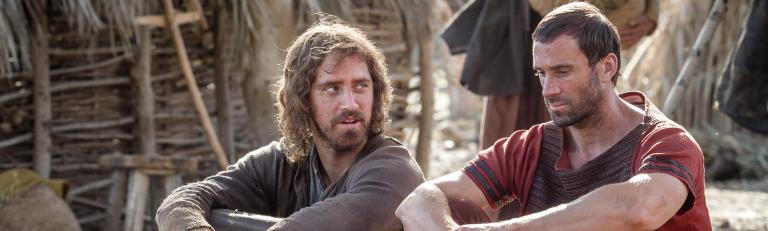
Risen — which stars Joseph Fiennes as a fictitious Roman officer who goes looking for the missing body of Jesus — is out on DVD and Blu-Ray today. Last week I had a chance to speak to Patrick Aiello, the producer who first started developing the film nearly a decade ago, and his brother Paul, who co-wrote the script.
What follows is a slightly edited transcript of our conversation. You can also click here for links to my other stories on the film, including my interview with Fiennes.
–
There was a story in Variety back in 2007, about a movie that you were going to write, Paul, called Risen: The Story of the First Easter, and at the time it was reported that it was going to be a story centred on Peter leading up to Pentecost. Here we are nine years later and we’ve got a movie called Risen, co-written by you, and it’s a story about somebody else leading up to the Ascension. So can you talk about what the earlier idea for the film was like, and how that changed over the years?
Paul Aiello: Well, the original idea was based on this: the story was the same, it was starting at the darkest moment of Christianity, which was the Crucifixion, and moving towards the light. And in the original first draft of the script, I had Peter — and of course they put that in the press because nobody knew who Clavius was — but Clavius was in the first draft of the script. So the idea was, at the Crucifixion, Peter and the disciples were at an all-time low, and the Clavius character, who was brought in to replace the centurion who left at the crucifixion, was at an all-time high, and he couldn’t care less about these people. He didn’t even know who they were, of course. And the story went on from there.
When Kevin [Reynolds] came in to direct the film, he decided, “You know what? Let’s just centre the movie on Clavius and bring Peter in at the point where they cross.” But the script he read had Peter in it, in the beginning. And quite frankly, when we first started showing people the movie, everyone thought the Clavius character arc was so powerful, and no one had ever seen that before, and no one had ever thought about the investigation and looking for the body and all that. The director really said, “You know, let’s really focus on this one character,” and that really is the only major difference in the story — and you know, I liked having Peter in it, but he said, “No, we know what Peter did. Let’s watch this guy, and then when Peter comes in, he’ll go with him.” And then, because the movie then became about Clavius, there was no reason to go forward with the Pentecost. And this happens with a lot of films, I’m sure you know that: he essentially took a piece out of the script and said, “Let’s concentrate on this,” and that’s what the film became.
So Clavius was always in the story, then?
Paul: Correct. He was always the guy that came and buried the body, and he was always that guy. So when they looked at it as a piece of material that would maybe capture the imagination of an audience, it was like, “We don’t know who this guy is. This would be more interesting.” And that’s where he pushed it down that road of “let’s follow this man.” But yeah, of course, he was always in there, yeah.
Of course, it takes a lot of time to get a film made, and you talk about people not thinking about the investigation the Romans did and all that. Between the original idea for this film and the film finally coming out, we have seen other things like, for example, last year, there was A.D. The Bible Continues, which actually had a whole episode devoted to the search for the body. Did it concern you that people might be beating you to the punch, as it were?
Patrick Aiello: No. We were ahead of them by years in our development; in other words, the script had been finalized a few years prior and the movie was pretty much in production, I think, when that premiered. But it’s a little unavoidable. And you know, material gets shown around town, because you’re sending the screenplay to talent and actors and so forth, so it’s possible they saw the idea and so forth. And it’s also very possible that this happened! And it’s an idea that people went, “Oh! Yeah, I see that, that’s possible.” So it’s nice that they went for it and did it, because it certainly warmed up the audience to the possibility that an investigation actually took place. So if anything, it was a helping hand.
You started this project back when The Passion of the Christ was brand new, and it took a long time to make the film, so by the time you got around to making it almost a decade later, were you surprised that there was still interest in this material, so long after The Passion?
Paul: My inspiration for the film was The Passion of the Christ, the very last scene, where he stands up and walks out into the world. That was my inspiration to tell this part of the story. Films are hard to get made, and a lot of films take ten years to be made, because there are so many people you have to convince, and Patrick finally got Mickey Liddell at LD Entertainment to read the script, and he was on board with this, and then it takes time to get directors and actors.
Patrick: In addition to what Paul said, we weren’t in a rush to make this movie. If anything, The Passion showed that the audience for the film, worldwide, is there. We took our time and methodically put together the film, piece by piece, as you would a house, and in doing that, we hand-selected our elements, that being our filmmaker, our cast, locations, composer, editor, all the way down the line — and in moving methodically, carefully, those pieces had to fit together perfectly, and you’re witness to the end result, and [so is] the audience that saw it, and now the DVD and the video-on-demand audience. So it was just a very methodical process, and we were in no rush. We took our time and did so with great care, because we knew the audience was there. And in making a piece like this, a film, you have to get it right. And Paul and I are both Christians, and we needed to make sure that the known spine of the story was intact and would see the light of day, so it wouldn’t get screwed up, and we had to basically manage that whole process. So it takes time, and that’s why it took so long. But we’re glad we took our time, because it came out beautifully.
I understand there are going to be some deleted scenes on the Blu-Ray, which I have not yet had a chance to see, and when I interviewed Joseph Fiennes a few months ago, we talked about a subplot that was deleted from the film involving his character’s Jewish mistress, and there may be other things that got dropped along the way. Was there anything that ended up being cut from the film that you really wish could have gotten in there?
Patrick: It was only a few scenes, I think there were three or four at the very most that fell away. And they did deal specifically with Joseph Fiennes’ character’s mistress. But ultimately it came down to time and pacing. And when we interrupted Joseph Fiennes’ character arc, coming into the faith and understanding that the Resurrection indeed happened and he would bear witness to it, we found that this personal story — this B-story of the lead actor — was interrupting that flow and that momentum. So after testing it and talking internally, we decided to drop it, and in doing so, the movie moved a lot quicker, and that was ultimately the experience we wanted.
There’s sort of a shift in the story, in terms of that moment where Clavius barges in on the disciples when they are actually meeting with the risen Jesus, and it’s sort of like the film does a bit of a pivot there. Up until then, it’s very much a story told from the outside, but then for the last 40 minutes or so it becomes a story told from the inside, even though it’s still seen from an outsider’s point of view.
Paul: That is exactly correct. That’s the intention. Let me ask you, are you Christian?
Oh yeah, absolutely.
Paul: The allegory of the story is this is a person– Clavius stands in for modern man, worn down, living in a very violent unpredictable world, he’s kind of trapped in his career like many people in the world right now. So the whole idea behind the film, for somebody coming to this as a modern-day Christian, we all have tremendous problems now with the media, we’re under siege, so this is a guy that’s starting to look at this and look at Christ, as an allegory, as a story, and then when he finally encounters him, of course it changes him. And that is what the film is about, is the fact that, as he goes on the road with him, he starts to shed his clothes, he starts to become like him. When he’s standing out there on the sand dune, he’s basically Lawrence of Arabia, he’s one of them.
And the fact that he doesn’t fully commit is also realistic for modern Christians. You’re not just going to jump head over heels into this, but when you start to realize that this could potentially be real, in modern life, you go through this process, so that’s what happens. He then becomes, on the inside, he’s still questioning, he’s still poking holes in it, but he’s in the presence of Christ now. And the moment on the rock is the moment we all want, where we sit there and have five minutes with Jesus Christ.
So the film does shift dramatically, and I think that’s the best part of the film. And that shift was in the first draft of the script, where he encounters Christ and he can’t fathom it. He laid this guy to rest, and now he’s there! But that also stands in for us, when we’re all told these stories, or this happened so long ago, but then something happens in your life, supernaturally or otherwise, you go wait a minute, maybe this is real.
What I thought was interesting is that it doesn’t just change him, but it changes the story in a way. Up until that point, Clavius is just like everyone in the audience who has heard the story and is trying to process it, but after that point, he’s got sort of an advantage that the rest of us don’t have, do you know what I mean?
Paul: Mm-hmm. Exactly. That’s the most inspirational part of the film, actually, because now he’s tagging along with them. It all opens up.
But do you think it might make it harder for audiences to relate to that character, if he’s actually seeing Jesus and the average audience member hasn’t?
Paul: Well, it’s a film. The whole point of the film is the experience that’s not possible, right? And again, in terms of storytelling, I think one of the smartest things that we did — and this was Patrick’s idea — was to hire Cliff Curtis as Christ, because he’s so strong, but the main thing we wanted to come across was that he’s also so loving and forgiving, and if you listen carefully when you watch the DVD, when Clavius walks in that room, in the upper room, Christ says to him, “Clavius, there’s no enemies here.” He knows who he is, so the idea — there’s a lot of subtlety to the film, which I think comes out in multiple viewings — is that he knows who he is. There’s a lot of subtlety to it, and the takeaway is supposed to be we’re encountering Jesus Christ here for ten minutes, and we’re seeing these famous scenes from the Bible played out, but the more important thing is we’re getting the feeling of what Clavius– You see Clavius physically change. He’s no longer this man who’s tired of death, to some degree his burden is lifted. That’s what the film is about. When he walks off into the desert, his burden to some degree is lifted. He’s starting a new chapter in his life. That’s what the film is about. At the beginning he’s trapped, he’s a soldier. At the end, he now has a day without death. He no longer has to kill people.
For what it’s worth, in my own review of the film, I made the point that one verse I’ve always been intrigued by in the gospels is in Matthew, when the disciples see Jesus it says that some of them doubted, and even seeing him didn’t erase their doubts. I’ve never really seen that dramatized on film, so in many ways the film feels like a dramatization of that verse. Clavius isn’t a disicple, but he does have the experience and he’s still sort of wrestling with it afterwards, which I thought was kind of cool.
Patrick: If we can imagine ourselves in that position, in other words you’re rewarded with an appearance or presence, it might take a minute to click in. Like, is this happening? And that was the intention. And then it comes full circle, when Christ appears by the Sea of Galilee, and Clavius realizes it’s him, and there he is.
Paul: If you think about it, this is Kevin’s dramatic device, the way he reframed the movie with the beginning of him at the end, because ultimately, if you analyze it as a film critic or a story critic, you realize he’s sitting there telling the story, that’s what he’s doing. He’s running this through his head, he’s processing this. Because it’s just too overwhelming. The whole thing is just too overwhelming. And we all have these kinds of experiences in our lives, where it takes a little time to process all this. And I like to think that, at the end, when he walks into the desert, he’s going to Jerusalem to join them. That’s what my intentions are. Even Peter, after the whole thing, he didn’t believe it right afterwards until he resurrected, and that’s very clearly in the Bible. A lot of that’s in there.
I have to ask: There’s a novelization of the movie, and Paul, I don’t know if you’ve ever had your name on the cover of a book before, but how does it feel, if this is the first time?
Paul: It feels great! I had nothing to do with that, obviously, but it felt great seeing that. It’s beautiful. Very cool, very exciting.
And what do you have in the works now, for a follow-up?
Patrick: We can say that we’re working on a few things right now, and we should be able to get into more detail officially before the end of the year.
Are any of them Bible films?
Patrick: Yes. Well, they are Christian-themed, broad audience films, so like Risen, they should appeal to the core because they’re made by Christians, and they should also cross over to the broad audience as well.
Previous Post

May 24, 2016
The Young Messiah -- a round-up of my top posts
Browse Our Archives
Select a Category Anglican Planet Articles BC Christian News BC Report Bible Movies Bible Review Blog Books & Culture Campus Times CBC Radio Christianity Today ChristianWeek Essays Faith Today Festival Cinemas Guide Film Journals Georgia Straight Interviews MB Herald National Catholic Register Salvationist Today's Christian Two Chairs Ubyssey Uncategorized Vancouver Courier Vancouver Sun
Select a Month August 2025 April 2025 January 2025 December 2024 November 2024 May 2024 February 2024 December 2023 May 2023 March 2023 November 2022 July 2022 June 2022 May 2022 April 2022 February 2022 January 2022 December 2021 November 2021 October 2021 September 2021 August 2021 July 2021 June 2021 April 2021 March 2021 February 2021 January 2021 December 2020 November 2020 October 2020 August 2020 July 2020 June 2020 May 2020 March 2020 February 2020 January 2020 December 2019 November 2019 September 2019 July 2019 May 2019 April 2019 March 2019 February 2019 January 2019 December 2018 November 2018 October 2018 September 2018 July 2018 June 2018 May 2018 April 2018 March 2018 February 2018 January 2018 December 2017 November 2017 October 2017 September 2017 August 2017 July 2017 June 2017 May 2017 April 2017 March 2017 February 2017 January 2017 December 2016 November 2016 October 2016 September 2016 August 2016 July 2016 June 2016 May 2016 April 2016 March 2016 February 2016 January 2016 December 2015 November 2015 October 2015 September 2015 August 2015 July 2015 June 2015 May 2015 April 2015 March 2015 February 2015 January 2015 December 2014 November 2014 October 2014 September 2014 August 2014 July 2014 June 2014 May 2014 April 2014 March 2014 February 2014 January 2014 December 2013 November 2013 October 2013 September 2013 August 2013 July 2013 June 2013 May 2013 April 2013 March 2013 February 2013 January 2013 December 2012 November 2012 October 2012 September 2012 August 2012 July 2012 June 2012 April 2012 January 2012 January 2011 December 2010 November 2010 October 2010 September 2010 August 2010 July 2010 June 2010 May 2010 April 2010 March 2010 February 2010 January 2010 December 2009 November 2009 October 2009 September 2009 August 2009 July 2009 June 2009 May 2009 April 2009 March 2009 February 2009 January 2009 December 2008 November 2008 October 2008 September 2008 August 2008 July 2008 June 2008 May 2008 April 2008 March 2008 February 2008 January 2008 December 2007 November 2007 October 2007 September 2007 August 2007 July 2007 June 2007 May 2007 April 2007 March 2007 February 2007 January 2007 December 2006 November 2006 October 2006 September 2006 August 2006 July 2006 June 2006 May 2006 April 2006 March 2006 February 2006 January 2006 December 2005 November 2005 October 2005 September 2005 August 2005 July 2005 June 2005 May 2005 April 2005 March 2005 January 2005 December 2004 November 2004 October 2004 September 2004 August 2004 July 2004 June 2004 May 2004 April 2004 March 2004 February 2004 January 2004 November 2003 October 2003 August 2003 July 2003 June 2003 May 2003 January 2003 December 2002 November 2002 August 2002 July 2002 June 2002 May 2002 March 2002 January 2002 December 2001 November 2001 September 2001 August 2001 July 2001 June 2001 April 2001 March 2001 February 2001 December 2000 November 2000 October 2000 September 2000 August 2000 July 2000 June 2000 May 2000 April 2000 March 2000 January 2000 October 1999 August 1999 May 1999 April 1999 February 1999 January 1999 December 1998 November 1998 October 1998 August 1998 July 1998 June 1998 April 1998 March 1998 January 1998 November 1997 September 1997 July 1997 June 1997 April 1997 March 1997 February 1997 January 1997 December 1996 October 1996 September 1996 June 1996 March 1996 February 1996 January 1996 April 1995 November 1994 September 1994 September 1991
Follow Us!
TAKE THE
Religious Wisdom Quiz
What was the rider of the Red Horse in Revelation given?
Select your answer to see how you score.
A large sword A crown A bow A balance scale
Related posts from FilmChat

Joseph of Egypt – the Chosen spin-off announces...

Exclusive: A clip from Angel Studios' The King...

Exclusive: Watch a clip from Angel Studios' Brave...

Exclusive: Watch a clip from Angel Studios' Homestead
TRENDING AT PATHEOS Religious Music & Entertainment

"Les Diabolique" and Transgression
Alongside something like Arrival, Vertigo, or Charade, Les Diaboliques is a...

"The Plague Dogs" and Mortality
So, flashback to the late 70s, early 80s. Walt Disney Studios is...

With the recent and highly successful release of Christopher Nolan’s epic film,...

"L'avventura" and Human Weakness
Today's piece is going to be a little different for a few...

I first want to apologize for not posting or writing anything. I'm...

I've engaged in the multi-year project of reading through the Church Fathers,...
view all Religious Music & Entertainment blogs
Ad-Free & Subscriber Log-In Subscription Support
- About Us
- 2026 Calendar
- Videos
- Podcasts
- Library of World Religions
- Faith In Media Tracker
- Advertise With Us
- Write for Us
- Privacy Policy
- Terms of Service
- Do Not Sell My Data
- Contact Us
- Radiant Digital
- Manage Newsletter Subscriptions
- Unsubscribe From Notifications
- Sitemap
Copyright 2008-2026, Patheos. All rights reserved.
Subscription Support Ad-Free & Subscriber Log-In
Follow Patheos