
BuddhistCatholicContemplativeEvangelicalGeneral ChristianHinduJewishLatter-day SaintMuslimNew VisionsProgressive Christian
Beliefs
- Buddhist
- Catholic
- Contemplative
- Evangelical
- General Christian
- Hindu
- Jewish
- Latter-day Saint
- More Voices
- Muslim
- New Visions
- Pagan
- Progressive Christian
Topics
- Religion News
- Food and Religion
- Sports and Religion
- Religious Art
- Religious Music and Entertainment
- Religious Events
- History and Religion
- Style and Religion
- Politics and Religion
- Women in Religion
- Recreation Outdoors and Religion
- Business Finance and Religion
- Careers Workplace and Religion
- Education and Religion
- Family Parenting and Religion
- Health Fitness and Religion
- Home and Religion
- Relationships and Religion
- Technology and Religion
- Travel and Religion
Columnists
- Buddhist Columnists
- Business Finance and Religion Columnists
- Careers Workplace and Religion Columnists
- Catholic Columnists
- Contemplative Columnists
- Education and Religion Columnists
- Evangelists Columnists
- Family Parenting and Religion Columnists
- General Christian Columnists
- Health Fitness and Religion Columnists
- Hindu Columnists
- History and Religion Columnists
- Home and Religion Columnists
- Jewish Columnists
- More Voices Columnists
- Latter Day Columnists
- Muslim Columnists
- New Visions Columnists
- Nonreligious Columnists
- Pagan Columnists
- Politics and Religion Columnists
- Progressive Columnists
- Recreation Outdoors and Religion Columnists
- Relationships and Religion Columnists
- Religion News Columnists
- Religious Art Columnists
- Religious Events Columnists
- Religious Music and Entertainment Columnists
- Sports and Religion Columnists
- Style and Religion Columnists
- Technology and Religion Columnists
- Travel and Religion Columnists
- Women in Religion Columnists
Resource Library
- 2026 Calendar
- Library of World Religions
- The 100 Most Holy Places on Earth
- Patheos Answers
- Podcasts
- Videos
- Faith Leaders Database
- Anglican Episcopalian
- Bahai
- Baptist
- Buddhism
- Christianity
- Confucianism
- Eastern Orthodoxy
- Hinduism
- Holiness and Pentecostal
- ISKCON
- Islam
- Judaism
- Lutheran
- Methodist
- The Church of Jesus Christ of Latter-day Saints
- New Age
- Paganism
- Presbytarian and Reformed
- Protestantism
- Religion Behind the Scenes
- Roman Catholic
- Scientology
- Shia Islam
- Sikhism
- Sufism
- Sunni Islam
- Taoism
- Zen
- See all religions
Research Tools
 Ad-Free & Subscriber Log-In Subscription Support
Ad-Free & Subscriber Log-In Subscription Support
Follow Patheos 

- Trending:
- Forgiveness
- |
- Marriage
- |
- Consciousness
- |
- Death Penalty
- |
- Election
- |
- Halloween

-
Articles
- Home
- Religious Music & Entertainment
- Bible movie of the week: The Last Days of Pompeii (dir. Ernest B. Schoedsack, 1935)
Bible movie of the week: The Last Days of Pompeii (dir. Ernest B. Schoedsack, 1935)
Last updated on: November 4, 2016 at 1:50 pm by Peter T. Chattaway
Bible movie of the week: The Last Days of Pompeii (dir. Ernest B. Schoedsack, 1935) 2016-11-04T13:50:24-07:00 Peter T. Chattaway
Patheos Explore the world's faith through different perspectives on religion and spirituality! Patheos has the views of the prevalent religions and spiritualities of the world.

Bible movies were big in the silent era, which came to an end in the late 1920s, and they were big again in the 1950s, when pious spectacle was all the rage — but very few were produced during the two decades between those eras.1 Hollywood, in particular, seemed to lose interest in the genre entirely during this period. Nevertheless, a few films did at least touch on the genre, even if they did not commit to it fully.
Cecil B. DeMille, of course, produced two early sound films that flirted with biblical elements. The Sign of the Cross (1932) depicts the persecution of the Christians under Nero, which took place just a few years after the events of the book of Acts — but the film does not depict any actual biblical characters or events, with the exception of Titus, who comes to Rome bearing a letter from Paul. And then there was Cleopatra (1934), in which Herod the Great stirs things up between the Egyptian queen and her Roman suitor just a few decades before the events of the New Testament.
But both of those films take place outside the biblical timeframe. The only Hollywood film I’ve seen from this era that actually depicts any events from the Bible is, of all things, The Last Days of Pompeii (1935).2 Produced by Merian C. Cooper and directed by Ernest B. Schoedsack just two years after they made King Kong, the film — by its own admission — shares a title and a setting and little else with the 1834 novel by Edward Bulwer-Lytton. The story breaks down into three parts that are roughly half-an-hour each, and while the first and last sections take place in Pompeii, the middle section takes place in Judea during the reign of Pontius Pilate (who is played by Basil Rathbone, four years before his first Sherlock Holmes movie).3
The story concerns a blacksmith named Marcus (Preston Foster) who loses his wife and infant son in an accident and, along the way, becomes a gladiator, convinced that money is the only thing that matters in the world so you might as well kill people to get it. At one point Marcus learns that he has orphaned a gladiator’s son, so he adopts the boy, Flavius, as his own — and then, when Marcus is wounded and informed that he will never be able to fight in the arena again, he decides to become a slave trader and accumulate enough money to run the arena some day.
Marcus’s pursuit of wealth takes him to Judea, where Pontius Pilate helps him to steal some horses and gold and thereby make his fortune (more on that in a minute). Marcus also has three close encounters with Jesus, who remains offscreen throughout: once, Marcus steps into a stable and is informed that “the greatest man in Judea” is sleeping there; later, he takes Flavius to be healed by Jesus; and then, apparently just a few days later, he sees Jesus carrying his cross through the streets of Jerusalem.
By that point Marcus has acquired the wealth that he was looking for, and so he leaves Jerusalem and returns to Pompeii — at which point the movie jumps ahead to the days immediately preceding the destruction of that city. (Nearly half a century separates the death of Jesus circa AD 30 from the destruction of Pompeii in AD 79, but everyone in the film looks maybe 20 years older at most.) Marcus is indeed the head of the arena that he wanted to be, but Flavius has turned against his father’s materialism and is secretly planning to help runaway slaves escape to an island where there is “no wealth, no people to enslave” and “no Roman soldier has ever set foot” — and somewhere in all this, Pontius Pilate pays Marcus and Flavius a visit.
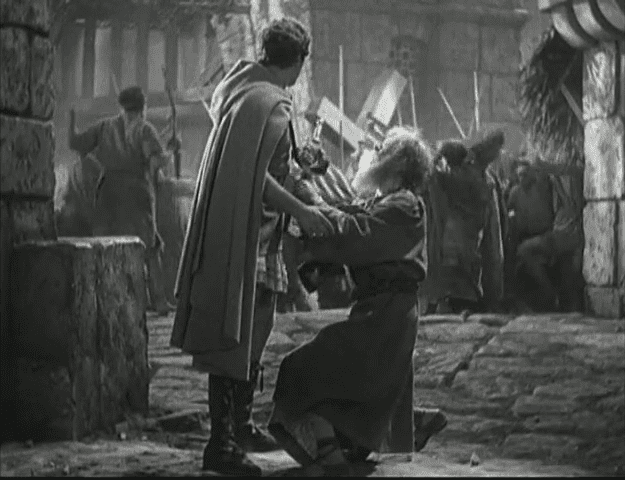
The story reaches its climax when Flavius and the slaves are captured and sent into the arena. Marcus pleads with the local prefect to set Flavius free, but the prefect won’t allow it — and then the volcano erupts and everybody panics. Marcus, realizing the error of his ways (partly because a man pleads for his son’s life with the same words that Marcus used when asking Jesus to heal Flavius), decides to rescue other people rather than save his own wealth, and his efforts eventually cost him his life. Finally, as he lays dying in the street, Marcus has a vision of Jesus himself.
The disaster footage is the film’s big selling point, and in some ways it is reminiscent of the destruction of Skull Island at the end of Son of Kong, which the filmmakers had made just two years earlier. (Willis O’Brien, the stop-motion pioneer who worked on the Kong films, is listed in Pompeii’s credits as the film’s “chief technician”.) Statues topple, buildings collapse, and a river of mud and lava flows through the city — and as in many disaster movies over the years, the people who suffer the most seem to “deserve” it, like when a wealthy woman being carried in a litter pushes a poor woman out of her way, and is almost immediately crushed by some falling debris. (Of course, the debris falls on the servants who were carrying the wealthy woman, too.)
But the main attraction for me is the film’s inclusion of the biblical narrative, and I am intrigued by the fact that the filmmakers included it at all when it doesn’t really fit the period of Pompeii’s destruction. As I mentioned above, roughly 50 years went by between the death of Christ and the eruption of Mt Vesuvius, yet the characters seem to age only 20 years or so, if that. Why did the filmmakers warp history so? I can only speculate, but I wonder if the filmmakers felt that a story about the ancient Romans needed to be linked somehow to the rise of Christianity, similar to how Stanley Kubrick’s Spartacus, set roughly one century before the events of the New Testament, begins with a reference to Jesus that the story doesn’t really need. It was not impossible back then to tell a purely secular story set in the ancient Roman world, but the biblical genre evidently exerted a pull on films set in that period, even in an era like the 1930s when full-fledged Bible movies weren’t really being made at all.
As noted, the film’s biblical elements revolve around Jesus, who interacts with the characters though he is never seen by the audience, and Pontius Pilate, who appears not only as the Roman official in Judea but as an old acquaintance who visits Marcus in Pompeii years later. And the film does some interesting things with these elements.
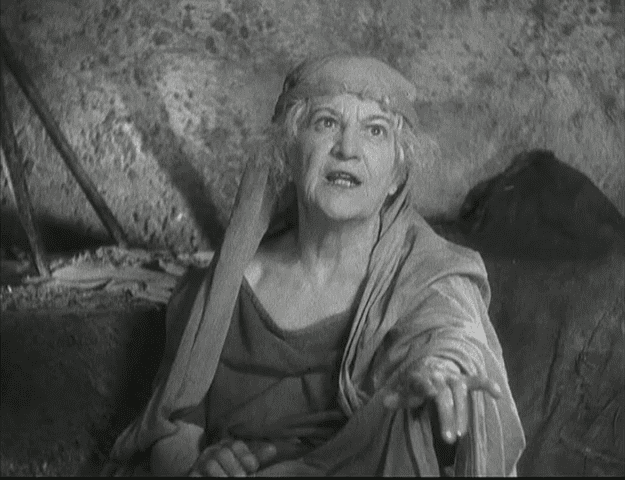
First, the film prepares us for the inclusion of Jesus in the story by having a female fortune-teller tell Marcus, before he sails for Judea, that Flavius will meet “the greatest man, greater than anyone yet known” there. “He will help the child when help is needed, and his spirit will direct the child,” says the fortune-teller. This is interesting on two levels: first, the film seems to affirm not just Christian miracle-working but pagan clairvoyance (which admittedly isn’t so hard when you recall how the birth of Christ was heralded by astrologers from the east in Matthew’s gospel); and second, while the young Flavius will indeed be healed by Jesus, he will grow up never knowing who Jesus was, and his efforts to set slaves free will stem from a general humanist impulse rather than any particular religious motive. The film thus suggests that the “spirit” of Jesus lies behind the quest for justice and freedom, but conscious religious affiliation with Jesus is not an essential part of that quest.
Second, Jesus is never depicted at all, with the exception of the very final shot, when Jesus appears as a transparent ghost-like figure whose appearance is still somewhat obscured. When Marcus takes Flavius to be healed by Jesus, the pivotal moment is shot essentially from Jesus’ point of view as Marcus approaches the camera and a bright light illuminates Marcus’s face. The film then wipes from the close-up to a wide shot of the crowd, and soon after that, the crowd walks offscreen (presumably following Jesus, who is hidden from our view) and leaves Marcus and Flavius standing or kneeling where they are. The use of a wipe here is interesting, as it leaves us wondering just how much time has passed since Marcus asked Jesus to heal Flavius — and also because there is another wipe at the very end of the film, when Marcus looks offscreen at Jesus and the film wipes to a wide shot of Marcus and Jesus looking at each other. In that case, no time seems to have passed at all, but the use of a wipe creates the sense that Jesus is being “revealed” to the audience.
Third, one of the film’s most persistent themes is the relationship between rich and poor, between material wealth and the spiritual kind. Jesus is identified by one character here as “a wandering healer” who is called “Master and Lord” by “all the poor people.” When Marcus comes to Judea, he meets with Pontius Pilate because he assumes Pilate is the “great man” that the fortune-teller prophesied — but of course, that just shows how Marcus’s pursuit of money and power has blinded him to the possibility that “greatness” can exist on a more spiritual plane. When Marcus makes a pit stop at a stable and is told that “the greatest man in Judea” is sleeping there, he scoffs, but is told that Jesus “was born in a stable.” Later, after Jesus has healed Flavius, Marcus tells one of Jesus’ followers that he would gladly give Jesus money in thanks, but the man says Jesus won’t take the money because he’s already “the richest man in the world.” And many years later, when Pilate visits Marcus and Flavius in Pompeii and confirms that Flavius isn’t just dreaming that he was healed by a man many years before, Marcus reveals that he is aware of Jesus’ teaching that people should sell everything they have and give their money to the poor, but he says Flavius couldn’t have had the life that he’s had if Marcus had followed that teaching; in reply, Flavius walks out on his father and says he wants nothing to do with his father’s money.
Fourth, there is an interesting tension in the scene where Marcus watches the crowd from a short distance as Jesus carries his cross. The follower of Jesus who spoke to Marcus in the earlier scenes appears here too, bemoaning the fact that Jesus is about to die, and he urges Marcus to intervene — but Marcus, who briefly thinks about using his sword in defense of Jesus, decides he has to follow the horses carrying his bags of gold instead. The Jesus follower than shouts at Marcus, “When your world crumbles around you, you will understand what you have done today! You have rejected him!” On the one hand, this scene fits the film’s overarching theme regarding the conflict between material and spiritual wealth: Marcus, by following his gold instead of Jesus, chooses money over God. And yet, the film suggests that following Jesus, for Marcus, would have meant intervening violently on Jesus’ behalf — and hadn’t the Jesus of the Bible already told Peter not to defend him with a sword by this point?
Then there is the film’s portrayal of Pilate. On the one hand, the film follows the traditional and somewhat unhistorical portrayal of Pilate as a conscientious man who is forced to execute Jesus against his better judgment.4 (The crowd calling for Jesus’ death is much bigger than the crowd that follows Jesus when he heals Flavius.) But in his scenes with Marcus, Pilate is more of a political schemer who uses Marcus to get back at Herod (by encouraging Marcus to steal horses and gold from an Ammonite chief who is allied with Herod), and he even considers profiting personally from Marcus’s actions. This fits the bit in Luke’s gospel which says that Herod and Pilate were enemies prior to the crucifixion of Jesus; however, it is not clear whether the film’s timeline would allow for Pilate to send Jesus to Herod, also as per Luke’s gospel. The film’s most explicit nod to the gospels comes when Pilate washes his hands and says that he is innocent of Jesus’ blood, as per Matthew’s gospel. Finally, when Pilate appears in Pompeii and is confronted by Flavius’s idealism many years later, he asks “What is truth?” just as he did when faced with Jesus in John’s gospel.
The Last Days of Pompeii isn’t a great film by any stretch — it’s a fairly typical mid-1930s melodrama — but it’s interesting, both as a time capsule that captures common attitudes about wealth and poverty at the height of the Great Depression, and also as one of the very rare films made during this period that depicts, however tangentially, a few key events from the Bible. There’s a certain look and sound that the Hollywood films of this era had, when sound was new and actors spoke with certain kinds of accents, and this may be the only film that gives us even a taste of what it would have been like to see a Bible story filtered through that aesthetic. As such, it’s worth a look, for those who are curious about such things.
–
Two clips from the film can be streamed via the Turner Classic Movies website.
Below are some screen captures from the film, which is available on DVD.
The opening title card notes that the film is not based on the identically-titled Bulwer-Lytton novel:

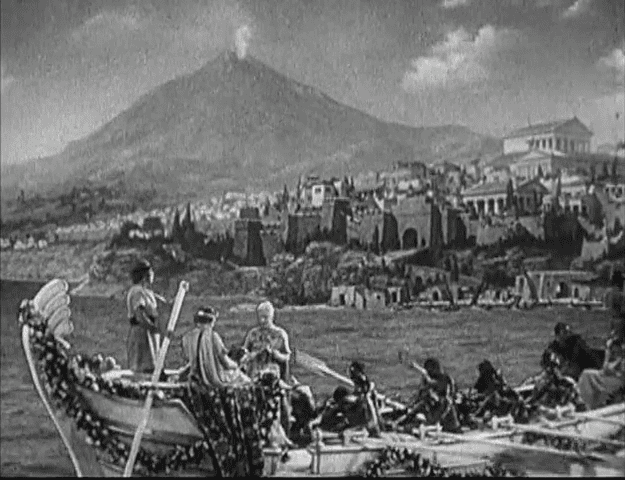
The first shot in the film is a finely-executed matte shot of a boat sailing near Pompeii:
Our first look at Marcus the blacksmith:

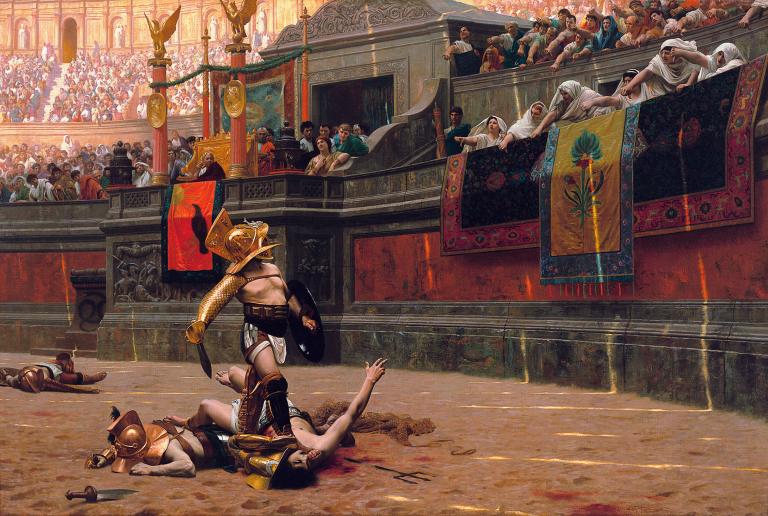
Marcus becomes a gladiator…
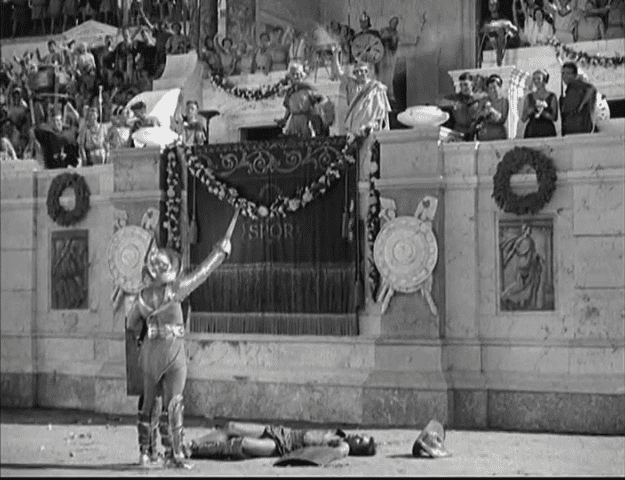
…in a shot that echoes Jean-Léon Gérôme’s 1872 painting Pollice Verso:
A fortune-teller predicts that Flavius will meet the “greatest man” in Judea:
Marcus meets a follower of Jesus in a stable:
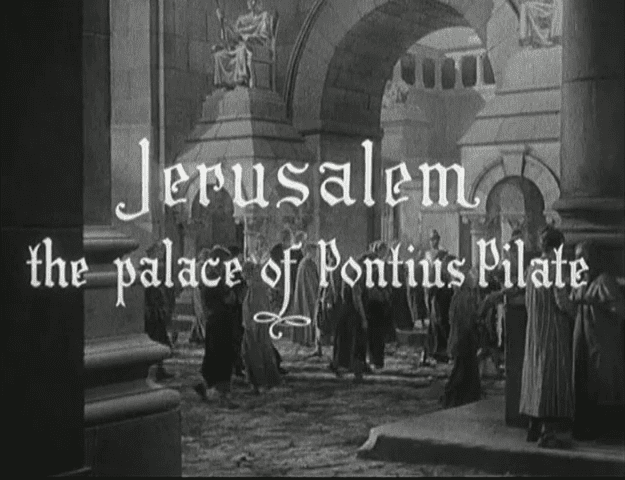
An establishing shot of Jerusalem:
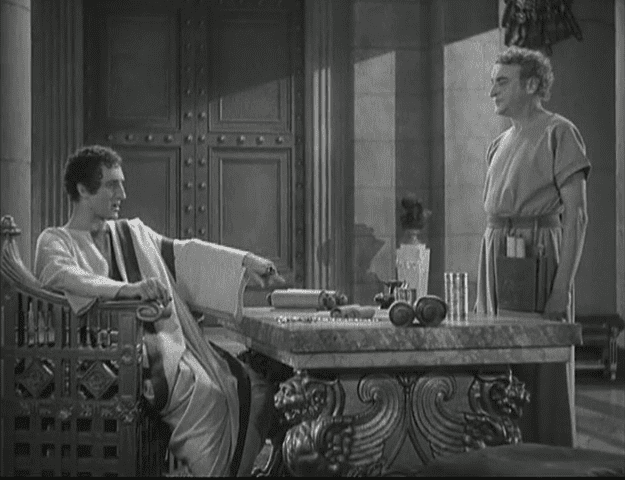
Pilate complains to an assistant about Herod and the Ammonites:
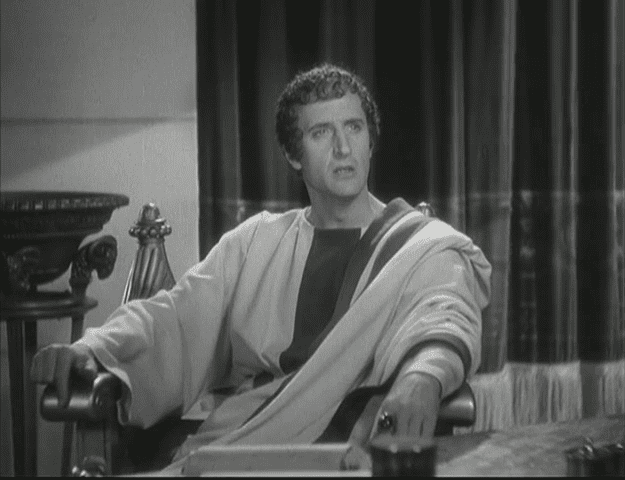
Pilate stays seated as he talks to Marcus:
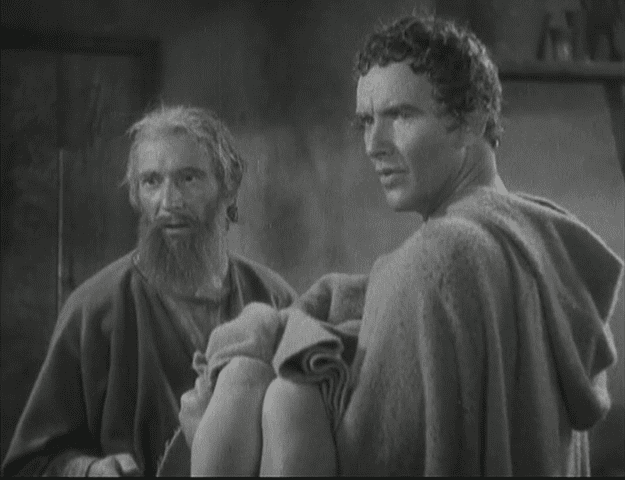
Marcus approaches the crowd surrounding Jesus:
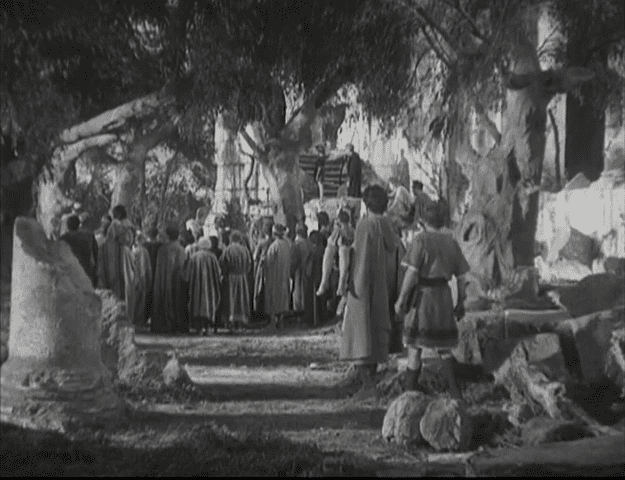
A light shines on Marcus’s face as he asks Jesus to heal Flavius:
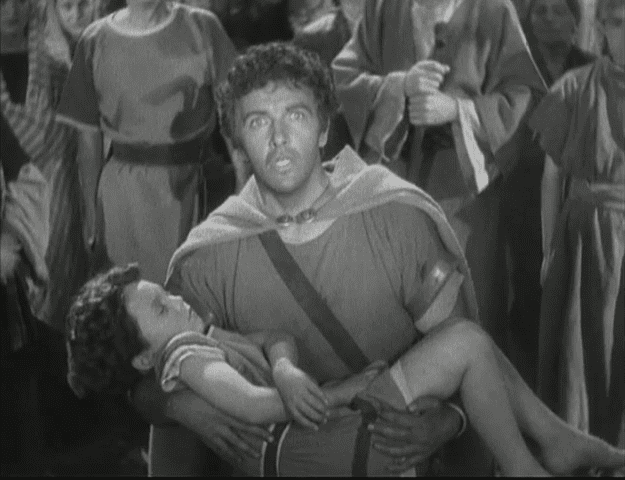
A crowd calls loudly for Jesus’ execution:
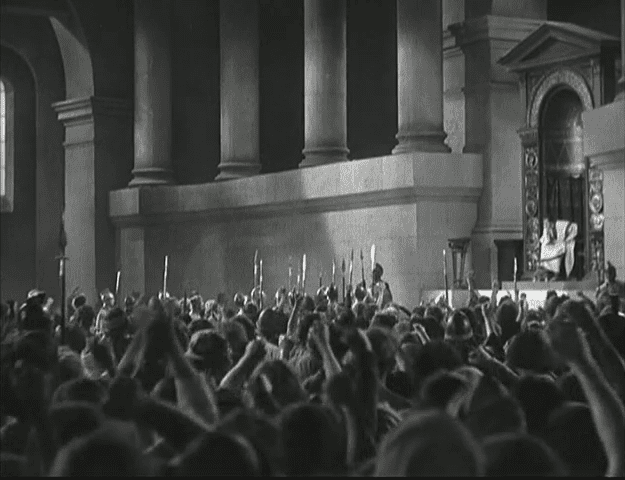
Pilate washes his hands and says he is innocent of Jesus’ blood:
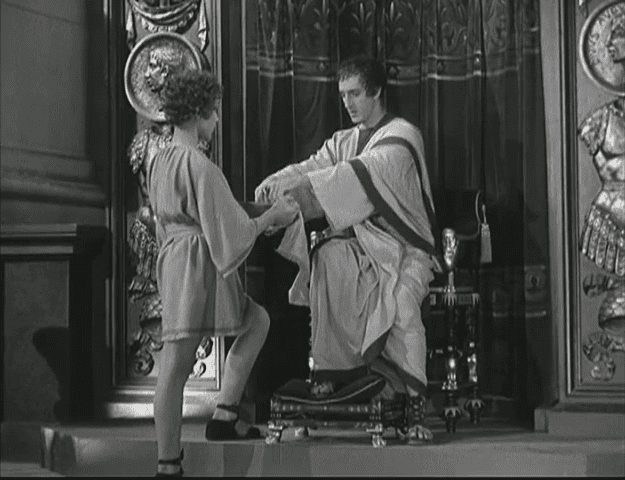
Marcus watches as Jesus carries his cross through the streets of Jerusalem:
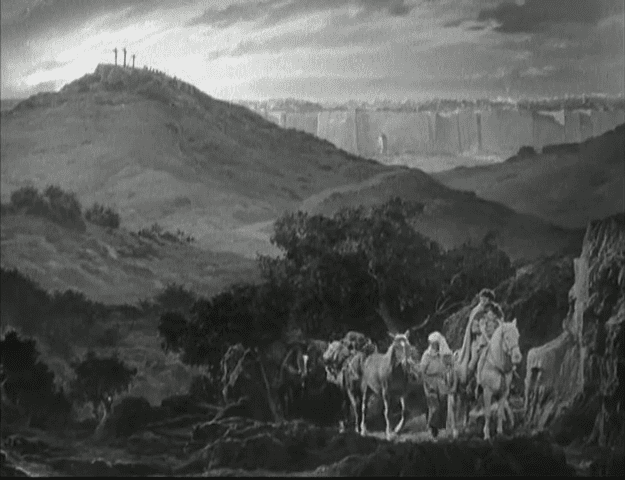
Marcus leaves Jerusalem while Jesus is crucified in the background:
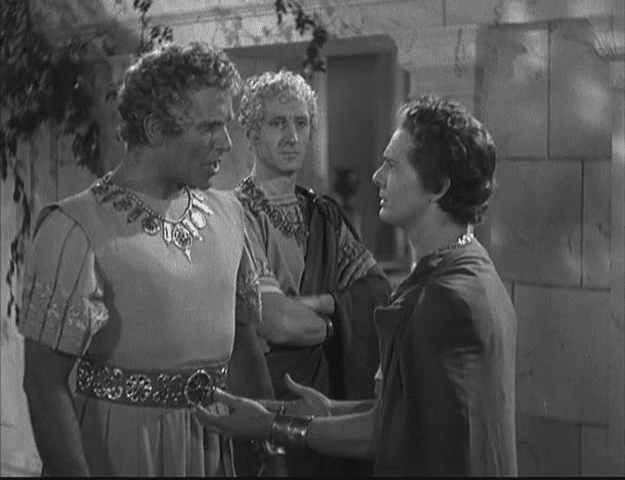
Pilate visits Marcus and Flavius in Pompeii:
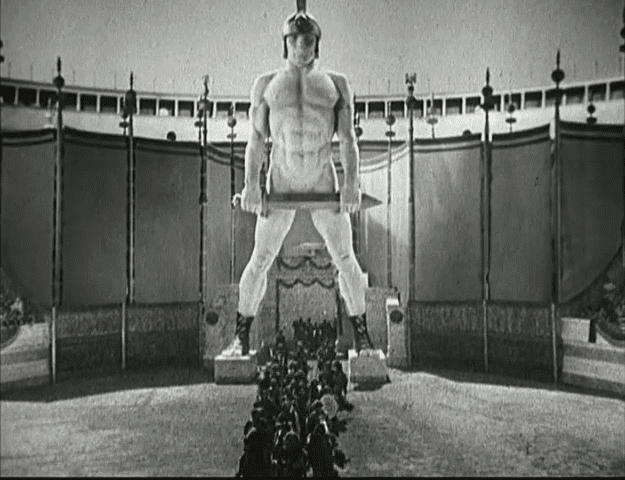
The statue at the entrance to the arena in Pompeii:
The volcano erupts:
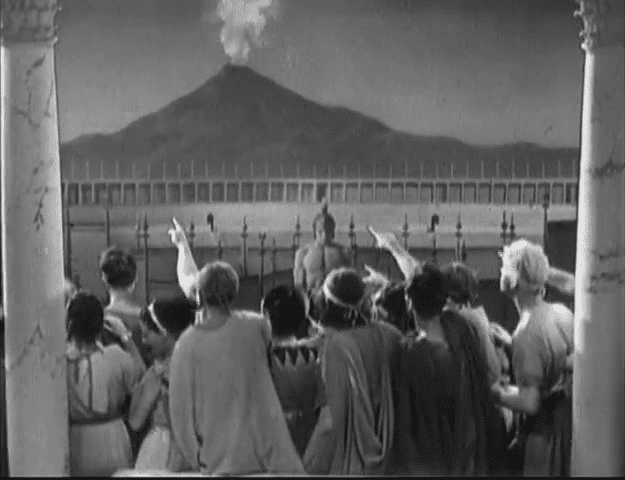
Marcus has a vision of Jesus as he lays dying amidst the rubble:

–
1. For the purposes of this discussion, “the 1950s” basically begins with 1949’s Samson and Delilah.
2. I refer here to films that present the biblical narrative in its historical setting. I am not thinking of films like, say, The Green Pastures (1936), which re-imagined several biblical stories as quasi-modern folk tales. There were also foreign and independent Bible films produced during this period — such as Julien Duvivier’s Golgotha (1935), the British short-film series The Life of St. Paul (1938) and the experimental film Lot in Sodom (1933) — but those were all produced well outside the Hollywood mainstream.
3. This was not Rathbone’s only Bible movie; he also played Caiaphas in Pontius Pilate (1962).
4. Both the gospels and secular history agree that Pilate was a brutal, provocative leader who cared little for keeping the peace, except insofar as turmoil would get him in trouble with the Emperor.
Previous Post

April 6, 2016
The villain joins the action in a new Ben-Hur poster
Next Post
April 7, 2016 How did Luke Skywalker "make his bones"?
Browse Our Archives
Select a Category Anglican Planet Articles BC Christian News BC Report Bible Movies Bible Review Blog Books & Culture Campus Times CBC Radio Christianity Today ChristianWeek Essays Faith Today Festival Cinemas Guide Film Journals Georgia Straight Interviews MB Herald National Catholic Register Salvationist Today's Christian Two Chairs Ubyssey Uncategorized Vancouver Courier Vancouver Sun
Select a Month August 2025 April 2025 January 2025 December 2024 November 2024 May 2024 February 2024 December 2023 May 2023 March 2023 November 2022 July 2022 June 2022 May 2022 April 2022 February 2022 January 2022 December 2021 November 2021 October 2021 September 2021 August 2021 July 2021 June 2021 April 2021 March 2021 February 2021 January 2021 December 2020 November 2020 October 2020 August 2020 July 2020 June 2020 May 2020 March 2020 February 2020 January 2020 December 2019 November 2019 September 2019 July 2019 May 2019 April 2019 March 2019 February 2019 January 2019 December 2018 November 2018 October 2018 September 2018 July 2018 June 2018 May 2018 April 2018 March 2018 February 2018 January 2018 December 2017 November 2017 October 2017 September 2017 August 2017 July 2017 June 2017 May 2017 April 2017 March 2017 February 2017 January 2017 December 2016 November 2016 October 2016 September 2016 August 2016 July 2016 June 2016 May 2016 April 2016 March 2016 February 2016 January 2016 December 2015 November 2015 October 2015 September 2015 August 2015 July 2015 June 2015 May 2015 April 2015 March 2015 February 2015 January 2015 December 2014 November 2014 October 2014 September 2014 August 2014 July 2014 June 2014 May 2014 April 2014 March 2014 February 2014 January 2014 December 2013 November 2013 October 2013 September 2013 August 2013 July 2013 June 2013 May 2013 April 2013 March 2013 February 2013 January 2013 December 2012 November 2012 October 2012 September 2012 August 2012 July 2012 June 2012 April 2012 January 2012 January 2011 December 2010 November 2010 October 2010 September 2010 August 2010 July 2010 June 2010 May 2010 April 2010 March 2010 February 2010 January 2010 December 2009 November 2009 October 2009 September 2009 August 2009 July 2009 June 2009 May 2009 April 2009 March 2009 February 2009 January 2009 December 2008 November 2008 October 2008 September 2008 August 2008 July 2008 June 2008 May 2008 April 2008 March 2008 February 2008 January 2008 December 2007 November 2007 October 2007 September 2007 August 2007 July 2007 June 2007 May 2007 April 2007 March 2007 February 2007 January 2007 December 2006 November 2006 October 2006 September 2006 August 2006 July 2006 June 2006 May 2006 April 2006 March 2006 February 2006 January 2006 December 2005 November 2005 October 2005 September 2005 August 2005 July 2005 June 2005 May 2005 April 2005 March 2005 January 2005 December 2004 November 2004 October 2004 September 2004 August 2004 July 2004 June 2004 May 2004 April 2004 March 2004 February 2004 January 2004 November 2003 October 2003 August 2003 July 2003 June 2003 May 2003 January 2003 December 2002 November 2002 August 2002 July 2002 June 2002 May 2002 March 2002 January 2002 December 2001 November 2001 September 2001 August 2001 July 2001 June 2001 April 2001 March 2001 February 2001 December 2000 November 2000 October 2000 September 2000 August 2000 July 2000 June 2000 May 2000 April 2000 March 2000 January 2000 October 1999 August 1999 May 1999 April 1999 February 1999 January 1999 December 1998 November 1998 October 1998 August 1998 July 1998 June 1998 April 1998 March 1998 January 1998 November 1997 September 1997 July 1997 June 1997 April 1997 March 1997 February 1997 January 1997 December 1996 October 1996 September 1996 June 1996 March 1996 February 1996 January 1996 April 1995 November 1994 September 1994 September 1991
Follow Us!
TAKE THE
Religious Wisdom Quiz
Which Gospel is written by a doctor?
Select your answer to see how you score.
Mark John Matthew Luke
Related posts from FilmChat

Joseph of Egypt – the Chosen spin-off announces...

Exclusive: A clip from Angel Studios' The King...

Exclusive: Watch a clip from Angel Studios' Brave...

Exclusive: Watch a clip from Angel Studios' Homestead
TRENDING AT PATHEOS Religious Music & Entertainment

"Les Diabolique" and Transgression
Alongside something like Arrival, Vertigo, or Charade, Les Diaboliques is a...

"The Plague Dogs" and Mortality
So, flashback to the late 70s, early 80s. Walt Disney Studios is...

With the recent and highly successful release of Christopher Nolan’s epic film,...

"L'avventura" and Human Weakness
Today's piece is going to be a little different for a few...

I first want to apologize for not posting or writing anything. I'm...

I've engaged in the multi-year project of reading through the Church Fathers,...
view all Religious Music & Entertainment blogs
Ad-Free & Subscriber Log-In Subscription Support
- About Us
- 2026 Calendar
- Videos
- Podcasts
- Library of World Religions
- Faith In Media Tracker
- Advertise With Us
- Write for Us
- Privacy Policy
- Terms of Service
- Do Not Sell My Data
- Contact Us
- Radiant Digital
- Manage Newsletter Subscriptions
- Unsubscribe From Notifications
- Sitemap
Copyright 2008-2026, Patheos. All rights reserved.
Subscription Support Ad-Free & Subscriber Log-In
Follow Patheos