
BuddhistCatholicContemplativeEvangelicalGeneral ChristianHinduJewishLatter-day SaintMuslimNew VisionsProgressive Christian
Beliefs
- Buddhist
- Catholic
- Contemplative
- Evangelical
- General Christian
- Hindu
- Jewish
- Latter-day Saint
- More Voices
- Muslim
- New Visions
- Pagan
- Progressive Christian
Topics
- Religion News
- Food and Religion
- Sports and Religion
- Religious Art
- Religious Music and Entertainment
- Religious Events
- History and Religion
- Style and Religion
- Politics and Religion
- Women in Religion
- Recreation Outdoors and Religion
- Business Finance and Religion
- Careers Workplace and Religion
- Education and Religion
- Family Parenting and Religion
- Health Fitness and Religion
- Home and Religion
- Relationships and Religion
- Technology and Religion
- Travel and Religion
Columnists
- Buddhist Columnists
- Business Finance and Religion Columnists
- Careers Workplace and Religion Columnists
- Catholic Columnists
- Contemplative Columnists
- Education and Religion Columnists
- Evangelists Columnists
- Family Parenting and Religion Columnists
- General Christian Columnists
- Health Fitness and Religion Columnists
- Hindu Columnists
- History and Religion Columnists
- Home and Religion Columnists
- Jewish Columnists
- More Voices Columnists
- Latter Day Columnists
- Muslim Columnists
- New Visions Columnists
- Nonreligious Columnists
- Pagan Columnists
- Politics and Religion Columnists
- Progressive Columnists
- Recreation Outdoors and Religion Columnists
- Relationships and Religion Columnists
- Religion News Columnists
- Religious Art Columnists
- Religious Events Columnists
- Religious Music and Entertainment Columnists
- Sports and Religion Columnists
- Style and Religion Columnists
- Technology and Religion Columnists
- Travel and Religion Columnists
- Women in Religion Columnists
Resource Library
- 2026 Calendar
- Library of World Religions
- The 100 Most Holy Places on Earth
- Patheos Answers
- Podcasts
- Videos
- Faith Leaders Database
- Anglican Episcopalian
- Bahai
- Baptist
- Buddhism
- Christianity
- Confucianism
- Eastern Orthodoxy
- Hinduism
- Holiness and Pentecostal
- ISKCON
- Islam
- Judaism
- Lutheran
- Methodist
- The Church of Jesus Christ of Latter-day Saints
- New Age
- Paganism
- Presbytarian and Reformed
- Protestantism
- Religion Behind the Scenes
- Roman Catholic
- Scientology
- Shia Islam
- Sikhism
- Sufism
- Sunni Islam
- Taoism
- Zen
- See all religions
Research Tools
 Ad-Free & Subscriber Log-In Subscription Support
Follow Patheos 

- Trending:
- Advent
- |
- Forgiveness
- |
- Thanksgiving
- |
- Election
- |
- Seasonal Holidays
- |
- Marriage

-
Articles
- Home
- Religious Music & Entertainment
- Review: The Young Messiah (dir. Cyrus Nowrasteh, 2016)
Review: The Young Messiah (dir. Cyrus Nowrasteh, 2016)
Last updated on: March 11, 2016 at 1:36 pm by Peter T. Chattaway
Review: The Young Messiah (dir. Cyrus Nowrasteh, 2016) 2016-03-11T13:36:17-08:00 Peter T. Chattaway
Patheos Explore the world's faith through different perspectives on religion and spirituality! Patheos has the views of the prevalent religions and spiritualities of the world.
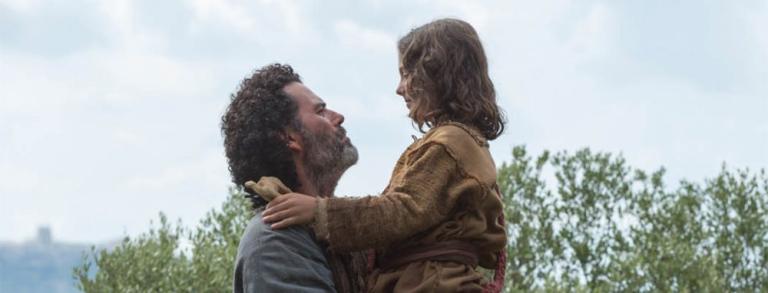
There have been many movies about Jesus, and even a few that have spent some time on his childhood, but there have been none, to my knowledge, that dwell on what it would have been like for Jesus to grow up with brothers and sisters his own age. Indeed, there are very few films that acknowledge the presence of brothers and sisters in Jesus’ adult life, even though the gospels mention his siblings on several occasions. Thus, one of the best things about The Young Messiah — Cyrus Nowrasteh’s long-awaited adaptation of Anne Rice’s novel Christ the Lord: Out of Egypt — is the way it focuses on Jesus’ relatives right from its opening scene.
When the film begins, seven-year-old Jesus (Adam Greaves-Neal) is standing in the street, somewhere in Alexandria — his family has been living in Egypt ever since Herod killed the babies in Bethlehem — and he is watching his cousin Salome (Lois Ellington) draw a camel in the sand. You get the sense, from his facial expressions, that Jesus would rather be doing something else, but he patiently waits for Salome to finish what she’s doing — and then some bullies attack him, ostensibly because he’s playing with a girl. All very believable behaviour for children of that age.
But there is a supernatural edge to this scene, too, as a man with bleached-blonde hair — listed in the credits as The Demon (Rory Keenan) — watches the scene unfold. Jesus does not fight back against the bullies, but Salome does, and when the bullies turn to pursue her, Jesus tells them to stop — at which point The Demon causes one of the bullies to trip and fall, thereby killing him. The crowd, prompted by The Demon, accuses Jesus of putting a curse on the boy — and one of the people who believes this accusation is Jesus’ own adopted brother James (Finn McLeod Ireland).
There’s a lot that we can unpack just within those opening scenes.
Take, for instance, the accusation that Jesus cursed the boy, and how this part of the story is redacted from its sources. In the Infancy Gospel of Thomas, Jesus does, in fact, kill a boy with a curse, and the community lives in terror around Jesus because he has a tendency to lash out supernaturally at anyone who offends him. Rice’s novel tones this down a bit, and has Jesus kill the boy accidentally; like little Clark Kent or one of the X-Men, Jesus is more powerful than he knows, and he hasn’t learned how to control his powers yet. But Nowrasteh’s film goes even further and absolves Jesus of any responsibility for the boy’s death whatsoever; now, it is basically the Devil’s fault that the boy died, and Jesus — not for the last time — finds himself bearing the blame for someone else’s actions.
Then there is Jesus’ relationship with James. We know from the New Testament that the brothers of Jesus did not believe in him during his ministry (John 7:5) — indeed they thought he was crazy (Mark 3:21) — but then Jesus appeared to James after rising from the dead (I Corinthians 15:7), and the brothers of Jesus went on to join the apostles and were worshiping with them by the time Pentecost occurred (Acts 1:14). None of this has happened yet when The Young Messiah begins, of course, but the film introduces James as someone who is willing to believe the worst about Jesus, and this points towards the friction that will exist between the brothers when they are adults. But the film also shows moments of closeness between Jesus and his brother, moments that hint at the reconciliations to come.
And then, of course, there is Jesus’ relationship with his “sister” Salome. (In the culture depicted within this film, the word can apply to female cousins, too.) Salome tells Jesus that she believes he can raise the dead boy back to life, the same way he once raised a dead bird (another miracle borrowed, and modified, from the Infancy Gospel of Thomas), and Salome’s belief in Jesus is reminiscent of how Martha believed the adult Jesus could raise her brother Lazarus. (The dead boy is, in fact, named Eleazar — a variation of Lazarus.) By focusing on Jesus’ relationship with Salome, the film suggests that the close friendships Jesus had with his female followers may have had their roots in his relationships with his female kin.
There are other issues raised by the opening scenes in The Young Messiah. Take, for example, the question of violence. Jesus does not fight back against the bullies — he turns the other cheek, as it were — but the bullies do let go of him when Salome strikes them, and if it wasn’t for The Demon’s intervention, Jesus presumably would have had to do something after telling Eleazar to leave Salome alone. In a much later scene, one of Jesus’ adult relatives will even make a point of distinguishing between murder and killing in self-defense. Could Jesus have defended himself from the bullies? Would it have been out of character if he had physically intervened to protect his sister? The adult Jesus brandished a whip and threw the money-changers out of the Temple, which sounds kind of aggressive at least. Could The Young Messiah have foreshadowed that in any way, or would it send kids the wrong message?
The ruckus in the streets soon catches the attention of Jesus’ parents Mary (Sara Lazzaro) and Joseph (Vincent Walsh) — and also the attention of his uncle Cleopas (Me and Orson Welles’ Christian McKay) and his aunt Miriam (Agni Scott). (Technically, Mary and Miriam are the same name in Hebrew, but there are so many Marys in the Bible you can understand why the filmmakers wanted to differentiate the two sisters-in-law like this.) And matters aren’t helped when Jesus does, in fact, raise Eleazar from the dead — which just makes the neighbours look at Jesus and his family even more strangely. Fortunately, it turns out Herod the Great has recently died, so the family decides it will be safe to live in Nazareth again.
But the journey back home isn’t entirely safe. The path to Nazareth is filled with perils — Romans battling Jewish rebels, a woman killing a rapist in self-defense, and rows of crosses guarded by soldiers and fierce-looking dogs — and along the way, Jesus’ uncle Cleopas comes down with an illness, which forces Jesus to make a choice: will he let his uncle die, or will he heal his uncle and, by doing so, attract the same sort of unwanted attention that the family left Egypt to get away from in the first place?
Even worse, rumours of Jesus’ survival have reached the ears of Herod’s successor, who orders Severus (Sean Bean) — a Roman centurion who took part in the Bethlehem slaughter — to find the boy and kill him. And as Severus follows the clues, there are other acts of violence and intimidation; at one point Severus interrogates a man who is already hanging on a cross, and then mercy-kills him with his gladius. (Parental advisory: the actual violence — the gory stuff — is kept off-screen, but the camera stays on the crucified man’s face, and there is no mistaking the painful gasps and spasms as the sword is thrust into his body.)
The subplot with Herod and Severus is not in Anne Rice’s novel, and for me it is the film’s weakest and most problematic aspect. For one thing, it adds levels of violence to the story that make the film less family-friendly than it clearly wants to be. For another, it hinges on contrivances, such as a toy camel that a stranger gives to Jesus as they’re sailing out of Egypt; this toy — which isn’t that unique, and could easily have been lost — becomes the primary means of identifying Jesus long after he has journeyed all the way to Nazareth and then turned around and gone back south to Jerusalem.
The recurring appearances of The Demon also didn’t work for me as well as they could have, partly because they sometimes interfered with the agency of the human characters. People are capable of hatred and suspicion on their own and don’t always need a devil whispering in their ears. Plus, I had to stifle a laugh when The Demon taunts Jesus and yells, “Chaos rules, and I am its prince!” I know the line is in Rice’s novel, and thus predates Lars von Trier’s Antichrist by a few years, but still.
The real narrative arc of the film concerns the fact that Jesus has questions about himself and his origins, and his parents haven’t answered them yet. And here is where the film’s real strength lies.
Philippians 2 tells us that Jesus “emptied himself” or “made himself nothing” when he became human, Luke 2 tells us that Jesus was still growing “in wisdom and stature, and in favour with God and man” when he was 12 years old, and even the adult Jesus admitted that there were some things he still did not know (cf. Mark 13) — so the film is on firm ground in depicting Jesus as a boy who hasn’t figured everything out yet, including who he is. As my friend Steven D. Greydanus has put it, one of the really interesting things about this film is how it imagines that “the Messianic secret” was, for a time, kept secret even from the Messiah himself!
But eventually (and this might be a spoiler, though it’s the first thing the trailer shows us), Jesus does learn who he is, and Greaves-Neal does a masterful job of conveying the confusion, for lack of a better word, that Jesus feels when he first lets this information sink in. “But we’re all children of God,” he says — and he’s right. But he’s more than that, too, and the film affirms that every step of the way.
The performances are all pretty good, though Mary and Joseph spend most of their screentime expressing various degrees of concern; McKay, as Mary’s outspoken, opinionated and slightly sexist older brother Cleopas, seems to be having the most fun, at least where the adults are concerned. Harry Potter fans might recognize David Bradley (a.k.a. Hogwarts caretaker Argus Filch) as a rabbi who probes Jesus’ knowledge of the scriptures. And the score, by John Debney (an Oscar nominee for his work on The Passion of the Christ) is beautifully stirring and atmospheric.
The Young Messiah isn’t flawless, but it captures several aspects of the Jesus story that have rarely ever been developed — and developed this well — in other films about Jesus, and for that, it is a worthy addition to the genre’s canon.
Previous Post

March 11, 2016
Battle of the Thursday-night Bible-movie previews!
Next Post
March 12, 2016 Of Kings and Prophets -- season one, episode one
Browse Our Archives
Select a Category Anglican Planet Articles BC Christian News BC Report Bible Movies Bible Review Blog Books & Culture Campus Times CBC Radio Christianity Today ChristianWeek Essays Faith Today Festival Cinemas Guide Film Journals Georgia Straight Interviews MB Herald National Catholic Register Salvationist Today's Christian Two Chairs Ubyssey Uncategorized Vancouver Courier Vancouver Sun
Select a Month August 2025 April 2025 January 2025 December 2024 November 2024 May 2024 February 2024 December 2023 May 2023 March 2023 November 2022 July 2022 June 2022 May 2022 April 2022 February 2022 January 2022 December 2021 November 2021 October 2021 September 2021 August 2021 July 2021 June 2021 April 2021 March 2021 February 2021 January 2021 December 2020 November 2020 October 2020 August 2020 July 2020 June 2020 May 2020 March 2020 February 2020 January 2020 December 2019 November 2019 September 2019 July 2019 May 2019 April 2019 March 2019 February 2019 January 2019 December 2018 November 2018 October 2018 September 2018 July 2018 June 2018 May 2018 April 2018 March 2018 February 2018 January 2018 December 2017 November 2017 October 2017 September 2017 August 2017 July 2017 June 2017 May 2017 April 2017 March 2017 February 2017 January 2017 December 2016 November 2016 October 2016 September 2016 August 2016 July 2016 June 2016 May 2016 April 2016 March 2016 February 2016 January 2016 December 2015 November 2015 October 2015 September 2015 August 2015 July 2015 June 2015 May 2015 April 2015 March 2015 February 2015 January 2015 December 2014 November 2014 October 2014 September 2014 August 2014 July 2014 June 2014 May 2014 April 2014 March 2014 February 2014 January 2014 December 2013 November 2013 October 2013 September 2013 August 2013 July 2013 June 2013 May 2013 April 2013 March 2013 February 2013 January 2013 December 2012 November 2012 October 2012 September 2012 August 2012 July 2012 June 2012 April 2012 January 2012 January 2011 December 2010 November 2010 October 2010 September 2010 August 2010 July 2010 June 2010 May 2010 April 2010 March 2010 February 2010 January 2010 December 2009 November 2009 October 2009 September 2009 August 2009 July 2009 June 2009 May 2009 April 2009 March 2009 February 2009 January 2009 December 2008 November 2008 October 2008 September 2008 August 2008 July 2008 June 2008 May 2008 April 2008 March 2008 February 2008 January 2008 December 2007 November 2007 October 2007 September 2007 August 2007 July 2007 June 2007 May 2007 April 2007 March 2007 February 2007 January 2007 December 2006 November 2006 October 2006 September 2006 August 2006 July 2006 June 2006 May 2006 April 2006 March 2006 February 2006 January 2006 December 2005 November 2005 October 2005 September 2005 August 2005 July 2005 June 2005 May 2005 April 2005 March 2005 January 2005 December 2004 November 2004 October 2004 September 2004 August 2004 July 2004 June 2004 May 2004 April 2004 March 2004 February 2004 January 2004 November 2003 October 2003 August 2003 July 2003 June 2003 May 2003 January 2003 December 2002 November 2002 August 2002 July 2002 June 2002 May 2002 March 2002 January 2002 December 2001 November 2001 September 2001 August 2001 July 2001 June 2001 April 2001 March 2001 February 2001 December 2000 November 2000 October 2000 September 2000 August 2000 July 2000 June 2000 May 2000 April 2000 March 2000 January 2000 October 1999 August 1999 May 1999 April 1999 February 1999 January 1999 December 1998 November 1998 October 1998 August 1998 July 1998 June 1998 April 1998 March 1998 January 1998 November 1997 September 1997 July 1997 June 1997 April 1997 March 1997 February 1997 January 1997 December 1996 October 1996 September 1996 June 1996 March 1996 February 1996 January 1996 April 1995 November 1994 September 1994 September 1991
Follow Us!
TAKE THE
Religious Wisdom Quiz
Who wrote the majority of the Psalms?
Select your answer to see how you score.
David Solomon Moses Asaph
Related posts from FilmChat

Joseph of Egypt – the Chosen spin-off announces...
Exclusive: A clip from Angel Studios' The King...
Exclusive: Watch a clip from Angel Studios' Brave...

Exclusive: Watch a clip from Angel Studios' Homestead
TRENDING AT PATHEOS Religious Music & Entertainment

A Christian, a Narnia Fan, and a Filmmaker...
Watching The Narnia Trailer As A Fan And A Filmmaker Ever since...

Great Spiritual Horror Films of the 20th Century...
For the Christian, horror movies are often troubling—and many would say that...

"Les Diabolique" and Transgression
Alongside something like Arrival, Vertigo, or Charade, Les Diaboliques is a...

"The Plague Dogs" and Mortality
So, flashback to the late 70s, early 80s. Walt Disney Studios is...

With the recent and highly successful release of Christopher Nolan’s epic film,...

"L'avventura" and Human Weakness
Today's piece is going to be a little different for a few...
view all Religious Music & Entertainment blogs
Ad-Free & Subscriber Log-In Subscription Support
- About Us
- 2026 Calendar
- Videos
- Podcasts
- Library of World Religions
- Faith In Media Tracker
- Advertise With Us
- Write for Us
- Privacy Policy
- Terms of Service
- Do Not Sell My Data
- Contact Us
- Radiant Digital
- Manage Newsletter Subscriptions
- Unsubscribe From Notifications
- Sitemap
Copyright 2008-2026, Patheos, part of the Radiant Digital network of media brands. All rights reserved.
Subscription Support Ad-Free & Subscriber Log-In
Follow Patheos