
BuddhistCatholicContemplativeEvangelicalGeneral ChristianHinduJewishLatter-day SaintMuslimNew VisionsProgressive Christian
Beliefs
- Buddhist
- Catholic
- Contemplative
- Evangelical
- General Christian
- Hindu
- Jewish
- Latter-day Saint
- More Voices
- Muslim
- New Visions
- Pagan
- Progressive Christian
Topics
- Religion News
- Food and Religion
- Sports and Religion
- Religious Art
- Religious Music and Entertainment
- Religious Events
- History and Religion
- Style and Religion
- Politics and Religion
- Women in Religion
- Recreation Outdoors and Religion
- Business Finance and Religion
- Careers Workplace and Religion
- Education and Religion
- Family Parenting and Religion
- Health Fitness and Religion
- Home and Religion
- Relationships and Religion
- Technology and Religion
- Travel and Religion
Columnists
- Buddhist Columnists
- Business Finance and Religion Columnists
- Careers Workplace and Religion Columnists
- Catholic Columnists
- Contemplative Columnists
- Education and Religion Columnists
- Evangelists Columnists
- Family Parenting and Religion Columnists
- General Christian Columnists
- Health Fitness and Religion Columnists
- Hindu Columnists
- History and Religion Columnists
- Home and Religion Columnists
- Jewish Columnists
- More Voices Columnists
- Latter Day Columnists
- Muslim Columnists
- New Visions Columnists
- Nonreligious Columnists
- Pagan Columnists
- Politics and Religion Columnists
- Progressive Columnists
- Recreation Outdoors and Religion Columnists
- Relationships and Religion Columnists
- Religion News Columnists
- Religious Art Columnists
- Religious Events Columnists
- Religious Music and Entertainment Columnists
- Sports and Religion Columnists
- Style and Religion Columnists
- Technology and Religion Columnists
- Travel and Religion Columnists
- Women in Religion Columnists
Resource Library
- 2026 Calendar
- Library of World Religions
- The 100 Most Holy Places on Earth
- Patheos Answers
- Podcasts
- Videos
- Faith Leaders Database
- Anglican Episcopalian
- Bahai
- Baptist
- Buddhism
- Christianity
- Confucianism
- Eastern Orthodoxy
- Hinduism
- Holiness and Pentecostal
- ISKCON
- Islam
- Judaism
- Lutheran
- Methodist
- The Church of Jesus Christ of Latter-day Saints
- New Age
- Paganism
- Presbytarian and Reformed
- Protestantism
- Religion Behind the Scenes
- Roman Catholic
- Scientology
- Shia Islam
- Sikhism
- Sufism
- Sunni Islam
- Taoism
- Zen
- See all religions
Research Tools
 Ad-Free & Subscriber Log-In Subscription Support
Ad-Free & Subscriber Log-In Subscription Support
Follow Patheos 

- Trending:
- Forgiveness
- |
- Marriage
- |
- Consciousness
- |
- Death Penalty
- |
- Election
- |
- Halloween

-
Articles
- Home
- Religious Music & Entertainment
- Review: Of Kings and Prophets — Episode 1: Offerings of Blood (dir. Michael Offer, 2016)
Review: Of Kings and Prophets — Episode 1: Offerings of Blood (dir. Michael Offer, 2016)
Last updated on: March 12, 2016 at 9:53 am by Peter T. Chattaway
Review: Of Kings and Prophets — Episode 1: Offerings of Blood (dir. Michael Offer, 2016) 2016-03-12T09:53:04-08:00 Peter T. Chattaway
Patheos Explore the world's faith through different perspectives on religion and spirituality! Patheos has the views of the prevalent religions and spiritualities of the world.
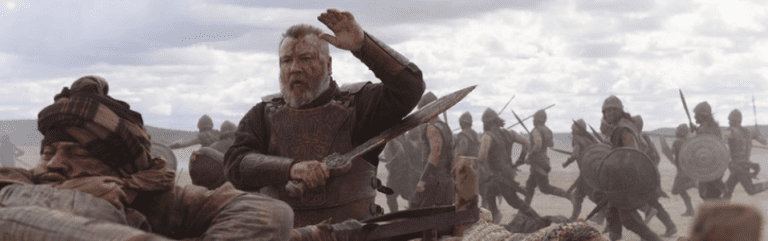
It’s hard to beat the story of Saul and David for biblical sex and violence, and the first shots in Of Kings and Prophets — premiering tonight at 10pm on ABC — waste no time getting to the “violence” part of that equation. (The sex comes later.)
Before the first episode has even gotten so far as to tell us the show’s title, it gives us a blood-soaked montage that introduces the story’s two parallel storylines: in one, Saul and his sons are in battle, savagely killing their enemies, while in the other, David wakes from a nightmare to discover that his sheep have been killed by a lion.
One of these storylines has a lot of substance and thematic potential. The other, I’m afraid, seems a bit silly to me, and unintentionally reveals the perils of trying to expand minor details in the Old Testament into full-fledged drama.
Let’s get the silly storyline out of the way first.
I should admit up front that I have never been a shepherd, and I have never had to track or kill a lion. But I couldn’t help chuckling a bit when, early in the episode, the people of Bethlehem get together to discuss their lion problem and one of them shouts, with great perplexity, “How are we going to kill a lion!?” Hunting parties were not exactly unknown to the ancients, but no one here even proposes forming one; instead, it is left to David to go after the lion on his own. And this is all to kill just one lion: it is not part of a pride, it is not traveling with any other lions or lionesses.
The biblical David said he killed lions and bears as a matter of course — it was all just part of the job of being a shepherd — but in the first episode of this show, Queen Ahinoam tells David “word of this will spread,” and she says he will become “famous” for killing just one of these beasts. Somehow this seems unlikely to me.
Much better, so far, is the series’ depiction of Saul and his family.
Saul had been king for only a decade or two by the time this story starts, and there were no kings before him at all; what’s more, his own tribe, the tribe of Benjamin, had been almost exterminated just a generation or two earlier in a civil war described in Judges 19-21. (There was a reason Saul said he came from “the smallest tribe of Israel” when Samuel made him king.) So I question whether Saul’s monarchy would have seemed as established as it does in this series, with its palace and whatnot.
That being said, I do like how the show focuses on Saul’s efforts to unite the tribes of Israel, whether by fighting against a common enemy — the Philistines — or by arranging marriages between his daughters and the leading men of other tribes. The Israelites were never as united as we like to think they were; all three of the kings associated with the “united monarchy” had to deal with civil wars and rebellions of one sort or another. So it makes sense for this series to focus on the politics that went on within the Israelite nation, as well as their wars against the other nations.
The series also focuses on the tug-of-war between Saul and Samuel, and in a way that is sympathetic to Saul’s side. Your typical Sunday School lesson takes it as a given that when Samuel told Saul to wipe out the Amalekites, his word was the word of God and needed to be obeyed — but within this episode, Saul cannot tell whether Samuel is speaking for God or only for himself, and, with the threat of the Philistines looming above them, Saul sees no point to attacking the Amalekites, who are portrayed here as a relatively minor nomadic tribe that can easily be wiped out in a day (in a scene that’s strikingly reminiscent of the “No prisoners!” sequence in Lawrence of Arabia).
It would be tempting to say that this series is pitting modern skepticism against traditional religion, but it’s actually more complicated than that. The Old Testament is full of disagreements on how the Israelites should treat foreigners and their offspring, and in its own way, Of Kings and Prophets is tapping into those debates within the Bible — and the dialogue shows that the writers have done their research. Ahinoam quotes Deuteronomy 25 to the effect that the Amalekites are not supposed to be punished until after Israel is at rest from its enemies — and with the Philistines still oppressing the Israelites, the nation is clearly not at rest yet. On a deeper note, Saul protests that killing women and children is what Israel’s enemies do, and he says the Israelites are meant to be “a light to the nations.” That phrase actually comes from the book of Isaiah, which was written hundreds of years after Saul’s time, but there are passages in Isaiah that do stand in opposition to the books of Moses on these issues (I get into some of that here) — so as anachronistic as the Isaiah reference might be, it does show that the series is engaging with the Old Testament as a whole.
On a dramatic level, I love that the series is paying attention to the family dynamics within Saul’s home, even if I don’t always like the way it pays attention to them. Plenty of films about David have focused on his friendship with Saul’s son Jonathan and his ill-fated marriage to Saul’s daughter Michal, but this may be the first to give equal time to Saul’s daughter Merav and youngest son Ishbaal. (The biblical Saul had at least two other sons, but you can only do so much in a TV series, I guess.) This might also be the first show to pay significant attention to Saul’s concubine Rizpah. The show’s Twitter feed has made a point lately of noting that each member of the cast comes from a different ethnic background (Haaz Sleiman is Lebanese, Jeanine Mason is Cuban, Simone Kessell is Maori, etc.), and at times you might wonder how such different-looking people could all come from the same genetic family, but in the case of Michal (Maisie Richardson-Sellers), at least, it is explained that her mother was a Cushite, i.e. African, concubine. (And we know that some of the ancient Israelites — including Moses! — were married to Cushites, and that some Cushites worked for the Israelite kings, so kudos to the series for bringing that to the foreground, too.)
Where there are wives and concubines, sex cannot be far behind, and I don’t mind the fact that the series gets into that, per se. But there is something about the portrayal of the sex that feels a bit modern and titillating, like the way Rizpah sinks out of the frame to give Saul one last blowjob before battle, or the way Merav rolls around in bed with her fiancé shortly after meeting him for the first time. (Well, for the first time since she was a child, at any rate.) It was very important to the ancients that a woman be a virgin on her wedding day, and, well, yes, Merav is engaged to the man she’s with in this scene, but we know from the Bible that Saul will eventually offer her to other men — including David — so if later episodes follow the Bible in this regard, then the fact that she isn’t a virgin any more ought to be a big deal. I guess we’ll see if it is. For now, I simply note that neither Merav nor her fiancé even notes that they’re crossing a line here, beyond a bit of dialogue to the effect that her father would be upset.
If there’s anything missing from the show so far, it’s a sense of David’s spirituality. There’s plenty of God-talk between Saul and Samuel, but if David and Joab talk about anything other than lions and women, I missed it. In the original trailer for this series, which was based on a pilot episode that got scrapped in favour of the episode airing tonight (and tonight’s episode does look better, overall), David told Ahinoam he could hunt the lion because he was “certain of God’s grace and care,” but there is nothing like that in the current episode. Will future episodes give us a taste of the psalmist who is described in the Bible as “a man after God’s own heart”? We shall see.
In any case, while the first episode isn’t perfect, I do like a lot of what it does. And now that the lion is dead and out of the way, here’s hoping that the David storyline begins to make more sense, and to reflect more of what the Bible does say about him.
Previous Post

March 7, 2016
Anne Rice is "very thankful" for The Young Messiah
Browse Our Archives
Select a Category Anglican Planet Articles BC Christian News BC Report Bible Movies Bible Review Blog Books & Culture Campus Times CBC Radio Christianity Today ChristianWeek Essays Faith Today Festival Cinemas Guide Film Journals Georgia Straight Interviews MB Herald National Catholic Register Salvationist Today's Christian Two Chairs Ubyssey Uncategorized Vancouver Courier Vancouver Sun
Select a Month August 2025 April 2025 January 2025 December 2024 November 2024 May 2024 February 2024 December 2023 May 2023 March 2023 November 2022 July 2022 June 2022 May 2022 April 2022 February 2022 January 2022 December 2021 November 2021 October 2021 September 2021 August 2021 July 2021 June 2021 April 2021 March 2021 February 2021 January 2021 December 2020 November 2020 October 2020 August 2020 July 2020 June 2020 May 2020 March 2020 February 2020 January 2020 December 2019 November 2019 September 2019 July 2019 May 2019 April 2019 March 2019 February 2019 January 2019 December 2018 November 2018 October 2018 September 2018 July 2018 June 2018 May 2018 April 2018 March 2018 February 2018 January 2018 December 2017 November 2017 October 2017 September 2017 August 2017 July 2017 June 2017 May 2017 April 2017 March 2017 February 2017 January 2017 December 2016 November 2016 October 2016 September 2016 August 2016 July 2016 June 2016 May 2016 April 2016 March 2016 February 2016 January 2016 December 2015 November 2015 October 2015 September 2015 August 2015 July 2015 June 2015 May 2015 April 2015 March 2015 February 2015 January 2015 December 2014 November 2014 October 2014 September 2014 August 2014 July 2014 June 2014 May 2014 April 2014 March 2014 February 2014 January 2014 December 2013 November 2013 October 2013 September 2013 August 2013 July 2013 June 2013 May 2013 April 2013 March 2013 February 2013 January 2013 December 2012 November 2012 October 2012 September 2012 August 2012 July 2012 June 2012 April 2012 January 2012 January 2011 December 2010 November 2010 October 2010 September 2010 August 2010 July 2010 June 2010 May 2010 April 2010 March 2010 February 2010 January 2010 December 2009 November 2009 October 2009 September 2009 August 2009 July 2009 June 2009 May 2009 April 2009 March 2009 February 2009 January 2009 December 2008 November 2008 October 2008 September 2008 August 2008 July 2008 June 2008 May 2008 April 2008 March 2008 February 2008 January 2008 December 2007 November 2007 October 2007 September 2007 August 2007 July 2007 June 2007 May 2007 April 2007 March 2007 February 2007 January 2007 December 2006 November 2006 October 2006 September 2006 August 2006 July 2006 June 2006 May 2006 April 2006 March 2006 February 2006 January 2006 December 2005 November 2005 October 2005 September 2005 August 2005 July 2005 June 2005 May 2005 April 2005 March 2005 January 2005 December 2004 November 2004 October 2004 September 2004 August 2004 July 2004 June 2004 May 2004 April 2004 March 2004 February 2004 January 2004 November 2003 October 2003 August 2003 July 2003 June 2003 May 2003 January 2003 December 2002 November 2002 August 2002 July 2002 June 2002 May 2002 March 2002 January 2002 December 2001 November 2001 September 2001 August 2001 July 2001 June 2001 April 2001 March 2001 February 2001 December 2000 November 2000 October 2000 September 2000 August 2000 July 2000 June 2000 May 2000 April 2000 March 2000 January 2000 October 1999 August 1999 May 1999 April 1999 February 1999 January 1999 December 1998 November 1998 October 1998 August 1998 July 1998 June 1998 April 1998 March 1998 January 1998 November 1997 September 1997 July 1997 June 1997 April 1997 March 1997 February 1997 January 1997 December 1996 October 1996 September 1996 June 1996 March 1996 February 1996 January 1996 April 1995 November 1994 September 1994 September 1991
Follow Us!
TAKE THE
Religious Wisdom Quiz
According to Paul, nothing in all creation can separate you from me—not death, not life, not angels or demons. What am I?
Select your answer to see how you score.
The love of God God's mercy Salvation God's grace
Related posts from FilmChat

Joseph of Egypt – the Chosen spin-off announces...

Exclusive: A clip from Angel Studios' The King...

Exclusive: Watch a clip from Angel Studios' Brave...

Exclusive: Watch a clip from Angel Studios' Homestead
TRENDING AT PATHEOS Religious Music & Entertainment

"Les Diabolique" and Transgression
Alongside something like Arrival, Vertigo, or Charade, Les Diaboliques is a...

"The Plague Dogs" and Mortality
So, flashback to the late 70s, early 80s. Walt Disney Studios is...

With the recent and highly successful release of Christopher Nolan’s epic film,...

"L'avventura" and Human Weakness
Today's piece is going to be a little different for a few...

I first want to apologize for not posting or writing anything. I'm...

I've engaged in the multi-year project of reading through the Church Fathers,...
view all Religious Music & Entertainment blogs
Ad-Free & Subscriber Log-In Subscription Support
- About Us
- 2026 Calendar
- Videos
- Podcasts
- Library of World Religions
- Faith In Media Tracker
- Advertise With Us
- Write for Us
- Privacy Policy
- Terms of Service
- Do Not Sell My Data
- Contact Us
- Radiant Digital
- Manage Newsletter Subscriptions
- Unsubscribe From Notifications
- Sitemap
Copyright 2008-2026, Patheos. All rights reserved.
Subscription Support Ad-Free & Subscriber Log-In
Follow Patheos