
BuddhistCatholicContemplativeEvangelicalGeneral ChristianHinduJewishLatter-day SaintMuslimNew VisionsProgressive Christian
Beliefs
- Buddhist
- Catholic
- Contemplative
- Evangelical
- General Christian
- Hindu
- Jewish
- Latter-day Saint
- More Voices
- Muslim
- New Visions
- Pagan
- Progressive Christian
Topics
- Religion News
- Food and Religion
- Sports and Religion
- Religious Art
- Religious Music and Entertainment
- Religious Events
- History and Religion
- Style and Religion
- Politics and Religion
- Women in Religion
- Recreation Outdoors and Religion
- Business Finance and Religion
- Careers Workplace and Religion
- Education and Religion
- Family Parenting and Religion
- Health Fitness and Religion
- Home and Religion
- Relationships and Religion
- Technology and Religion
- Travel and Religion
Columnists
- Buddhist Columnists
- Business Finance and Religion Columnists
- Careers Workplace and Religion Columnists
- Catholic Columnists
- Contemplative Columnists
- Education and Religion Columnists
- Evangelists Columnists
- Family Parenting and Religion Columnists
- General Christian Columnists
- Health Fitness and Religion Columnists
- Hindu Columnists
- History and Religion Columnists
- Home and Religion Columnists
- Jewish Columnists
- More Voices Columnists
- Latter Day Columnists
- Muslim Columnists
- New Visions Columnists
- Nonreligious Columnists
- Pagan Columnists
- Politics and Religion Columnists
- Progressive Columnists
- Recreation Outdoors and Religion Columnists
- Relationships and Religion Columnists
- Religion News Columnists
- Religious Art Columnists
- Religious Events Columnists
- Religious Music and Entertainment Columnists
- Sports and Religion Columnists
- Style and Religion Columnists
- Technology and Religion Columnists
- Travel and Religion Columnists
- Women in Religion Columnists
Resource Library
- 2026 Calendar
- Library of World Religions
- The 100 Most Holy Places on Earth
- Patheos Answers
- Podcasts
- Videos
- Faith Leaders Database
- Anglican Episcopalian
- Bahai
- Baptist
- Buddhism
- Christianity
- Confucianism
- Eastern Orthodoxy
- Hinduism
- Holiness and Pentecostal
- ISKCON
- Islam
- Judaism
- Lutheran
- Methodist
- The Church of Jesus Christ of Latter-day Saints
- New Age
- Paganism
- Presbytarian and Reformed
- Protestantism
- Religion Behind the Scenes
- Roman Catholic
- Scientology
- Shia Islam
- Sikhism
- Sufism
- Sunni Islam
- Taoism
- Zen
- See all religions
Research Tools
 Ad-Free & Subscriber Log-In Subscription Support
Ad-Free & Subscriber Log-In Subscription Support
Follow Patheos 

- Trending:
- Forgiveness
- |
- Marriage
- |
- Consciousness
- |
- Death Penalty
- |
- Election
- |
- Halloween

-
Articles
- Home
- Religious Music & Entertainment
- Six cinematic interpretations of the Jewish elder Gamaliel
Six cinematic interpretations of the Jewish elder Gamaliel
Last updated on: June 10, 2016 at 12:14 pm by Peter T. Chattaway
Six cinematic interpretations of the Jewish elder Gamaliel 2016-06-10T12:14:41-07:00 Peter T. Chattaway
Patheos Explore the world's faith through different perspectives on religion and spirituality! Patheos has the views of the prevalent religions and spiritualities of the world.

Yesterday was the day when Eastern Orthodox Christians remember Gamaliel, the Jewish leader who defended the apostles before the Sanhedrin in Acts 5. So I thought it might be fun to take a quick look at how Gamaliel has been portrayed in film.
The book of Acts tells us two things about Gamaliel: one, that he preached tolerance of the Christians, and two, that Saul (aka Paul), who was one of the first great persecutors of the Church, studied under him. Saul and Gamaliel don’t share any “scenes” together in the Bible, but this contrast, between the tolerant teacher and his intolerant student, has understandably fascinated some screenwriters.
By far the most thoroughly developed interpretation of Gamaliel in any film that I can think of is the one in the 1985 miniseries A.D. Anno Domini.
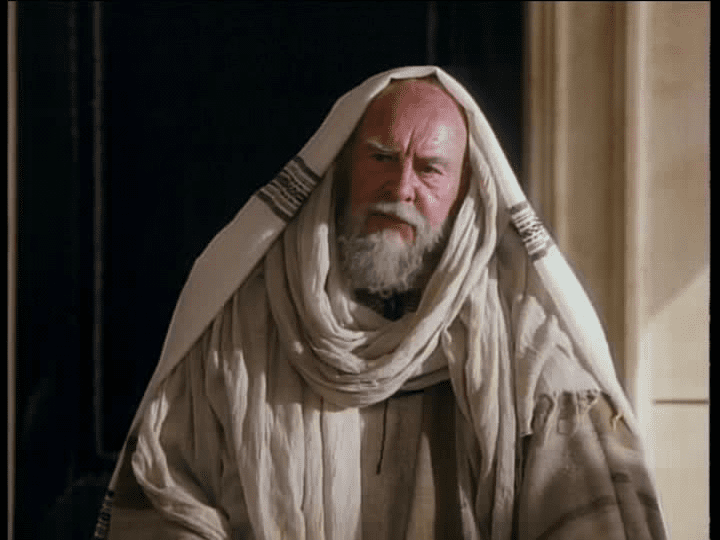
The first time we see him, Gamaliel (played by John Houseman, an Oscar winner for 1973’s The Paper Chase) is leading a discussion between Sadducees, Pharisees, Zealots, and so on. (His students include Saul, a Pharisee, and Stephen, a Hellenist.) The idea that these schools of thought all co-existed in an actual school is not very likely historically, but the scene does allow the filmmakers to explore the diversity of first-century Judaism, and it also establishes Gamaliel as a wise teacher who is respected by everyone.
Most of his subsequent scenes show him arguing with members of the Sanhedrin, all of whom respect him but many of whom disagree with him — especially when he preaches tolerance for the early Christian sect. Through Gamaliel, who firmly rejects the messianic claims about Jesus but acknowledges the good that his followers do, the filmmakers establish that it is possible to be a non-Christian Jew without being anti-Christian.
Interestingly, Gamaliel is a respected figure within rabbinic Judaism too, and the one scene of his in A.D. Anno Domini that is taken from the book of Acts incorporates a relevant detail from the Talmudic tradition. Here is a transcript of that scene, which begins with Peter and the other apostles being tried before the Sanhedrin:
Gamaliel: It is necessary to state — and to state emphatically — that the aims of the Zealots and those of the Nazarenes are utterly opposed. The Zealots are concerned with inflaming the hearts of the people, and shouting need of insurrection. The followers of the man Jesus seek to cultivate charity for all. A beautiful dream.
Caiaphas: These imposing words cannot hide a dangerous reality, Rabban Gamaliel. Doctrinally, the Zealots are still inside the Law. Doctrinally, the followers of Jesus preach heresy. They have gone outside the Law. They practice blasphemy.
Gamaliel: Healing the sick, for instance?
Priest #1: Rabban Gamaliel is right. We must wait before judging them!
Caiaphas: Whether they heal the sick or not is hardly the point. They breed superstition. There are those who seek to have their ailments cured by standing in the shadow of the man Peter, a common fisherman. (to Peter) You have filled the synagogues with your blasphemy. What do you say?
Peter: This, Caiaphas: We must obey God rather than men. The God of our fathers raised up Jesus who died on the cross and after three days was resurrected from death.
Sanhedrin: (lots of shouting)
Gamaliel: The belief in resurrection has its roots deep in our traditions. Remember the prophet Isaiah: “Fresh lives shall they have, Lord, that are thine in death. Lost to us, they shall live in thee. Awake and utter your praises, you that dwell in dust.”
Peter: God exalted Jesus at his right hand to be a prince and a saviour, to give repentance to Israel and the remission of sins. We are witnesses of these things!
Caiaphas: Such blasphemy! You put yourself in peril of death!
Peter: Death, as you call it, is in the hands of the Romans. Are you ready to give them more victims for their crosses?
Caiaphas: That you challenge the authority of the Sanhedrin, which is answerable to the occupying power!
Sanhedrin: (more shouting)
Gamaliel: May I be heard! Men of Israel, take heed. Do nothing you will regret. What I say is this: Leave these men alone. For if their counsel and their work is of human origin, it will collapse. But if it is from the Lord, you cannot overthrow it, and you risk finding yourselves at war with God.
Priest #2: God is not with them!
Sanhedrin: (more shouting)
Caiaphas: (to Peter and the other apostles) You are hereby charged to speak no more in the name of the man Jesus. Let them be warned by the punishment of the whipping, and then let them be gone.
Roughly half of that dialogue comes from Acts 5; most of the rest of it is dramatic embellishment. But the fact that Gamaliel quotes Isaiah in defense of the resurrection actually has a precedent in the Babylonian Talmud, which states:
Sectarians asked Rabban Gamaliel: Whence do we know that the Holy One, blessed be He, will resurrect the dead? He answered them from the Torah, the Prophets, and the Hagiographa, yet they did not accept it [as conclusive proof]. ‘From the Torah’: for it is written, And the Lord said unto Moses, Behold, thou shalt sleep with thy fathers and rise up [again]. ‘But perhaps,’ said they to him, ‘[the verse reads], and the people will rise up?’ ‘From the prophets’: as it is written, Thy dead men shall live, together with my dead body shall they arise. Awake and sing, ye that dwell in the dust: for thy dew is as the dew of herbs, and the earth shall cast out its dead. . . .
The last passage quoted in that excerpt from the Talmud is taken from Isaiah 26, and it’s the very same passage Gamaliel quotes in the Acts 5 scene in A.D.
Now, it turns out that the Gamaliel referenced in this part of the Talmud might not be identical to the Gamaliel who is mentioned in the book of Acts. The Gamaliel in Acts is known to scholars as “Gamaliel I” while the Gamaliel in this part of the Talmud is thought to be his grandson, a man known to scholars as “Gamaliel II”.
Either way, though, it appears the writers of A.D. did their homework and found a way to bring the Jewish and Christian traditions together in this scene.
After this scene, there are others in which Gamaliel protests the stoning of Stephen and argues against Saul’s persecution of the Christians in Jerusalem.
In his last scene, if memory serves, he expresses regret that Saul is being sent to Damascus to persecute the Christians there. I don’t believe A.D. ever shows Gamaliel’s reaction to Saul’s conversion. When Saul returns to Jerusalem to meet the apostles, he never meets with his former teacher, as far as this miniseries is concerned.
Paul the Apostle, produced in 2000 as part of the Lux Vide ‘Bible Collection’, also expands Gamaliel’s role in the story somewhat — it even keeps him involved in the story after Saul’s conversion — but instead of emphasizing how Jews of all stripes respected Gamaliel, it emphasizes how the Sadducees disagreed with Pharisees like Gamaliel (who is played here by Franco Nero, the original Django).

Here, for example, is how this film’s version of the Acts 5 scene begins:
High Priest: Yesterday, three thousand more were baptized in a matter of hours. We have a new heresy to deal with!
Gamaliel: Heresy? Are you sure?
High Priest: Their leader was crucified by the Romans.
Gamaliel: So now the Romans decide what is heresy?
Reuben: This morning the Romans issue a formal complaint. They fear a rebellion if these teachings persist. So you Pharisees must get control of these people.
Gamaliel: We Pharisees? Why blame us, Reuben?
Reuben: Who teaches that the Messiah is coming? Pharisees! And now they teach that the Messiah is risen from the dead! This Pharisee teaching — this fantasy of an afterlife. You restrain this sect of yours, or Rome will make us suffer.
Gamaliel: Our teaching is clear. At the end of time, we shall all rise again.
Reuben: But the Torah does not teach that. The Torah is the Law as given by God to Moses on Sinai.
Gamaliel: You speak the teachings of Sadducees. But to Pharisees, the Torah was given by God to every man. It is up to each man to decide how to interpret these words for himself.
Reuben: You delude the people with the promise of resurrection, and this is what you get! A risen messiah!
Gamaliel then replies by launching into his famous defense of the Christians.
In a later scene, Reuben sees Stephen preaching in the temple, so he openly challenges Stephen and — seeing Saul and Gamaliel standing off to the side — he walks up to them and asks, “Gamaliel, is that what the Pharisees teach? A man-god?” Gamaliel, who does not want to participate in Reuben’s condemnation of the Christians but also doesn’t want to associate himself with Christian belief in Jesus, replies softly, “You know it’s not.” Unlike the Gamaliel of A.D., who was respected (if not always heeded) by all the other Jews, the Gamaliel of this film can be cornered in a debate.
Possibly unique among films based on Acts, Paul the Apostle also shows Gamaliel after Paul’s conversion, in a few brief scenes where he defends Paul from Reuben and the Romans. It is also Gamaliel who advises Paul to tone down his rhetoric — helpfully rather than accusingly — when Paul lashes out against the high priest a la Acts 23.
Most other portrayals of Gamaliel in Acts-themed films have been a lot more brief.
For example, earlier this year, he appeared in two episodes of A.D. The Bible Continues: once to defend the apostles before the Sanhedrin, and once to talk to Saul as Saul embarks on his persecution of the Church — though he does not oppose Saul’s actions as explicitly as he opposed the Sanhedrin’s.

Similarly, Gamaliel appears in just one scene in the 1981 miniseries Peter and Paul, where he is played by Jose Ferrer — and in this scene, which takes place just before Saul (Anthony Hopkins) goes to Damascus to persecute the Christians there, Gamaliel gives Saul the advice that he gave the Sanhedrin in Acts 5:
Saul: I must go against them.
Gamaliel: But against whom? We are occupied by Rome, not by followers of Jesus. Rome, whose force is overwhelming, corrupts our leaders, subverts from within, and throws us into bitter opposition against each other until we see threats and act against them more in passion than reason. And Jews, in the name of salvation, turn against Jews.
Saul: They would destroy the temple, would they not? It is against them that I turn, not the Jews.
Gamaliel: What are they, if not Jews?
Saul: (turns to leave) Rabban Gamaliel.
Gamaliel: Saul Paulus, be cautious in deciding what you do with these men. Leave them alone. If this idea of theirs or its execution is of human origin, it will collapse. But if it comes from God, you will never be able to put them down, and you risk finding yourself at war with God.
Once again, you can see how the film uses Gamaliel to underscore the Jewish roots of Christianity and the larger threat posed by the Romans, who are only alluded to in Acts 5. (The biblical Gamaliel talks about how the revolutionaries Theudas and Judas the Galilean were “killed”, but he doesn’t say by who. He didn’t need to.)

Despite the fact that he is never mentioned in the gospels, Gamaliel has also appeared in a few films set during the ministry of Jesus — though the only examples that come to mind right now are very different from the usual Hollywood productions.
In the Iranian film Jesus, the Spirit of God, which tells a Muslim version of the story of Jesus, Gamaliel basically does what he does in Acts: he advises his fellow Jews to leave the Jesus movement alone, lest they find themselves opposing God.

More bizarrely, he also appears in Color of the Cross, a film that imagines Jesus was black — and instead of being the voice of tolerance that he is in Acts, the Gamaliel of this film says it is “blasphemy” to call a black man the messiah.

Gamaliel has appeared in other films as well, but these are the first ones that come to mind. If I missed any other worthy examples, please let me know in the comments.
Previous Post

July 31, 2015
Four Jesus films make Pop Classics' "ancient movies" list
Next Post
August 5, 2015 Faith-based animated Christmas film gets a release date
Browse Our Archives
Select a Category Anglican Planet Articles BC Christian News BC Report Bible Movies Bible Review Blog Books & Culture Campus Times CBC Radio Christianity Today ChristianWeek Essays Faith Today Festival Cinemas Guide Film Journals Georgia Straight Interviews MB Herald National Catholic Register Salvationist Today's Christian Two Chairs Ubyssey Uncategorized Vancouver Courier Vancouver Sun
Select a Month August 2025 April 2025 January 2025 December 2024 November 2024 May 2024 February 2024 December 2023 May 2023 March 2023 November 2022 July 2022 June 2022 May 2022 April 2022 February 2022 January 2022 December 2021 November 2021 October 2021 September 2021 August 2021 July 2021 June 2021 April 2021 March 2021 February 2021 January 2021 December 2020 November 2020 October 2020 August 2020 July 2020 June 2020 May 2020 March 2020 February 2020 January 2020 December 2019 November 2019 September 2019 July 2019 May 2019 April 2019 March 2019 February 2019 January 2019 December 2018 November 2018 October 2018 September 2018 July 2018 June 2018 May 2018 April 2018 March 2018 February 2018 January 2018 December 2017 November 2017 October 2017 September 2017 August 2017 July 2017 June 2017 May 2017 April 2017 March 2017 February 2017 January 2017 December 2016 November 2016 October 2016 September 2016 August 2016 July 2016 June 2016 May 2016 April 2016 March 2016 February 2016 January 2016 December 2015 November 2015 October 2015 September 2015 August 2015 July 2015 June 2015 May 2015 April 2015 March 2015 February 2015 January 2015 December 2014 November 2014 October 2014 September 2014 August 2014 July 2014 June 2014 May 2014 April 2014 March 2014 February 2014 January 2014 December 2013 November 2013 October 2013 September 2013 August 2013 July 2013 June 2013 May 2013 April 2013 March 2013 February 2013 January 2013 December 2012 November 2012 October 2012 September 2012 August 2012 July 2012 June 2012 April 2012 January 2012 January 2011 December 2010 November 2010 October 2010 September 2010 August 2010 July 2010 June 2010 May 2010 April 2010 March 2010 February 2010 January 2010 December 2009 November 2009 October 2009 September 2009 August 2009 July 2009 June 2009 May 2009 April 2009 March 2009 February 2009 January 2009 December 2008 November 2008 October 2008 September 2008 August 2008 July 2008 June 2008 May 2008 April 2008 March 2008 February 2008 January 2008 December 2007 November 2007 October 2007 September 2007 August 2007 July 2007 June 2007 May 2007 April 2007 March 2007 February 2007 January 2007 December 2006 November 2006 October 2006 September 2006 August 2006 July 2006 June 2006 May 2006 April 2006 March 2006 February 2006 January 2006 December 2005 November 2005 October 2005 September 2005 August 2005 July 2005 June 2005 May 2005 April 2005 March 2005 January 2005 December 2004 November 2004 October 2004 September 2004 August 2004 July 2004 June 2004 May 2004 April 2004 March 2004 February 2004 January 2004 November 2003 October 2003 August 2003 July 2003 June 2003 May 2003 January 2003 December 2002 November 2002 August 2002 July 2002 June 2002 May 2002 March 2002 January 2002 December 2001 November 2001 September 2001 August 2001 July 2001 June 2001 April 2001 March 2001 February 2001 December 2000 November 2000 October 2000 September 2000 August 2000 July 2000 June 2000 May 2000 April 2000 March 2000 January 2000 October 1999 August 1999 May 1999 April 1999 February 1999 January 1999 December 1998 November 1998 October 1998 August 1998 July 1998 June 1998 April 1998 March 1998 January 1998 November 1997 September 1997 July 1997 June 1997 April 1997 March 1997 February 1997 January 1997 December 1996 October 1996 September 1996 June 1996 March 1996 February 1996 January 1996 April 1995 November 1994 September 1994 September 1991
Follow Us!
TAKE THE
Religious Wisdom Quiz
What caused the sailors to throw Jonah overboard?
Select your answer to see how you score.
A vision A prophecy A mutiny A violent storm
Related posts from FilmChat

Joseph of Egypt – the Chosen spin-off announces...

Exclusive: A clip from Angel Studios' The King...

Exclusive: Watch a clip from Angel Studios' Brave...

Exclusive: Watch a clip from Angel Studios' Homestead
TRENDING AT PATHEOS Religious Music & Entertainment

"Les Diabolique" and Transgression
Alongside something like Arrival, Vertigo, or Charade, Les Diaboliques is a...

"The Plague Dogs" and Mortality
So, flashback to the late 70s, early 80s. Walt Disney Studios is...

With the recent and highly successful release of Christopher Nolan’s epic film,...

"L'avventura" and Human Weakness
Today's piece is going to be a little different for a few...

I first want to apologize for not posting or writing anything. I'm...

I've engaged in the multi-year project of reading through the Church Fathers,...
view all Religious Music & Entertainment blogs
Ad-Free & Subscriber Log-In Subscription Support
- About Us
- 2026 Calendar
- Videos
- Podcasts
- Library of World Religions
- Faith In Media Tracker
- Advertise With Us
- Write for Us
- Privacy Policy
- Terms of Service
- Do Not Sell My Data
- Contact Us
- Radiant Digital
- Manage Newsletter Subscriptions
- Unsubscribe From Notifications
- Sitemap
Copyright 2008-2026, Patheos. All rights reserved.
Subscription Support Ad-Free & Subscriber Log-In
Follow Patheos