
BuddhistCatholicContemplativeEvangelicalGeneral ChristianHinduJewishLatter-day SaintMuslimNew VisionsProgressive Christian
Beliefs
- Buddhist
- Catholic
- Contemplative
- Evangelical
- General Christian
- Hindu
- Jewish
- Latter-day Saint
- More Voices
- Muslim
- New Visions
- Pagan
- Progressive Christian
Topics
- Religion News
- Food and Religion
- Sports and Religion
- Religious Art
- Religious Music and Entertainment
- Religious Events
- History and Religion
- Style and Religion
- Politics and Religion
- Women in Religion
- Recreation Outdoors and Religion
- Business Finance and Religion
- Careers Workplace and Religion
- Education and Religion
- Family Parenting and Religion
- Health Fitness and Religion
- Home and Religion
- Relationships and Religion
- Technology and Religion
- Travel and Religion
Columnists
- Buddhist Columnists
- Business Finance and Religion Columnists
- Careers Workplace and Religion Columnists
- Catholic Columnists
- Contemplative Columnists
- Education and Religion Columnists
- Evangelists Columnists
- Family Parenting and Religion Columnists
- General Christian Columnists
- Health Fitness and Religion Columnists
- Hindu Columnists
- History and Religion Columnists
- Home and Religion Columnists
- Jewish Columnists
- More Voices Columnists
- Latter Day Columnists
- Muslim Columnists
- New Visions Columnists
- Nonreligious Columnists
- Pagan Columnists
- Politics and Religion Columnists
- Progressive Columnists
- Recreation Outdoors and Religion Columnists
- Relationships and Religion Columnists
- Religion News Columnists
- Religious Art Columnists
- Religious Events Columnists
- Religious Music and Entertainment Columnists
- Sports and Religion Columnists
- Style and Religion Columnists
- Technology and Religion Columnists
- Travel and Religion Columnists
- Women in Religion Columnists
Resource Library
- 2026 Calendar
- Library of World Religions
- The 100 Most Holy Places on Earth
- Patheos Answers
- Podcasts
- Videos
- Faith Leaders Database
- Anglican Episcopalian
- Bahai
- Baptist
- Buddhism
- Christianity
- Confucianism
- Eastern Orthodoxy
- Hinduism
- Holiness and Pentecostal
- ISKCON
- Islam
- Judaism
- Lutheran
- Methodist
- The Church of Jesus Christ of Latter-day Saints
- New Age
- Paganism
- Presbytarian and Reformed
- Protestantism
- Religion Behind the Scenes
- Roman Catholic
- Scientology
- Shia Islam
- Sikhism
- Sufism
- Sunni Islam
- Taoism
- Zen
- See all religions
Research Tools
 Ad-Free & Subscriber Log-In Subscription Support
Follow Patheos 

- Trending:
- Advent
- |
- Forgiveness
- |
- Thanksgiving
- |
- Election
- |
- Seasonal Holidays
- |
- Marriage

-
Articles
- Home
- Religious Music & Entertainment
- Review: Inside Out (dir. Pete Docter, 2015) marks a return to form — and formula — for sequel-driven Pixar
Review: Inside Out (dir. Pete Docter, 2015) marks a return to form — and formula — for sequel-driven Pixar
Last updated on: June 18, 2015 at 12:52 pm by Peter T. Chattaway
Review: Inside Out (dir. Pete Docter, 2015) marks a return to form — and formula — for sequel-driven Pixar 2015-06-18T12:52:49-07:00 Peter T. Chattaway
Patheos Explore the world's faith through different perspectives on religion and spirituality! Patheos has the views of the prevalent religions and spiritualities of the world.
The last few years have been kind of dispiriting for old-time Pixar fans (i.e. people like me who remember seeing Tin Toy at animation festivals before it became the first computer-animated film to win the Oscar for best animated short).
The studio, which was pushing in ever stranger and more adventurous directions prior to its purchase by the Disney corporation a decade ago, had lost some of its mojo since then, as it cranked out unnecessary sequels — one good (Toy Story 3), one bad (Cars 2), and one that was at least okay (Monsters University) — plus one “original” film, the reputation of which was tarnished when the studio took it away from the woman who created it and handed it over to one of her male colleagues (Brave).
Not to put too fine a point on it, but the studio, once praised as a bastion of creativity and artistic freedom, has been stuck in a rut these last few years.
Thankfully, Inside Out — directed by Pete Docter, of Monsters, Inc. fame — represents a return to form, which is both a plus and a… well, not a minus, exactly, but here’s what I mean: The film is an “original” story, completed by the filmmaker who conceptualized it in the first place, and thus represents the purest expression of what Pixar represents for many people since Docter’s last film, Up. But in some ways, it feels very much like a throwback to the Toy Story movies that got Pixar started as a feature-film studio in the first place. It’s a new story, but not that new.
Consider the premise: Instead of toys who secretly come alive and make plans for an upcoming move to a new home when the boy who plays with them isn’t in the room, the film concerns five “emotions” who secretly live inside the mind of an 11-year-old girl named Riley (Kaitlyn Dias) and are, themselves, making plans for a new home when Riley’s family moves to San Francisco at the beginning of the movie.
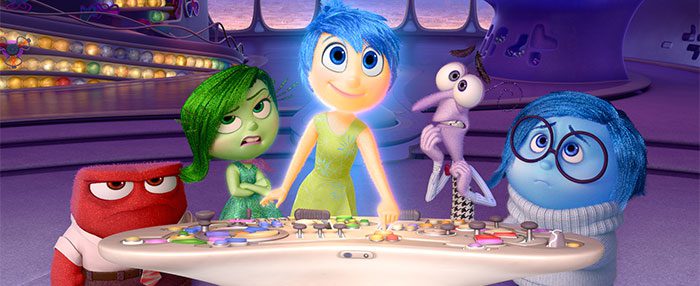
The chief toy, Sheriff Woody, was an upbeat, peppy, take-charge leader surrounded by various other personality types, while the chief emotion is Joy (Amy Poehler), an upbeat, peppy, take-charge leader who has to work with Sadness (Phyllis Smith), Fear (Bill Hader), Disgust (Mindy Kaling) and, my favorite, Anger (Lewis Black).
And just as Toy Story revolved around Woody’s jealous resentment of Buzz Lightyear, which was resolved only after Woody and Buzz were lost at the gas station and had to make their way home with the help of some scary, surreal playthings, Inside Out revolves around Joy’s initial determination to marginalize if not get rid of Sadness, until the two of them become lost in a distant corner of Riley’s mind and have to make their way home together through a series of bizarre and sometimes scary landscapes. (A similar odd-couple voyage formed the backbone to Finding Nemo, as well.)
There are even more parallels, which I’ll get to in a moment. But suffice it to say that elements like these feel very “safe” for Pixar, and give one the impression that the studio is staying very much within its wheelhouse.
There’s still plenty to like here, though.
First, the film revolves almost entirely around female protagonists, particularly Joy and Sadness (and let’s not forget Riley). Lewis Black’s Anger gets some of the best lines, and Joy and Sadness are helped by a character named Bing Bong, who is voiced by Pixar veteran Richard Kind (A Bug’s Life, etc.), but those are strictly supporting performances. The film ultimately belongs to the female characters, and while that has been true for many Disney films over the years, it is still something of a novelty for Pixar, which has attempted it only once before (with the aforementioned Brave).
Second, the visuals. The opening frames establish the two very different palettes for the film: our first glimpse of Riley as a baby is almost photorealistic, as are some of the environments we see later in the film, while the emergence of her emotions, somewhere inside her mind,1 is stylized and cartoony. The film works especially well if you watch it in 3D: sometimes the images inside Riley’s mind have an almost epic quality (e.g. the way Joy stands on a cliff and watches a mighty structure collapse into the void beyond), and at other times they get downright playful in the way that only animation can (e.g. a brief foray into “abstract” thought and two-dimensionality).
Third, there is the aforementioned Bing Bong, an “imaginary friend” from Riley’s preschool days who has been living in her long-term memory since she stopped playing with him. Like so much else in this film, Bing Bong harks back to the Toy Story franchise, too: he is a pastiche of things that kids love (cats, elephants, cotton candy and more), not unlike the Frankenstein’s-monster creations in Sid’s bedroom in that other film, and he has basically been abandoned by a child who outgrew him, just like Jessie and Lotso and so many others in the Toy Story sequels. In some ways Bing Bong’s fate is more bleak, because there is no way for him to move on to another child; but he also arguably accepts his fate with more grace than any of Pixar’s previous creations, and he is easily one of the film’s most memorable characters.
Fourth, there’s the impeccable vocal casting, which is particularly spot-on in the cases of Sadness (The Office’s Phyllis Smith) and Anger (the aforementioned Lewis Black, whose mannerisms were evidently studied quite carefully by the animators, not least in the scene where Anger rants about how San Francisco has ruined pizza).
Fifth, it turns out that one of the film’s central themes is memory — the role that memory plays in defining us and our relationships, and the way losing our memories can be a form of death — which is a favorite topic of mine. Memory was also a central theme in Finding Nemo, but it is given a different spin here, since instead of a fish with no long-term memory who gradually learns to remember things that are important to someone else, Inside Out revolves around a girl who starts out with some pretty solid “core memories”, which define what she values most in life, but then begins to lose touch with them as her sense of self is threatened by her family’s move away from home. We see Riley’s memories collapse and fade, not unlike the memories in Inception and Eternal Sunshine of the Spotless Mind, but here there is the added threat that Riley’s very sense of who she is could collapse along with them.
And, finally, there is the film’s other central theme, which is that Joy and Sadness do not need to compete with each other but, rather, can complement each other. When the story begins, Joy says she doesn’t know what Sadness is good for, but as the story progresses, she learns that sadness and empathy go hand-in-hand, and that sadness can lead to catharsis and make space for joy again. And as Joy learns the importance of Sadness, she gains a deeper appreciation for the other emotions too.2
The film has some other clever concepts, too, from the Memory Dump — a vast abyss from which nothing ever returns — to the movie studio which creates all the dreams and nightmares that pass through Riley’s mind while she’s asleep.
But as enjoyable and out-there as the movie can be at times, you never get the sense that Pixar is moving out of its safety zone. The film features familiar characters in familiar situations expressing familiar feelings. It’s also fairly plot-driven, and the twists and turns often hinge on physics that seem rather arbitrary.
Some people have acclaimed Inside Out as one of Pixar’s best films ever, if not the best film Pixar ever made; it’s the sort of hyperbole we often saw during the ‘Rubber Soul’ phase of the company’s history, when they put out films like WALL-E and Up that pushed the boundaries of American animation without quite redefining the form. I can’t pile that sort of praise on Inside Out myself, alas; compared to other movies starring Saturday Night Live alumni that take place inside the human mind and/or body and end on a tear-jerking note, I’m not even sure it beats Osmosis Jones, which was one of my favorite animated films around the turn of the millennium.
But it’s a solid family film, which is rare enough these days, and it’s made with genuine wit and feeling. It also gives us hope that Pixar might strike out in an original direction or two again (for example, with The Good Dinosaur, coming out later this year) before it sinks back into its neverending stream of sequels (Finding Dory next year, Toy Story 4 the year after that, and so on). Here’s hoping.
–
1. “Head” would be the wrong word here, as there is no indication that the emotions occupy any sort of physical space inside Riley’s brain or anything like that. When Riley runs and jumps and plays hockey etc., there is no sense of inertia affecting the emotions or the space in which they operate, and the emotions who live inside Riley never make contact with any of her biological systems (digestive, etc.). Then again, when Riley and her friend drink Slurpees together, the emotions do experience “brain freeze”.
2. Incidentally, I can’t resist noting here that Joy’s colour is orange and Sadness’s colour is blue, which means the film is partly about the reconciliation of teal and orange — though thankfully Anger, who is red, and Disgust, who is green, get their moments too, as does Fear, who is purple.
Next Post

June 20, 2015 A.D. The Bible Continues -- season one, episode eleven
Browse Our Archives
Select a Category Anglican Planet Articles BC Christian News BC Report Bible Movies Bible Review Blog Books & Culture Campus Times CBC Radio Christianity Today ChristianWeek Essays Faith Today Festival Cinemas Guide Film Journals Georgia Straight Interviews MB Herald National Catholic Register Salvationist Today's Christian Two Chairs Ubyssey Uncategorized Vancouver Courier Vancouver Sun
Select a Month August 2025 April 2025 January 2025 December 2024 November 2024 May 2024 February 2024 December 2023 May 2023 March 2023 November 2022 July 2022 June 2022 May 2022 April 2022 February 2022 January 2022 December 2021 November 2021 October 2021 September 2021 August 2021 July 2021 June 2021 April 2021 March 2021 February 2021 January 2021 December 2020 November 2020 October 2020 August 2020 July 2020 June 2020 May 2020 March 2020 February 2020 January 2020 December 2019 November 2019 September 2019 July 2019 May 2019 April 2019 March 2019 February 2019 January 2019 December 2018 November 2018 October 2018 September 2018 July 2018 June 2018 May 2018 April 2018 March 2018 February 2018 January 2018 December 2017 November 2017 October 2017 September 2017 August 2017 July 2017 June 2017 May 2017 April 2017 March 2017 February 2017 January 2017 December 2016 November 2016 October 2016 September 2016 August 2016 July 2016 June 2016 May 2016 April 2016 March 2016 February 2016 January 2016 December 2015 November 2015 October 2015 September 2015 August 2015 July 2015 June 2015 May 2015 April 2015 March 2015 February 2015 January 2015 December 2014 November 2014 October 2014 September 2014 August 2014 July 2014 June 2014 May 2014 April 2014 March 2014 February 2014 January 2014 December 2013 November 2013 October 2013 September 2013 August 2013 July 2013 June 2013 May 2013 April 2013 March 2013 February 2013 January 2013 December 2012 November 2012 October 2012 September 2012 August 2012 July 2012 June 2012 April 2012 January 2012 January 2011 December 2010 November 2010 October 2010 September 2010 August 2010 July 2010 June 2010 May 2010 April 2010 March 2010 February 2010 January 2010 December 2009 November 2009 October 2009 September 2009 August 2009 July 2009 June 2009 May 2009 April 2009 March 2009 February 2009 January 2009 December 2008 November 2008 October 2008 September 2008 August 2008 July 2008 June 2008 May 2008 April 2008 March 2008 February 2008 January 2008 December 2007 November 2007 October 2007 September 2007 August 2007 July 2007 June 2007 May 2007 April 2007 March 2007 February 2007 January 2007 December 2006 November 2006 October 2006 September 2006 August 2006 July 2006 June 2006 May 2006 April 2006 March 2006 February 2006 January 2006 December 2005 November 2005 October 2005 September 2005 August 2005 July 2005 June 2005 May 2005 April 2005 March 2005 January 2005 December 2004 November 2004 October 2004 September 2004 August 2004 July 2004 June 2004 May 2004 April 2004 March 2004 February 2004 January 2004 November 2003 October 2003 August 2003 July 2003 June 2003 May 2003 January 2003 December 2002 November 2002 August 2002 July 2002 June 2002 May 2002 March 2002 January 2002 December 2001 November 2001 September 2001 August 2001 July 2001 June 2001 April 2001 March 2001 February 2001 December 2000 November 2000 October 2000 September 2000 August 2000 July 2000 June 2000 May 2000 April 2000 March 2000 January 2000 October 1999 August 1999 May 1999 April 1999 February 1999 January 1999 December 1998 November 1998 October 1998 August 1998 July 1998 June 1998 April 1998 March 1998 January 1998 November 1997 September 1997 July 1997 June 1997 April 1997 March 1997 February 1997 January 1997 December 1996 October 1996 September 1996 June 1996 March 1996 February 1996 January 1996 April 1995 November 1994 September 1994 September 1991
Follow Us!
TAKE THE
Religious Wisdom Quiz
In Revelation, what are the names of the two cities that the two witnesses' bodies lie in?
Select your answer to see how you score.
Sodom and Egypt (figuratively called) Rome and Athens Babylon and Jerusalem Damascus and Tyre
Related posts from FilmChat

Joseph of Egypt – the Chosen spin-off announces...

Exclusive: A clip from Angel Studios' The King...

Exclusive: Watch a clip from Angel Studios' Brave...

Exclusive: Watch a clip from Angel Studios' Homestead
TRENDING AT PATHEOS Religious Music & Entertainment

A Christian, a Narnia Fan, and a Filmmaker...
Watching The Narnia Trailer As A Fan And A Filmmaker Ever since...

Great Spiritual Horror Films of the 20th Century...
For the Christian, horror movies are often troubling—and many would say that...

"Les Diabolique" and Transgression
Alongside something like Arrival, Vertigo, or Charade, Les Diaboliques is a...

"The Plague Dogs" and Mortality
So, flashback to the late 70s, early 80s. Walt Disney Studios is...

With the recent and highly successful release of Christopher Nolan’s epic film,...

"L'avventura" and Human Weakness
Today's piece is going to be a little different for a few...
view all Religious Music & Entertainment blogs
Ad-Free & Subscriber Log-In Subscription Support
- About Us
- 2026 Calendar
- Videos
- Podcasts
- Library of World Religions
- Faith In Media Tracker
- Advertise With Us
- Write for Us
- Privacy Policy
- Terms of Service
- Do Not Sell My Data
- Contact Us
- Radiant Digital
- Manage Newsletter Subscriptions
- Unsubscribe From Notifications
- Sitemap
Copyright 2008-2026, Patheos, part of the Radiant Digital network of media brands. All rights reserved.
Subscription Support Ad-Free & Subscriber Log-In
Follow Patheos