
BuddhistCatholicContemplativeEvangelicalGeneral ChristianHinduJewishLatter-day SaintMuslimNew VisionsProgressive Christian
Beliefs
- Buddhist
- Catholic
- Contemplative
- Evangelical
- General Christian
- Hindu
- Jewish
- Latter-day Saint
- More Voices
- Muslim
- New Visions
- Pagan
- Progressive Christian
Topics
- Religion News
- Food and Religion
- Sports and Religion
- Religious Art
- Religious Music and Entertainment
- Religious Events
- History and Religion
- Style and Religion
- Politics and Religion
- Women in Religion
- Recreation Outdoors and Religion
- Business Finance and Religion
- Careers Workplace and Religion
- Education and Religion
- Family Parenting and Religion
- Health Fitness and Religion
- Home and Religion
- Relationships and Religion
- Technology and Religion
- Travel and Religion
Columnists
- Buddhist Columnists
- Business Finance and Religion Columnists
- Careers Workplace and Religion Columnists
- Catholic Columnists
- Contemplative Columnists
- Education and Religion Columnists
- Evangelists Columnists
- Family Parenting and Religion Columnists
- General Christian Columnists
- Health Fitness and Religion Columnists
- Hindu Columnists
- History and Religion Columnists
- Home and Religion Columnists
- Jewish Columnists
- More Voices Columnists
- Latter Day Columnists
- Muslim Columnists
- New Visions Columnists
- Nonreligious Columnists
- Pagan Columnists
- Politics and Religion Columnists
- Progressive Columnists
- Recreation Outdoors and Religion Columnists
- Relationships and Religion Columnists
- Religion News Columnists
- Religious Art Columnists
- Religious Events Columnists
- Religious Music and Entertainment Columnists
- Sports and Religion Columnists
- Style and Religion Columnists
- Technology and Religion Columnists
- Travel and Religion Columnists
- Women in Religion Columnists
Resource Library
- 2026 Calendar
- Library of World Religions
- The 100 Most Holy Places on Earth
- Patheos Answers
- Podcasts
- Videos
- Faith Leaders Database
- Anglican Episcopalian
- Bahai
- Baptist
- Buddhism
- Christianity
- Confucianism
- Eastern Orthodoxy
- Hinduism
- Holiness and Pentecostal
- ISKCON
- Islam
- Judaism
- Lutheran
- Methodist
- The Church of Jesus Christ of Latter-day Saints
- New Age
- Paganism
- Presbytarian and Reformed
- Protestantism
- Religion Behind the Scenes
- Roman Catholic
- Scientology
- Shia Islam
- Sikhism
- Sufism
- Sunni Islam
- Taoism
- Zen
- See all religions
Research Tools
 Ad-Free & Subscriber Log-In Subscription Support
Ad-Free & Subscriber Log-In Subscription Support
Follow Patheos 

- Trending:
- Forgiveness
- |
- Marriage
- |
- Consciousness
- |
- Death Penalty
- |
- Election
- |
- Halloween

-
Articles
- Home
- Religious Music & Entertainment
- A.D. The Bible Continues — season one, episode ten
A.D. The Bible Continues — season one, episode ten
Last updated on: June 30, 2015 at 7:35 pm by Peter T. Chattaway
A.D. The Bible Continues — season one, episode ten 2015-06-30T19:35:03-07:00 Peter T. Chattaway
Patheos Explore the world's faith through different perspectives on religion and spirituality! Patheos has the views of the prevalent religions and spiritualities of the world.
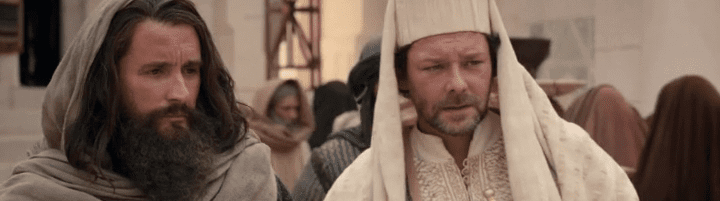
Season 1, Episode 10 — ‘Brothers in Arms’
Acts 9:28-31
Editing Acts, redux. The tenth episode of A.D. The Bible Continues is based on just a few verses from Acts 9, but it also borrows elements from other passages in Acts.
The episode depicts how Saul stayed with the apostles in Jerusalem (9:28), how the apostles sent Saul home to Tarsus when his life was in danger (9:29-30), and — through the truce arranged by James the Just and the high priest Caiaphas — how the persecution of the church came to a temporary end after Saul left (9:31).
The episode does not depict Saul arguing with the Hellenistic Jews (9:29). Saul’s life is threatened in this episode by the Zealots instead. (This is not the first time A.D. has ignored the Hellenistic Jews; it ignored them in the fifth episode, too.)
This episode also does not make any use of the passage in Acts 22 in which Paul says he left Jerusalem because Jesus appeared to him in a vision and told him to leave.
This episode does introduce or expand upon three characters who figure prominently in other sections of the book of Acts.
First, we see more of Tabitha, who was introduced in the last episode and is now punished by Pilate for becoming a Christian. The wounds she sustains in this episode will lead to her death and subsequent resuscitation, as per Acts 9.
Next, there is the Ethiopian eunuch, who receives a copy of the book of Isaiah from Caiaphas. The eunuch and the scroll are mentioned in Acts 8, when Philip meets the eunuch on the road to Gaza — but that meeting won’t happen until the eleventh episode. Also: the biblical eunuch had gone to Jerusalem to worship, before he met Philip, whereas the eunuch in A.D. has gone for a more… political reason.
Finally, and most significantly, there is James the Just.
James is identified in the Bible as one of the “brothers” of Jesus, along with Joseph, Judas and Simon (Mark 6, Matthew 13).1 The brothers did not believe in Jesus during his ministry (John 7) and actively tried to stop him at one point (Mark 3), but then Jesus appeared to James after the Resurrection (I Corinthians 15) and, by Pentecost, the brothers were meeting and praying with the apostles regularly (Acts 1).2
None of this back-story is mentioned in A.D., except for the fact that James is some sort of kinsman of Jesus.3 As far as this episode is concerned, James is an old friend of Peter’s who has been living in Galilee this whole time (since before Jesus died) and who has now popped down to Jerusalem because of a dream he just had.
But the episode does acknowledge that James was a significant enough figure by the time of Saul’s conversion that Saul met him during his stay in Jerusalem, as per Galatians 1. And it does foreshadow how James will become a leader in the Jerusalem church, as per Acts 12, 15 and 21 — and how his leadership there will sometimes put him at odds with the more “radical” teachings of Saul, as per Galatians 2.
Scripture references, redux. Caiaphas performs the Yom Kippur (or Day of Atonement) ceremonies described in Leviticus 16, including placing all of the nation’s sins upon a goat and sending it into the wilderness to die.
The episode cross-cuts between the scapegoat and the apostles sending Saul away from Jerusalem, as if to suggest a thematic link between the two.
Saul says “Isaiah’s prophecy has been completed.” He doesn’t say which prophecy, but other episodes have pointed to the “suffering servant” passage in Isaiah 53.
James remembers finding Jesus in the temple when Jesus was a boy — but in Luke 2, it was Mary and Joseph who found Jesus in the temple, not James.
Two of Jesus’ teachings are referenced in this episode. Joanna and Mary Magdalene tell Tabitha the “eye of a needle” story from Mark 10, Matthew 19 and Luke 18 — fitting, since Tabitha is a seamstress — and Saul says Jesus came not to abolish the Law but to fulfill it, which is something Jesus said about himself in Matthew 5.
Saul also comforts Tabitha with a passage from Romans 8, which the historical Saul, going by the name Paul, wrote about 20 years after the events of this episode.
Leah recites a prayer that begins: “Blessed Lord, I have shut my ears to your teachings and ignored your commandments. I have closed my eyes to the suffering of others…” This sounds like a formal prayer, but I can find no precedent for it.
Introducing Saul, redux. This episode plays up Saul’s indifference to the temple and to Jewish rituals in general. He tells Caiaphas that there is no point to bathing in mikvahs etc. now that Jesus has come; he preaches that everyone can be born again and be free of the temple’s tyranny; and he asks the other Christians why they should respect “that pile of stones” just because James told Caiaphas they would.
I do like the scene where Saul says farewell to the apostles. As performed by Emmett J. Scanlan, there are some subtle emotional shifts on Saul’s face as he seems to feel alternately rejected and accepted by the apostles; he gives Peter one last hug, and he takes one last humourous little dig at Simon the Zealot. It’s a perfect send-off, and it makes me hope that we will get to see these characters meet again someday.
Political friction, redux. The Ethiopian eunuch, surprisingly, comes to Jerusalem not to worship, per se, but to make a financial contribution to the Zealots. He also agrees to attend a banquet at Pilate’s palace as per the governor’s demand.
Caiaphas says repeatedly that he wants to unite the Jews of all sects, including the Christians, to deal with the crisis that will arise when the Romans try to put Caligula’s statue in the temple. However, Caiaphas is not keen to include Saul in that unity.
It’s interesting how both Caiaphas and the Zealots want to defend the temple, but Caiaphas, who once handed Jesus over to be crucified by the Romans, is willing to let Saul go free, on the assumption that the mob will kill Saul once they hear his preaching — whereas the Zealots, with a bit of encouragement from Caiaphas’s wife Leah, want to kill Saul precisely to stop people from hearing his preaching.
When Pilate hears that Joanna and Tabitha are Christian, he orders that they be punished so the whole world from Rome to Ethiopia will know; Pilate’s wife Claudia asks if the emperor would really care about something as tawdry as this.
Violence, redux. Cornelius rips the back of Tabitha’s shirt and flogs her.
Leah and the Zealots plot to kill Saul, but he escapes before they can do anything.
Family matters, redux. After Pilate punishes Tabitha in front of his guests, he tells Claudia privately that she cannot show her disapproval of his actions in public.
Both Leah and Claudia go behind their husbands’ backs — Leah to plot the death of Saul with the Zealots, Claudia to let Mary Magdalene go scot-free.
Joanna is visited in prison by her husband Chuza, who fears she will die. She tells him she is happy, he was the best husband, and he should be happy too.
Historical reference points, redux. The sixth episode took place during Purim. This episode takes place during Yom Kippur, which is about seven months after Purim. Does it seem like seven months went by over the last four episodes?
Odds and ends. Saul scratches a fish symbol on the wall of his prison cell, similar to the fish symbol Barnabas found on the door of the Christians’ hiding place in the previous episode. But Saul, unlike most of the other apostles, is not a fisherman, so what does the symbol mean for him? Is it a reminder of the apostles in general? Has the symbol already begun to take on its special meaning as a Greek acrostic?
–
1. Mark and Matthew also note that Jesus had an unspecified number of anonymous sisters.
2. John 2 seems to indicate that the brothers of Jesus also went with him, his mother and his disciples to the wedding at Cana where Jesus performed his first miracle (i.e. turning water to wine).
3. Different churches have different beliefs on the exact nature of James’s relationship to Jesus because of its implications for beliefs about Mary’s virginity: Protestants tend to believe James was a half-brother of Jesus, i.e. that they had the same mother; Orthodox tend to believe James was a step-brother of Jesus, i.e. a son of Joseph’s from a previous marriage; and Catholics tend to believe James was a cousin of Jesus.
A.D. seems to be following the Catholic view that James was a cousin of Jesus. He is too close in age to be an older step-brother, and when he tells the story of how the young Jesus went missing in the temple, James says, “His mother was beside herself with worry.” Note: his mother, not our mother.
Incidentally, have you noticed that we haven’t seen Mary for several episodes now? If she were still here, this episode might have had to take a stand and specify whether she was James’s mother or not.
–
CT Movies recaps: one | two | three | four | five | six | seven | eight | nine | ten | eleven | twelve
FilmChat recaps: one | two | three | four | five | six | seven | eight | nine | ten | eleven | twelve
Next Post

June 14, 2015 Watch: The tenth episode of digital talk show Beyond A.D.
Browse Our Archives
Select a Category Anglican Planet Articles BC Christian News BC Report Bible Movies Bible Review Blog Books & Culture Campus Times CBC Radio Christianity Today ChristianWeek Essays Faith Today Festival Cinemas Guide Film Journals Georgia Straight Interviews MB Herald National Catholic Register Salvationist Today's Christian Two Chairs Ubyssey Uncategorized Vancouver Courier Vancouver Sun
Select a Month August 2025 April 2025 January 2025 December 2024 November 2024 May 2024 February 2024 December 2023 May 2023 March 2023 November 2022 July 2022 June 2022 May 2022 April 2022 February 2022 January 2022 December 2021 November 2021 October 2021 September 2021 August 2021 July 2021 June 2021 April 2021 March 2021 February 2021 January 2021 December 2020 November 2020 October 2020 August 2020 July 2020 June 2020 May 2020 March 2020 February 2020 January 2020 December 2019 November 2019 September 2019 July 2019 May 2019 April 2019 March 2019 February 2019 January 2019 December 2018 November 2018 October 2018 September 2018 July 2018 June 2018 May 2018 April 2018 March 2018 February 2018 January 2018 December 2017 November 2017 October 2017 September 2017 August 2017 July 2017 June 2017 May 2017 April 2017 March 2017 February 2017 January 2017 December 2016 November 2016 October 2016 September 2016 August 2016 July 2016 June 2016 May 2016 April 2016 March 2016 February 2016 January 2016 December 2015 November 2015 October 2015 September 2015 August 2015 July 2015 June 2015 May 2015 April 2015 March 2015 February 2015 January 2015 December 2014 November 2014 October 2014 September 2014 August 2014 July 2014 June 2014 May 2014 April 2014 March 2014 February 2014 January 2014 December 2013 November 2013 October 2013 September 2013 August 2013 July 2013 June 2013 May 2013 April 2013 March 2013 February 2013 January 2013 December 2012 November 2012 October 2012 September 2012 August 2012 July 2012 June 2012 April 2012 January 2012 January 2011 December 2010 November 2010 October 2010 September 2010 August 2010 July 2010 June 2010 May 2010 April 2010 March 2010 February 2010 January 2010 December 2009 November 2009 October 2009 September 2009 August 2009 July 2009 June 2009 May 2009 April 2009 March 2009 February 2009 January 2009 December 2008 November 2008 October 2008 September 2008 August 2008 July 2008 June 2008 May 2008 April 2008 March 2008 February 2008 January 2008 December 2007 November 2007 October 2007 September 2007 August 2007 July 2007 June 2007 May 2007 April 2007 March 2007 February 2007 January 2007 December 2006 November 2006 October 2006 September 2006 August 2006 July 2006 June 2006 May 2006 April 2006 March 2006 February 2006 January 2006 December 2005 November 2005 October 2005 September 2005 August 2005 July 2005 June 2005 May 2005 April 2005 March 2005 January 2005 December 2004 November 2004 October 2004 September 2004 August 2004 July 2004 June 2004 May 2004 April 2004 March 2004 February 2004 January 2004 November 2003 October 2003 August 2003 July 2003 June 2003 May 2003 January 2003 December 2002 November 2002 August 2002 July 2002 June 2002 May 2002 March 2002 January 2002 December 2001 November 2001 September 2001 August 2001 July 2001 June 2001 April 2001 March 2001 February 2001 December 2000 November 2000 October 2000 September 2000 August 2000 July 2000 June 2000 May 2000 April 2000 March 2000 January 2000 October 1999 August 1999 May 1999 April 1999 February 1999 January 1999 December 1998 November 1998 October 1998 August 1998 July 1998 June 1998 April 1998 March 1998 January 1998 November 1997 September 1997 July 1997 June 1997 April 1997 March 1997 February 1997 January 1997 December 1996 October 1996 September 1996 June 1996 March 1996 February 1996 January 1996 April 1995 November 1994 September 1994 September 1991
Follow Us!
TAKE THE
Religious Wisdom Quiz
What do the Shoes of the Gospel of Peace allow believers to do?
Select your answer to see how you score.
Run into battle Stand firm Dance Walk in darkness
Related posts from FilmChat

Joseph of Egypt – the Chosen spin-off announces...

Exclusive: A clip from Angel Studios' The King...

Exclusive: Watch a clip from Angel Studios' Brave...

Exclusive: Watch a clip from Angel Studios' Homestead
TRENDING AT PATHEOS Religious Music & Entertainment

"Les Diabolique" and Transgression
Alongside something like Arrival, Vertigo, or Charade, Les Diaboliques is a...

"The Plague Dogs" and Mortality
So, flashback to the late 70s, early 80s. Walt Disney Studios is...

With the recent and highly successful release of Christopher Nolan’s epic film,...

"L'avventura" and Human Weakness
Today's piece is going to be a little different for a few...

I first want to apologize for not posting or writing anything. I'm...

I've engaged in the multi-year project of reading through the Church Fathers,...
view all Religious Music & Entertainment blogs
Ad-Free & Subscriber Log-In Subscription Support
- About Us
- 2026 Calendar
- Videos
- Podcasts
- Library of World Religions
- Faith In Media Tracker
- Advertise With Us
- Write for Us
- Privacy Policy
- Terms of Service
- Do Not Sell My Data
- Contact Us
- Radiant Digital
- Manage Newsletter Subscriptions
- Unsubscribe From Notifications
- Sitemap
Copyright 2008-2026, Patheos. All rights reserved.
Subscription Support Ad-Free & Subscriber Log-In
Follow Patheos