
BuddhistCatholicContemplativeEvangelicalGeneral ChristianHinduJewishLatter-day SaintMuslimNew VisionsProgressive Christian
Beliefs
- Buddhist
- Catholic
- Contemplative
- Evangelical
- General Christian
- Hindu
- Jewish
- Latter-day Saint
- More Voices
- Muslim
- New Visions
- Pagan
- Progressive Christian
Topics
- Religion News
- Food and Religion
- Sports and Religion
- Religious Art
- Religious Music and Entertainment
- Religious Events
- History and Religion
- Style and Religion
- Politics and Religion
- Women in Religion
- Recreation Outdoors and Religion
- Business Finance and Religion
- Careers Workplace and Religion
- Education and Religion
- Family Parenting and Religion
- Health Fitness and Religion
- Home and Religion
- Relationships and Religion
- Technology and Religion
- Travel and Religion
Columnists
- Buddhist Columnists
- Business Finance and Religion Columnists
- Careers Workplace and Religion Columnists
- Catholic Columnists
- Contemplative Columnists
- Education and Religion Columnists
- Evangelists Columnists
- Family Parenting and Religion Columnists
- General Christian Columnists
- Health Fitness and Religion Columnists
- Hindu Columnists
- History and Religion Columnists
- Home and Religion Columnists
- Jewish Columnists
- More Voices Columnists
- Latter Day Columnists
- Muslim Columnists
- New Visions Columnists
- Nonreligious Columnists
- Pagan Columnists
- Politics and Religion Columnists
- Progressive Columnists
- Recreation Outdoors and Religion Columnists
- Relationships and Religion Columnists
- Religion News Columnists
- Religious Art Columnists
- Religious Events Columnists
- Religious Music and Entertainment Columnists
- Sports and Religion Columnists
- Style and Religion Columnists
- Technology and Religion Columnists
- Travel and Religion Columnists
- Women in Religion Columnists
Resource Library
- 2026 Calendar
- Library of World Religions
- The 100 Most Holy Places on Earth
- Patheos Answers
- Podcasts
- Videos
- Faith Leaders Database
- Anglican Episcopalian
- Bahai
- Baptist
- Buddhism
- Christianity
- Confucianism
- Eastern Orthodoxy
- Hinduism
- Holiness and Pentecostal
- ISKCON
- Islam
- Judaism
- Lutheran
- Methodist
- The Church of Jesus Christ of Latter-day Saints
- New Age
- Paganism
- Presbytarian and Reformed
- Protestantism
- Religion Behind the Scenes
- Roman Catholic
- Scientology
- Shia Islam
- Sikhism
- Sufism
- Sunni Islam
- Taoism
- Zen
- See all religions
Research Tools
 Ad-Free & Subscriber Log-In Subscription Support
Ad-Free & Subscriber Log-In Subscription Support
Follow Patheos 

- Trending:
- Forgiveness
- |
- Marriage
- |
- Consciousness
- |
- Death Penalty
- |
- Election
- |
- Halloween

-
Articles
- Home
- Religious Music & Entertainment
- A.D. The Bible Continues — season one, episode nine
A.D. The Bible Continues — season one, episode nine
Last updated on: June 30, 2015 at 7:34 pm by Peter T. Chattaway
A.D. The Bible Continues — season one, episode nine 2015-06-30T19:34:11-07:00 Peter T. Chattaway
Patheos Explore the world's faith through different perspectives on religion and spirituality! Patheos has the views of the prevalent religions and spiritualities of the world.
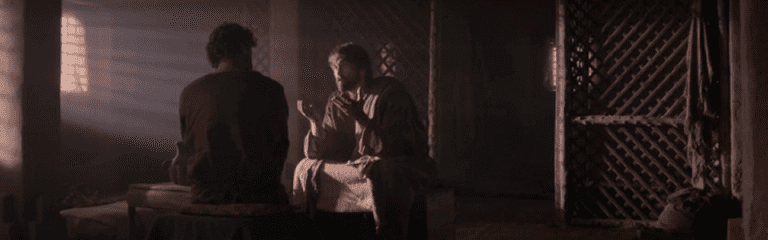
Season 1, Episode 9 — ‘Saul’s Return’
Acts 9:20-27
Editing Acts, redux. The ninth episode of A.D. The Bible Continues, like a couple of the episodes that preceded it, dwells on just a few verses from the book of Acts.
A bit of dialogue at the beginning alludes to Saul’s efforts to preach in the synagogues of Damascus (9:20-22), while the episode as a whole depicts his escape from the city (9:23-25) and his efforts to meet and be reconciled to the apostles (9:26-27).
Notably, the episode does not make use of the autobiographical information in Paul’s letters that overlaps with this section of Acts.
In his letters, we learn that Saul went to Arabia immediately after his conversion and then returned to Damascus (Galatians 1:17), that he had to escape from Damascus partly because an Arabian governor was trying to arrest him (2 Corinthians 11:32-33),1 that he went to Jerusalem three years after his conversion and stayed with Peter for fifteen days (Galatians 1:18), and that he did not see any of the other apostles on his visit to Jerusalem except for James the brother of Jesus (Galatians 1:19).
A few movies, such as Peter and Paul and Paul the Apostle, have integrated the book of Acts with the letters of Paul by incorporating details like these. But A.D. The Bible Continues, like A.D. Anno Domini, relies on Acts alone for its biblical storyline.
This episode also introduces Tabitha, who comes up in a slightly later section of Acts; presumably a future episode will show her dying and being brought back to life by Peter, as per Acts 9:36-42. In this episode, she is introduced as a seamstress working for the Herods, which is a cute nod to the bit in Acts where the widows mourning her death show Peter “the robes and other clothing” that she had made for them.
Scripture references, redux. Caligula declares that he will put a statue of himself in the Jerusalem temple, and both Caiaphas and the apostle John state that this statue could fulfill a prophecy in Daniel about the “abomination of desolation”.
This prophecy was already mentioned in episode three, when one of Boaz’s friends said Pilate’s visit to the temple at Pentecost was the fulfillment of this prophecy.
The phrase “abomination of desolation” is mentioned three times in Daniel, but Mary Magdalene adds to John’s speculation by saying that “war will come like a flood,” which indicates that she is probably thinking of Daniel 9 specifically.2
John also states that Jesus himself quoted this prophecy when he spoke about his return to earth. It is true that Jesus quotes this prophecy in Mark 13 and Matthew 24,3 and that he also quotes Daniel 7 to the effect that people will see “the Son of Man coming on the clouds of heaven” — but it is not clear that he was predicting the Second Coming, per se. Some theologians have noted that the Son of Man in Daniel, and thus presumably in Jesus’ prophecy, comes to heaven and not to earth.
Other Bible passages are quoted in this episode too.
Caiaphas quotes Leviticus 19 and its commandment to “love your neighbour as yourself” when he tries to persuade his wife that Saul should not be killed but should, instead, be won back to the non-Christian form of Judaism that they practice.
Interestingly, Jesus himself said that this is the second-greatest commandment (following the commandment to love God) in Mark 12, Matthew 22 and Luke 10, and he also cited it in a list of commandments that need to be kept in Matthew 19. It is also cited by Paul in Romans 13 and Galatians 5, and by James in James 2.
This episode also refers, directly or indirectly, to specific passages in the gospels.
Joanna gives Mary Magdalene some money “for the cause”, which reflects how both of these women supported Jesus and his followers “out of their own means” in Luke 8.
Barnabas talks to Peter about the time Jesus washed Peter’s feet, as per John 13.
And Saul recites the Matthew 6 version of the Lord’s Prayer in prison. (Jesus taught a slightly different version of this prayer to his followers in Luke 11.)
Introducing Saul, redux. Saul the Christian has all the zeal of Saul of persecutor of Christians, but now his zeal comes across as joyful enthusiasm rather than pathological obsession. And his joy is, indeed, rather infectious.
There’s something a tad glib about it, though. The Paul of the Bible was still writing, years later, that he didn’t deserve to be called an apostle because of how he had persecuted the Church, but the Saul of this series seems to expect everyone to accept him with open arms even though he was persecuting them just a few weeks ago — and at one point he even complains that Peter won’t “let go” of the past.
I do like how the apostles are very protective of their relationship with Jesus: the way Simon the Zealot tells Saul, “You don’t get to speak his name!” or the way Peter tells Barnabas, “He talks like he’s in charge and he never even knew Jesus.”
And Saul does, indeed, have a take-charge attitude, not least when he tells the apostles, “I’m worried you’re not fully engaged in Jesus’ message,” or when he pursues Simon the Zealot into the street and says, “Simon! Simon! If you’ll just listen to me, you’ll realize I’m right!”
There’s also some interesting competitiveness in the way Peter, referring to Jesus, tells Saul, “I miss him,” and Saul replies, “I don’t. I feel him,” and Peter has to clarify that Jesus is a living presence for him too by saying, “I feel him too.”
Of course, both of these men have encountered the risen Christ and are filled with his Spirit — but Peter knew Jesus in a way that Saul never did (and never will), and he misses that experience of Jesus, which he knows he will never have again.
Historical reference points, redux. Caligula, who had just become emperor at the end of last week’s episode, returns to Rome — but not before declaring that he will send a statue of himself to be installed in the Jerusalem temple.
The historical Caligula became emperor in AD 37 but did not try to install a statue of himself in the temple until AD 40, after a string of other incidents.
Political friction, redux. Even Caligula’s buddy Agrippa is bothered by Caligula’s intention to desecrate the temple. Agrippa — who is Jewish, after all — says he hopes Caligula will have forgotten all about this by the time they get back to Rome.
Herodias hopes the turmoil caused by the desecration will lead to Pilate’s downfall, and thus make it possible for Herod Antipas to take Pilate’s place.
Simon the Zealot makes contact with the, uh, Zealots when he learns about the temple’s possible fate. I guess this is supposed to be how he got his name? (This is the first time we have seen Boaz’s fiancée Eva or her father since the fifth episode.)
Violence, redux. One of the first things Caligula does, upon becoming emperor, is to get one of the advisors he inherited from Tiberius to commit suicide. The camera lingers on the point of the sword coming through the advisor’s back.
Leah really wants to kill Saul. First she tells her husband Caiaphas to find Saul, shame him, and kill him. Then she tells Herodias and Claudia that they might be able to satisfy Caligula’s bloodlust by making Saul a scapegoat and killing him.
Sexualization, redux. For the third episode in a row, Caligula sexually harasses the women he comes across in Pilate’s palace. He apparently does something (we know not what) to Tabitha, and he also expresses an unhealthy interest in Claudia.
Family matters, redux. Pilate apologizes to Claudia for the way Caligula looked at her. Claudia tells Cornelius the emperor will use her to punish Pilate. Cornelius says Pilate would never let that happen, but Claudia isn’t entirely convinced.
Tabitha expresses interest in Jesus after Joanna says Jesus gave her the strength to stand up to her husband, instead of just being “quiet and good” around him.
Odds and ends. Claudia prays to the Roman gods Mars and Vesta.
Barnabas finds the Christian hideout when he spots a door with a fish carved in the corner. The fish symbol can be a sort of Greek code: the word “ichthus”, meaning “fish”, consists of the initials for the Greek words for “Jesus Christ God’s Son Saviour”. But I wonder if the Aramaic-speaking Christians in Jerusalem would have used the symbol this way. Maybe they just use it because some of them are fishermen.
–
1. Acts 9 says “the Jews . . . kept close watch on the city gates in order to kill” Saul, while in 2 Corinthians 11, Paul himself writes that “the governor under King Aretas had the city of the Damascenes guarded in order to arrest me.” Aretas was the king of the Nabateans, an Arabian kingdom, from about 9 BC to AD 40. (One of Aretas’s daughters was Herod Antipas’s first wife, and the two kings went to war sometime after Antipas left Aretas’s daughter for Herodias. A garbled version of these events forms the back-story to the 1959 film The Big Fisherman, in which Aretas’s granddaughter seeks revenge against Antipas.)
2. Daniel 9 is noteworthy for predicting that an “anointed one” — or “messiah” — will be “cut off” about 483 years after the Persian king gives instructions to rebuild the city of Jerusalem. By some calculations, this “cutting off” would coincide with the death of Jesus circa AD 30.
3. Luke 21 is very similar to Mark 13 and Matthew 24, but in this version of the prophecy, Jesus refers to “Jerusalem being surrounded by armies” and not to an “abomination of desolation”.
–
CT Movies recaps: one | two | three | four | five | six | seven | eight | nine | ten | eleven | twelve
FilmChat recaps: one | two | three | four | five | six | seven | eight | nine | ten | eleven | twelve
Previous Post

June 6, 2015
Idris Elba to star in Laurence Fishburne's The Alchemist
Next Post
June 7, 2015 Watch: The ninth episode of digital talk show Beyond A.D.
Browse Our Archives
Select a Category Anglican Planet Articles BC Christian News BC Report Bible Movies Bible Review Blog Books & Culture Campus Times CBC Radio Christianity Today ChristianWeek Essays Faith Today Festival Cinemas Guide Film Journals Georgia Straight Interviews MB Herald National Catholic Register Salvationist Today's Christian Two Chairs Ubyssey Uncategorized Vancouver Courier Vancouver Sun
Select a Month August 2025 April 2025 January 2025 December 2024 November 2024 May 2024 February 2024 December 2023 May 2023 March 2023 November 2022 July 2022 June 2022 May 2022 April 2022 February 2022 January 2022 December 2021 November 2021 October 2021 September 2021 August 2021 July 2021 June 2021 April 2021 March 2021 February 2021 January 2021 December 2020 November 2020 October 2020 August 2020 July 2020 June 2020 May 2020 March 2020 February 2020 January 2020 December 2019 November 2019 September 2019 July 2019 May 2019 April 2019 March 2019 February 2019 January 2019 December 2018 November 2018 October 2018 September 2018 July 2018 June 2018 May 2018 April 2018 March 2018 February 2018 January 2018 December 2017 November 2017 October 2017 September 2017 August 2017 July 2017 June 2017 May 2017 April 2017 March 2017 February 2017 January 2017 December 2016 November 2016 October 2016 September 2016 August 2016 July 2016 June 2016 May 2016 April 2016 March 2016 February 2016 January 2016 December 2015 November 2015 October 2015 September 2015 August 2015 July 2015 June 2015 May 2015 April 2015 March 2015 February 2015 January 2015 December 2014 November 2014 October 2014 September 2014 August 2014 July 2014 June 2014 May 2014 April 2014 March 2014 February 2014 January 2014 December 2013 November 2013 October 2013 September 2013 August 2013 July 2013 June 2013 May 2013 April 2013 March 2013 February 2013 January 2013 December 2012 November 2012 October 2012 September 2012 August 2012 July 2012 June 2012 April 2012 January 2012 January 2011 December 2010 November 2010 October 2010 September 2010 August 2010 July 2010 June 2010 May 2010 April 2010 March 2010 February 2010 January 2010 December 2009 November 2009 October 2009 September 2009 August 2009 July 2009 June 2009 May 2009 April 2009 March 2009 February 2009 January 2009 December 2008 November 2008 October 2008 September 2008 August 2008 July 2008 June 2008 May 2008 April 2008 March 2008 February 2008 January 2008 December 2007 November 2007 October 2007 September 2007 August 2007 July 2007 June 2007 May 2007 April 2007 March 2007 February 2007 January 2007 December 2006 November 2006 October 2006 September 2006 August 2006 July 2006 June 2006 May 2006 April 2006 March 2006 February 2006 January 2006 December 2005 November 2005 October 2005 September 2005 August 2005 July 2005 June 2005 May 2005 April 2005 March 2005 January 2005 December 2004 November 2004 October 2004 September 2004 August 2004 July 2004 June 2004 May 2004 April 2004 March 2004 February 2004 January 2004 November 2003 October 2003 August 2003 July 2003 June 2003 May 2003 January 2003 December 2002 November 2002 August 2002 July 2002 June 2002 May 2002 March 2002 January 2002 December 2001 November 2001 September 2001 August 2001 July 2001 June 2001 April 2001 March 2001 February 2001 December 2000 November 2000 October 2000 September 2000 August 2000 July 2000 June 2000 May 2000 April 2000 March 2000 January 2000 October 1999 August 1999 May 1999 April 1999 February 1999 January 1999 December 1998 November 1998 October 1998 August 1998 July 1998 June 1998 April 1998 March 1998 January 1998 November 1997 September 1997 July 1997 June 1997 April 1997 March 1997 February 1997 January 1997 December 1996 October 1996 September 1996 June 1996 March 1996 February 1996 January 1996 April 1995 November 1994 September 1994 September 1991
Follow Us!
TAKE THE
Religious Wisdom Quiz
Who refused to defile himself with the king's food and wine?
Select your answer to see how you score.
Obadiah Daniel Joel Ezekiel
Related posts from FilmChat

Joseph of Egypt – the Chosen spin-off announces...

Exclusive: A clip from Angel Studios' The King...

Exclusive: Watch a clip from Angel Studios' Brave...

Exclusive: Watch a clip from Angel Studios' Homestead
TRENDING AT PATHEOS Religious Music & Entertainment

"Les Diabolique" and Transgression
Alongside something like Arrival, Vertigo, or Charade, Les Diaboliques is a...

"The Plague Dogs" and Mortality
So, flashback to the late 70s, early 80s. Walt Disney Studios is...

With the recent and highly successful release of Christopher Nolan’s epic film,...

"L'avventura" and Human Weakness
Today's piece is going to be a little different for a few...

I first want to apologize for not posting or writing anything. I'm...

I've engaged in the multi-year project of reading through the Church Fathers,...
view all Religious Music & Entertainment blogs
Ad-Free & Subscriber Log-In Subscription Support
- About Us
- 2026 Calendar
- Videos
- Podcasts
- Library of World Religions
- Faith In Media Tracker
- Advertise With Us
- Write for Us
- Privacy Policy
- Terms of Service
- Do Not Sell My Data
- Contact Us
- Radiant Digital
- Manage Newsletter Subscriptions
- Unsubscribe From Notifications
- Sitemap
Copyright 2008-2026, Patheos. All rights reserved.
Subscription Support Ad-Free & Subscriber Log-In
Follow Patheos