
BuddhistCatholicContemplativeEvangelicalGeneral ChristianHinduJewishLatter-day SaintMuslimNew VisionsProgressive Christian
Beliefs
- Buddhist
- Catholic
- Contemplative
- Evangelical
- General Christian
- Hindu
- Jewish
- Latter-day Saint
- More Voices
- Muslim
- New Visions
- Pagan
- Progressive Christian
Topics
- Religion News
- Food and Religion
- Sports and Religion
- Religious Art
- Religious Music and Entertainment
- Religious Events
- History and Religion
- Style and Religion
- Politics and Religion
- Women in Religion
- Recreation Outdoors and Religion
- Business Finance and Religion
- Careers Workplace and Religion
- Education and Religion
- Family Parenting and Religion
- Health Fitness and Religion
- Home and Religion
- Relationships and Religion
- Technology and Religion
- Travel and Religion
Columnists
- Buddhist Columnists
- Business Finance and Religion Columnists
- Careers Workplace and Religion Columnists
- Catholic Columnists
- Contemplative Columnists
- Education and Religion Columnists
- Evangelists Columnists
- Family Parenting and Religion Columnists
- General Christian Columnists
- Health Fitness and Religion Columnists
- Hindu Columnists
- History and Religion Columnists
- Home and Religion Columnists
- Jewish Columnists
- More Voices Columnists
- Latter Day Columnists
- Muslim Columnists
- New Visions Columnists
- Nonreligious Columnists
- Pagan Columnists
- Politics and Religion Columnists
- Progressive Columnists
- Recreation Outdoors and Religion Columnists
- Relationships and Religion Columnists
- Religion News Columnists
- Religious Art Columnists
- Religious Events Columnists
- Religious Music and Entertainment Columnists
- Sports and Religion Columnists
- Style and Religion Columnists
- Technology and Religion Columnists
- Travel and Religion Columnists
- Women in Religion Columnists
Resource Library
- 2026 Calendar
- Library of World Religions
- The 100 Most Holy Places on Earth
- Patheos Answers
- Podcasts
- Videos
- Faith Leaders Database
- Anglican Episcopalian
- Bahai
- Baptist
- Buddhism
- Christianity
- Confucianism
- Eastern Orthodoxy
- Hinduism
- Holiness and Pentecostal
- ISKCON
- Islam
- Judaism
- Lutheran
- Methodist
- The Church of Jesus Christ of Latter-day Saints
- New Age
- Paganism
- Presbytarian and Reformed
- Protestantism
- Religion Behind the Scenes
- Roman Catholic
- Scientology
- Shia Islam
- Sikhism
- Sufism
- Sunni Islam
- Taoism
- Zen
- See all religions
Research Tools
 Ad-Free & Subscriber Log-In Subscription Support
Ad-Free & Subscriber Log-In Subscription Support
Follow Patheos 

- Trending:
- Forgiveness
- |
- Marriage
- |
- Consciousness
- |
- Death Penalty
- |
- Election
- |
- Halloween

-
Articles
- Home
- Religious Music & Entertainment
- A.D. The Bible Continues — season one, episode six
A.D. The Bible Continues — season one, episode six
Last updated on: June 30, 2015 at 7:30 pm by Peter T. Chattaway
A.D. The Bible Continues — season one, episode six 2015-06-30T19:30:16-07:00 Peter T. Chattaway
Patheos Explore the world's faith through different perspectives on religion and spirituality! Patheos has the views of the prevalent religions and spiritualities of the world.
Season 1, Episode 6 — ‘The Persecution’
Acts 8:1-3
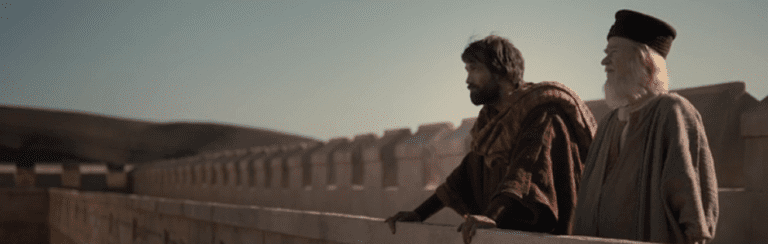
Editing Acts, redux. The first five episodes of A.D. The Bible Continues zipped through the gospels and the book of Acts at a brisk pace, covering multiple chapters at a time. But the sixth episode slows things down in a big way and covers just three verses in Acts: it begins with the burial of Stephen (8:2) and then goes on to show how Saul persecuted the church (8:3) and scattered the followers of Jesus (8:1).
The episode slows things down partly so that it can give us a proper introduction to Saul, who was briefly glimpsed at the end of the last episode. And in giving us this introduction, the episode incorporates elements from other parts of Acts, too.
For example, the teacher-student relationship between Gamaliel and Saul, mentioned in Acts 22, is reflected here in the conversations between the two characters.
Also, Saul’s education and argumentative nature are established in a scene where he debates Peter in front of the other Christians — and along the way, Peter uses a phrase or two from the sermon in Acts 2 that was omitted from the third episode.
Scripture references, redux. There’s a fair bit of Isaiah in this episode. John recites a passage from Isaiah 60 as Peter prepares Stephen for burial. Peter recites a passage from Isaiah 35 at the burial itself. And Peter quotes the “suffering servant” passage from Isaiah 53, and applies it to Jesus, during his debate with Saul.
Other passages get tossed around in the debate between Peter and Saul, too. Peter says Jesus is the way, the truth and the life and no one gets to the Father but through him, which is something Jesus said about himself in John 14. And Saul quotes Deuteronomy 21 (“anyone who is hung on a pole is under God’s curse”) as part of his argument that Jesus could not have been raised by God from the dead.
In another scene, Peter preaches in the streets of Jerusalem that Jesus is “the light of the world”, which is something that Jesus said about himself in John 8.
Introducing Saul. I don’t know if “foreshadowing” is quite the right word here, but this episode introduces Saul in a way that is kind of ironic, given what will happen to Saul once he becomes a Christian and starts going by his Roman name Paul.
For example, the first Christians Saul meets as he approaches the Christian camp are Philip and Barnabas. Saul is an enemy of theirs now, but he will eventually become their friend, going so far as to travel with Barnabas on a missionary journey (Acts 13-14) and to stay in Philip’s home with Philip’s family (as per Acts 21).
Also, the passage from Deuteronomy 21 that Saul cites here as evidence of why Jesus could not have been raised from the dead will eventually be quoted by Saul himself in Galatians 3, to demonstrate that Jesus’ victory over death is complete precisely because he suffered the worst kind of death imaginable under the law.
And finally, Peter tells Saul that his knowledge means nothing without love, which will of course become a big theme for Saul when he writes I Corinthians 13.
Most of these future developments fall outside the scope of the current season of A.D., which will only go as far as the events of Acts 10. But it’s good to see that the writers and producers are setting these things up, or are at least aware of these ironies.
Meanwhile, Saul has difficulty getting an audience with Caiaphas, which seems unlikely if Saul is so chummy with Gamaliel and has, indeed, been studying under him for a while. The 1985 miniseries A.D. Anno Domini did a much better job of establishing Saul as someone who is intimately connected with multiple members of the Sanhedrin before he finally embarks on his persecution of the Church.
Historical reference points. The fourth episode began the day after Pentecost. The sixth episode takes place during Purim. Purim takes place about nine months after Pentecost. Does it seem like nine months went by over the last two episodes?
It’s amusing, by the way, that characters would make a point — twice! — of saying that Herod Antipas has come to Jerusalem to celebrate Purim, given that Antipas is played by James Callis, who previously played Haman, the villain of the Purim story, in One Night with the King. Did the filmmakers discuss this at all behind the scenes?
Caiaphas also remarks that it is the tenth anniversary of his first meeting with Antipas as high priest. This is… odd, since the historical Caiaphas was high priest from AD 18 to AD 36. The producers have indicated that this series begins in AD 33, just three years before Caiaphas lost his job, so it would seem that Caiaphas didn’t meet Antipas until several years after becoming high priest, which seems unlikely.
Violence, redux. This might be the first episode in which no one dies. It depends on what Saul does to the followers of the Nazarene after he imprisons them, I guess. There are still plenty of beatings when the Christians are arrested, though.
Caiaphas tells Annas to get out of his house before he slips a blade through Annas’s ribs, which is a particularly nasty threat to make to one’s father-in-law.
Aggression, redux. When Saul first visits the Christian camp, Barnabas asks him to explain why the Christians are wrong in their beliefs, and then, after saying, “Have you no tongue,” he turns to Philip and says, “Or no brain?” This seems a tad rude, especially coming from the apostle whose nickname means “son of encouragement.”
Family matters, redux. Like the 1985 miniseries, the new A.D. introduces a grieving mother for Stephen. In the earlier miniseries, she ran down to the street to try to stop the crowd from dragging her son out to be stoned; in the new series, she mourns for Stephen as the disciples carry his body through the street.
Caiaphas finds his position as high priest threatened by his father-in-law Annas and his brother-in-law Jonathan (who will succeed him eventually, at least historically). At one point Caiaphas tells his wife Leah that her family gives him “indigestion”.
Political friction, redux. Joseph of Arimathea agrees to take part in Jonathan’s coup against Caiaphas, and is ultimately expelled from the Sanhedrin and told to leave Jerusalem. Presumably he will return to Arimathea, wherever that is?
Herod Antipas tells Caiaphas that Peter, the “ringleader” of the early Church, “is from Galilee. This reflects very badly on me.” This, I think, is the first time the series has shown Antipas acknowledging the fact that the Jesus movement sort of falls under his jurisdiction. (In Luke’s gospel, Pilate sent Jesus to be tried by Antipas before his crucifixion, but the first episode of this series had no time for that.)
Pilate prays to a small idol of Minerva in the presence of Caiaphas and his in-laws before deciding which of them will be high priest, and thus rubs in their faces the fact that Judaism is subject to Roman occupation not only politically but religiously as well. The strong implication is that the high priest who serves the Jewish God in his Temple will be picked not by the Jewish God but by a pagan deity instead.
However, Pilate then undermines this by saying Minerva has given him no direction, so he is going to toss a coin instead and let blind luck decide who gets to be high priest. But Caiaphas discovers afterwards that the coin has two heads, which means the decision was Pilate’s all along. But only Caiaphas knows that at this point.
Elsewhere, Cornelius watches as Saul’s men barge into homes, beat people up and arrest them. He seems increasingly uncomfortable with this sort of thing.
The episode also suggests that Caiaphas may have stepped up his persecution of the Christians (via Saul and his men) because of the pressure he faced from Pilate, Antipas and his own in-laws to do something about these people.
Interestingly, Stephen’s mother tells Peter that her son’s death was the result of Peter and his “politics”. And sure enough, this episode shows John telling people in the streets that the current Temple authorities are too cozy with the Romans, among other things. So there is a political edge to the Jesus movement, as depicted here.
Incidentally, this is the first episode with no Zealot scenes whatsoever.
Bribes, redux. It’s not exactly a bribe, per se, but Caiaphas does tell Saul he will pay the men that Saul hires to persecute the Church. And so, after one episode in which neither Caiaphas nor his wife bribed anyone to do something, Caiaphas goes back to handing out money just like he and his wife did in the first four episodes.
Amplified effects, redux. Mary Magdalene tells Peter to let his emotions out, so Peter throws his arms back and screams, and the wind blows through his hair as if to indicate the Holy Spirit’s approval. And then Peter launches right into a sermon.
Incidentally, Mary Magdalene prefaces this by telling Peter to stop being a man, and to start letting his emotions out like the women who mourned at Stephen’s funeral. But, um, we didn’t see Mary Magdalene wail like that at Stephen’s funeral.
Odds and ends. Matthew wonders why Peter won’t ask God to raise Stephen from the dead. It’s a not unreasonable question, given that other people have been raised from the dead, and given that no Christians have died before (apart from Ananias and Sapphira, who were struck down by the Holy Spirit two episodes ago).
In his debate with Peter, Saul refers to a few Jewish leaders whose movements ended in failure. One of these is Simon of Peraea, a former slave of Herod the Great’s who led a rebellion after Herod died. Saul also mentions a “Zachary of Beersheba” whose followers drowned in the Red Sea, though I can’t find a source for this right now.
Saul also asks if any of the Christians watching the debate have seen the risen Jesus. Saul assumes that none of them have, and that the Twelve are lying to all the others — and indeed, as far as the series is concerned, Jesus didn’t appear to anyone except for Mary Magdalene and the Twelve. But as Saul himself will write in I Corinthians 15, over 500 people saw the resurrected Jesus, which would have been about a tenth of the 5,000 people who were part of the Church at this point according to Acts 4.
Finally, I’m not sure what to make of the way Peter tells Saul at the end of the episode, “Let’s see whose fire burns brightest now!” In an earlier scene, Peter used the word “fire” to describe the Holy Spirit that motivated him and the other Christians — but at the end of the episode, it refers to mere flames, which seems like a poor pay-off.
–
CT Movies recaps: one | two | three | four | five | six | seven | eight | nine | ten | eleven | twelve
FilmChat recaps: one | two | three | four | five | six | seven | eight | nine | ten | eleven | twelve
Next Post

May 17, 2015 The Bible-movie actor who appeared in a Mad Max movie
Browse Our Archives
Select a Category Anglican Planet Articles BC Christian News BC Report Bible Movies Bible Review Blog Books & Culture Campus Times CBC Radio Christianity Today ChristianWeek Essays Faith Today Festival Cinemas Guide Film Journals Georgia Straight Interviews MB Herald National Catholic Register Salvationist Today's Christian Two Chairs Ubyssey Uncategorized Vancouver Courier Vancouver Sun
Select a Month August 2025 April 2025 January 2025 December 2024 November 2024 May 2024 February 2024 December 2023 May 2023 March 2023 November 2022 July 2022 June 2022 May 2022 April 2022 February 2022 January 2022 December 2021 November 2021 October 2021 September 2021 August 2021 July 2021 June 2021 April 2021 March 2021 February 2021 January 2021 December 2020 November 2020 October 2020 August 2020 July 2020 June 2020 May 2020 March 2020 February 2020 January 2020 December 2019 November 2019 September 2019 July 2019 May 2019 April 2019 March 2019 February 2019 January 2019 December 2018 November 2018 October 2018 September 2018 July 2018 June 2018 May 2018 April 2018 March 2018 February 2018 January 2018 December 2017 November 2017 October 2017 September 2017 August 2017 July 2017 June 2017 May 2017 April 2017 March 2017 February 2017 January 2017 December 2016 November 2016 October 2016 September 2016 August 2016 July 2016 June 2016 May 2016 April 2016 March 2016 February 2016 January 2016 December 2015 November 2015 October 2015 September 2015 August 2015 July 2015 June 2015 May 2015 April 2015 March 2015 February 2015 January 2015 December 2014 November 2014 October 2014 September 2014 August 2014 July 2014 June 2014 May 2014 April 2014 March 2014 February 2014 January 2014 December 2013 November 2013 October 2013 September 2013 August 2013 July 2013 June 2013 May 2013 April 2013 March 2013 February 2013 January 2013 December 2012 November 2012 October 2012 September 2012 August 2012 July 2012 June 2012 April 2012 January 2012 January 2011 December 2010 November 2010 October 2010 September 2010 August 2010 July 2010 June 2010 May 2010 April 2010 March 2010 February 2010 January 2010 December 2009 November 2009 October 2009 September 2009 August 2009 July 2009 June 2009 May 2009 April 2009 March 2009 February 2009 January 2009 December 2008 November 2008 October 2008 September 2008 August 2008 July 2008 June 2008 May 2008 April 2008 March 2008 February 2008 January 2008 December 2007 November 2007 October 2007 September 2007 August 2007 July 2007 June 2007 May 2007 April 2007 March 2007 February 2007 January 2007 December 2006 November 2006 October 2006 September 2006 August 2006 July 2006 June 2006 May 2006 April 2006 March 2006 February 2006 January 2006 December 2005 November 2005 October 2005 September 2005 August 2005 July 2005 June 2005 May 2005 April 2005 March 2005 January 2005 December 2004 November 2004 October 2004 September 2004 August 2004 July 2004 June 2004 May 2004 April 2004 March 2004 February 2004 January 2004 November 2003 October 2003 August 2003 July 2003 June 2003 May 2003 January 2003 December 2002 November 2002 August 2002 July 2002 June 2002 May 2002 March 2002 January 2002 December 2001 November 2001 September 2001 August 2001 July 2001 June 2001 April 2001 March 2001 February 2001 December 2000 November 2000 October 2000 September 2000 August 2000 July 2000 June 2000 May 2000 April 2000 March 2000 January 2000 October 1999 August 1999 May 1999 April 1999 February 1999 January 1999 December 1998 November 1998 October 1998 August 1998 July 1998 June 1998 April 1998 March 1998 January 1998 November 1997 September 1997 July 1997 June 1997 April 1997 March 1997 February 1997 January 1997 December 1996 October 1996 September 1996 June 1996 March 1996 February 1996 January 1996 April 1995 November 1994 September 1994 September 1991
Follow Us!
TAKE THE
Religious Wisdom Quiz
Who insulted and opposed David, then died after Abigail pleaded his case?
Select your answer to see how you score.
Amasa Nabal Ahithophel Joab
Related posts from FilmChat

Joseph of Egypt – the Chosen spin-off announces...

Exclusive: A clip from Angel Studios' The King...

Exclusive: Watch a clip from Angel Studios' Brave...

Exclusive: Watch a clip from Angel Studios' Homestead
TRENDING AT PATHEOS Religious Music & Entertainment

"Les Diabolique" and Transgression
Alongside something like Arrival, Vertigo, or Charade, Les Diaboliques is a...

"The Plague Dogs" and Mortality
So, flashback to the late 70s, early 80s. Walt Disney Studios is...

With the recent and highly successful release of Christopher Nolan’s epic film,...

"L'avventura" and Human Weakness
Today's piece is going to be a little different for a few...

I first want to apologize for not posting or writing anything. I'm...

I've engaged in the multi-year project of reading through the Church Fathers,...
view all Religious Music & Entertainment blogs
Ad-Free & Subscriber Log-In Subscription Support
- About Us
- 2026 Calendar
- Videos
- Podcasts
- Library of World Religions
- Faith In Media Tracker
- Advertise With Us
- Write for Us
- Privacy Policy
- Terms of Service
- Do Not Sell My Data
- Contact Us
- Radiant Digital
- Manage Newsletter Subscriptions
- Unsubscribe From Notifications
- Sitemap
Copyright 2008-2026, Patheos. All rights reserved.
Subscription Support Ad-Free & Subscriber Log-In
Follow Patheos