
BuddhistCatholicContemplativeEvangelicalGeneral ChristianHinduJewishLatter-day SaintMuslimNew VisionsProgressive Christian
Beliefs
- Buddhist
- Catholic
- Contemplative
- Evangelical
- General Christian
- Hindu
- Jewish
- Latter-day Saint
- More Voices
- Muslim
- New Visions
- Pagan
- Progressive Christian
Topics
- Religion News
- Food and Religion
- Sports and Religion
- Religious Art
- Religious Music and Entertainment
- Religious Events
- History and Religion
- Style and Religion
- Politics and Religion
- Women in Religion
- Recreation Outdoors and Religion
- Business Finance and Religion
- Careers Workplace and Religion
- Education and Religion
- Family Parenting and Religion
- Health Fitness and Religion
- Home and Religion
- Relationships and Religion
- Technology and Religion
- Travel and Religion
Columnists
- Buddhist Columnists
- Business Finance and Religion Columnists
- Careers Workplace and Religion Columnists
- Catholic Columnists
- Contemplative Columnists
- Education and Religion Columnists
- Evangelists Columnists
- Family Parenting and Religion Columnists
- General Christian Columnists
- Health Fitness and Religion Columnists
- Hindu Columnists
- History and Religion Columnists
- Home and Religion Columnists
- Jewish Columnists
- More Voices Columnists
- Latter Day Columnists
- Muslim Columnists
- New Visions Columnists
- Nonreligious Columnists
- Pagan Columnists
- Politics and Religion Columnists
- Progressive Columnists
- Recreation Outdoors and Religion Columnists
- Relationships and Religion Columnists
- Religion News Columnists
- Religious Art Columnists
- Religious Events Columnists
- Religious Music and Entertainment Columnists
- Sports and Religion Columnists
- Style and Religion Columnists
- Technology and Religion Columnists
- Travel and Religion Columnists
- Women in Religion Columnists
Resource Library
- 2026 Calendar
- Library of World Religions
- The 100 Most Holy Places on Earth
- Patheos Answers
- Podcasts
- Videos
- Faith Leaders Database
- Anglican Episcopalian
- Bahai
- Baptist
- Buddhism
- Christianity
- Confucianism
- Eastern Orthodoxy
- Hinduism
- Holiness and Pentecostal
- ISKCON
- Islam
- Judaism
- Lutheran
- Methodist
- The Church of Jesus Christ of Latter-day Saints
- New Age
- Paganism
- Presbytarian and Reformed
- Protestantism
- Religion Behind the Scenes
- Roman Catholic
- Scientology
- Shia Islam
- Sikhism
- Sufism
- Sunni Islam
- Taoism
- Zen
- See all religions
Research Tools
 Ad-Free & Subscriber Log-In Subscription Support
Ad-Free & Subscriber Log-In Subscription Support
Follow Patheos 

- Trending:
- Forgiveness
- |
- Marriage
- |
- Consciousness
- |
- Death Penalty
- |
- Election
- |
- Halloween

-
Articles
- Home
- Religious Music & Entertainment
- A.D. The Bible Continues — season one, episode five
A.D. The Bible Continues — season one, episode five
Last updated on: June 30, 2015 at 7:08 pm by Peter T. Chattaway
A.D. The Bible Continues — season one, episode five 2015-06-30T19:08:34-07:00 Peter T. Chattaway
Patheos Explore the world's faith through different perspectives on religion and spirituality! Patheos has the views of the prevalent religions and spiritualities of the world.
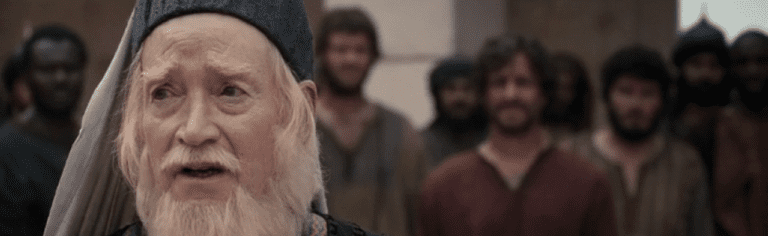
Season 1, Episode 5 — ‘The First Martyr’
Acts 5-8
Editing Acts, redux. Last week’s episode of A.D. The Bible Continues took time to develop a few simple stories from Acts. No such luck this week. Instead, this episode skips over some pretty major developments, all so that it can focus on the capture, torture and death of a fictitious Zealot, while also cramming in the brutal death of the first Christian martyr — a character that we had only just begun to get to know.
The episode does depict the fear that gripped the early Church following the deaths of Ananias and Sapphira (5:11), the imprisonment of the apostles and their angelic escape (5:17-26), the second trial of the apostles (5:27-33), the speech that Gamaliel makes in the apostles’ defense (5:34-39), the flogging of the apostles (5:40-42), the stoning of Stephen (7:54-60) and Saul’s approval of Stephen’s death (8:1).
The episode does not depict the appointment of the seven Hellenistic Jewish deacons (6:1-7), the false allegations against Stephen (6:8-15) or Stephen’s trial before the Sanhedrin (7:1-53) — though a few words from Stephen’s speech do make it into the scene where Stephen strides into the Sanhedrin and starts haranguing the elders.
The omission of the appointment of the seven deacons is a major, major flaw, in my books. It’s made worse by the fact that, when Peter tells Stephen he wants Stephen to run the camp, Stephen actually replies that such a job is beneath him — he’s too educated! — and that he wants to preach instead. This is the exact opposite of what happens in Acts, where Stephen is one of the deacons who oversee the distribution of food so that the apostles can focus on “prayer and the ministry of the word.”
To make things even worse, this episode introduces Philip, who was also one of the seven deacons, but the episode never associates him with Stephen or the diaconate or anything else (apart from a single line of dialogue in which Peter says he wants Stephen and Philip to look after the camp): it just turns him into a guy who bumps into Peter while trying to save some Jews from Pilate’s executioners.
There’s one other connection that this episode fails to make: This is the first episode to feature either Gamaliel or Saul, yet it never acknowledges the fact that Gamaliel was Saul’s teacher (as per Acts 22). Other films have used the Saul-Gamaliel relationship to explore the tensions within Judaism between Gamaliel’s tolerance of the Christians and Saul’s dogmatic persecution of them, but this episode couldn’t be bothered.
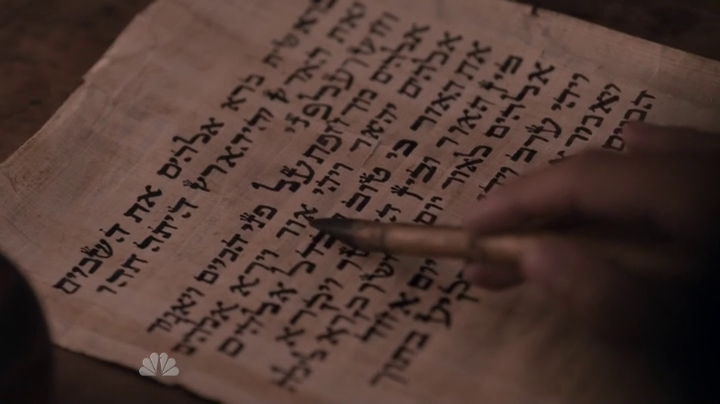
Scripture references, redux. Stephen teaches Peter how to read, using Genesis 1.1
Peter sings a mournful passage from Psalm 69 when he and Caiaphas find themselves standing before the dead body of Boaz, and Caiaphas briefly joins in.
Caiaphas recites a list of curses from Deuteronomy 28 while the apostles are flogged.
This isn’t scripture, exactly, but Caiaphas tells Boaz at one point that a monster cannot be slain, because if you cut its head off, it grows another one that bites back twice as hard. I am not aware of any Jewish legends to this effect, but it sounds like something from Greek myth (e.g. the Hydra, which grew two heads for every head it lost).
Jerusalem. This episode makes much of the fact that the Christians are living in a camp somewhere outside Jerusalem, where people can be “safe” from the authorities. This is not at all what one finds in the book of Acts, which says the early Christians preached every day “in the temple courts and from house to house”.
Interestingly, this episode also features two scenes in which Peter proclaims that Jesus is going to come back to establish his kingdom in Jerusalem. This is not part of the message Peter preaches in Acts; he does mention the Second Coming once, in Acts 3, but the language of “kingdoms” and “Jerusalem” comes from somewhere else.2
Will this series show how early Christian eschatology changed as people realized the Second Coming wasn’t happening as soon as they had thought it would? Or is it taking modern ideas about the end times and imposing them on the past, the same way it imposed certain ideas about the Second Coming onto the Ascension?
Violence, redux. Cornelius arrests and executes more Jews, though most of this takes place offscreen. Finally, to stop the reprisals, Boaz turns himself in to Caiaphas, who hands him over to Pilate, who promises Boaz that he will die slowly.
Pilate himself delivers the first blow, by sticking a knife in Boaz and twisting it. Then Boaz is tortured under Cornelius’s supervision, as a brand is placed on Boaz’s arm. Finally Boaz’s father-in-law Levi shows up and mercy-kills him with an arrow.
The apostles are flogged by the Sanhedrin. I don’t think any other film has actually depicted this. Rossellini’s Acts of the Apostles shows the apostles returning from their flogging with torn robes, while A.D. Anno Domini shows Caiaphas giving the order to whip the apostles — but neither of those films shows the actual flogging itself. Even The Visual Bible merely narrates this passage, instead of dramatizing it.
And, of course, Stephen is stoned to death, with close-ups on his face as a few of the rocks hit his head.
Interestingly, at one point Boaz justifies his own violence by saying that Peter killed a man and woman (i.e. Ananias and Sapphira, who died supernaturally in last week’s episode). Peter replies that only God decides who lives and dies. And so the series does make an effort to differentiate between the different kinds of violence in the Bible.
Aggression, redux. The moment of shared Psalm-singing between Peter and Caiaphas comes to an end when Peter decides to use the death of Boaz as a witnessing tool and starts proclaiming the name of Jesus right in Caiaphas’s face.
Stephen also strides into the Sanhedrin and starts chewing out the elders without any warning. As Nicola A. Menzie put it to me on Twitter, the Stephen of the Bible was full of the Holy Spirit, but the Stephen of this episode is “full of pride.” (Last week’s episode showed gusts of wind blowing across Peter’s face to signify that he was full of the Spirit. This week’s episode did no such thing for Stephen.)
Amplified effects, redux. Speaking of those gusts of wind, a similar breath-like sound is heard on the soundtrack when Peter decides how to deal with the Boaz situation. So rather than justify the characters’ decisions based on internal narrative logic, the writers are invoking the Holy Spirit as a sort of deus ex machina.
Sympathy for Caiaphas. More and more, Caiaphas is the most interesting character, to me. Yes, he’s an antagonist to the early Christians, but he also expresses sincere concern for them because of their shared Jewish heritage.
In the Christian camp, Caiaphas tells Peter, “There are hundreds of innocent people here. I pray to God for their sake.” And when Stephen bursts in on the Sanhedrin and starts ranting at them, Caiaphas actually looks a little concerned that Stephen might have wandered into a much more dangerous situation than he anticipated.
Family matters, redux. Mary Magdalene gets Peter’s daughter Maya to look after the daughter of the Zealot who died in last week’s episode. Maya ends up telling Peter that she plans to move back to Galilee, to a place far from the turmoil in Jerusalem.
This makes me wonder if the producers have decided to abandon the back-story that they were developing for Peter. Episode one introduced Boaz the Zealot as a childhood friend of Peter’s; episode three introduced Peter’s daughter Maya. But now, as of episode five, Boaz is dead and Maya says she’s going back home. So is that it, then?
Interestingly, Mary Magdalene tells Maya, “You’re still a child yourself,” but Maya is a teenager, which in this culture would make her old enough to marry, etc., yes?
The Virgin Mary has another of her morale-boosting conversations with Peter, which I’m beginning to find kind of interesting, because according to Christian tradition (as per John 19), Mary lived with the apostle John after the Crucifixion, but we haven’t really seen her interact one-to-one with John all that much in this series.
Boaz’s fiancée Eva asks her father Levi, who is also a Zealot, to teach her how to kill. This is starting to sound like one of the subplots from The Dovekeepers.
Claudia begins to act behind Pilate’s back, hoping to save at least some of the Jews from her husband’s wrath. Cornelius notices this, but covers up for her.
Political friction, redux. Pilate and Caiaphas keep things relatively civil this time, but their wives get into a bit of a spat that ends with Claudia slapping Leah.
Caiaphas does make a point of telling Pilate that “knowledge can be as effective as force” when Pilate asks how Caiaphas found Boaz.
Curiously, when Caiaphas goes to the Christian camp looking for Boaz, he warns Peter that the Romans will be there to destroy the camp “in less than an hour” if Peter doesn’t give Boaz up… but Boaz doesn’t turn himself in until hours later, at night, and the Christian camp remains untouched. Was it just an empty threat?
After Boaz turns himself in to Caiaphas, and before Caiaphas hands him over to Pilate, Boaz intuits that Caiaphas hates Pilate as much as Boaz does.
Bribes, redux — or not, as the case may be. Amazingly, when Leah tries to persuade Eva to give up Boaz, she does not offer Eva any money. That makes this the first episode in which neither Caiaphas nor his wife tries to bribe anyone.
Odds and ends. It’s awfully banal, how Gamaliel begins his speech to the Sanhedrin by asking if Caiaphas really can’t recall being carried away by his own enthusiasms when he was young. And just how young are the apostles, anyway?
–
1. My friend Steve Pahl tells me that the Hebrew text used in this episode doesn’t quite match the standard text used by Bible translators. In a discussion of this scene on my Facebook wall, he wrote that, just within the first few lines, “there are spelling mistakes and some dropped words, etc. The concept of the Spirit of Elohim hovering is dropped in favor of just Elohim hovering. . . . The pen is pointing to the word ‘light’ and the word that precedes it is ‘and let there be’ (although . . . the consonant ‘heh’ is poorly written and looks a little odd). But the next word should be ‘and there was light’ but the next word here is probably ‘and he said’ but I can’t make out the word following ‘and he said…’ so I don’t know what he said!!” He wonders if the producers hired a consultant who had access to “some obscure early text”.
2. When the New Testament does speak of Jerusalem in eschatological terms, it refers to “the Jerusalem that is above” or “the heavenly Jerusalem” or “the new Jerusalem, coming down out of heaven”.
–
CT Movies recaps: one | two | three | four | five | six | seven | eight | nine | ten | eleven | twelve
FilmChat recaps: one | two | three | four | five | six | seven | eight | nine | ten | eleven | twelve
Previous Post

May 9, 2015
The prophet Isaiah at the movies: a quick round-up
Next Post
May 10, 2015 A.D. The Bible Continues spotlight: Simon the Zealot
Browse Our Archives
Select a Category Anglican Planet Articles BC Christian News BC Report Bible Movies Bible Review Blog Books & Culture Campus Times CBC Radio Christianity Today ChristianWeek Essays Faith Today Festival Cinemas Guide Film Journals Georgia Straight Interviews MB Herald National Catholic Register Salvationist Today's Christian Two Chairs Ubyssey Uncategorized Vancouver Courier Vancouver Sun
Select a Month August 2025 April 2025 January 2025 December 2024 November 2024 May 2024 February 2024 December 2023 May 2023 March 2023 November 2022 July 2022 June 2022 May 2022 April 2022 February 2022 January 2022 December 2021 November 2021 October 2021 September 2021 August 2021 July 2021 June 2021 April 2021 March 2021 February 2021 January 2021 December 2020 November 2020 October 2020 August 2020 July 2020 June 2020 May 2020 March 2020 February 2020 January 2020 December 2019 November 2019 September 2019 July 2019 May 2019 April 2019 March 2019 February 2019 January 2019 December 2018 November 2018 October 2018 September 2018 July 2018 June 2018 May 2018 April 2018 March 2018 February 2018 January 2018 December 2017 November 2017 October 2017 September 2017 August 2017 July 2017 June 2017 May 2017 April 2017 March 2017 February 2017 January 2017 December 2016 November 2016 October 2016 September 2016 August 2016 July 2016 June 2016 May 2016 April 2016 March 2016 February 2016 January 2016 December 2015 November 2015 October 2015 September 2015 August 2015 July 2015 June 2015 May 2015 April 2015 March 2015 February 2015 January 2015 December 2014 November 2014 October 2014 September 2014 August 2014 July 2014 June 2014 May 2014 April 2014 March 2014 February 2014 January 2014 December 2013 November 2013 October 2013 September 2013 August 2013 July 2013 June 2013 May 2013 April 2013 March 2013 February 2013 January 2013 December 2012 November 2012 October 2012 September 2012 August 2012 July 2012 June 2012 April 2012 January 2012 January 2011 December 2010 November 2010 October 2010 September 2010 August 2010 July 2010 June 2010 May 2010 April 2010 March 2010 February 2010 January 2010 December 2009 November 2009 October 2009 September 2009 August 2009 July 2009 June 2009 May 2009 April 2009 March 2009 February 2009 January 2009 December 2008 November 2008 October 2008 September 2008 August 2008 July 2008 June 2008 May 2008 April 2008 March 2008 February 2008 January 2008 December 2007 November 2007 October 2007 September 2007 August 2007 July 2007 June 2007 May 2007 April 2007 March 2007 February 2007 January 2007 December 2006 November 2006 October 2006 September 2006 August 2006 July 2006 June 2006 May 2006 April 2006 March 2006 February 2006 January 2006 December 2005 November 2005 October 2005 September 2005 August 2005 July 2005 June 2005 May 2005 April 2005 March 2005 January 2005 December 2004 November 2004 October 2004 September 2004 August 2004 July 2004 June 2004 May 2004 April 2004 March 2004 February 2004 January 2004 November 2003 October 2003 August 2003 July 2003 June 2003 May 2003 January 2003 December 2002 November 2002 August 2002 July 2002 June 2002 May 2002 March 2002 January 2002 December 2001 November 2001 September 2001 August 2001 July 2001 June 2001 April 2001 March 2001 February 2001 December 2000 November 2000 October 2000 September 2000 August 2000 July 2000 June 2000 May 2000 April 2000 March 2000 January 2000 October 1999 August 1999 May 1999 April 1999 February 1999 January 1999 December 1998 November 1998 October 1998 August 1998 July 1998 June 1998 April 1998 March 1998 January 1998 November 1997 September 1997 July 1997 June 1997 April 1997 March 1997 February 1997 January 1997 December 1996 October 1996 September 1996 June 1996 March 1996 February 1996 January 1996 April 1995 November 1994 September 1994 September 1991
Follow Us!
TAKE THE
Religious Wisdom Quiz
Who was Rahab's husband?
Select your answer to see how you score.
Jesse Boaz Salmon Obed
Related posts from FilmChat

Joseph of Egypt – the Chosen spin-off announces...

Exclusive: A clip from Angel Studios' The King...

Exclusive: Watch a clip from Angel Studios' Brave...

Exclusive: Watch a clip from Angel Studios' Homestead
TRENDING AT PATHEOS Religious Music & Entertainment

"Les Diabolique" and Transgression
Alongside something like Arrival, Vertigo, or Charade, Les Diaboliques is a...

"The Plague Dogs" and Mortality
So, flashback to the late 70s, early 80s. Walt Disney Studios is...

With the recent and highly successful release of Christopher Nolan’s epic film,...

"L'avventura" and Human Weakness
Today's piece is going to be a little different for a few...

I first want to apologize for not posting or writing anything. I'm...

I've engaged in the multi-year project of reading through the Church Fathers,...
view all Religious Music & Entertainment blogs
Ad-Free & Subscriber Log-In Subscription Support
- About Us
- 2026 Calendar
- Videos
- Podcasts
- Library of World Religions
- Faith In Media Tracker
- Advertise With Us
- Write for Us
- Privacy Policy
- Terms of Service
- Do Not Sell My Data
- Contact Us
- Radiant Digital
- Manage Newsletter Subscriptions
- Unsubscribe From Notifications
- Sitemap
Copyright 2008-2026, Patheos. All rights reserved.
Subscription Support Ad-Free & Subscriber Log-In
Follow Patheos