
BuddhistCatholicContemplativeEvangelicalGeneral ChristianHinduJewishLatter-day SaintMuslimNew VisionsProgressive Christian
Beliefs
- Buddhist
- Catholic
- Contemplative
- Evangelical
- General Christian
- Hindu
- Jewish
- Latter-day Saint
- More Voices
- Muslim
- New Visions
- Pagan
- Progressive Christian
Topics
- Religion News
- Food and Religion
- Sports and Religion
- Religious Art
- Religious Music and Entertainment
- Religious Events
- History and Religion
- Style and Religion
- Politics and Religion
- Women in Religion
- Recreation Outdoors and Religion
- Business Finance and Religion
- Careers Workplace and Religion
- Education and Religion
- Family Parenting and Religion
- Health Fitness and Religion
- Home and Religion
- Relationships and Religion
- Technology and Religion
- Travel and Religion
Columnists
- Buddhist Columnists
- Business Finance and Religion Columnists
- Careers Workplace and Religion Columnists
- Catholic Columnists
- Contemplative Columnists
- Education and Religion Columnists
- Evangelists Columnists
- Family Parenting and Religion Columnists
- General Christian Columnists
- Health Fitness and Religion Columnists
- Hindu Columnists
- History and Religion Columnists
- Home and Religion Columnists
- Jewish Columnists
- More Voices Columnists
- Latter Day Columnists
- Muslim Columnists
- New Visions Columnists
- Nonreligious Columnists
- Pagan Columnists
- Politics and Religion Columnists
- Progressive Columnists
- Recreation Outdoors and Religion Columnists
- Relationships and Religion Columnists
- Religion News Columnists
- Religious Art Columnists
- Religious Events Columnists
- Religious Music and Entertainment Columnists
- Sports and Religion Columnists
- Style and Religion Columnists
- Technology and Religion Columnists
- Travel and Religion Columnists
- Women in Religion Columnists
Resource Library
- 2026 Calendar
- Library of World Religions
- The 100 Most Holy Places on Earth
- Patheos Answers
- Podcasts
- Videos
- Faith Leaders Database
- Anglican Episcopalian
- Bahai
- Baptist
- Buddhism
- Christianity
- Confucianism
- Eastern Orthodoxy
- Hinduism
- Holiness and Pentecostal
- ISKCON
- Islam
- Judaism
- Lutheran
- Methodist
- The Church of Jesus Christ of Latter-day Saints
- New Age
- Paganism
- Presbytarian and Reformed
- Protestantism
- Religion Behind the Scenes
- Roman Catholic
- Scientology
- Shia Islam
- Sikhism
- Sufism
- Sunni Islam
- Taoism
- Zen
- See all religions
Research Tools
 Ad-Free & Subscriber Log-In Subscription Support
Ad-Free & Subscriber Log-In Subscription Support
Follow Patheos 

- Trending:
- Forgiveness
- |
- Marriage
- |
- Consciousness
- |
- Death Penalty
- |
- Election
- |
- Halloween

-
Articles
- Home
- Religious Music & Entertainment
- A.D. The Bible Continues — season one, episode two
A.D. The Bible Continues — season one, episode two
Last updated on: June 30, 2015 at 7:03 pm by Peter T. Chattaway
A.D. The Bible Continues — season one, episode two 2015-06-30T19:03:34-07:00 Peter T. Chattaway
Patheos Explore the world's faith through different perspectives on religion and spirituality! Patheos has the views of the prevalent religions and spiritualities of the world.
Season 1, Episode 2 — ‘The Body Is Gone’
Matthew 28, Luke 24, John 20-21, Acts 1
Harmonization, redux. It’s pretty much impossible to harmonize the empty-tomb accounts in the four canonical gospels, and A.D. The Bible Continues doesn’t even try. It does, however, blend the various resurrection appearances that took place afterwards, as well as the final words of Jesus in Matthew and Acts.
For the discovery of the empty tomb itself, the series follows the basic template set by John’s gospel: Mary Magdalene goes to the tomb by herself,1 finds it empty, comes back and tells Peter and John, goes back to the tomb with them, and then encounters Jesus by the tomb after Peter and John have gone back to the city.
However, in this episode she does not see the angels that John mentions, after Peter and John have gone back to the city and before she sees Jesus. (In Luke’s gospel, she and the other women see these angels before Peter goes to the tomb.)
After that, the resurrection appearances are a mix of things, source-wise.
Jesus appears to most of the disciples in the upper room and eats a piece of bread to prove that he has a physical body (in Luke’s gospel, he eats a piece of fish instead), but Thomas is missing on this occasion, so Jesus appears to the apostles in the upper room again after Thomas has rejoined them (as per John’s gospel).
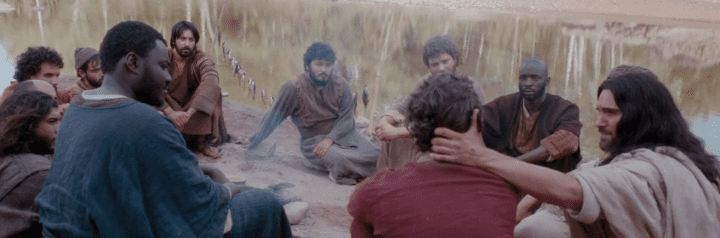
Then, the apostles go to Galilee and encounter Jesus while fishing (as per John’s gospel), and afterwards he walks up a mountain with them and tells them to spread his message (as per Matthew’s gospel), and then, after that, he ascends into heaven (in both Luke and Acts, this happens outside Jerusalem and not in Galilee).
The episode does not depict Jesus’ appearance to Peter before he appeared to the others (as per Paul and Luke), nor does it depict his appearance to Cleopas and the other person walking to Emmaus on the day of the Resurrection itself.
It’s interesting that this episode omits the women who accompanied Mary Magdalene to the tomb (as per Mark, Matthew and Luke) and encountered the risen Jesus with her before the male disciples did (as per Matthew’s gospel), since we know that A.D. will eventually introduce one of those women, namely Joanna. Oh well.
Pacing. The book of Acts tells us that Jesus ascended to heaven forty days after he rose from the dead, so unlike the first episode of A.D., which covered a single weekend, this second episode should be covering a month and then some. But it feels like it is covering a much, much smaller span of time than that.
Consider: In John’s gospel, an entire week passes between Jesus’ appearance to the disciples without Thomas and his subsequent appearance to the disciples with Thomas. But here it all seems to happen in a single day. (Thomas leaves the upper room to check the empty tomb for himself, but he comes back and says the temple guards are already re-sealing it, to put an end to the resurrection rumours.)
Consider also how the disciples are shown fleeing Jerusalem under cover of a riot in one scene, and are then shown fishing in Galilee the next time we see them. The latter scene is so relaxed compared to all the action that precedes it, it doesn’t really fit.
How did the disciples shift gears like this? What was the journey from Jerusalem to Galilee like? (Google Maps says it takes at least two days by foot.) How long did Peter and the others mill about, wondering what to make of the things they had seen in Jerusalem, before they decided to go back to their old job? Whose boat are they using? We know that we will see Peter’s daughter in future episodes, so where is she while these scenes in Galilee are happening? The episode never fills in those blanks.
In this respect, the second episode feels like a step down from the first, which used the time between the crucifixion and the resurrection to develop the disciples and explore how they felt. There’s a bit of that at the beginning of the second episode, after Mary Magdalene discovers the empty tomb, but after that it’s all plot, plot, plot.
Scripture references, redux. Once again, Caiaphas quotes the Old Testament in his prayers. The first part of the prayer he speaks before sinking into his mikvah comes from Jeremiah 17. I am not sure where the second part comes from.
The “warrior angels” at the Ascension have no direct basis in the book of Acts, but they do have something to do with it in a roundabout sort of way.
The book of Acts simply says that Jesus rose into the air and vanished behind a cloud, and that two men dressed in white suddenly appeared next to the disciples and told them that Jesus would return one day the same way they had seen him leave.
There is no rising through the air in this episode, and there are no angels talking to the apostles either. But in last week’s episode of Beyond A.D., Mark Burnett revealed that the “warrior angels” were added to this scene to foreshadow the Second Coming.
There are numerous passages in the New Testament that describe Jesus or “the Son of Man” coming back to Earth accompanied by “clouds” and “angels”. In John’s gospel, Jesus tells the apostles that they “will see heaven open, and the angels of God ascending and descending on the Son of Man,” while Paul writes in II Thessalonians that Jesus will be “revealed from heaven in blazing fire with his powerful angels.” Those passages seem to have had the most direct influence on this scene.
So, because the angels in Acts told the disciples that Jesus would come back the way he left, and because these other passages seem to describe the Second Coming a certain way (though some scholars, such as N.T. Wright, argue that at least some of those passages are actually describing something else), this episode depicts the Ascension that way instead of giving us a more literal depiction of Acts 1.
Incidentally, last year I devoted an entire post to depictions of the Ascension in film, and I noted that very, very few films have depicted it the way Acts describes it.
Many films have avoided the Ascension altogether, and those that do depict it have tended to do so indirectly, by using overlapping images or having Jesus vanish off-screen. This is partly to avoid anything as potentially goofy as the sight of a flying Jesus (especially if the visual effects aren’t up to snuff), and also partly to convey the notion that Jesus has transcended the literal historical setting of the story.
A.D., for all its spectacle, similarly avoids depicting the Ascension directly. It never actually shows Jesus ascending into heaven. Instead, as Jesus walks up the mountain, a giant cloud comes down to Earth and a light opens where the cloud and mountain meet, as if Jesus is about to step into some sort of inter-dimensional portal.
Violence. Reuben, the head of the temple guard, hires a guy to find a dead body — and possibly murder it himself — so that the priests can wound it and pass it off as the body of Jesus, though Caiaphas nixes this idea as soon as he sees the corpse.
Cornelius — the centurion described in Acts 10 as devout, prayerful, and generous to the poor even before he becomes a Christian — threatens to hit Mary Magdalene while he looks for Jesus’ body, though he does not actually hit her in the end.
Two of the Romans chasing the disciples through the streets of Jerusalem run into a house filled with Jewish men who immediately begin beating the Romans up.
Cornelius puts the city of Jerusalem under “lockdown” — a rather modern-sounding word, to my ears — so the Zealots team up with the disciples to get them out of the city. The Zealots throw rocks and the first-century equivalent of Molotov cocktails at the Romans by the gate, and in all the commotion, the disciples get through.
(Before this, there is some pro forma dialogue between Peter and Boaz, the Zealot, to clarify that Peter disapproves of violence; Boaz, for his part, says he only takes life as a last resort. Once again, there is no acknowledgement of the fact that, in the Bible, Peter had cut off the ear of the high priest’s servant just a few days earlier.)
The guards who were stationed at the tomb all suffer horrible deaths at the hands of the Romans. The Jewish guards are murdered in the street by Cornelius, and the Roman guards are first beaten by their colleagues in one scene, and then strangled to death in another, except for one who is stabbed in the back by Pilate himself.
Family matters, redux. Caiaphas’s wife does a lot of proclaiming in this episode, as she did in the first one. She spends a lot of time describing people to themselves or articulating theories about the nature of good leadership, etc. I do appreciate the scene where she and Caiaphas almost kiss, but of course, alas, they are interrupted.
I also appreciate Pilate’s concern for his own wife’s mental well-being. She’s perfectly fine, of course. But Pilate doesn’t accept her dreams and premonitions, and it’s interesting to see him react to this side of her with something resembling weary concern, instead of the outrage that he vents at Caiaphas and the Roman soldiers.
Political friction, redux. Caiaphas barged in on Pilate’s office last week. Now this week, Pilate and his officers barge in on Caiaphas while he is bathing in a mikvah.
Apologetics, redux. As Caiaphas interrogates the Jewish guards, he emphasizes that the stone at the tomb was so heavy it must have taken multiple men to roll it away. Similarly, Simon the Zealot asks Thomas how all of the apostles could have been deluded into thinking that they had seen Jesus the same way at the same time.
Lines like these sound like the sort of points that many an apologist has made over the years. Most Jesus films don’t spell things out quite so clearly; the disciples who have seen Jesus believe in his resurrection, and those who haven’t don’t, but they rarely try to convince each other of their doubt or belief through logical argument.
Theological points, redux. When Thomas sees Jesus, he says, “My Lord,” and that’s it. In John’s gospel, he says “My Lord, and my God,” to underscore the recurring theme of John’s gospel that Jesus is divine in every sense of the word.
In the 1985 miniseries A.D. Anno Domini, Thomas says, “My master, and my Lord.”
Perhaps, for most English-speaking viewers, the word “Lord” is now associated more often with divinity than with a higher social class: thus, the 1985 miniseries shifted the language (replacing “lord” with “master” and “God” with “Lord”), while the current series perhaps did not omit the word “God” so much as conflate it with “Lord”.
The same, but different, redux. Pilate’s wife Claudia says Jesus was “favoured by the gods,” which is similar to what she said (“chosen by the gods”) in The Bible.
Odds and ends. Jesus closes his eyes when eating the bread in the upper room as if to indicate the pleasure it gives him. You can almost hear him thinking, “I haven’t had anything to eat in so long…” It’s actually kind of reminiscent of movies like The Preacher’s Wife and Meet Joe Black, in which an angel or similar spiritual being assumes a human form and takes great delight in the ability to eat food.
–
1. Interestingly, while Mary Magdalene seems to be the only woman who finds the empty tomb in John’s gospel, John does record that Mary said, “They have taken the Lord out of the tomb, and we don’t know where they have put him,” which suggests that there may have been other people with her on that first trip to the tomb who are simply never mentioned by John. This would fit with the other three gospels, which all say that other women went to the tomb with Mary Magdalene.
–
CT Movies recaps: one | two | three | four | five | six | seven | eight | nine | ten | eleven | twelve
FilmChat recaps: one | two | three | four | five | six | seven | eight | nine | ten | eleven | twelve
Previous Post

April 17, 2015
Watch: Behind-the-scenes clips from Of Kings and Prophets
Browse Our Archives
Select a Category Anglican Planet Articles BC Christian News BC Report Bible Movies Bible Review Blog Books & Culture Campus Times CBC Radio Christianity Today ChristianWeek Essays Faith Today Festival Cinemas Guide Film Journals Georgia Straight Interviews MB Herald National Catholic Register Salvationist Today's Christian Two Chairs Ubyssey Uncategorized Vancouver Courier Vancouver Sun
Select a Month August 2025 April 2025 January 2025 December 2024 November 2024 May 2024 February 2024 December 2023 May 2023 March 2023 November 2022 July 2022 June 2022 May 2022 April 2022 February 2022 January 2022 December 2021 November 2021 October 2021 September 2021 August 2021 July 2021 June 2021 April 2021 March 2021 February 2021 January 2021 December 2020 November 2020 October 2020 August 2020 July 2020 June 2020 May 2020 March 2020 February 2020 January 2020 December 2019 November 2019 September 2019 July 2019 May 2019 April 2019 March 2019 February 2019 January 2019 December 2018 November 2018 October 2018 September 2018 July 2018 June 2018 May 2018 April 2018 March 2018 February 2018 January 2018 December 2017 November 2017 October 2017 September 2017 August 2017 July 2017 June 2017 May 2017 April 2017 March 2017 February 2017 January 2017 December 2016 November 2016 October 2016 September 2016 August 2016 July 2016 June 2016 May 2016 April 2016 March 2016 February 2016 January 2016 December 2015 November 2015 October 2015 September 2015 August 2015 July 2015 June 2015 May 2015 April 2015 March 2015 February 2015 January 2015 December 2014 November 2014 October 2014 September 2014 August 2014 July 2014 June 2014 May 2014 April 2014 March 2014 February 2014 January 2014 December 2013 November 2013 October 2013 September 2013 August 2013 July 2013 June 2013 May 2013 April 2013 March 2013 February 2013 January 2013 December 2012 November 2012 October 2012 September 2012 August 2012 July 2012 June 2012 April 2012 January 2012 January 2011 December 2010 November 2010 October 2010 September 2010 August 2010 July 2010 June 2010 May 2010 April 2010 March 2010 February 2010 January 2010 December 2009 November 2009 October 2009 September 2009 August 2009 July 2009 June 2009 May 2009 April 2009 March 2009 February 2009 January 2009 December 2008 November 2008 October 2008 September 2008 August 2008 July 2008 June 2008 May 2008 April 2008 March 2008 February 2008 January 2008 December 2007 November 2007 October 2007 September 2007 August 2007 July 2007 June 2007 May 2007 April 2007 March 2007 February 2007 January 2007 December 2006 November 2006 October 2006 September 2006 August 2006 July 2006 June 2006 May 2006 April 2006 March 2006 February 2006 January 2006 December 2005 November 2005 October 2005 September 2005 August 2005 July 2005 June 2005 May 2005 April 2005 March 2005 January 2005 December 2004 November 2004 October 2004 September 2004 August 2004 July 2004 June 2004 May 2004 April 2004 March 2004 February 2004 January 2004 November 2003 October 2003 August 2003 July 2003 June 2003 May 2003 January 2003 December 2002 November 2002 August 2002 July 2002 June 2002 May 2002 March 2002 January 2002 December 2001 November 2001 September 2001 August 2001 July 2001 June 2001 April 2001 March 2001 February 2001 December 2000 November 2000 October 2000 September 2000 August 2000 July 2000 June 2000 May 2000 April 2000 March 2000 January 2000 October 1999 August 1999 May 1999 April 1999 February 1999 January 1999 December 1998 November 1998 October 1998 August 1998 July 1998 June 1998 April 1998 March 1998 January 1998 November 1997 September 1997 July 1997 June 1997 April 1997 March 1997 February 1997 January 1997 December 1996 October 1996 September 1996 June 1996 March 1996 February 1996 January 1996 April 1995 November 1994 September 1994 September 1991
Follow Us!
TAKE THE
Religious Wisdom Quiz
In Revelation, what is the correct sequence of events in the End Times?
Select your answer to see how you score.
Beast rises from sea, dragon cast to earth, mark of the beast given, false prophet rises Dragon cast to earth, beast rises from sea, false prophet rises from earth, mark of the beast given Mark of the beast given, dragon cast to earth, beast rises, false prophet rises False prophet rises, dragon cast to earth, beast rises from sea, mark of the beast given
Related posts from FilmChat

Joseph of Egypt – the Chosen spin-off announces...

Exclusive: A clip from Angel Studios' The King...

Exclusive: Watch a clip from Angel Studios' Brave...

Exclusive: Watch a clip from Angel Studios' Homestead
TRENDING AT PATHEOS Religious Music & Entertainment

"Les Diabolique" and Transgression
Alongside something like Arrival, Vertigo, or Charade, Les Diaboliques is a...

"The Plague Dogs" and Mortality
So, flashback to the late 70s, early 80s. Walt Disney Studios is...

With the recent and highly successful release of Christopher Nolan’s epic film,...

"L'avventura" and Human Weakness
Today's piece is going to be a little different for a few...

I first want to apologize for not posting or writing anything. I'm...

I've engaged in the multi-year project of reading through the Church Fathers,...
view all Religious Music & Entertainment blogs
Ad-Free & Subscriber Log-In Subscription Support
- About Us
- 2026 Calendar
- Videos
- Podcasts
- Library of World Religions
- Faith In Media Tracker
- Advertise With Us
- Write for Us
- Privacy Policy
- Terms of Service
- Do Not Sell My Data
- Contact Us
- Radiant Digital
- Manage Newsletter Subscriptions
- Unsubscribe From Notifications
- Sitemap
Copyright 2008-2026, Patheos. All rights reserved.
Subscription Support Ad-Free & Subscriber Log-In
Follow Patheos