
BuddhistCatholicContemplativeEvangelicalGeneral ChristianHinduJewishLatter-day SaintMuslimNew VisionsProgressive Christian
Beliefs
- Buddhist
- Catholic
- Contemplative
- Evangelical
- General Christian
- Hindu
- Jewish
- Latter-day Saint
- More Voices
- Muslim
- New Visions
- Pagan
- Progressive Christian
Topics
- Religion News
- Food and Religion
- Sports and Religion
- Religious Art
- Religious Music and Entertainment
- Religious Events
- History and Religion
- Style and Religion
- Politics and Religion
- Women in Religion
- Recreation Outdoors and Religion
- Business Finance and Religion
- Careers Workplace and Religion
- Education and Religion
- Family Parenting and Religion
- Health Fitness and Religion
- Home and Religion
- Relationships and Religion
- Technology and Religion
- Travel and Religion
Columnists
- Buddhist Columnists
- Business Finance and Religion Columnists
- Careers Workplace and Religion Columnists
- Catholic Columnists
- Contemplative Columnists
- Education and Religion Columnists
- Evangelists Columnists
- Family Parenting and Religion Columnists
- General Christian Columnists
- Health Fitness and Religion Columnists
- Hindu Columnists
- History and Religion Columnists
- Home and Religion Columnists
- Jewish Columnists
- More Voices Columnists
- Latter Day Columnists
- Muslim Columnists
- New Visions Columnists
- Nonreligious Columnists
- Pagan Columnists
- Politics and Religion Columnists
- Progressive Columnists
- Recreation Outdoors and Religion Columnists
- Relationships and Religion Columnists
- Religion News Columnists
- Religious Art Columnists
- Religious Events Columnists
- Religious Music and Entertainment Columnists
- Sports and Religion Columnists
- Style and Religion Columnists
- Technology and Religion Columnists
- Travel and Religion Columnists
- Women in Religion Columnists
Resource Library
- 2026 Calendar
- Library of World Religions
- The 100 Most Holy Places on Earth
- Patheos Answers
- Podcasts
- Videos
- Faith Leaders Database
- Anglican Episcopalian
- Bahai
- Baptist
- Buddhism
- Christianity
- Confucianism
- Eastern Orthodoxy
- Hinduism
- Holiness and Pentecostal
- ISKCON
- Islam
- Judaism
- Lutheran
- Methodist
- The Church of Jesus Christ of Latter-day Saints
- New Age
- Paganism
- Presbytarian and Reformed
- Protestantism
- Religion Behind the Scenes
- Roman Catholic
- Scientology
- Shia Islam
- Sikhism
- Sufism
- Sunni Islam
- Taoism
- Zen
- See all religions
Research Tools
 Ad-Free & Subscriber Log-In Subscription Support
Ad-Free & Subscriber Log-In Subscription Support
Follow Patheos 

- Trending:
- Forgiveness
- |
- Marriage
- |
- Consciousness
- |
- Death Penalty
- |
- Election
- |
- Halloween

-
Articles
- Home
- Religious Music & Entertainment
- A.D. The Bible Continues — season one, episode three
A.D. The Bible Continues — season one, episode three
Last updated on: June 30, 2015 at 7:04 pm by Peter T. Chattaway
A.D. The Bible Continues — season one, episode three 2015-06-30T19:04:58-07:00 Peter T. Chattaway
Patheos Explore the world's faith through different perspectives on religion and spirituality! Patheos has the views of the prevalent religions and spiritualities of the world.
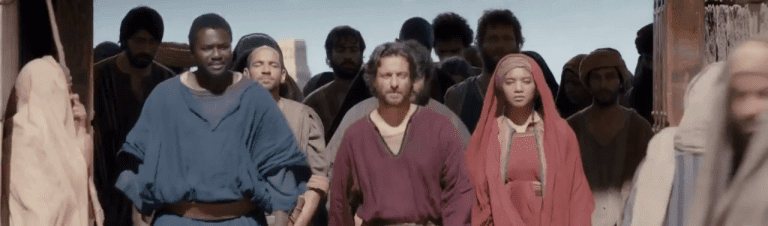
Season 1, Episode 3 — ‘The Spirit Arrives’
Acts 2-4
Editing Acts. The third episode of A.D. The Bible Continues is the first one that takes place entirely within the timeframe of the book of Acts, and it zips through the first few chapters so quickly that the final scenes are taken from Acts 4.
This is remarkable, when you consider that there are still nine episodes to go and the season as a whole is only supposed to get as far as Acts 10.
How does this episode get through the first few chapters of Acts so quickly? Partly by omitting entire stories.
The Ascension (1:1-11) was already covered in last week’s episode, of course. But this episode also leaves out the appointment of Matthias (1:12-26), the first sermon that Peter delivered to the crowds in Jerusalem (2:13-40), and the baptism and discipling of the many people who responded to that first sermon (2:41-47).
Instead of exploring the growth of the Church, the series goes straight to the first confrontation between the Christians and the Jewish leaders. The coming of the Holy Spirit at Pentecost (2:1-12) leads directly to the healing of the beggar at the Temple (3:1-10), a heavily abbreviated version of the speech that Peter gives to the people who witnessed the healing (3:11-26), and the arrest of Peter and John (4:1-4).
Admittedly, the series doesn’t completely ignore the sermon that Peter gives in Acts 2. The speech that Peter gives after healing the beggar in this episode actually includes a few lines from that sermon, in addition to the sermon he gives in Acts 3.
But it’s worth noting that this episode’s version of the speech completely leaves out all references to repentance, to the role that Peter’s audience played in the execution of Jesus, to the multiple Old Testament prophecies that the biblical Peter quotes, and to the fact that the Holy Spirit has been poured out for the entire world.
As written here, Peter seems to be telling the people that they should join the Church primarily for the power boost they can get from the Holy Spirit. And as evangelistic messages go, that seems somewhat… insufficient, to me.
Also worth noting: Acts 1:14-15 says the followers of Jesus numbered about 120 before the coming of the Holy Spirit, and that this group included a number of women in addition to members of Jesus’ family (i.e. his mother and his brothers). And it was from this group of 120 that Matthias was chosen to replace Judas.
But as far as this episode is concerned, the followers of Jesus amount to barely a tenth of that at this point. Aside from the Twelve — or should I say the Eleven, given that Judas died in the first episode — the only other people we see praying when the Holy Spirit comes at Pentecost are Mary Magdalene, Jesus’ mother Mary, and Peter’s daughter Maya. No Matthias, no brothers of Jesus, and no other women.
This episode also neglects to show how the pilgrims who had come to Jerusalem from all over the world could hear the apostles preaching in their own native languages.
This is something that The Bible did better, arguably, by providing subtitles for each of the apostles as they spoke in tongues, though in that case the apostles simply spoke within the upper room and let the crowds listen in from outside.
Pacing, redux. I do appreciate the way the first half of this episode takes time to explore what it might have been like for the apostles to wait, and wait, for the coming of the Holy Spirit. It’s only in the second half that the episode starts to rush through the various parts of Acts that it doesn’t omit entirely.
Political friction, redux. This is the episode that introduces Herod Antipas (played by Battlestar Galactica and One Night with the King veteran James Callis) and his wife Herodias.
Antipas finds himself in an interesting situation: he is a political authority like Pilate, but he is also Jewish like the high priest Caiaphas (religiously, that is; ethnically, he was Samaritan on his mother’s side and Arabic-Edomite on his father’s side). So he finds himself actively negotiating the space between those two leaders.
Here, too, the series deviates from the Bible. Both Luke and Acts tell us that Antipas was partly responsible for the execution of Jesus; Acts says he “conspired” with Pilate and others to kill Jesus, while Luke says Pilate and Antipas were “enemies” beforehand but became “friends” on the day that Jesus was crucified.
The first episode of A.D., on the other hand, blitzed through the trials and death of Jesus so quickly that it left no time for Antipas. So when Antipas appears in this episode, he had no involvement in the death of Jesus — indeed, he chastises poor, put-upon Caiaphas for mishandling the Nazarene’s case — and he and Pilate still get on each other’s nerves as much as they presumably did before Jesus’ death.
Indeed, in this episode, it is because Antipas asks Pilate to scale back the troops’ presence in the streets that Pilate decides to do something even more provocative and enter the Temple himself on the feast of Pentecost.
The historical Pilate was a provocative kind of guy and loved to snub the Jewish leaders whenever he could, but I wonder if he would have been quite this brazen about it, given that he had already been rebuked by the emperor Tiberius for similar incidents earlier in his career. In any case, I do like the way Caiaphas and Antipas try to defuse the situation by preemptively welcoming Pilate to the Temple and telling their fellow Jews that this was all planned ahead of time.
The bit where Caiaphas speaks in Hebrew does make me wonder what language the characters are supposed to be speaking the rest of the time, though.
It’s interesting, by the way, to see how Caiaphas’s wife Leah basically makes excuses for the Romans, even going so far as to call the murder of the temple guards in last week’s episode a “necessary sacrifice”. Is she simply trying to make the most of a bad situation — placating Caiaphas, as it were, before he reacts too drastically to Pilate’s actions — or is she really as ruthless as her words suggest?
Also: Antipas declares at one point that Caiaphas needs his “endorsement” to keep his position as high priest. Is there any historical basis for that? Antipas was the tetrarch of Galilee and had no jurisdiction in Judea — and if the high priest needed the endorsement of a member of the Herodian family, then why Antipas and not, say, his half-brother Philip, the tetrarch of Iturea (and Herodias’s first husband)?
Violence, redux. It wouldn’t be an episode of A.D. without gratuitous violence.
So, of course, Pilate’s visit to the Temple ends with an assassination attempt, followed by Boaz the Zealot slashing a Roman officer’s throat (with a spring-loaded knife that was hidden under his sleeve!) and Pilate getting his revenge by rounding up some random Jews and slaughtering them on the Temple’s steps.
Meanwhile, Peter and John are savagely beaten by the Temple guards before they are thrown in prison. Suffice it to say that there is no beating in Acts 4.
Aggression. Aside from the outright violence, there is also an aggressive quality to the apostles and their actions here, starting with the way they are practically shouting as they pray — demanding God’s attention — before the Holy Spirit comes.
Note also how, after the Holy Spirit comes, Peter says, “Now, we can leave this place! Now, spread his word!” Nobody better stand in his way!
And note the final close-up on Peter’s face as he glares at Caiaphas through the prison bars. He does look kind of menacing. The trial scene in next week’s episode — assuming the series depicts it — should be pretty intense.
The same, but different, redux. Antipas tells Caiaphas it was against Jewish law to hold Jesus’ trial at night, which is a point Nicodemus made in The Bible.
Scripture references, redux. One of Boaz’s fellow Zealots, describing Pilate’s visit to the Temple, says, “This desecration of our space is the abomination the prophets talked about.” This is almost certainly a reference to the passage in Daniel that speaks about an “abomination of desolation” that will be set up within the Temple.
In the first book of Maccabees, the phrase “abomination of desolation” refers to how the Greek ruler Antiochus Epiphanes desecrated the Temple in the 2nd century BC, and many scholars think Daniel was referring to this incident, too.
In the gospels of Mark and Matthew, Jesus cites Daniel’s prophecy as a reference to the end of the age, and possibly the end of the world.1
Some scholars have speculated that the authors of Mark and Matthew were also thinking of the Roman emperor Caligula, and his attempt to install a statue of himself in the Jerusalem temple circa AD 40, when they wrote those passages.
In any case, the Temple had clearly been desecrated many years before the events of this series, and it isn’t hard to see how some Jews in Jesus’ day would have seen present and future desecrations as recurrences of that earlier desecration.
Also worth noting: When John and Peter are in prison, they pray the Shema, a Jewish prayer that consists of two parts. The first part (“Hear O Israel, the Lord is our God, the Lord is one”) comes from Deuteronomy 6, while the second part (“Blessed be the name of the glory of His kingdom forever and ever”) comes from the Talmud.
And of course, just before the Holy Spirit comes at Pentecost, the disciples are praying the Lord’s Prayer, versions of which appear in Matthew 6 and Luke 11. The more famous version from Matthew is the one the apostles speak here.
Family matters. This is the episode that introduces Peter’s daughter Maya.
The Bible doesn’t say whether Peter had any children, but it does say that Peter had a mother-in-law, who was healed by Jesus, and a wife, who was apparently still traveling with him on his journeys more than two decades later.
There is a tradition to the effect that Peter may have had a daughter, but her name is said to have been Petronilla, and some interpreters believe that she was more of a “spiritual daughter”, i.e. a follower or convert rather than Peter’s offspring.
A.D. does acknowledge the existence of Peter’s mother-in-law — Peter tells Maya she should stay with her “grandmother” in Galilee — but his wife is dead long before this episode begins. (In this, A.D. resembles the 1959 film The Big Fisherman, which also imagined that Peter was a widower, albeit a childless one in that case.)
Luke’s gospel hints that some of the other apostles may have had wives and children too, but none are specified in the text, and A.D. — like most dramatizations of the New Testament — simply never addresses the issue. So as far as this series is concerned, Peter is the only apostle who has ever had a family of his own.
I do like the scenes between Peter and Maya in the first part of the episode, when the disciples are sitting around waiting for the Holy Spirit, and father and daughter are getting reacquainted. But the dialogue does lapse into clichés occasionally, as when Peter tells Maya to stop asking so many questions, Maya replies that Peter taught her to ask questions, and John says, “She’s definitely your daughter.”
Turning to other families, this episode also focuses on the negative effect that Pilate’s violence has had on his marriage to Claudia. She is offended that Pilate killed his soldiers “here, in my house,” and she declines to go to bed with him.
Meanwhile, Caiaphas’s wife Leah is still in the habit of pronouncing things. See, for example, how she tells her husband that Pilate killed the temple guards “to ensure that the ridiculous story of the Resurrection garners no credence among the gullible.” Who talks like this? …to her own husband? …in the privacy of their home?
Odds and ends. Right after one of the temple guards’ widows says her husband was guarding the Nazarene’s tomb, Caiaphas says “we will leave no stone unturned” in looking for her husband’s murderer. Unintentional pun?
The disciples are praying at Pentecost because Peter’s daughter Maya asked him, the night before, what Jesus would do if he were there. “He would pray,” says Peter, and then it dawns on him that maybe he and the others should pray too — so apparently they hadn’t been doing that in the nine days since the Ascension. The book of Acts, on the other hand, says they were praying constantly during this period.
The Holy Spirit comes down like a meteor, the same way the angel at the tomb did in the first episode. A spectacular cloud also forms above the upper room, and a light opens up from inside it, as if to suggest that a portal is being opened, similar to the portal in the cloud at Jesus’ ascension in the second episode. But it seems the Holy Spirit is really just falling through the cloud on its way to the apostles.
Jesus’ mother Mary is one of the Christians praying when the Holy Spirit comes at Pentecost. There is certainly a scriptural basis for this, as Acts 1 says she was with the apostles during the ten-day window between the Ascension and Pentecost.
But I find myself wondering what it would mean for Mary to be filled with the Holy Spirit when she had already carried the Son of God himself within her womb for nine months (and indeed, Luke 1 says the Holy Spirit came upon her back then).
I am also curious to see whether this series will show anyone speaking in tongues after Pentecost. It’s a key part of the biblical story of the conversion of Cornelius (in Acts 10), and we know this season of A.D. will get that far at least — but I can’t think of any other adaptation of Acts that has depicted any speaking in tongues there.2
–
1. In the equivalent passage in Luke’s gospel, Jesus refers not to an “abomination” but to Jerusalem being surrounded by armies — presumably the Roman armies that destroyed the city in AD 70.
2. Even the Visual Bible’s word-for-word adaptation of Acts doesn’t really show any speaking in tongues at Cornelius’s conversion. The narrator mentions it, but all we see are people looking up and smiling.
–
CT Movies recaps: one | two | three | four | five | six | seven | eight | nine | ten | eleven | twelve
FilmChat recaps: one | two | three | four | five | six | seven | eight | nine | ten | eleven | twelve
Next Post

April 26, 2015 Watch: The third episode of digital talk show Beyond A.D.
Browse Our Archives
Select a Category Anglican Planet Articles BC Christian News BC Report Bible Movies Bible Review Blog Books & Culture Campus Times CBC Radio Christianity Today ChristianWeek Essays Faith Today Festival Cinemas Guide Film Journals Georgia Straight Interviews MB Herald National Catholic Register Salvationist Today's Christian Two Chairs Ubyssey Uncategorized Vancouver Courier Vancouver Sun
Select a Month August 2025 April 2025 January 2025 December 2024 November 2024 May 2024 February 2024 December 2023 May 2023 March 2023 November 2022 July 2022 June 2022 May 2022 April 2022 February 2022 January 2022 December 2021 November 2021 October 2021 September 2021 August 2021 July 2021 June 2021 April 2021 March 2021 February 2021 January 2021 December 2020 November 2020 October 2020 August 2020 July 2020 June 2020 May 2020 March 2020 February 2020 January 2020 December 2019 November 2019 September 2019 July 2019 May 2019 April 2019 March 2019 February 2019 January 2019 December 2018 November 2018 October 2018 September 2018 July 2018 June 2018 May 2018 April 2018 March 2018 February 2018 January 2018 December 2017 November 2017 October 2017 September 2017 August 2017 July 2017 June 2017 May 2017 April 2017 March 2017 February 2017 January 2017 December 2016 November 2016 October 2016 September 2016 August 2016 July 2016 June 2016 May 2016 April 2016 March 2016 February 2016 January 2016 December 2015 November 2015 October 2015 September 2015 August 2015 July 2015 June 2015 May 2015 April 2015 March 2015 February 2015 January 2015 December 2014 November 2014 October 2014 September 2014 August 2014 July 2014 June 2014 May 2014 April 2014 March 2014 February 2014 January 2014 December 2013 November 2013 October 2013 September 2013 August 2013 July 2013 June 2013 May 2013 April 2013 March 2013 February 2013 January 2013 December 2012 November 2012 October 2012 September 2012 August 2012 July 2012 June 2012 April 2012 January 2012 January 2011 December 2010 November 2010 October 2010 September 2010 August 2010 July 2010 June 2010 May 2010 April 2010 March 2010 February 2010 January 2010 December 2009 November 2009 October 2009 September 2009 August 2009 July 2009 June 2009 May 2009 April 2009 March 2009 February 2009 January 2009 December 2008 November 2008 October 2008 September 2008 August 2008 July 2008 June 2008 May 2008 April 2008 March 2008 February 2008 January 2008 December 2007 November 2007 October 2007 September 2007 August 2007 July 2007 June 2007 May 2007 April 2007 March 2007 February 2007 January 2007 December 2006 November 2006 October 2006 September 2006 August 2006 July 2006 June 2006 May 2006 April 2006 March 2006 February 2006 January 2006 December 2005 November 2005 October 2005 September 2005 August 2005 July 2005 June 2005 May 2005 April 2005 March 2005 January 2005 December 2004 November 2004 October 2004 September 2004 August 2004 July 2004 June 2004 May 2004 April 2004 March 2004 February 2004 January 2004 November 2003 October 2003 August 2003 July 2003 June 2003 May 2003 January 2003 December 2002 November 2002 August 2002 July 2002 June 2002 May 2002 March 2002 January 2002 December 2001 November 2001 September 2001 August 2001 July 2001 June 2001 April 2001 March 2001 February 2001 December 2000 November 2000 October 2000 September 2000 August 2000 July 2000 June 2000 May 2000 April 2000 March 2000 January 2000 October 1999 August 1999 May 1999 April 1999 February 1999 January 1999 December 1998 November 1998 October 1998 August 1998 July 1998 June 1998 April 1998 March 1998 January 1998 November 1997 September 1997 July 1997 June 1997 April 1997 March 1997 February 1997 January 1997 December 1996 October 1996 September 1996 June 1996 March 1996 February 1996 January 1996 April 1995 November 1994 September 1994 September 1991
Follow Us!
TAKE THE
Religious Wisdom Quiz
Who was the king of Israel known for his wisdom?
Select your answer to see how you score.
Saul Solomon David Hezekiah
Related posts from FilmChat

Joseph of Egypt – the Chosen spin-off announces...

Exclusive: A clip from Angel Studios' The King...

Exclusive: Watch a clip from Angel Studios' Brave...

Exclusive: Watch a clip from Angel Studios' Homestead
TRENDING AT PATHEOS Religious Music & Entertainment

"Les Diabolique" and Transgression
Alongside something like Arrival, Vertigo, or Charade, Les Diaboliques is a...

"The Plague Dogs" and Mortality
So, flashback to the late 70s, early 80s. Walt Disney Studios is...

With the recent and highly successful release of Christopher Nolan’s epic film,...

"L'avventura" and Human Weakness
Today's piece is going to be a little different for a few...

I first want to apologize for not posting or writing anything. I'm...

I've engaged in the multi-year project of reading through the Church Fathers,...
view all Religious Music & Entertainment blogs
Ad-Free & Subscriber Log-In Subscription Support
- About Us
- 2026 Calendar
- Videos
- Podcasts
- Library of World Religions
- Faith In Media Tracker
- Advertise With Us
- Write for Us
- Privacy Policy
- Terms of Service
- Do Not Sell My Data
- Contact Us
- Radiant Digital
- Manage Newsletter Subscriptions
- Unsubscribe From Notifications
- Sitemap
Copyright 2008-2026, Patheos. All rights reserved.
Subscription Support Ad-Free & Subscriber Log-In
Follow Patheos