
BuddhistCatholicContemplativeEvangelicalGeneral ChristianHinduJewishLatter-day SaintMuslimNew VisionsProgressive Christian
Beliefs
- Buddhist
- Catholic
- Contemplative
- Evangelical
- General Christian
- Hindu
- Jewish
- Latter-day Saint
- More Voices
- Muslim
- New Visions
- Pagan
- Progressive Christian
Topics
- Religion News
- Food and Religion
- Sports and Religion
- Religious Art
- Religious Music and Entertainment
- Religious Events
- History and Religion
- Style and Religion
- Politics and Religion
- Women in Religion
- Recreation Outdoors and Religion
- Business Finance and Religion
- Careers Workplace and Religion
- Education and Religion
- Family Parenting and Religion
- Health Fitness and Religion
- Home and Religion
- Relationships and Religion
- Technology and Religion
- Travel and Religion
Columnists
- Buddhist Columnists
- Business Finance and Religion Columnists
- Careers Workplace and Religion Columnists
- Catholic Columnists
- Contemplative Columnists
- Education and Religion Columnists
- Evangelists Columnists
- Family Parenting and Religion Columnists
- General Christian Columnists
- Health Fitness and Religion Columnists
- Hindu Columnists
- History and Religion Columnists
- Home and Religion Columnists
- Jewish Columnists
- More Voices Columnists
- Latter Day Columnists
- Muslim Columnists
- New Visions Columnists
- Nonreligious Columnists
- Pagan Columnists
- Politics and Religion Columnists
- Progressive Columnists
- Recreation Outdoors and Religion Columnists
- Relationships and Religion Columnists
- Religion News Columnists
- Religious Art Columnists
- Religious Events Columnists
- Religious Music and Entertainment Columnists
- Sports and Religion Columnists
- Style and Religion Columnists
- Technology and Religion Columnists
- Travel and Religion Columnists
- Women in Religion Columnists
Resource Library
- 2026 Calendar
- Library of World Religions
- The 100 Most Holy Places on Earth
- Patheos Answers
- Podcasts
- Videos
- Faith Leaders Database
- Anglican Episcopalian
- Bahai
- Baptist
- Buddhism
- Christianity
- Confucianism
- Eastern Orthodoxy
- Hinduism
- Holiness and Pentecostal
- ISKCON
- Islam
- Judaism
- Lutheran
- Methodist
- The Church of Jesus Christ of Latter-day Saints
- New Age
- Paganism
- Presbytarian and Reformed
- Protestantism
- Religion Behind the Scenes
- Roman Catholic
- Scientology
- Shia Islam
- Sikhism
- Sufism
- Sunni Islam
- Taoism
- Zen
- See all religions
Research Tools
 Ad-Free & Subscriber Log-In Subscription Support
Follow Patheos 

- Trending:
- Advent
- |
- Forgiveness
- |
- Thanksgiving
- |
- Election
- |
- Seasonal Holidays
- |
- Marriage

-
Articles
- Home
- Religious Music & Entertainment
- Watch: Simeon and Anna in movies about the infant Jesus
Watch: Simeon and Anna in movies about the infant Jesus
Last updated on: February 2, 2015 at 4:47 pm by Peter T. Chattaway
Watch: Simeon and Anna in movies about the infant Jesus 2015-02-02T16:47:04-08:00 Peter T. Chattaway
Patheos Explore the world's faith through different perspectives on religion and spirituality! Patheos has the views of the prevalent religions and spiritualities of the world.

Today, for many Christians, is the Feast of the Meeting (or Presentation) of Our Lord in the Temple. It commemorates the time when Joseph and Mary took Jesus to the Temple forty days after he was born, and there met Simeon and Anna, two old people who recognized the Christ child and made great predictions about his future.
Despite the significance of this story — today’s feast is one of the Twelve Great Feasts in the eastern churches — it has rarely been committed to film.
There are a few possible reasons for this:
For one thing, the story appears in Luke’s gospel only, so films that rely more strongly on the gospels of Matthew or John, for example, wouldn’t include it.
For another, most movies about the birth of Jesus have harmonized the accounts in Matthew and Luke by compressing time or conflating events in a way that doesn’t leave space for Simeon or Anna. In most films, the Magi arrive on the night of Jesus’ birth, and Herod’s men slaughter the children of Bethlehem not long afterwards, so it wouldn’t make dramatic sense for Joseph and Mary to go towards Jerusalem.
In any case, a few filmed versions of this story do exist.
Naturally, the story appears in the Genesis Project’s word-for-word adaptation of Luke, produced in the late 1970s. You can watch the relevant clip here:
http://www.youtube.com/watch?v=JTb4UIbnOHE&t=24m30s
A few things stand out about this clip.
First, it takes its time, stretching these nineteen verses out to over five minutes, to give us a feel for the cultural and religious context of the times. Along the way, it includes two brief shots of Mary bathing in a mikvah, which might make this the only movie set in the ancient world that even hints at Mary’s nudity. (Jean-Luc Godard’s Je vous salue, Marie had lots of nudity, but it moved the story to the present day.)
Second, the way Simeon points at the Christ child is quite dramatic; indeed it almost looks like he’s accusing the child of something. But in a way, that fits, given that Simeon is predicting that the child will cause a fair amount of turmoil:
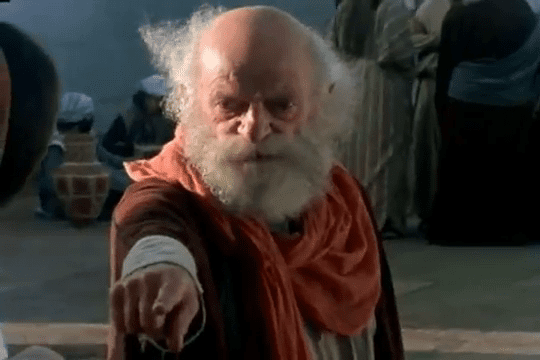
Third, this is the only filmed version of this story I can think of that includes Anna — and even this film omits the bulk of Anna’s back story from Luke 2:36:

Why have no other films included Anna? I can think of a few reasons:
First, some filmmakers might find two old people making proclamations of this sort somewhat redundant — which would be ironic, given that Luke’s gospel itself eliminates redundancies that are found in the other gospels (e.g., Luke has only one feeding of the multitude rather than the two in Mark and Matthew).
Second, Luke’s gospel doesn’t give Anna any specific dialogue, so writers have less to work with there than they do with Simeon. Even the Genesis Project doesn’t bother to dramatize how Anna “spoke about the child to all who were looking forward to the redemption of Jerusalem.” It just shows her walking up to Joseph and Mary, saying a few words that we don’t hear, and then going her own separate way.
Third, many films follow the tradition that Mary’s own mother was named Anna, so adding another Anna to the mix might have been too confusing for the viewer.
In any case, footage from the Genesis Project’s adaptation of Luke was incorporated into the Campus Crusade Jesus movie released in 1979, but they re-shot the entire Nativity sequence with a different set of actors, and they omitted Anna altogether and reduced this segment to a mere 50 seconds. You can watch the relevant clip here:
It is striking how this scene — in a movie that was widely hyped at the time as the most accurate Bible movie ever — not only omits some of Simeon’s harsher dialogue but even gives him a line or two that he never says in the Bible.
Here is the relevant passage, from Luke 2:28-35:
Simeon took him in his arms and praised God, saying: “Sovereign Lord, as you have promised, you may now dismiss your servant in peace. For my eyes have seen your salvation, which you have prepared in the sight of all nations: a light for revelation to the Gentiles, and the glory of your people Israel.”
The child’s father and mother marveled at what was said about him. Then Simeon blessed them and said to Mary, his mother: “This child is destined to cause the falling and rising of many in Israel, and to be a sign that will be spoken against, so that the thoughts of many hearts will be revealed. And a sword will pierce your own soul too.”
And here is what Simeon says in the Jesus film:
Lord, now lettest thou thy servant depart in peace, according to thy word. Mine eyes have seen thy salvation. This child is chosen by God. May you both be blessed.
As with the Magnificat, so here: the Jesus film omits any explicit reference to Israel or politics and instead keeps a vague reference to the idea that Mary is blessed. It also has Simeon say that Jesus is “chosen” — which isn’t quite what the biblical Simeon says — but it keeps this vague, too, and avoids saying what he was chosen for.
The Jesus film also omits that poignant final line about a sword piercing Mary’s soul or heart, which has typically been interpreted as a prophetic foreshadowing of the sorrow that Mary felt at Christ’s crucifixion (though it is John’s gospel, not Luke’s, that places Mary at the crucifixion). This, too, feels like a missed opportunity.
For a much more dramatically rewarding interpretation of the Simeon story, we turn to Franco Zeffirelli’s Jesus of Nazareth, which first aired on NBC in 1977. In addition to casting the great British actor Ralph Richardson as Simeon, this miniseries extends the character’s presence within the story in two significant ways.
First, it links the meeting in the Temple to the circumcision of Jesus.
These two events actually happen over a month apart in Luke’s gospel, but by joining them, Zeffirelli solves the problem of how to introduce Simeon in a way that makes his arrival seem less random than it does in, say, the Genesis Project films. Instead of interrupting Joseph and Mary as they walk or sit nowhere in particular, Simeon now introduces himself while they are doing something of religious significance.
Zeffirelli also makes Simeon’s arrival less surprising to the viewer by introducing him before he meets Joseph and Mary. As Joseph and Mary make their way into the Temple, they stop so that Joseph can adjust his shawl, and the camera stops with them — thus allowing the viewer to notice the old man to the left of the frame:

The camera then cuts to another angle as Joseph and Mary enter the building, and as they walk past the camera, we see Simeon again, and his eyes shift from right to left, almost as though he can sense that someone important has just gone past him:

Then, when the infant Jesus is circumcised, Simeon is alerted by the baby’s cries…

…and so he gets up, walks over and pays homage to the child:

What’s more, the film defuses the strangeness of this seemingly random encounter by acknowledging that it would, in fact, have seemed a little strange: as Simeon pays homage to the child, the man who performed the circumcision shakes his head and gives Joseph a look that says, in effect, “Sorry about the strange old man here.”
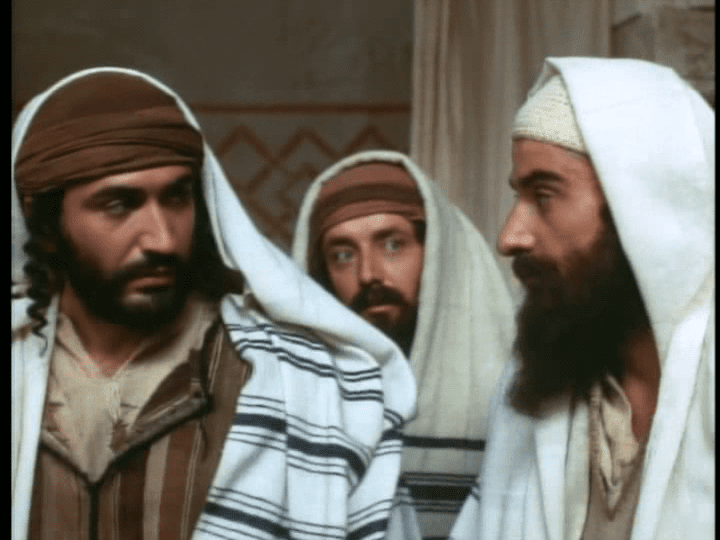
Simeon then introduces himself to Joseph before continuing to pay homage.
Joseph and Mary, of course, have already had encounters with angels and shepherds and strange dreams by this point, so they’re not too surprised that another man has recognized their child. But they are, perhaps, a little troubled by the sorrow in Simeon’s voice when he tells Mary that a sword will pierce her heart.


Here is Simeon’s dialogue in this scene:
(on entering the room) Where is he?
(while bowing before the child) Now I can die contented, Lord, according to thy word. (looks up at Joseph) I am Simeon, an old man who has waited long to see his salvation. (goes to pick the child up) And now my eyes have seen the child who will bring the salvation thou hast prepared before all people: a light of revelation to the Gentiles, and the glory of thy people Israel.
(after handing the child to Mary) And a sword shall pierce your heart.
The opening line — “Where is he?” — puts Simeon in the same camp as the shepherds and the wise men who are looking for the baby Jesus. The rest of his dialogue — except for one sentence of introduction taken from Luke’s narration — is a condensed version of what the biblical Simeon says, but it covers the basics: Simeon has seen the child he was waiting for, the child will bring salvation to Jews and Gentiles alike, and the means by which the child does this will be painful for those who love him.
Ordinarily, that would be it for Simeon. But Jesus of Nazareth brings him back several scenes later, after Herod’s men kill the children in Bethlehem. As the women weep in the streets, Simeon steps out of one building and quotes Matthew 2:17-28:
Thus is fulfilled that which was spoken by the prophet Jeremiah: “In Ramah, was there a voice heard: lamentation, weeping and great mourning, Rachel weeping for her children, and would not be comforted, because they were no more.”
And then Simeon, too, begins to weep. And so this scene harks back to the two elements that characterized his earlier scene: the prophetic sensibility, and the hint of sorrow in his voice when he told Mary that a sword would piece her heart.

That’s pretty much it for major Jesus films that have depicted Simeon (and Anna).
The Genesis Project films were based on Luke’s gospel, and thus didn’t have to worry about harmonizing their accounts of the Nativity, while Zeffirelli’s miniseries is one of the few harmonized films that delays the arrival of the Magi (and the subsequent murder of the children in Bethlehem) to a point well after the birth of Jesus, thus allowing Joseph and Mary to visit Jerusalem without fearing for their lives.
If I have forgotten any other significant films, please let me know!
Previous Post

February 2, 2015
The Ben-Hur remake has started principal photography
Next Post
February 3, 2015 Exodus: Gods and Kings: Blu-Ray bonus features revealed
Browse Our Archives
Select a Category Anglican Planet Articles BC Christian News BC Report Bible Movies Bible Review Blog Books & Culture Campus Times CBC Radio Christianity Today ChristianWeek Essays Faith Today Festival Cinemas Guide Film Journals Georgia Straight Interviews MB Herald National Catholic Register Salvationist Today's Christian Two Chairs Ubyssey Uncategorized Vancouver Courier Vancouver Sun
Select a Month August 2025 April 2025 January 2025 December 2024 November 2024 May 2024 February 2024 December 2023 May 2023 March 2023 November 2022 July 2022 June 2022 May 2022 April 2022 February 2022 January 2022 December 2021 November 2021 October 2021 September 2021 August 2021 July 2021 June 2021 April 2021 March 2021 February 2021 January 2021 December 2020 November 2020 October 2020 August 2020 July 2020 June 2020 May 2020 March 2020 February 2020 January 2020 December 2019 November 2019 September 2019 July 2019 May 2019 April 2019 March 2019 February 2019 January 2019 December 2018 November 2018 October 2018 September 2018 July 2018 June 2018 May 2018 April 2018 March 2018 February 2018 January 2018 December 2017 November 2017 October 2017 September 2017 August 2017 July 2017 June 2017 May 2017 April 2017 March 2017 February 2017 January 2017 December 2016 November 2016 October 2016 September 2016 August 2016 July 2016 June 2016 May 2016 April 2016 March 2016 February 2016 January 2016 December 2015 November 2015 October 2015 September 2015 August 2015 July 2015 June 2015 May 2015 April 2015 March 2015 February 2015 January 2015 December 2014 November 2014 October 2014 September 2014 August 2014 July 2014 June 2014 May 2014 April 2014 March 2014 February 2014 January 2014 December 2013 November 2013 October 2013 September 2013 August 2013 July 2013 June 2013 May 2013 April 2013 March 2013 February 2013 January 2013 December 2012 November 2012 October 2012 September 2012 August 2012 July 2012 June 2012 April 2012 January 2012 January 2011 December 2010 November 2010 October 2010 September 2010 August 2010 July 2010 June 2010 May 2010 April 2010 March 2010 February 2010 January 2010 December 2009 November 2009 October 2009 September 2009 August 2009 July 2009 June 2009 May 2009 April 2009 March 2009 February 2009 January 2009 December 2008 November 2008 October 2008 September 2008 August 2008 July 2008 June 2008 May 2008 April 2008 March 2008 February 2008 January 2008 December 2007 November 2007 October 2007 September 2007 August 2007 July 2007 June 2007 May 2007 April 2007 March 2007 February 2007 January 2007 December 2006 November 2006 October 2006 September 2006 August 2006 July 2006 June 2006 May 2006 April 2006 March 2006 February 2006 January 2006 December 2005 November 2005 October 2005 September 2005 August 2005 July 2005 June 2005 May 2005 April 2005 March 2005 January 2005 December 2004 November 2004 October 2004 September 2004 August 2004 July 2004 June 2004 May 2004 April 2004 March 2004 February 2004 January 2004 November 2003 October 2003 August 2003 July 2003 June 2003 May 2003 January 2003 December 2002 November 2002 August 2002 July 2002 June 2002 May 2002 March 2002 January 2002 December 2001 November 2001 September 2001 August 2001 July 2001 June 2001 April 2001 March 2001 February 2001 December 2000 November 2000 October 2000 September 2000 August 2000 July 2000 June 2000 May 2000 April 2000 March 2000 January 2000 October 1999 August 1999 May 1999 April 1999 February 1999 January 1999 December 1998 November 1998 October 1998 August 1998 July 1998 June 1998 April 1998 March 1998 January 1998 November 1997 September 1997 July 1997 June 1997 April 1997 March 1997 February 1997 January 1997 December 1996 October 1996 September 1996 June 1996 March 1996 February 1996 January 1996 April 1995 November 1994 September 1994 September 1991
Follow Us!
TAKE THE
Religious Wisdom Quiz
"Train up a child in the way he should go" is found in which book?
Select your answer to see how you score.
Job Proverbs Matthew Jonah
Related posts from FilmChat

Joseph of Egypt – the Chosen spin-off announces...
Exclusive: A clip from Angel Studios' The King...
Exclusive: Watch a clip from Angel Studios' Brave...

Exclusive: Watch a clip from Angel Studios' Homestead
TRENDING AT PATHEOS Religious Music & Entertainment

A Christian, a Narnia Fan, and a Filmmaker...
Watching The Narnia Trailer As A Fan And A Filmmaker Ever since...

Great Spiritual Horror Films of the 20th Century...
For the Christian, horror movies are often troubling—and many would say that...

"Les Diabolique" and Transgression
Alongside something like Arrival, Vertigo, or Charade, Les Diaboliques is a...

"The Plague Dogs" and Mortality
So, flashback to the late 70s, early 80s. Walt Disney Studios is...

With the recent and highly successful release of Christopher Nolan’s epic film,...

"L'avventura" and Human Weakness
Today's piece is going to be a little different for a few...
view all Religious Music & Entertainment blogs
Ad-Free & Subscriber Log-In Subscription Support
- About Us
- 2026 Calendar
- Videos
- Podcasts
- Library of World Religions
- Faith In Media Tracker
- Advertise With Us
- Write for Us
- Privacy Policy
- Terms of Service
- Do Not Sell My Data
- Contact Us
- Radiant Digital
- Manage Newsletter Subscriptions
- Unsubscribe From Notifications
- Sitemap
Copyright 2008-2026, Patheos, part of the Radiant Digital network of media brands. All rights reserved.
Subscription Support Ad-Free & Subscriber Log-In
Follow Patheos