
BuddhistCatholicContemplativeEvangelicalGeneral ChristianHinduJewishLatter-day SaintMuslimNew VisionsProgressive Christian
Beliefs
- Buddhist
- Catholic
- Contemplative
- Evangelical
- General Christian
- Hindu
- Jewish
- Latter-day Saint
- More Voices
- Muslim
- New Visions
- Pagan
- Progressive Christian
Topics
- Religion News
- Food and Religion
- Sports and Religion
- Religious Art
- Religious Music and Entertainment
- Religious Events
- History and Religion
- Style and Religion
- Politics and Religion
- Women in Religion
- Recreation Outdoors and Religion
- Business Finance and Religion
- Careers Workplace and Religion
- Education and Religion
- Family Parenting and Religion
- Health Fitness and Religion
- Home and Religion
- Relationships and Religion
- Technology and Religion
- Travel and Religion
Columnists
- Buddhist Columnists
- Business Finance and Religion Columnists
- Careers Workplace and Religion Columnists
- Catholic Columnists
- Contemplative Columnists
- Education and Religion Columnists
- Evangelists Columnists
- Family Parenting and Religion Columnists
- General Christian Columnists
- Health Fitness and Religion Columnists
- Hindu Columnists
- History and Religion Columnists
- Home and Religion Columnists
- Jewish Columnists
- More Voices Columnists
- Latter Day Columnists
- Muslim Columnists
- New Visions Columnists
- Nonreligious Columnists
- Pagan Columnists
- Politics and Religion Columnists
- Progressive Columnists
- Recreation Outdoors and Religion Columnists
- Relationships and Religion Columnists
- Religion News Columnists
- Religious Art Columnists
- Religious Events Columnists
- Religious Music and Entertainment Columnists
- Sports and Religion Columnists
- Style and Religion Columnists
- Technology and Religion Columnists
- Travel and Religion Columnists
- Women in Religion Columnists
Resource Library
- 2026 Calendar
- Library of World Religions
- The 100 Most Holy Places on Earth
- Patheos Answers
- Podcasts
- Videos
- Faith Leaders Database
- Anglican Episcopalian
- Bahai
- Baptist
- Buddhism
- Christianity
- Confucianism
- Eastern Orthodoxy
- Hinduism
- Holiness and Pentecostal
- ISKCON
- Islam
- Judaism
- Lutheran
- Methodist
- The Church of Jesus Christ of Latter-day Saints
- New Age
- Paganism
- Presbytarian and Reformed
- Protestantism
- Religion Behind the Scenes
- Roman Catholic
- Scientology
- Shia Islam
- Sikhism
- Sufism
- Sunni Islam
- Taoism
- Zen
- See all religions
Research Tools
 Ad-Free & Subscriber Log-In Subscription Support
Follow Patheos 

- Trending:
- Advent
- |
- Forgiveness
- |
- Thanksgiving
- |
- Election
- |
- Seasonal Holidays
- |
- Marriage

-
Articles
- Home
- Religious Music & Entertainment
- The Magnificat, and the politics thereof, in film
The Magnificat, and the politics thereof, in film
Last updated on: December 24, 2015 at 8:22 pm by Peter T. Chattaway
The Magnificat, and the politics thereof, in film 2015-12-24T20:22:00-08:00 Peter T. Chattaway
Patheos Explore the world's faith through different perspectives on religion and spirituality! Patheos has the views of the prevalent religions and spiritualities of the world.
 Christ is born! Glorify him!
Fred Clark posted a really interesting item this morning, noting that “the true meaning of Christmas” can be found in a poem spoken by Mary not long after she learned that she was pregnant with the Son of God — and he notes that the poem in question has a significant political edge, in which the powerful are brought down from their thrones while the humble are lifted up, and the rich are sent away hungry while the poor are filled.
This got me curious as to how many films have actually reflected the edgier aspects of this poem, which is known as the Magnificat. And the answer is: not many. In fact, there are very few films that incorporate the Magnificat at all, and those that do usually cut out the more politically-charged stuff. Usually, but not always.
I’ll get to the films in a moment, but first, for comparison’s sake, here is the Magnificat itself. It is spoken by Mary when she meets her cousin Elizabeth, who is pregnant with John the Baptist. Elizabeth declares that Mary is blessed, and that the baby in her womb (i.e. Elizabeth’s) leapt for joy at the sound of Mary’s voice, and Mary responds with this song, which takes up ten verses in the first chapter of Luke’s gospel:
46 And Mary said:
“My soul glorifies the Lord
47 and my spirit rejoices in God my Savior,
48 for he has been mindful
of the humble state of his servant.
From now on all generations will call me blessed,
49 for the Mighty One has done great things for me—
holy is his name.
50 His mercy extends to those who fear him,
from generation to generation.
51 He has performed mighty deeds with his arm;
he has scattered those who are proud in their inmost thoughts.
52 He has brought down rulers from their thrones
but has lifted up the humble.
53 He has filled the hungry with good things
but has sent the rich away empty.
54 He has helped his servant Israel,
remembering to be merciful
55 to Abraham and his descendants forever,
just as he promised our ancestors.”
Now, to the films themselves.
This isn’t an exhaustive list by any stretch, but after a quick skim of all the major Bible movies in my collection, I could find only four films that had the Magnificat.
Why so few? I can think of at least three reasons: a number of films begin when Jesus is an adult, and skip over the birth narratives entirely; those that do include the Nativity sometimes omit Mary’s visit to Elizabeth; and some are based exclusively on the gospels of Matthew or John and thus cannot include a passage from Luke.
There is, however, one film that includes the entire text of Luke, word for word, and so of course it includes the entire Magnificat as well. That film is the Genesis Project’s adaptation of Luke, from the 1970s, and you can watch it here:
http://www.youtube.com/watch?v=JTb4UIbnOHE&t=11m40s
When the Genesis Project’s adaptation of Luke was condensed into the two-hour Jesus film (1979), the Nativity section was re-shot altogether. And in that version, the Magnificat was cut down to this:
My soul doth magnify the Lord, and my spirit hath rejoiced in God my saviour. From now on, all generations will call me blessed.
So the version of the Magnificat that appears in the Jesus film was basically reduced to verses 46, 47 and the second half of 48 — thus skipping over the line about God being mindful of Mary’s humble state. All the topsy-turvy stuff from the later verses about God exalting the humble and scattering the proud was left out altogether.
You can watch this version of the Magnificat here, starting at the 1:30 mark:
Around the time those films were being made, Franco Zeffirelli directed Jesus of Nazareth (1977), a six-hour miniseries that devotes over an hour to the Nativity, including Mary’s visit to Elizabeth. And in that film, this is what Mary says:
My soul doth magnify the Lord, and my spirit hath rejoiced in God my saviour, for he has looked kindly upon the most humble of his handmaidens, and he has told me that all generations shall call me blessed. He who is mighty has done unto me a mighty thing.
This version keeps verses 46 to 49 — including the reference to Mary’s humble state — but it leaves out all the verses that follow. The Magnificat in this film is all about Mary, but it doesn’t say anything about the broader implications of the Incarnation.
You can watch this version of the Magnificat here, starting at the 18:05 mark:
The only film I can find that keeps the more political bits of the Magnificat — not counting the Genesis Project, which was obliged to keep those bits by virtue of being a complete word-for-word adaptation of the text — is, perhaps surprisingly, The Nativity Story (2006), which was criticized when it first came out for being too mild for a Bible film released only two years after The Passion of the Christ.
Significantly, this film omits the Magnificat from the scene in which Mary first meets Elizabeth, but it makes up for this by giving the Magnificat the last word, by placing it at the end of the movie and allowing it to sum up what the story was about. This is what Mary says in a voiceover as she and Joseph make their way to Egypt:
The Almighty has done great things, and holy is his name. He has shown strength with his arm. He has scattered the proud. He has filled the hungry with good things, and the rich, he has sent away empty. He has brought down rulers from their thrones, and has exalted those who were humble.
This version is based on verses 49 and 51-53. It skips over the verses about Mary — in verse 49, it even leaves out the bit where Mary says that God has done great things “for me” — and it also skips over verse 50, which talks about people “fearing” God, as well as verses 54 and 55, which talk about God’s relationship with Israel.
But it does go straight to the verses about God scattering the proud, sending the rich away empty, and bringing rulers down from their thrones.
Note, incidentally, how the voiceover flips verses 52 and 53, so that the last line in the film focuses on the downfall of the rulers rather than the rich being sent away empty. This ties in to the film’s recurring focus on Herod the Great and the many signs of tyranny under his reign, culminating in the massacre of the children in Bethlehem.
Putting the Magnificat at the end of the film also allows the filmmakers to develop a character arc for Mary. She has doubts at first — doubts about her betrothal to Joseph, doubts about her destiny as the mother of the Messiah — but those doubts are resolved by the end of the film. In addition to summing up the movie’s themes, the Magnificat reflects the confidence that Mary has found in her calling.
You can watch this version of the Magnificat here, starting at the 1:32:30 mark:
http://www.youtube.com/watch?v=UzaLk7WOK2k&t=1h32m25s
One film that could have included the Magnificat but doesn’t is Mary, Mother of Jesus (1999). In that film, Mary meets Elizabeth and the baby leaps in Elizabeth’s womb, but Elizabeth’s declaration of praise for Mary and her child is deferred to another scene, and neither of those scenes contains the Magnificat. Instead, Mary simply responds to Elizabeth’s praise by saying, “We mustn’t be afraid. We must trust in the Lord.”
So, there are four films (that I know of) that include the Magnificat in any way, shape or form. Only one of them includes the entire passage, but that’s because the film in question is a word-for-word adaptation of Luke. Of the two dramatic films — i.e., films which are not limited by the need to stick to the text — only one, Jesus of Nazareth, incorporates the Magnificat into the diegesis. But it is the other dramatic film, The Nativity Story, that includes the socio-political thrust of the passage.
If you can think of any other films that depict Mary reciting the Magnificat, please let me know in the comments. Cheers, and merry Christmas!
P.S.: Honourable mention goes to Jean-Luc Godard’s Je vous salue, Marie (1985), which sets the Nativity in modern Switzerland. I haven’t watched the film all the way through in years, but I do recall this nod to the Magnificat from near the end:
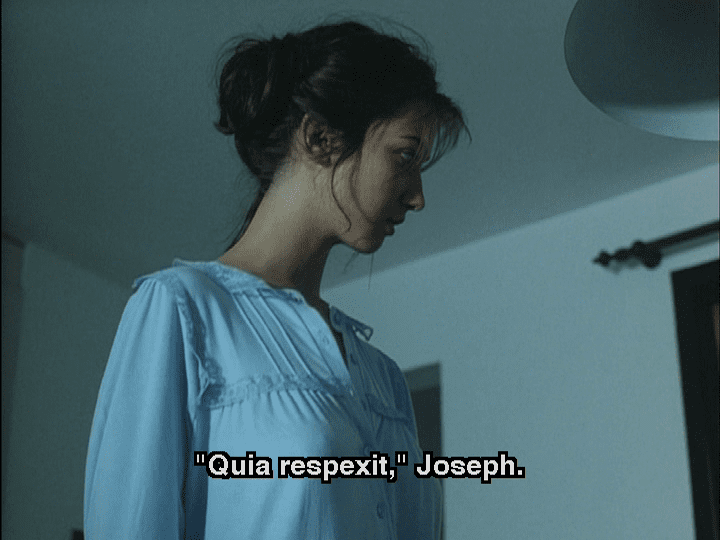
The film was very controversial at the time because it dwelled at some length on the nudity of Mary while she is pregnant with Jesus, and in this particular scene, Jesus is a young boy who looks under Mary’s nightgown and asks her to name the various parts of her body. Joseph objects that Jesus is too old to see Mary naked now, and Mary replies by saying, “Quia respexit, Joseph,” which comes from the Latin translation of “For he has regarded the humble state of his handmaiden.”
So in his typically provocative way, Godard takes this passage about God exalting the humble and applies it to the humble status of the flesh. Make of it what you will.
Next Post

December 26, 2014 Exodus: Gods and Kings banned in some Muslim countries
Browse Our Archives
Select a Category Anglican Planet Articles BC Christian News BC Report Bible Movies Bible Review Blog Books & Culture Campus Times CBC Radio Christianity Today ChristianWeek Essays Faith Today Festival Cinemas Guide Film Journals Georgia Straight Interviews MB Herald National Catholic Register Salvationist Today's Christian Two Chairs Ubyssey Uncategorized Vancouver Courier Vancouver Sun
Select a Month August 2025 April 2025 January 2025 December 2024 November 2024 May 2024 February 2024 December 2023 May 2023 March 2023 November 2022 July 2022 June 2022 May 2022 April 2022 February 2022 January 2022 December 2021 November 2021 October 2021 September 2021 August 2021 July 2021 June 2021 April 2021 March 2021 February 2021 January 2021 December 2020 November 2020 October 2020 August 2020 July 2020 June 2020 May 2020 March 2020 February 2020 January 2020 December 2019 November 2019 September 2019 July 2019 May 2019 April 2019 March 2019 February 2019 January 2019 December 2018 November 2018 October 2018 September 2018 July 2018 June 2018 May 2018 April 2018 March 2018 February 2018 January 2018 December 2017 November 2017 October 2017 September 2017 August 2017 July 2017 June 2017 May 2017 April 2017 March 2017 February 2017 January 2017 December 2016 November 2016 October 2016 September 2016 August 2016 July 2016 June 2016 May 2016 April 2016 March 2016 February 2016 January 2016 December 2015 November 2015 October 2015 September 2015 August 2015 July 2015 June 2015 May 2015 April 2015 March 2015 February 2015 January 2015 December 2014 November 2014 October 2014 September 2014 August 2014 July 2014 June 2014 May 2014 April 2014 March 2014 February 2014 January 2014 December 2013 November 2013 October 2013 September 2013 August 2013 July 2013 June 2013 May 2013 April 2013 March 2013 February 2013 January 2013 December 2012 November 2012 October 2012 September 2012 August 2012 July 2012 June 2012 April 2012 January 2012 January 2011 December 2010 November 2010 October 2010 September 2010 August 2010 July 2010 June 2010 May 2010 April 2010 March 2010 February 2010 January 2010 December 2009 November 2009 October 2009 September 2009 August 2009 July 2009 June 2009 May 2009 April 2009 March 2009 February 2009 January 2009 December 2008 November 2008 October 2008 September 2008 August 2008 July 2008 June 2008 May 2008 April 2008 March 2008 February 2008 January 2008 December 2007 November 2007 October 2007 September 2007 August 2007 July 2007 June 2007 May 2007 April 2007 March 2007 February 2007 January 2007 December 2006 November 2006 October 2006 September 2006 August 2006 July 2006 June 2006 May 2006 April 2006 March 2006 February 2006 January 2006 December 2005 November 2005 October 2005 September 2005 August 2005 July 2005 June 2005 May 2005 April 2005 March 2005 January 2005 December 2004 November 2004 October 2004 September 2004 August 2004 July 2004 June 2004 May 2004 April 2004 March 2004 February 2004 January 2004 November 2003 October 2003 August 2003 July 2003 June 2003 May 2003 January 2003 December 2002 November 2002 August 2002 July 2002 June 2002 May 2002 March 2002 January 2002 December 2001 November 2001 September 2001 August 2001 July 2001 June 2001 April 2001 March 2001 February 2001 December 2000 November 2000 October 2000 September 2000 August 2000 July 2000 June 2000 May 2000 April 2000 March 2000 January 2000 October 1999 August 1999 May 1999 April 1999 February 1999 January 1999 December 1998 November 1998 October 1998 August 1998 July 1998 June 1998 April 1998 March 1998 January 1998 November 1997 September 1997 July 1997 June 1997 April 1997 March 1997 February 1997 January 1997 December 1996 October 1996 September 1996 June 1996 March 1996 February 1996 January 1996 April 1995 November 1994 September 1994 September 1991
Follow Us!
TAKE THE
Religious Wisdom Quiz
True or False: Cornelius was a Roman centurion who was the first Gentile convert.
Select your answer to see how you score.
TRUE FALSE
Related posts from FilmChat

Joseph of Egypt – the Chosen spin-off announces...
Exclusive: A clip from Angel Studios' The King...

Exclusive: Watch a clip from Angel Studios' Brave...

Exclusive: Watch a clip from Angel Studios' Homestead
TRENDING AT PATHEOS Religious Music & Entertainment

A Christian, a Narnia Fan, and a Filmmaker...
Watching The Narnia Trailer As A Fan And A Filmmaker Ever since...

Great Spiritual Horror Films of the 20th Century...
For the Christian, horror movies are often troubling—and many would say that...

"Les Diabolique" and Transgression
Alongside something like Arrival, Vertigo, or Charade, Les Diaboliques is a...

"The Plague Dogs" and Mortality
So, flashback to the late 70s, early 80s. Walt Disney Studios is...

With the recent and highly successful release of Christopher Nolan’s epic film,...

"L'avventura" and Human Weakness
Today's piece is going to be a little different for a few...
view all Religious Music & Entertainment blogs
Ad-Free & Subscriber Log-In Subscription Support
- About Us
- 2026 Calendar
- Videos
- Podcasts
- Library of World Religions
- Faith In Media Tracker
- Advertise With Us
- Write for Us
- Privacy Policy
- Terms of Service
- Do Not Sell My Data
- Contact Us
- Radiant Digital
- Manage Newsletter Subscriptions
- Unsubscribe From Notifications
- Sitemap
Copyright 2008-2026, Patheos, part of the Radiant Digital network of media brands. All rights reserved.
Subscription Support Ad-Free & Subscriber Log-In
Follow Patheos