
BuddhistCatholicContemplativeEvangelicalGeneral ChristianHinduJewishLatter-day SaintMuslimNew VisionsProgressive Christian
Beliefs
- Buddhist
- Catholic
- Contemplative
- Evangelical
- General Christian
- Hindu
- Jewish
- Latter-day Saint
- More Voices
- Muslim
- New Visions
- Pagan
- Progressive Christian
Topics
- Religion News
- Food and Religion
- Sports and Religion
- Religious Art
- Religious Music and Entertainment
- Religious Events
- History and Religion
- Style and Religion
- Politics and Religion
- Women in Religion
- Recreation Outdoors and Religion
- Business Finance and Religion
- Careers Workplace and Religion
- Education and Religion
- Family Parenting and Religion
- Health Fitness and Religion
- Home and Religion
- Relationships and Religion
- Technology and Religion
- Travel and Religion
Columnists
- Buddhist Columnists
- Business Finance and Religion Columnists
- Careers Workplace and Religion Columnists
- Catholic Columnists
- Contemplative Columnists
- Education and Religion Columnists
- Evangelists Columnists
- Family Parenting and Religion Columnists
- General Christian Columnists
- Health Fitness and Religion Columnists
- Hindu Columnists
- History and Religion Columnists
- Home and Religion Columnists
- Jewish Columnists
- More Voices Columnists
- Latter Day Columnists
- Muslim Columnists
- New Visions Columnists
- Nonreligious Columnists
- Pagan Columnists
- Politics and Religion Columnists
- Progressive Columnists
- Recreation Outdoors and Religion Columnists
- Relationships and Religion Columnists
- Religion News Columnists
- Religious Art Columnists
- Religious Events Columnists
- Religious Music and Entertainment Columnists
- Sports and Religion Columnists
- Style and Religion Columnists
- Technology and Religion Columnists
- Travel and Religion Columnists
- Women in Religion Columnists
Resource Library
- 2026 Calendar
- Library of World Religions
- The 100 Most Holy Places on Earth
- Patheos Answers
- Podcasts
- Videos
- Faith Leaders Database
- Anglican Episcopalian
- Bahai
- Baptist
- Buddhism
- Christianity
- Confucianism
- Eastern Orthodoxy
- Hinduism
- Holiness and Pentecostal
- ISKCON
- Islam
- Judaism
- Lutheran
- Methodist
- The Church of Jesus Christ of Latter-day Saints
- New Age
- Paganism
- Presbytarian and Reformed
- Protestantism
- Religion Behind the Scenes
- Roman Catholic
- Scientology
- Shia Islam
- Sikhism
- Sufism
- Sunni Islam
- Taoism
- Zen
- See all religions
Research Tools
 Ad-Free & Subscriber Log-In Subscription Support
Ad-Free & Subscriber Log-In Subscription Support
Follow Patheos 

- Trending:
- Forgiveness
- |
- Marriage
- |
- Consciousness
- |
- Death Penalty
- |
- Election
- |
- Halloween

-
Articles
- Home
- Religious Music & Entertainment
- Moses at the Movies / When we trace more than a century of movies about the Exodus, what do we learn?
Moses at the Movies / When we trace more than a century of movies about the Exodus, what do we learn?
Last updated on: September 26, 2016 at 9:28 pm by Peter T. Chattaway
Moses at the Movies / When we trace more than a century of movies about the Exodus, what do we learn? 2016-09-26T21:28:00-07:00 Peter T. Chattaway
Patheos Explore the world's faith through different perspectives on religion and spirituality! Patheos has the views of the prevalent religions and spiritualities of the world.
 Ridley Scott isn’t the first filmmaker to tackle the story of Moses, and he certainly won’t be the last. There’s drama in the prophet’s confrontations with the rulers of Egypt, there’s spectacle in the miracles he performed to liberate his people, and there are lessons to be learned from the way he led the Israelites and forged them into a nation, not least by giving them the Law. And filmmakers have been turning to Moses’ story for inspiration since pretty much the dawn of cinema.
According to the Bible, Moses lived to be 120 years old, and people have been making movies about him for just about that long, now.
Some of the earliest movies about Moses were made in France: short films like Moses in the Bullrushes (1903), La Vie de Moïse (1905) and The Infancy of Moses (1911). In the United States, the American Vitagraph company produced a five-part series called The Life of Moses (1909–1910); each part focused on an episode from Moses’ life, such as the parting of the Red Sea or the giving of the Ten Commandments, and because the complete series ran to about 90 minutes, some have called it one of the earliest feature films.
The biggest silent Moses movie of them all, however, was The Ten Commandments (1923) — not the famous remake with Charlton Heston, but the original black-and-white film. Like several other films in that period (such as Sodom and Gomorrah and Noah’s Ark), The Ten Commandments combined a dramatization of the Bible with a modern story, and director Cecil B. DeMille lets us know the moral of that story right from the opening title cards, which chastise “our modern world” for calling the Ten Commandments “old fashioned.”
The first 50 minutes or so are taken from the Bible, and show the plague of the firstborn, the Hebrews marching across the desert (in 2-strip Technicolor, a new format at that time), the parting of the Red Sea, the giving of the Ten Commandments, and the divine wrath that falls upon the Hebrews when they worship the golden calf. The film then segues to the “present day” and a story about two brothers who were raised in a religious home, one of whom rebels against his mother’s faith and ends up suffering for it.
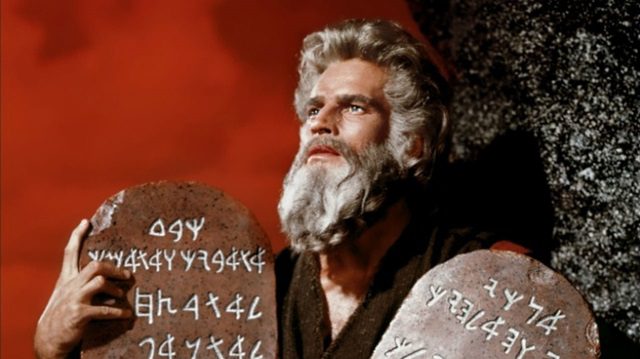
There were a few other Moses-themed movies after that, such as Moon of Israel (1924), an Austrian film that earned director Michael Curtiz a permanent job in Hollywood (where he went on to make such classics as Casablanca and White Christmas). But these were eclipsed by DeMille’s 1956 remake of his own The Ten Commandments.
The remake, which was such a huge hit at the time that some people estimate it would still be one of the top-grossing films of all time if we adjusted for inflation, differed from the silent film in that it took place entirely in the ancient world and did not tell a modern story.
But it also created an elaborate fictitious storyline around Moses’ experience as a prince of Egypt — a period in his life about which the Bible says almost nothing.
In that early part of the film, we see how Moses intuitively follows the commandments even though he has not received them yet; for example, he gives the slaves a weekly day of rest. Moses’ basic decency stands in stark contrast to the jealous, power-hungry manner of his rival prince Ramses, and the fact that Moses can follow the commandments even though he doesn’t have them yet (a la Rom. 2:14–15) underscores DeMille’s belief that the Ten Commandments are not just religious laws but fundamental moral principles.
The Bible-epic genre more or less died out on the big screen in the 1960s, but it lived on, in less expensive form, in television. One of the longest treatments of the Moses story to date is Gianfranco de Bosio’s Moses the Lawgiver (1974), a six-part miniseries produced by Vincenzo Labella and cowritten by Anthony Burgess, who would collaborate again a few years later on Franco Zeffirelli’s Jesus of Nazareth. Unlike DeMille, whose films reached their climax with the giving of the Law and the worship of the golden calf, de Bosio follows the Israelites all the way through the 40 years of wandering in the wilderness.
Other TV productions have tried to pay more attention to what happened after the crossing of the Red Sea, too. Moses (1995), a two-part miniseries starring Ben Kingsley, and The Ten Commandments (2006), a two-part miniseries starring Dougray Scott, both put the crossing of the Red Sea at the middle of the story, as a cliffhanger at the end of the first episode — but where the 1995 film goes as far as the Israelites’ journey to the edge of the Promised Land 40 years later, the 2006 film looks at how the Israelites grumbled against Moses and fought against the Amalekites on their journey from the Red Sea to Mount Sinai.
Parodies of the Moses story also followed the death of the Bible-movie genre. Wholly Moses! (1980) was a lame attempt to copy the formula set by Monty Python’s Life of Brian: it concerns a Hebrew named Herschel (Dudley Moore) who keeps popping up on the fringe of Moses’ story, just as Brian kept popping up on the outskirts of the gospels. In History of the World Part I (1981), Mel Brooks played a Moses who originally came down from Mount Sinai with 15 commandments, but then dropped and broke 1 of his 3 tablets.
The last major big-screen version of the Moses story was The Prince of Egypt (1998), which was also the first animated film produced by DreamWorks (though it was the second animated film they released, following a last-minute change to the release date of Antz). This was the first film to imagine that Moses and Ramses might have been friends at first, rather than enemies — a concept borrowed by Exodus: Gods and Kings — and it was also one of the first major films in recent memory to aggressively court the faith-based market.
While the producers of The Prince of Egypt sought input from Jewish and Muslim consultants too, it seems fair to say, in hindsight, that their outreach to Christian leaders prefigured the marketing of The Passion of the Christ just a little over five years later, to say nothing of the “faith-based” marketing that now accompanies films like Noah on a regular basis.
For the most part, Exodus: Gods and Kings has downplayed its more explicitly religious marketing hooks. When the film was first put into development five years ago, it was billed as an action movie like Braveheart or 300; and after Ridley Scott became involved a few years later, everyone focused on the fact that it was from “the director of Gladiator.” But the film fits into certain trends that can be traced across the Moses-movie genre.
Miracles
DeMille was quite happy to give a literal interpretation of the Bible’s miracles. The 1923 version of The Ten Commandments even depicts a woman being healed of leprosy in the modern story, in imitation of the healings that take place in the Bible. But by the time he made the 1956 version, he felt the need to address modern skepticism on that issue.
In one scene, after several plagues have already happened, Ramses rejects the Egyptian and Hebrew gods alike and declares that the plagues were caused by purely natural forces: even though he saw the Nile turn to blood himself, Ramses now declares that red mud poisoned the Nile and caused the frogs and insects to leave the water and spread disease. Moses replies by predicting a hailstorm which cannot be tied to those other disasters — and it arrives within seconds. Thus the film acknowledges modern skepticism, only to dismiss it.
Later films, however, have been more ambivalent. In Moses the Lawgiver, various people speculate that the miracles might not be so miraculous after all — and when the Hebrews are trudging through the desert towards Sinai, Moses himself admits to Miriam that he knew enough about the migratory patterns of quail to predict that the Hebrews would soon be able to eat some. “A miracle, I suppose, is something you get when you need it,” he says.
Exodus: Gods and Kings pushes modern discomfort with the miraculous even further, by omitting some of the miracles (such as the staff that turns to a snake) and assigning natural causes to all of the plagues except the final one. In this film, the Red Sea doesn’t part; instead, a faraway meteorite causes a tsunami that first drains the water, thereby allowing the Hebrews to cross to the other side, before bringing it back with a vengeance.
However, Exodus just may be the only major movie about Moses that follows the Bible in depicting an angel at the burning bush (Ex. 3:2; Acts 7:30–38). Granted, the film shows Moses getting knocked on the head first, and it leaves open the possibility that Moses is hallucinating. But the boy Moses sees is called Malak, which is Hebrew for “messenger” or “angel,” and through him Moses learns things he couldn’t have known any other way.
Ethnicity
Most American or European films about Moses have cast white actors in the lead roles, but they have also tried, somewhat fitfully, to acknowledge the ethnic diversity of ancient Egypt and the universality of the biblical story through their supporting casts.
The 1956 version of The Ten Commandments, which came out as the American civil rights movement was gathering steam, featured an Ethiopian princess flirting with Moses, possibly as a nod to the statement in Numbers 12:1 that one of Moses’ wives was a “Cushite.”
A later scene is more ambivalent; at the first Passover, Moses welcomes the African men who serve as his mother’s litter-bearers, saying there is room for “all who thirst for freedom” — but after entering the room, the men stand in the shadows, separate from the others, and when the Exodus gets under way, they continue to bear his mother’s litter. The Hebrew slaves no longer serve anyone, but apparently the African slaves still do.
The Prince of Egypt aimed for ethnic accuracy in its depiction of the Hebrews and Egyptians alike, giving them Middle Eastern features. (The voices were largely Anglo, but of course they were redubbed by other actors in other parts of the world anyway.) And the 2006 version of The Ten Commandments cast Indian actors as Moses’ adoptive mother and her son, while casting Egyptian actor Omar Sharif as Moses’ father-in-law Jethro.
Exodus: Gods and Kings has been criticized widely for its “whitewashed” cast, which features actors of northern European descent as Moses, Ramses and a few other characters. But the film also features Iranian, Iraqi, Palestinian and half-Indian actors as members of the Egyptian nobility, including Ramses’ wife and Moses’ adoptive mother.
Violence
One of the questions everyone has to face when dealing with the Moses story is the violence: first the violence done to the Egyptians, including the firstborn and everyone who drowns in the Red Sea, and then — if the movies follow the story this far — the violence committed by the Hebrews against each other, sometimes at God’s command.
DeMille largely skirted around these questions by portraying the victims unsympathetically or shifting responsibility for the violence. In the 1923 version of The Ten Commandments, Pharaoh’s son is a brat whose death no one in the audience is supposed to mourn, while in the 1956 version, Moses warns Ramses that the next plague will be whatever Ramses decrees — so when Ramses decides to kill all of the Hebrew firstborn, God kills the Egyptian firstborn first. Later, when the Hebrews worship the golden calf, God punishes them with lightning and earthquakes, and not by sending the Levites to kill them at random.
Moses the Lawgiver keeps the more biblical, more violent version of the punishment (Ex. 32:25-29). It also shows Moses ordering that a man who was found gathering sticks on the Sabbath be stoned to death (Num. 15:32-36). The camera focuses not just on the man who dies in this painful way, but on the children who witness the stoning, and flinch.
Similarly, the 2006 version of The Ten Commandments shows Moses ordering the stoning of a couple who committed adultery and killed the woman’s husband. (In an ironic twist, the adulterous man is the same man that Moses saved when he killed the Egyptian taskmaster.) Also, when the Hebrews are punished for worshiping the golden calf, it looks like all-out civil war — and when it’s over, Moses says to kill the prisoners, because “it’s God’s will.”
Exodus: Gods and Kings is similarly haunted by violence. Moses himself argues with God that the plagues are too extreme (“Is that it? Are you done?”). In the end, the film takes its cue from DeMille and suggests that killing the other side’s children was Ramses’ idea before it was God’s. But then, when Ramses’ firstborn son dies, he shows the body to Moses and asks, “What kind of fanatics worship such a God?” — and it’s not hard to imagine director Scott, who self-identifies as atheist or agnostic, asking that same question.
The Law
Most movies acknowledge, to one degree or another, that it wasn’t enough for Moses to set his people free from slavery; he had to give them a Law that would guide them as they forged a new nation, free of taskmasters telling them what to do.
The Prince of Egypt, which devotes only one or two shots to Moses bringing the tablets of the Law down from Sinai, may be the briefest expression of this. Other films go further. Both of DeMille’s films juxtaposed the giving of the Ten Commandments with the Hebrews’ worship of the golden calf, to underscore both the need for the Law and the perils of breaking it.
But where DeMille made a point of showing that it was possible for Moses to be a good man before he became a Hebrew prophet, Moses the Lawgiver and the 2006 version of The Ten Commandments devote entire scenes to Hebrews behaving badly before and after they leave Egypt, to show that they needed the Law and perhaps even its harsh enforcement.
Exodus: Gods and Kings is mostly concerned with the Hebrews securing their freedom, so it doesn’t devote much time to the giving of the Law. But it does have a key scene near the end in which Moses asks what will become of the Israelites once they get to the Promised Land. And it ends with Moses carving out the Ten Commandments, as God tells him, “A leader can falter, but stone will endure. These laws will guide them in your stead.”
And so Scott’s film, for all of its deviations from the biblical story, fits into a number of trends that can be traced across cinematic interpretations of the Exodus. Time will tell whether it influences later films, the way that other films seem to have influenced it.
Peter T. Chattaway lives in Surrey, BC and blogs about film at Patheos. His earlier essays on Bible films for CT Movies include “Top Ten Jesus Movies,” “Mary Goes to the Movies” and “The Genesis of ‘Noah’.”
— An earlier version of this essay was first posted at ChristianityToday.com.
Next Post

December 10, 2014 Moses movies -- the article's up! (plus three new videos)
Browse Our Archives
Select a Category Anglican Planet Articles BC Christian News BC Report Bible Movies Bible Review Blog Books & Culture Campus Times CBC Radio Christianity Today ChristianWeek Essays Faith Today Festival Cinemas Guide Film Journals Georgia Straight Interviews MB Herald National Catholic Register Salvationist Today's Christian Two Chairs Ubyssey Uncategorized Vancouver Courier Vancouver Sun
Select a Month August 2025 April 2025 January 2025 December 2024 November 2024 May 2024 February 2024 December 2023 May 2023 March 2023 November 2022 July 2022 June 2022 May 2022 April 2022 February 2022 January 2022 December 2021 November 2021 October 2021 September 2021 August 2021 July 2021 June 2021 April 2021 March 2021 February 2021 January 2021 December 2020 November 2020 October 2020 August 2020 July 2020 June 2020 May 2020 March 2020 February 2020 January 2020 December 2019 November 2019 September 2019 July 2019 May 2019 April 2019 March 2019 February 2019 January 2019 December 2018 November 2018 October 2018 September 2018 July 2018 June 2018 May 2018 April 2018 March 2018 February 2018 January 2018 December 2017 November 2017 October 2017 September 2017 August 2017 July 2017 June 2017 May 2017 April 2017 March 2017 February 2017 January 2017 December 2016 November 2016 October 2016 September 2016 August 2016 July 2016 June 2016 May 2016 April 2016 March 2016 February 2016 January 2016 December 2015 November 2015 October 2015 September 2015 August 2015 July 2015 June 2015 May 2015 April 2015 March 2015 February 2015 January 2015 December 2014 November 2014 October 2014 September 2014 August 2014 July 2014 June 2014 May 2014 April 2014 March 2014 February 2014 January 2014 December 2013 November 2013 October 2013 September 2013 August 2013 July 2013 June 2013 May 2013 April 2013 March 2013 February 2013 January 2013 December 2012 November 2012 October 2012 September 2012 August 2012 July 2012 June 2012 April 2012 January 2012 January 2011 December 2010 November 2010 October 2010 September 2010 August 2010 July 2010 June 2010 May 2010 April 2010 March 2010 February 2010 January 2010 December 2009 November 2009 October 2009 September 2009 August 2009 July 2009 June 2009 May 2009 April 2009 March 2009 February 2009 January 2009 December 2008 November 2008 October 2008 September 2008 August 2008 July 2008 June 2008 May 2008 April 2008 March 2008 February 2008 January 2008 December 2007 November 2007 October 2007 September 2007 August 2007 July 2007 June 2007 May 2007 April 2007 March 2007 February 2007 January 2007 December 2006 November 2006 October 2006 September 2006 August 2006 July 2006 June 2006 May 2006 April 2006 March 2006 February 2006 January 2006 December 2005 November 2005 October 2005 September 2005 August 2005 July 2005 June 2005 May 2005 April 2005 March 2005 January 2005 December 2004 November 2004 October 2004 September 2004 August 2004 July 2004 June 2004 May 2004 April 2004 March 2004 February 2004 January 2004 November 2003 October 2003 August 2003 July 2003 June 2003 May 2003 January 2003 December 2002 November 2002 August 2002 July 2002 June 2002 May 2002 March 2002 January 2002 December 2001 November 2001 September 2001 August 2001 July 2001 June 2001 April 2001 March 2001 February 2001 December 2000 November 2000 October 2000 September 2000 August 2000 July 2000 June 2000 May 2000 April 2000 March 2000 January 2000 October 1999 August 1999 May 1999 April 1999 February 1999 January 1999 December 1998 November 1998 October 1998 August 1998 July 1998 June 1998 April 1998 March 1998 January 1998 November 1997 September 1997 July 1997 June 1997 April 1997 March 1997 February 1997 January 1997 December 1996 October 1996 September 1996 June 1996 March 1996 February 1996 January 1996 April 1995 November 1994 September 1994 September 1991
Follow Us!
TAKE THE
Religious Wisdom Quiz
What empire destroyed Jerusalem in 70 AD?
Select your answer to see how you score.
Babylonian Persian Greek Roman
Related posts from FilmChat

Exclusive: A clip from Angel Studios' The King...

Watch: The Chosen's creators on Season 4's big...

Which Bible movies are getting the most views...

Talking about The Prince of Egypt: The Musical
TRENDING AT PATHEOS Religious Music & Entertainment

"Les Diabolique" and Transgression
Alongside something like Arrival, Vertigo, or Charade, Les Diaboliques is a...

"The Plague Dogs" and Mortality
So, flashback to the late 70s, early 80s. Walt Disney Studios is...

With the recent and highly successful release of Christopher Nolan’s epic film,...

"L'avventura" and Human Weakness
Today's piece is going to be a little different for a few...

I first want to apologize for not posting or writing anything. I'm...

I've engaged in the multi-year project of reading through the Church Fathers,...
view all Religious Music & Entertainment blogs
Ad-Free & Subscriber Log-In Subscription Support
- About Us
- 2026 Calendar
- Videos
- Podcasts
- Library of World Religions
- Faith In Media Tracker
- Advertise With Us
- Write for Us
- Privacy Policy
- Terms of Service
- Do Not Sell My Data
- Contact Us
- Radiant Digital
- Manage Newsletter Subscriptions
- Unsubscribe From Notifications
- Sitemap
Copyright 2008-2026, Patheos. All rights reserved.
Subscription Support Ad-Free & Subscriber Log-In
Follow Patheos