
BuddhistCatholicContemplativeEvangelicalGeneral ChristianHinduJewishLatter-day SaintMuslimNew VisionsProgressive Christian
Beliefs
- Buddhist
- Catholic
- Contemplative
- Evangelical
- General Christian
- Hindu
- Jewish
- Latter-day Saint
- More Voices
- Muslim
- New Visions
- Pagan
- Progressive Christian
Topics
- Religion News
- Food and Religion
- Sports and Religion
- Religious Art
- Religious Music and Entertainment
- Religious Events
- History and Religion
- Style and Religion
- Politics and Religion
- Women in Religion
- Recreation Outdoors and Religion
- Business Finance and Religion
- Careers Workplace and Religion
- Education and Religion
- Family Parenting and Religion
- Health Fitness and Religion
- Home and Religion
- Relationships and Religion
- Technology and Religion
- Travel and Religion
Columnists
- Buddhist Columnists
- Business Finance and Religion Columnists
- Careers Workplace and Religion Columnists
- Catholic Columnists
- Contemplative Columnists
- Education and Religion Columnists
- Evangelists Columnists
- Family Parenting and Religion Columnists
- General Christian Columnists
- Health Fitness and Religion Columnists
- Hindu Columnists
- History and Religion Columnists
- Home and Religion Columnists
- Jewish Columnists
- More Voices Columnists
- Latter Day Columnists
- Muslim Columnists
- New Visions Columnists
- Nonreligious Columnists
- Pagan Columnists
- Politics and Religion Columnists
- Progressive Columnists
- Recreation Outdoors and Religion Columnists
- Relationships and Religion Columnists
- Religion News Columnists
- Religious Art Columnists
- Religious Events Columnists
- Religious Music and Entertainment Columnists
- Sports and Religion Columnists
- Style and Religion Columnists
- Technology and Religion Columnists
- Travel and Religion Columnists
- Women in Religion Columnists
Resource Library
- 2026 Calendar
- Library of World Religions
- The 100 Most Holy Places on Earth
- Patheos Answers
- Podcasts
- Videos
- Faith Leaders Database
- Anglican Episcopalian
- Bahai
- Baptist
- Buddhism
- Christianity
- Confucianism
- Eastern Orthodoxy
- Hinduism
- Holiness and Pentecostal
- ISKCON
- Islam
- Judaism
- Lutheran
- Methodist
- The Church of Jesus Christ of Latter-day Saints
- New Age
- Paganism
- Presbytarian and Reformed
- Protestantism
- Religion Behind the Scenes
- Roman Catholic
- Scientology
- Shia Islam
- Sikhism
- Sufism
- Sunni Islam
- Taoism
- Zen
- See all religions
Research Tools
 Ad-Free & Subscriber Log-In Subscription Support
Ad-Free & Subscriber Log-In Subscription Support
Follow Patheos 

- Trending:
- Forgiveness
- |
- Marriage
- |
- Consciousness
- |
- Death Penalty
- |
- Election
- |
- Halloween

-
Articles
- Home
- Religious Music & Entertainment
- Patti Smith talks to various Oscar bloggers about her Noah song ‘Mercy Is’ and why it no longer mentions horses
Patti Smith talks to various Oscar bloggers about her Noah song ‘Mercy Is’ and why it no longer mentions horses
Last updated on: January 14, 2015 at 2:05 pm by Peter T. Chattaway
Patti Smith talks to various Oscar bloggers about her Noah song ‘Mercy Is’ and why it no longer mentions horses 2015-01-14T14:05:33-08:00 Peter T. Chattaway
Patheos Explore the world's faith through different perspectives on religion and spirituality! Patheos has the views of the prevalent religions and spiritualities of the world.
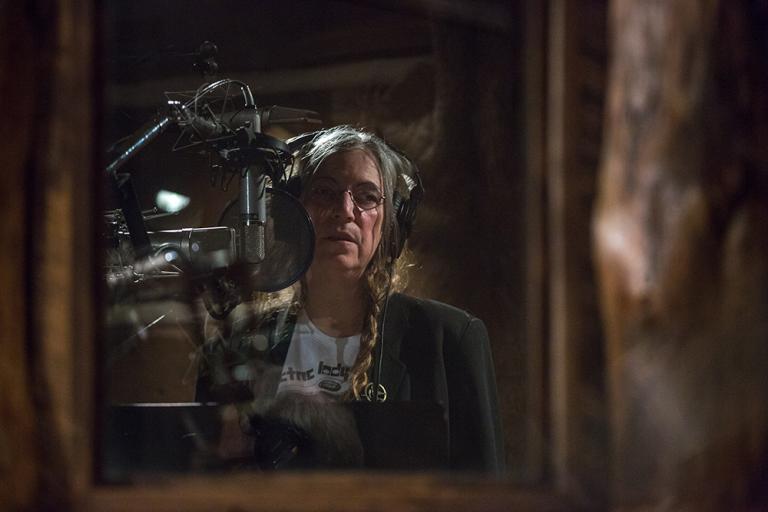 Noah may have come out seven months ago, but the people who worked on it are still talking about it — and in one case, they are doing so with a definite eye towards the upcoming Oscar season.
Patti Smith, who co-wrote a lullaby sung by Russell Crowe and Emma Watson in the movie, gave a few interviews this week to discuss the theme song ‘Mercy Is’, which plays over the film’s end credits. It was the first song she had ever written for a movie — so it is also the first song of hers to be eligible for an Academy Award.
Scott Feinberg at The Hollywood Reporter asked Smith to describe how she became involved with Noah in the first place:
So, in the case of Noah, how did you first hear about it? And then was it sort of, “Hey, we’d love it if you would write a song? Or, “We’d like a song specifically tied to a specific scene?”
Well, it was truthfully Darren. I had to do some work at the Venice Film Festival some years ago and I bumped into Darren. He was the chairman, I think, of the jury. I had a couple of days off and he said, “Well, why don’t you stay a couple of days and we’ll watch films together?” And we did. We watched Steve McQueen’s film Hunger — no, Shame, we watched Shame — and several other movies. And we were walking around the streets of Venice and I said, “Well, what are you working on? What’s your next dream? What’s your next project?” And he told me that he’s always wanted to do the story of Noah. Well, I loved the story of Noah. I had a very strong bible education as a kid, I loved biblical themed films and I thought, “This is fantastic: an artist — instead of, you know, an epic-style filmmaker, an actual artist — doing a biblical film.” And Darren’s also an environmentalist so I really intuited that he would do something special. And then he mentioned that he was getting the songs together and he needed a lullaby. And I just impulsively said, “Please, let me write it.” Because I’ve written like, three or four lullabies in my life. It’s one of my specialties. And I said, you know, “Just give me a chance, and if you don’t like it, fine.” And he was so happy and so welcoming. I mean, I’m not usually so aggressive. You know, I’ll usually be much cooler than that. But I just knew it was my project.
The Venice Film Festival to which Smith refers took place in September 2011 — one month before Paramount officially announced it was going to make Noah.
And so, were you in communication as it was being written, or did you just turn over the final product?
No, no, no, he let me see the script. We talked. I mean, the song is pivotal, even if it’s — I mean, it’s a lullaby and it’s a delicate piece, but it’s pivotal in the film. It’s in two very strong emotional scenes in the film. Noah has to sing it to a little girl he believes to be dying. And then, this little girl, he raises her and she has babies, which you know, he feels commanded by God that he has to kill. And, well, she just chooses that their last thing that they would hear is the song he sang her when she was close to death, and now her infants are close to death. And so, then she sings it. And you know, they sing a portion of it because of time, but it’s such a beautiful, fragile, but important part of the film. And you know, to have that responsibility, you know, it’s tremendous and daunting. So, I knew what my responsibility was, and I understood it. I know the story of Noah. Even any of ways that he, you know, embellished it or whatever, the essence of the story is there. And I re-read the scriptures. I read his script over and over. Russell Crowe is one of my favorite actors. I well know what Russell Crowe is capable of. Russell Crowe is a man that always seems, no matter how — because he’s certainly a male — no matter what his attitude is, you feel like he could on a dime, weep, you know? And he was the perfect person to have to write something for. . . .
And just as a quick aside, I heard you tell a funny story about horses, right? There were originally lyrics about horses?
Oh, yeah. Well, I wrote it and there was a line — let me see how it goes: [sings] “Two white horses, two white doves, to carry you away into the land of memory,” [speaks] because I was seeing like, white horses and the white doves. And Darren said, “Patti, it’s beautiful — but they didn’t have horses then. There were no horses, you know, in Noah’s world.” And we just laughed about that. I just changed it to two white wings, two white doves; it wasn’t difficult. It wasn’t a simple song to write. I had labored over it quite a bit because it was a particular lullaby. It wasn’t just to sing the little girl to sleep; it was a song that Methuselah, [sic] Noah’s father, had sang to him, so I had to take in account what Methuselah’s subject matter would be and how it would resonate to the little girl. The little girl’s father has just been killed. Noah, believing her to be dying, would be going back to God, the Father. And so, to comfort her, he sings her the little part of the song, “I think your father waits for thee.” And he is speaking of God — but he allows the little girl to interpret that her father is waiting for her. And so I had to really think about all these different little subtleties. And also, it tells a bit about the landscape of the new world and what’s in that landscape, you know? So Darren and I had a lot of talk, and Darren was great because I got to a point where I got slightly — I’m not easily intimidated, but I got a little intimidated of the responsibility and I was wondering, “I don’t have any real experience doing this. Do they need someone more experienced?” And Darren was like, “No, no, no.” He spent an extraordinary amount of time reassuring me and then, when we recorded it again, I had to do something I never did: record live with a string quartet — not only a string quartet, but one that has a tonal sound. So I had to sing against a melody, against not even a harmony, just something that tonally makes sense, but for a singer, trying to track a melody, it was challenging, but Darren was right there in the studio and the Kronos quartet was great. And I felt by the end of it that I had accomplished something.
Other Oscar bloggers who spoke to Smith this week include Jeffrey Wells, who posted an mp3 of their conversation and described it as “one of the more spiritually-directed discussions I’ve ever sunk into with a name-brand artist,” and Sasha Stone, who doesn’t actually provide all that many quotes from her interview with Smith.
Rolling Stone also spoke to Smith, but they’re saving the ‘Mercy Is’ part of the conversation for next week. This week, they posted the news that Smith is planning a world tour to mark the 40th anniversary of her debut album Horses next year — and wouldn’t it be nice if Smith had an Oscar to take with her on that tour?
I will add links to other interviews with Smith to this post as they surface.
Update: Hitfix just posted an interview with Smith, too, in which they talk about the sadness and hope of the song as well as Smith’s favorite Bible movies:
What Biblical epics are you fond of?
I love the [Pier Paolo] Pasolini’s ‘The Gospel According to St. Matthew.’ I’ve always loved Biblical stuff since I was a kid. Even though I broke from religion when I was a teenager, I had a strong Biblical education. What appealed to me was the idea of an artist, like Darren, approaching a Biblical subject. And Darren is an environmentalist. His vision was to use his political ideology and infuse it in the film. His vision appealed to me.
The song sounds like it follows the mechanics of Christian music. What is it we’re hearing specifically?
It was rooted more in prayer, more spiritual than religious. I know I’ve written ‘Jesus died for my sins, but not mine,’ in ‘Gloria,’ but that doesn’t mean I don’t have a reverence for certain aspects of scripture and an understanding of them. I’ve always loved hymnals. I used to sing in a choir when I was a kid so I have a relationship to arias and opera, the idea of a small, contained song that is written to encapsulate hope or an ideology. My task was to write a little song that was written post-Eden, perhaps by Methuselah, but it was supposed to be handed down generation to generation so that the child would have a hope, a memory of Eden, a memory of the Creator, waiting for them and letting them return to Eden from a very corrupt world. That was the message. I also had to make it viable for Russell Crowe’s character to sing and for his adopted daughter to sing, Emma Watson.
It’s not the sweetest lullaby. There’s a musical sadness in there.
It’s looking at the times. This is a song a man wrote, that a man would sing to his son. It was meant to comfort his child. But it also has the nostalgia of a world that was lost. It’s describing paradise, which was lost. ‘Hope’ is always synonymous with sadness. We have hope but we can’t be told absolutely certain that we’re going to attain what we hope for. I find all lullabies a bit sad. William Blake wrote lullabies. I wrote a lullaby with my husband for our son. The idea of the lullaby was that we would be there for him always. And then his father died not long after. When I hear it, the hope of that lullaby, the promise, there’s sadness rooted in it. If you think about it, many beautiful songs, even love songs, have a tinge of melancholy because, in the end, everything has an end. . . .
Songwriting for a film is a collaborative process, but I heard even Russell had input in the final version?
Yes, that’s true. For me, I was serving Darren serving Russell’s Noah. Russell, when he sang a portion of it — the song was much longer than needed, so I wrote three minutes and they only needed a certain amount of seconds — but it had to be bended to how he saw the character. He changed a couple words that bended the melody a bit. I was so happy. My first duty was to fit Darren’s vision, but my second most important duty was that it was good for Russell.
There’s a lot more in that interview, so be sure to read the whole thing.
October 15 update: Rolling Stone has now posted the second part of their interview with Smith. An excerpt:
What is your relationship with religion like these days?
I left organized religion at 12 or 13, because I was brought up a Jehovah’s Witness. I have a very strong biblical background. I studied the bible quite a bit when I was young and continue to study it, independent of any religion, but I still study it.
My sister is still Jehovah’s Witness. We talk all the time. I like to keep abreast of what she’s doing and what she believes in. I believe there is good in in all religions. But religion, politics and business, all of these things, have been so corrupted and so infused with power that I really don’t have interest in any of it – governments, religion, corporations. But I do have interest in the human condition. . . .
Is writing a lullaby easy?
It might seem like a modest little song, but it was a complicated task. I had to write a song that Methuselah, Anthony Hopkins’ character, sang to Noah’s father, and Noah’s father sang it to Noah; it was handed down. And then Noah had to sing it to this little girl who might be close to death. And I had to imagine Russell Crowe as Noah and Emma Watson’s character having to sing it to her babies, and then I had to sing it at the end. So I had a slew of responsibilities.
It sounds like a tall order.
Well, I asked for it. I went back and looked at the scriptures. I really studied Darren’s script. I’m a big follower of Russell Crowe, so I just watched a few of his movies again. I wanted to write something that he could feel in the singing of it. And it had make sense historically, some kind of biblical sense or some kind of sense of its time and its mission. The song is supposed to remember Eden and hope that the Father will come and deliver us back to Eden, the hope of a new world.
These are things I know about because of my own education: The promise of a new world is paramount in the teachings of Jehovah’s Witnesses. There was a lot that I could draw from.
If any more awards-season interviews with Smith pop up, I will add them to this post.
November 26 update: Variety has a new interview with Smith:
Tapping Smith to compose a lullaby proved a deft decision. In spite of her canonization as “the godmother of punk,” Smith’s music has long dealt in hymnal textures, from the rockabye rhythms and maternal themes of “Kimberly,” off her groundbreaking 1975 debut “Horses,” to the more straightforward lullaby “Seneca,” which Smith wrote for her son on 2012 album “Banga.”
“My mother had a lovely voice, a very June Christy, Chris Connor-style voice, and she always sang lullabies to us,” Smith remembers. “I just find them beautiful, whether it’s a William Blake lullaby, or a traditional American, Appalachian-style one. It also suits the natural sound of my voice. I don’t wake up in the morning singing ‘Gloria,’ you know. I never sing rock and roll songs unless I’m performing. When I’m singing to myself walking down the street or in the shower or something, I’m usually singing little arias and lullabies.
“But I find lullabies both comforting and also melancholy — there’s always something innately sad about them, and I don’t know why.”
Smith is effusive in her praise of Aronofsky’s guidance into the world of film music — “there’s no point writing a song for a film if it doesn’t serve the character who has to sing it” — and notes that she took equal inspiration from his screenplay and the Bible itself, particularly the Song of Solomon.
“Darren does all these interesting things in the film,” she observes, “merging these futuristic environments with biblical chronology. Same with the song; it couldn’t be too modern, and yet I didn’t want it to feel archaic. It had to sit within the film’s own history. So I read (the Song of Solomon) just to get a sense of the language and the rhythms. There’s such a sense of longing in those poems, and in the Psalms. Everyone is longing for a time when they were unfettered by the fall of the garden, or longing for the completion of love. That probably sounds so ambitious for such a little song, but you have to think about all these things. And it’s sort of like alchemical, how these ideas that sound so lofty have to be distilled into a very simple song.”
December 9 update: The Los Angeles Times also has an interview with Smith:
“I’m no stranger to the Scriptures,” says Smith in a separate phone call. “I’ve read the Bible quite a bit, there’s a lot of poetry in it — the Song of Solomon and the Psalms, a lot of poetry in Isaiah. So I tried to find language that wouldn’t be difficult to sing but wouldn’t feel out of place in this biblical setting.” . . .
Smith says: “So I tried to think, what would the song be about? It seemed to me that, early in human history, the song would go back to the promise of Eden and communication with God. This is obviously way before the New Testament, so what would they be comforted by? The idea of the Father returning, or them returning to the Father, and redeeming Eden. So the song resonates that.” . . .
“A lullaby is not just ‘Rock-a-Bye Baby,'” says Smith. “In singing a child a lullaby, you can give him or her wisdom. In the lullaby for Noah, the idea is that in life there is that hope that God and the promise of Paradise is with you always. Sometimes the simplest of songs can give us a great message, great hope. So a song that you sing to a child over and over, that message will eventually permeate their consciousness.”
December 11 update: ‘Mercy Is’ was nominated for a Golden Globe today.
December 17 update: Thompson on Hollywood has a new interview with Smith:
“We talked about the essential message of the Old Testament and what type of message would be handed down through the ages through a lullaby,” added Smith. “And I thought about Russell Crowe as Noah and the kind of man he is. What I was trying to get across in the song, though, is that man in biblical times had a direct memory of Eden and an oral history memory of God speaking to man of a paradise and a paradise lost. So this song is accessing the idea of this paradise, but not the idea that it’s lost but that it dwells within our memory and that the creator waits for us there and that we hope to return there. So this song is hopeful and that’s why it’s called ‘Mercy Is’ because Emma Watson’s character reminds Noah that he showed mercy to her babies and God showed that he was pleased.”
Smith continued, “It’s just like Abraham. Man is rewarded when he’s tested in the Bible. And forgiveness is one of the most beautiful things that we can give one another. It was a bold move for Darren to end that movie with a lullaby. Because it has such strong action, it very easily could’ve ended orchestrally — Beethovenesque, I suppose. But he chose to end it with this song. And I was very proud. I actually didn’t know he was going to do that. I thought my task was to write this song for Noah and then he asked me to sing it on the closing credits. I was very moved that he wanted to keep the integrity of the song — its strength and also its fragile nature — and not amp it up.”
January 2 update: The Wrap has a new interview with Smith:
Smith, an unstoppable 67, is in the mix this year with “Mercy Is,” a lullaby from Darren Aronofsky’s “Noah” that somehow manages to sound ancient but not dated.
“You have a sense of the future, of the present and of the deep past in this film,” said Smith, “and I had to serve that as best I could.”
She was able to do it, she said, because the Biblical story of Noah speaks to her, and to humanity, across the centuries.
“God creates Earth as a paradise, and over and over man finds ways to corrupt paradise with murder, adultery and thievery,” said Smith, who was raised as a Jehovah’s Witness but left organized religion — but not the study of religion — in her teens.
“At the end of the story He gives Man a chance to start afresh, and this has happened all through history. We fight World War I and think, ‘We’re done with war, let’s rebuild our world.’ Then we have World War II, and Vietnam, and Iraq… We’re still doing the same things, making the same mistakes, and you can see those concepts in one of the oldest of all Biblical stories.”
January 6 update: The Hollywood Reporter has a short blurb on the song:
. . . for the end credits, “I thought Darren would want me to deliver it more like a heavy metal ballad,” says Smith. “But he wanted it to maintain its integrity as a lullaby. Even when I sang it with Kronos Quartet, I was still delivering it a little more aria-like, and he asked me if I could step back a bit with it.”
More links later if I find any.
January 14 update: Elle spoke to Smith on the Golden Globes red carpet.

Browse Our Archives
Select a Category Anglican Planet Articles BC Christian News BC Report Bible Movies Bible Review Blog Books & Culture Campus Times CBC Radio Christianity Today ChristianWeek Essays Faith Today Festival Cinemas Guide Film Journals Georgia Straight Interviews MB Herald National Catholic Register Salvationist Today's Christian Two Chairs Ubyssey Uncategorized Vancouver Courier Vancouver Sun
Select a Month August 2025 April 2025 January 2025 December 2024 November 2024 May 2024 February 2024 December 2023 May 2023 March 2023 November 2022 July 2022 June 2022 May 2022 April 2022 February 2022 January 2022 December 2021 November 2021 October 2021 September 2021 August 2021 July 2021 June 2021 April 2021 March 2021 February 2021 January 2021 December 2020 November 2020 October 2020 August 2020 July 2020 June 2020 May 2020 March 2020 February 2020 January 2020 December 2019 November 2019 September 2019 July 2019 May 2019 April 2019 March 2019 February 2019 January 2019 December 2018 November 2018 October 2018 September 2018 July 2018 June 2018 May 2018 April 2018 March 2018 February 2018 January 2018 December 2017 November 2017 October 2017 September 2017 August 2017 July 2017 June 2017 May 2017 April 2017 March 2017 February 2017 January 2017 December 2016 November 2016 October 2016 September 2016 August 2016 July 2016 June 2016 May 2016 April 2016 March 2016 February 2016 January 2016 December 2015 November 2015 October 2015 September 2015 August 2015 July 2015 June 2015 May 2015 April 2015 March 2015 February 2015 January 2015 December 2014 November 2014 October 2014 September 2014 August 2014 July 2014 June 2014 May 2014 April 2014 March 2014 February 2014 January 2014 December 2013 November 2013 October 2013 September 2013 August 2013 July 2013 June 2013 May 2013 April 2013 March 2013 February 2013 January 2013 December 2012 November 2012 October 2012 September 2012 August 2012 July 2012 June 2012 April 2012 January 2012 January 2011 December 2010 November 2010 October 2010 September 2010 August 2010 July 2010 June 2010 May 2010 April 2010 March 2010 February 2010 January 2010 December 2009 November 2009 October 2009 September 2009 August 2009 July 2009 June 2009 May 2009 April 2009 March 2009 February 2009 January 2009 December 2008 November 2008 October 2008 September 2008 August 2008 July 2008 June 2008 May 2008 April 2008 March 2008 February 2008 January 2008 December 2007 November 2007 October 2007 September 2007 August 2007 July 2007 June 2007 May 2007 April 2007 March 2007 February 2007 January 2007 December 2006 November 2006 October 2006 September 2006 August 2006 July 2006 June 2006 May 2006 April 2006 March 2006 February 2006 January 2006 December 2005 November 2005 October 2005 September 2005 August 2005 July 2005 June 2005 May 2005 April 2005 March 2005 January 2005 December 2004 November 2004 October 2004 September 2004 August 2004 July 2004 June 2004 May 2004 April 2004 March 2004 February 2004 January 2004 November 2003 October 2003 August 2003 July 2003 June 2003 May 2003 January 2003 December 2002 November 2002 August 2002 July 2002 June 2002 May 2002 March 2002 January 2002 December 2001 November 2001 September 2001 August 2001 July 2001 June 2001 April 2001 March 2001 February 2001 December 2000 November 2000 October 2000 September 2000 August 2000 July 2000 June 2000 May 2000 April 2000 March 2000 January 2000 October 1999 August 1999 May 1999 April 1999 February 1999 January 1999 December 1998 November 1998 October 1998 August 1998 July 1998 June 1998 April 1998 March 1998 January 1998 November 1997 September 1997 July 1997 June 1997 April 1997 March 1997 February 1997 January 1997 December 1996 October 1996 September 1996 June 1996 March 1996 February 1996 January 1996 April 1995 November 1994 September 1994 September 1991
Follow Us!
TAKE THE
Religious Wisdom Quiz
According to Paul, nothing in all creation can separate you from me—not death, not life, not angels or demons. What am I?
Select your answer to see how you score.
The love of God God's mercy Salvation God's grace
Related posts from FilmChat

Joseph of Egypt – the Chosen spin-off announces...

Exclusive: A clip from Angel Studios' The King...

Exclusive: Watch a clip from Angel Studios' Brave...

Exclusive: Watch a clip from Angel Studios' Homestead
TRENDING AT PATHEOS Religious Music & Entertainment

"Les Diabolique" and Transgression
Alongside something like Arrival, Vertigo, or Charade, Les Diaboliques is a...

"The Plague Dogs" and Mortality
So, flashback to the late 70s, early 80s. Walt Disney Studios is...

With the recent and highly successful release of Christopher Nolan’s epic film,...

"L'avventura" and Human Weakness
Today's piece is going to be a little different for a few...

I first want to apologize for not posting or writing anything. I'm...

I've engaged in the multi-year project of reading through the Church Fathers,...
view all Religious Music & Entertainment blogs
Ad-Free & Subscriber Log-In Subscription Support
- About Us
- 2026 Calendar
- Videos
- Podcasts
- Library of World Religions
- Faith In Media Tracker
- Advertise With Us
- Write for Us
- Privacy Policy
- Terms of Service
- Do Not Sell My Data
- Contact Us
- Radiant Digital
- Manage Newsletter Subscriptions
- Unsubscribe From Notifications
- Sitemap
Copyright 2008-2026, Patheos. All rights reserved.
Subscription Support Ad-Free & Subscriber Log-In
Follow Patheos