
BuddhistCatholicContemplativeEvangelicalGeneral ChristianHinduJewishLatter-day SaintMuslimNew VisionsProgressive Christian
Beliefs
- Buddhist
- Catholic
- Contemplative
- Evangelical
- General Christian
- Hindu
- Jewish
- Latter-day Saint
- More Voices
- Muslim
- New Visions
- Pagan
- Progressive Christian
Topics
- Religion News
- Food and Religion
- Sports and Religion
- Religious Art
- Religious Music and Entertainment
- Religious Events
- History and Religion
- Style and Religion
- Politics and Religion
- Women in Religion
- Recreation Outdoors and Religion
- Business Finance and Religion
- Careers Workplace and Religion
- Education and Religion
- Family Parenting and Religion
- Health Fitness and Religion
- Home and Religion
- Relationships and Religion
- Technology and Religion
- Travel and Religion
Columnists
- Buddhist Columnists
- Business Finance and Religion Columnists
- Careers Workplace and Religion Columnists
- Catholic Columnists
- Contemplative Columnists
- Education and Religion Columnists
- Evangelists Columnists
- Family Parenting and Religion Columnists
- General Christian Columnists
- Health Fitness and Religion Columnists
- Hindu Columnists
- History and Religion Columnists
- Home and Religion Columnists
- Jewish Columnists
- More Voices Columnists
- Latter Day Columnists
- Muslim Columnists
- New Visions Columnists
- Nonreligious Columnists
- Pagan Columnists
- Politics and Religion Columnists
- Progressive Columnists
- Recreation Outdoors and Religion Columnists
- Relationships and Religion Columnists
- Religion News Columnists
- Religious Art Columnists
- Religious Events Columnists
- Religious Music and Entertainment Columnists
- Sports and Religion Columnists
- Style and Religion Columnists
- Technology and Religion Columnists
- Travel and Religion Columnists
- Women in Religion Columnists
Resource Library
- 2026 Calendar
- Library of World Religions
- The 100 Most Holy Places on Earth
- Patheos Answers
- Podcasts
- Videos
- Faith Leaders Database
- Anglican Episcopalian
- Bahai
- Baptist
- Buddhism
- Christianity
- Confucianism
- Eastern Orthodoxy
- Hinduism
- Holiness and Pentecostal
- ISKCON
- Islam
- Judaism
- Lutheran
- Methodist
- The Church of Jesus Christ of Latter-day Saints
- New Age
- Paganism
- Presbytarian and Reformed
- Protestantism
- Religion Behind the Scenes
- Roman Catholic
- Scientology
- Shia Islam
- Sikhism
- Sufism
- Sunni Islam
- Taoism
- Zen
- See all religions
Research Tools
 Ad-Free & Subscriber Log-In Subscription Support
Ad-Free & Subscriber Log-In Subscription Support
Follow Patheos 

- Trending:
- Forgiveness
- |
- Marriage
- |
- Consciousness
- |
- Death Penalty
- |
- Election
- |
- Halloween

-
Articles
- Home
- Religious Music & Entertainment
- Review: Edge of Tomorrow (dir. Doug Liman, 2014)
Review: Edge of Tomorrow (dir. Doug Liman, 2014)
Last updated on: June 10, 2014 at 6:07 pm by Peter T. Chattaway
Review: Edge of Tomorrow (dir. Doug Liman, 2014) 2014-06-10T18:07:54-07:00 Peter T. Chattaway
Patheos Explore the world's faith through different perspectives on religion and spirituality! Patheos has the views of the prevalent religions and spiritualities of the world.
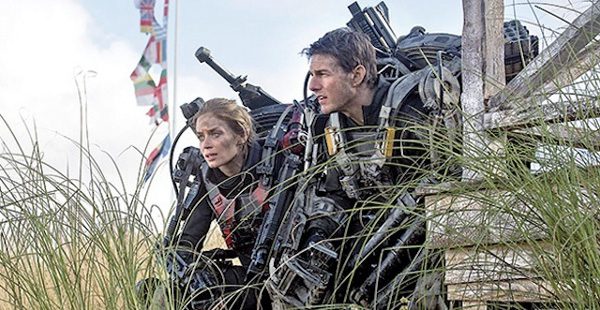 Edge of Tomorrow stars Tom Cruise as a soldier who gets caught in a time loop and finds himself living the same day over and over again. This gives much of the film a feeling of déjà vu, which is only fitting, since many elements in this film are reminiscent of other movies, from the battle scenes of Saving Private Ryan and Starship Troopers to the mechanical suits of Iron Man and Aliens and the endless time loops in Groundhog Day and Source Code. You might spend much of this new film thinking that you’ve seen it all before.
Indeed, Tom Cruise has been in the movie-star business for so long that his latest film feels at times like a callback to earlier Tom Cruise movies. Even the fact that it’s a bit of a pastiche seems like a replay of earlier pastiches, not least because Edge of Tomorrow is the second consecutive film of his — following last year’s Oblivion, which borrowed from many other films itself — in which the Earth is attacked by aliens and Cruise becomes the only man who can do anything about it.
Not only that, but both films also seem to be following in the footsteps of a particular director, however accidentally. Oblivion had a subplot that strongly resembled a subplot in the independent film Moon, which was directed by Duncan Jones, while Edge of Tomorrow has Tom Cruise relive the same day over and over again in an effort to prevent a terrible act of violence, which strongly resembles the plot of the sci-fi film Source Code, which was also directed by Duncan Jones.
In addition to Source Code, many people have cited Harold Ramis’s Groundhog Day as a precedent for the new film, and for obvious reasons — though the films are also rather different, for reasons I’ll get to in a moment. But the one movie that kept coming to my mind while watching Edge of Tomorrow was the Philip K. Dick adaptation Next, which starred Nicolas Cage as a man who can see a few minutes into the future, and who uses this knowledge to avoid being shot or captured, etc.
I thought of that film partly because Cruise plays a character named Cage in the new movie — William Cage, to be precise — but it mainly came to mind because Cruise spends part of the new movie dodging punches before they are thrown and knowing exactly where to step to avoid being seen, just like Nicolas Cage in Next.
And when I looked up my review of that film last night, I discovered I had compared it to yet another Tom Cruise movie, i.e. Minority Report, in which a “pre-cog” who can see the future guides Cruise through exactly those same kinds of steps.
So much for the movie references. Is Edge of Tomorrow actually any good? The answer, I’m happy to say, is yes.
Much of the credit has to go to Cruise himself. On one level, this is a familiar kind of role for him — the callow jerk who eventually mans up and gets the job done — but the fact that he plays both ends of this persona within nearly-identical scenes makes the changes to his character really stand out.
Also, in a summer full of “post-human” films that celebrate visual effects for their own sake, or that jerk us around by putting certain actors front-and-centre in the ad campaign and then killing them off in the first act (I’m looking at you, Godzilla), it’s handy to have someone like Cruise around to ground a film like this from start to finish in an accessible, believable performance.
Also, I have to say that I agree with Jeffrey Wells, who has argued that Cruise became a more interesting and even vulnerable actor in the mid- to late ’90s as his face began to grow crow’s feet, frown lines and other signs of impending middle age. (He turns 52 next month.) That may not be the deepest of reasons to appreciate a film, but film is a visual medium, and Cruise has certainly gotten more interesting to look at.
Credit must also go to Cruise’s co-star, Emily Blunt, who plays a war hero named Rita Vrataski who happens to be one of the few people around who knows what Cruise is going through. She’s tough, she’s determined, and in the end both Cage and Vrataski bring out the humanity in each other. By the second half of the film, I was utterly invested in these characters and their relationship, even though Cage is the only one who “remembers” all their experiences together.
Based on the Japanese novel All You Need Is Kill and written by Jez and John-Henry Butterworth (who worked on director Doug Liman’s previous film Fair Game) and Christopher McQuarrie (who wrote Valkyrie and Jack Reacher for Cruise), the script is clever enough, and amusing when it needs to be. Sometimes it takes us day-by-day through Cage’s experiences, and sometimes it leaps ahead, but we don’t realize this until Cage’s knowledge of his environment is revealed to us (and to Vrataski) in some way. That uncertainty — not knowing whether we are experiencing any given scene from Cage’s point of view or Vrataski’s — keeps us on our toes.
I also appreciate the fact that the film takes place in Europe (specifically, England and France). Far too many movie aliens have landed in the United States, and suspiciously close to national monuments at that. This film is a healthy exception to that rule.
There are a few plot holes.
Cage, at the beginning of the film, is an officer who has never had any actual combat training; his job is to go on TV and promote the war effort on national television. But when he runs afoul of a general who is overseeing a D-Day style invasion of alien-occupied France (Brendan Gleeson), he is arrested, tasered, stripped of his rank and assigned to one of the military units that is getting ready to storm the beaches. All the other soldiers are told that Cage is a deserter, but is it really possible that none of them would recognize him from his TV appearances? At the very least, the general who treated Cage this way was taking something of a risk.
Also, I couldn’t quite buy the idea that Cage would relive each day in precisely the same way. It has been a long time since I played video games with any regularity, but I can remember how maddeningly difficult it was, with the more predicable games, to hit the buttons or move the joystick at the exact moment when I needed to do those things, time after time. And if that was difficult to do for just a few minutes, imagine how difficult it would be to maintain that kind of concentration for several hours, just to get back to where you were before you died and had to start over again.
Also, the film pretty much ignores the “butterfly effect”, whereby even the most minor of changes to the timestream can have significant consequences further down the road.
And this raises a third potential problem: the lack of free will for all those people around Cage. Is it necessarily a given that everyone would make the exact same choices if they had to live the same day over and over again? If they genuinely had free will, then perhaps they would make slightly different choices — which, again, would have potentially significant consequences further down the road.
I do have one moral issue with the film, though it’s one I can set aside for the sake of enjoying the film. Specifically: Cage jumps back in time only when he is killed, and although he does die in combat many, many times, there are also times when Vrataski actively puts a gun to his head and pulls the trigger just to hit the “reset” button, as it were.
Vrataski has, in a sense, earned the right to do this. While she doesn’t have Cage’s time-looping powers any more, she used to have them, and she can remember losing them when she was merely injured and taken to a field hospital. Based on this, she surmises that if Cage doesn’t die at certain points in the story, he will lose the ability to go back in time and start over again, and then he won’t be able to figure out how to save the Earth any more.
Also, our introduction to Vrataski — the first time Cage actually meets her — shows that she isn’t afraid to die herself, if it will help Cage to hit that “reset” button.
Factors like these help to explain why Cage, at least, doesn’t hold it against Vrataski that she has killed him so many times. (Plus, of course, there is the fact that the Vrataski he encounters in any given time-loop has never actually killed him.) Still, if you regard human life as sacrosanct, or if you resist the idea that human life and death can be treated as means to an end, then this should give one pause, at least.
It is also worth noting one of the key differences between this film and Groundhog Day, which remains the time-loop movie par excellence.
In Ramis’s film, the whole point of the time loops was that they were open-ended, and that the Bill Murray character needed to learn to appreciate each moment for what it was. The fact that he eventually comes out of those loops is a bonus, a gift of grace you might say, but not something that he was consciously trying to earn through his own good works, so to speak. (Forgive me if that all sounds a tad theological.)
Edge of Tomorrow, on the other hand, is very much about trying to achieve a goal, and while there are a few scenes in which Cage simply tries to live in the moment — a detour to a London pub comes to mind — the fact remains that most of Cage’s experiences are all about figuring out the next little step on his long, long journey towards defeating the aliens. And it’s not clear that the movie will resonate much for audiences on any sort of spiritual level once that journey is over.
None of that detracts from the film, though. In the end, it’s a really solid bit of popcorn entertainment. And it ends on an absolutely perfect note. It’s been a while since a film left me wanting more, but this one did. I kind of want to see it again.
June 9 update: My wife reminded me last night that a bit near the end of this film echoes a scene from one other Tom Cruise film that I didn’t mention above:
Previous Post

June 4, 2014
Darren Aronofsky adapts another Flood story... sort of!
Next Post
June 8, 2014 Sympathy for the snake-haired monster Medusa
Browse Our Archives
Select a Category Anglican Planet Articles BC Christian News BC Report Bible Movies Bible Review Blog Books & Culture Campus Times CBC Radio Christianity Today ChristianWeek Essays Faith Today Festival Cinemas Guide Film Journals Georgia Straight Interviews MB Herald National Catholic Register Salvationist Today's Christian Two Chairs Ubyssey Uncategorized Vancouver Courier Vancouver Sun
Select a Month August 2025 April 2025 January 2025 December 2024 November 2024 May 2024 February 2024 December 2023 May 2023 March 2023 November 2022 July 2022 June 2022 May 2022 April 2022 February 2022 January 2022 December 2021 November 2021 October 2021 September 2021 August 2021 July 2021 June 2021 April 2021 March 2021 February 2021 January 2021 December 2020 November 2020 October 2020 August 2020 July 2020 June 2020 May 2020 March 2020 February 2020 January 2020 December 2019 November 2019 September 2019 July 2019 May 2019 April 2019 March 2019 February 2019 January 2019 December 2018 November 2018 October 2018 September 2018 July 2018 June 2018 May 2018 April 2018 March 2018 February 2018 January 2018 December 2017 November 2017 October 2017 September 2017 August 2017 July 2017 June 2017 May 2017 April 2017 March 2017 February 2017 January 2017 December 2016 November 2016 October 2016 September 2016 August 2016 July 2016 June 2016 May 2016 April 2016 March 2016 February 2016 January 2016 December 2015 November 2015 October 2015 September 2015 August 2015 July 2015 June 2015 May 2015 April 2015 March 2015 February 2015 January 2015 December 2014 November 2014 October 2014 September 2014 August 2014 July 2014 June 2014 May 2014 April 2014 March 2014 February 2014 January 2014 December 2013 November 2013 October 2013 September 2013 August 2013 July 2013 June 2013 May 2013 April 2013 March 2013 February 2013 January 2013 December 2012 November 2012 October 2012 September 2012 August 2012 July 2012 June 2012 April 2012 January 2012 January 2011 December 2010 November 2010 October 2010 September 2010 August 2010 July 2010 June 2010 May 2010 April 2010 March 2010 February 2010 January 2010 December 2009 November 2009 October 2009 September 2009 August 2009 July 2009 June 2009 May 2009 April 2009 March 2009 February 2009 January 2009 December 2008 November 2008 October 2008 September 2008 August 2008 July 2008 June 2008 May 2008 April 2008 March 2008 February 2008 January 2008 December 2007 November 2007 October 2007 September 2007 August 2007 July 2007 June 2007 May 2007 April 2007 March 2007 February 2007 January 2007 December 2006 November 2006 October 2006 September 2006 August 2006 July 2006 June 2006 May 2006 April 2006 March 2006 February 2006 January 2006 December 2005 November 2005 October 2005 September 2005 August 2005 July 2005 June 2005 May 2005 April 2005 March 2005 January 2005 December 2004 November 2004 October 2004 September 2004 August 2004 July 2004 June 2004 May 2004 April 2004 March 2004 February 2004 January 2004 November 2003 October 2003 August 2003 July 2003 June 2003 May 2003 January 2003 December 2002 November 2002 August 2002 July 2002 June 2002 May 2002 March 2002 January 2002 December 2001 November 2001 September 2001 August 2001 July 2001 June 2001 April 2001 March 2001 February 2001 December 2000 November 2000 October 2000 September 2000 August 2000 July 2000 June 2000 May 2000 April 2000 March 2000 January 2000 October 1999 August 1999 May 1999 April 1999 February 1999 January 1999 December 1998 November 1998 October 1998 August 1998 July 1998 June 1998 April 1998 March 1998 January 1998 November 1997 September 1997 July 1997 June 1997 April 1997 March 1997 February 1997 January 1997 December 1996 October 1996 September 1996 June 1996 March 1996 February 1996 January 1996 April 1995 November 1994 September 1994 September 1991
Follow Us!
TAKE THE
Religious Wisdom Quiz
What did Jesus say the sacrament bread symbolizes?
Select your answer to see how you score.
Noah's Ark The Fish that Swallowed Jonah The Ark of the Covenant His Body
Related posts from FilmChat

Joseph of Egypt – the Chosen spin-off announces...

Exclusive: A clip from Angel Studios' The King...

Exclusive: Watch a clip from Angel Studios' Brave...

Exclusive: Watch a clip from Angel Studios' Homestead
TRENDING AT PATHEOS Religious Music & Entertainment

"Les Diabolique" and Transgression
Alongside something like Arrival, Vertigo, or Charade, Les Diaboliques is a...

"The Plague Dogs" and Mortality
So, flashback to the late 70s, early 80s. Walt Disney Studios is...

With the recent and highly successful release of Christopher Nolan’s epic film,...

"L'avventura" and Human Weakness
Today's piece is going to be a little different for a few...

I first want to apologize for not posting or writing anything. I'm...

I've engaged in the multi-year project of reading through the Church Fathers,...
view all Religious Music & Entertainment blogs
Ad-Free & Subscriber Log-In Subscription Support
- About Us
- 2026 Calendar
- Videos
- Podcasts
- Library of World Religions
- Faith In Media Tracker
- Advertise With Us
- Write for Us
- Privacy Policy
- Terms of Service
- Do Not Sell My Data
- Contact Us
- Radiant Digital
- Manage Newsletter Subscriptions
- Unsubscribe From Notifications
- Sitemap
Copyright 2008-2026, Patheos. All rights reserved.
Subscription Support Ad-Free & Subscriber Log-In
Follow Patheos