
BuddhistCatholicContemplativeEvangelicalGeneral ChristianHinduJewishLatter-day SaintMuslimNew VisionsProgressive Christian
Beliefs
- Buddhist
- Catholic
- Contemplative
- Evangelical
- General Christian
- Hindu
- Jewish
- Latter-day Saint
- More Voices
- Muslim
- New Visions
- Pagan
- Progressive Christian
Topics
- Religion News
- Food and Religion
- Sports and Religion
- Religious Art
- Religious Music and Entertainment
- Religious Events
- History and Religion
- Style and Religion
- Politics and Religion
- Women in Religion
- Recreation Outdoors and Religion
- Business Finance and Religion
- Careers Workplace and Religion
- Education and Religion
- Family Parenting and Religion
- Health Fitness and Religion
- Home and Religion
- Relationships and Religion
- Technology and Religion
- Travel and Religion
Columnists
- Buddhist Columnists
- Business Finance and Religion Columnists
- Careers Workplace and Religion Columnists
- Catholic Columnists
- Contemplative Columnists
- Education and Religion Columnists
- Evangelists Columnists
- Family Parenting and Religion Columnists
- General Christian Columnists
- Health Fitness and Religion Columnists
- Hindu Columnists
- History and Religion Columnists
- Home and Religion Columnists
- Jewish Columnists
- More Voices Columnists
- Latter Day Columnists
- Muslim Columnists
- New Visions Columnists
- Nonreligious Columnists
- Pagan Columnists
- Politics and Religion Columnists
- Progressive Columnists
- Recreation Outdoors and Religion Columnists
- Relationships and Religion Columnists
- Religion News Columnists
- Religious Art Columnists
- Religious Events Columnists
- Religious Music and Entertainment Columnists
- Sports and Religion Columnists
- Style and Religion Columnists
- Technology and Religion Columnists
- Travel and Religion Columnists
- Women in Religion Columnists
Resource Library
- 2026 Calendar
- Library of World Religions
- The 100 Most Holy Places on Earth
- Patheos Answers
- Podcasts
- Videos
- Faith Leaders Database
- Anglican Episcopalian
- Bahai
- Baptist
- Buddhism
- Christianity
- Confucianism
- Eastern Orthodoxy
- Hinduism
- Holiness and Pentecostal
- ISKCON
- Islam
- Judaism
- Lutheran
- Methodist
- The Church of Jesus Christ of Latter-day Saints
- New Age
- Paganism
- Presbytarian and Reformed
- Protestantism
- Religion Behind the Scenes
- Roman Catholic
- Scientology
- Shia Islam
- Sikhism
- Sufism
- Sunni Islam
- Taoism
- Zen
- See all religions
Research Tools
 Ad-Free & Subscriber Log-In Subscription Support
Ad-Free & Subscriber Log-In Subscription Support
Follow Patheos 

- Trending:
- Forgiveness
- |
- Marriage
- |
- Consciousness
- |
- Death Penalty
- |
- Election
- |
- Halloween

-
Articles
- Home
- Religious Music & Entertainment
- Flood Theology
Flood Theology
Last updated on: April 4, 2015 at 3:18 pm by Peter T. Chattaway
Flood Theology 2015-04-04T15:18:14-07:00 Peter T. Chattaway
Patheos Explore the world's faith through different perspectives on religion and spirituality! Patheos has the views of the prevalent religions and spiritualities of the world.
 Darren Aronofsky makes movies about obsessive people. To be the protagonist in an Aronofsky film is to be a mathematician who studies the stock market looking for hidden or even mystical patterns, or a middle-aged woman who takes drastic measures to lose weight because she thinks she will be on television soon, or a scientist who neglects his wife because he’s trying to cure her terminal illness, or a wrestler or ballet dancer who would literally rather die than miss an opportunity to give the performance of a lifetime.
Aronofsky also makes movies that explicitly deal with religious themes and metaphors. Pi (1998), his extremely low-budget first feature film, touches on an aspect of Jewish mysticism which holds that there are numerical codes hidden inside the Torah. The Fountain (2006) revolves around a tree of life — maybe even the Tree of Life — and the belief that death is but a necessary step toward regeneration. And The Wrestler (2008) centers on a man known as “the Ram,” whose sort-of girlfriend, a stripper, calls him a “sacrificial ram”; she even quotes the suffering-servant passage from Isaiah and applies it to the Ram and his wounds, saying she got the quote from Mel Gibson’s The Passion of the Christ.
So it’s not at all surprising to find that Aronofsky has now focused his efforts on making an actual biblical epic, about Noah and the Ark. And it is also not surprising — or at least, it shouldn’t be — that Aronofsky has put his personal stamp on the story by portraying Noah as someone who is so obsessed with the task that God has given him that he almost takes it too far, driving members of his family away from him in the process.
The film hits you from its opening frames with a bold mix of the familiar and the unfamiliar. Jarring notes on the soundtrack accompany a series of title cards that list Adam’s three sons1 and describe how Cain killed Abel and was afterwards protected by a race of beings known as the Watchers, who enabled the descendants of Cain to spread out over the world and wreak environmental havoc. Later scenes feature a sort of magic snakeskin that is passed down to the descendants of Seth, as well as a flashback sequence in which we learn that the Watchers are angels who took humanity’s side after God cast Adam and Eve out of Eden, but who were then betrayed by the very humans they had come to help.
So from its very opening moments, the film could be somewhat disorienting to the average viewer who thinks he already knows his basic Bible stories. The film fuses the biblical text with apocryphal Jewish legends (the flaming sword wielded by Methuselah in one flashback was inspired by a midrashic tradition, and the film borrows some of its ideas about the Watchers from the non-canonical Book of Enoch) and modern socio-political concerns (such as the abuse of animals and the effect of modern technology on the environment), and all of it is filtered through a fantasy aesthetic that owes more than a little to The Lord of the Rings.
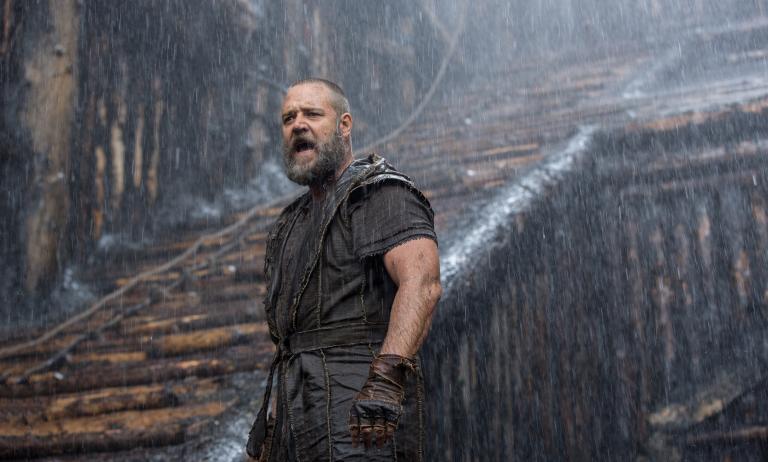
But those who approach the film looking for a pure fantasy adventure will find it challenging in other ways, too. For one thing, Noah is not quite the hero — even the reluctant hero — that Frodo and Aragorn were. When we first encounter the adult Noah (Russell Crowe), he is living in utter isolation from the rest of humanity with his wife Naameh (Jennifer Connelly) and their three young sons; he is also a stern defender of plants and animals who chides his son Ham for plucking a flower needlessly and violently fights back against poachers in the name of “justice.” When Noah receives the visions which indicate that God is going to destroy the world and wants him to build an Ark, Noah assumes it is to save the animals but not necessarily the humans, who he figures would only ruin the Earth all over again.
So, while audiences might cheer as Noah and the Watchers2 fight off an army led by the villainous Tubal-Cain (Ray Winstone) — a self-proclaimed king who plans to take the Ark for himself and his men when the Flood comes — they might begin to question Noah’s goodness when he leaves a potential wife for one of his sons to die in the forest, and then refuses to help some people who are battered by the waves as they cling to a mountain peak that is not yet fully submerged. And they might come to actively dislike the character when, learning that his daughter-in-law Ila (Emma Watson) is pregnant, Noah declares that he will kill her child if it turns out to be a girl and is thus capable of continuing the human race.
This last plot element in particular has caused quite a bit of controversy ever since an early draft of the screenplay was leaked two years ago. But a few points are worth bearing in mind. First, rather than endorse Noah’s environmental extremism — what some have called his Earth-Firstism — the film actively critiques it, not least through members of his own family, who actively oppose and even subvert his plans. The miraculous intervention of his grandfather Methuselah (Anthony Hopkins) is especially interesting here, as the old man, who is something of an eccentric mystic, otherwise accepts the Flood as a sign of God’s justice. Second, Noah is driven by an awareness of what you might call original sin, and that includes an awareness of his own sin. He does not set himself above the rest of humanity; rather, he feels that he dare not exempt himself and his family from God’s judgment.
But it’s also interesting to look at this plot twist in the light of Aronofsky’s other films, which often dwell on the idea that purity or perfection is impossible, and that the pursuit of these things is self-destructive. Sometimes the self-destruction is presented as a positive thing, as in The Fountain, which explicitly states that “death is the road to awe.” At other times it is more ambiguous, as in Black Swan (2010), where the ballet-dancer protagonist lies dying on the floor after her climactic performance and says, “Perfect. It was perfect.” And at other times there is no upside to it at all; witness the doom and gloom that affects nearly every major character’s fate in the final scenes of Requiem for a Dream (2000).
Seen in that context, Noah becomes another Aronofsky protagonist who is determined to achieve perfection — meaning, in this case, a world where the animals can live as they once did in Eden, without fear of exploitation by fallen human beings — even if it means letting his family die out, indeed ensuring that his family dies out. And the question that hangs over this section of the film — especially when Ila offers a rival interpretation of the “sign” that Noah interprets as validation for his plan — is whether Noah’s violence can still be seen as an extension of divine wrath, or whether it is part of the fallenness that he shares with other human beings, whose violence incurred God’s wrath in the first place.
In the end, of course, Noah chooses mercy; even as he holds his knife over Ila’s twin girls, in a pose that is awfully reminiscent of Abraham’s near-sacrifice of Isaac, Noah is overcome with love for them and decides he cannot go through with his plan. And in a scene set some time later — when the waters have receded, the Ark has landed, and Noah is reconciled to most (but not all) members of his family — he reminds his children that they, like their ancestor Adam, are made in God’s image and must care for creation, and he enjoins them to “be fruitful and multiply, and replenish the Earth.” This statement is immediately followed by the appearance of a rainbow, signifying that God approves of this benediction.
With a budget reportedly double that of all his previous films combined, Aronofsky is working on a much bigger canvas here than he ever has before, and he uses digital effects to create some of the most powerfully unsettling and inspiring visuals you’re ever likely to see (from Noah’s dream of corpses drifting underwater to a spellbinding sequence that finds common ground for evolutionary theory and the Genesis account of Creation). Whether the film works on a purely dramatic level is more difficult to say, at least after a single viewing; there are plot holes and seemingly inexplicable changes of heart on the part of certain characters, but then, one could argue that there are gaps in the biblical account, too.
Either way, Aronofsky is mining rich theological territory here, and it’s to his credit that he is asking his audience to think about concepts like sin, forgiveness, and righteousness, instead of reducing the Bible to popcorn-friendly heroics. Noah may be Aronofsky’s first foray into major studio moviemaking, but he has kept his obsessions intact.
Peter T. Chattaway is a freelance film critic and blogger at Patheos.com with a special interest in Bible movies. He lives with his family in Surrey, B.C.
1. The Bible gives names to three of Adam’s sons, but it says he had “other sons and daughters” as well (Gen. 5:4).
2. The Watchers help Noah build his boat as a sort of penance for their earlier disobedience; you might say the film gives them a “redemptive Ark.”
— A version of this article was first published in Books & Culture*.*
Next Post

May 3, 2014 I'm number two! I'm number two!
Browse Our Archives
Select a Category Anglican Planet Articles BC Christian News BC Report Bible Movies Bible Review Blog Books & Culture Campus Times CBC Radio Christianity Today ChristianWeek Essays Faith Today Festival Cinemas Guide Film Journals Georgia Straight Interviews MB Herald National Catholic Register Salvationist Today's Christian Two Chairs Ubyssey Uncategorized Vancouver Courier Vancouver Sun
Select a Month August 2025 April 2025 January 2025 December 2024 November 2024 May 2024 February 2024 December 2023 May 2023 March 2023 November 2022 July 2022 June 2022 May 2022 April 2022 February 2022 January 2022 December 2021 November 2021 October 2021 September 2021 August 2021 July 2021 June 2021 April 2021 March 2021 February 2021 January 2021 December 2020 November 2020 October 2020 August 2020 July 2020 June 2020 May 2020 March 2020 February 2020 January 2020 December 2019 November 2019 September 2019 July 2019 May 2019 April 2019 March 2019 February 2019 January 2019 December 2018 November 2018 October 2018 September 2018 July 2018 June 2018 May 2018 April 2018 March 2018 February 2018 January 2018 December 2017 November 2017 October 2017 September 2017 August 2017 July 2017 June 2017 May 2017 April 2017 March 2017 February 2017 January 2017 December 2016 November 2016 October 2016 September 2016 August 2016 July 2016 June 2016 May 2016 April 2016 March 2016 February 2016 January 2016 December 2015 November 2015 October 2015 September 2015 August 2015 July 2015 June 2015 May 2015 April 2015 March 2015 February 2015 January 2015 December 2014 November 2014 October 2014 September 2014 August 2014 July 2014 June 2014 May 2014 April 2014 March 2014 February 2014 January 2014 December 2013 November 2013 October 2013 September 2013 August 2013 July 2013 June 2013 May 2013 April 2013 March 2013 February 2013 January 2013 December 2012 November 2012 October 2012 September 2012 August 2012 July 2012 June 2012 April 2012 January 2012 January 2011 December 2010 November 2010 October 2010 September 2010 August 2010 July 2010 June 2010 May 2010 April 2010 March 2010 February 2010 January 2010 December 2009 November 2009 October 2009 September 2009 August 2009 July 2009 June 2009 May 2009 April 2009 March 2009 February 2009 January 2009 December 2008 November 2008 October 2008 September 2008 August 2008 July 2008 June 2008 May 2008 April 2008 March 2008 February 2008 January 2008 December 2007 November 2007 October 2007 September 2007 August 2007 July 2007 June 2007 May 2007 April 2007 March 2007 February 2007 January 2007 December 2006 November 2006 October 2006 September 2006 August 2006 July 2006 June 2006 May 2006 April 2006 March 2006 February 2006 January 2006 December 2005 November 2005 October 2005 September 2005 August 2005 July 2005 June 2005 May 2005 April 2005 March 2005 January 2005 December 2004 November 2004 October 2004 September 2004 August 2004 July 2004 June 2004 May 2004 April 2004 March 2004 February 2004 January 2004 November 2003 October 2003 August 2003 July 2003 June 2003 May 2003 January 2003 December 2002 November 2002 August 2002 July 2002 June 2002 May 2002 March 2002 January 2002 December 2001 November 2001 September 2001 August 2001 July 2001 June 2001 April 2001 March 2001 February 2001 December 2000 November 2000 October 2000 September 2000 August 2000 July 2000 June 2000 May 2000 April 2000 March 2000 January 2000 October 1999 August 1999 May 1999 April 1999 February 1999 January 1999 December 1998 November 1998 October 1998 August 1998 July 1998 June 1998 April 1998 March 1998 January 1998 November 1997 September 1997 July 1997 June 1997 April 1997 March 1997 February 1997 January 1997 December 1996 October 1996 September 1996 June 1996 March 1996 February 1996 January 1996 April 1995 November 1994 September 1994 September 1991
Follow Us!
TAKE THE
Religious Wisdom Quiz
Why did Jesus often use parables?
Select your answer to see how you score.
To reveal truths to those open to God To show off To confuse listeners To entertain only
Related posts from FilmChat

Exclusive: A clip from Angel Studios' The King...

Watch: The Chosen's creators on Season 4's big...
Which Bible movies are getting the most views...
Talking about The Prince of Egypt: The Musical
TRENDING AT PATHEOS Religious Music & Entertainment

"Les Diabolique" and Transgression
Alongside something like Arrival, Vertigo, or Charade, Les Diaboliques is a...

"The Plague Dogs" and Mortality
So, flashback to the late 70s, early 80s. Walt Disney Studios is...

With the recent and highly successful release of Christopher Nolan’s epic film,...

"L'avventura" and Human Weakness
Today's piece is going to be a little different for a few...

I first want to apologize for not posting or writing anything. I'm...

I've engaged in the multi-year project of reading through the Church Fathers,...
view all Religious Music & Entertainment blogs
Ad-Free & Subscriber Log-In Subscription Support
- About Us
- 2026 Calendar
- Videos
- Podcasts
- Library of World Religions
- Faith In Media Tracker
- Advertise With Us
- Write for Us
- Privacy Policy
- Terms of Service
- Do Not Sell My Data
- Contact Us
- Radiant Digital
- Manage Newsletter Subscriptions
- Unsubscribe From Notifications
- Sitemap
Copyright 2008-2026, Patheos. All rights reserved.
Subscription Support Ad-Free & Subscriber Log-In
Follow Patheos