
BuddhistCatholicContemplativeEvangelicalGeneral ChristianHinduJewishLatter-day SaintMuslimNew VisionsProgressive Christian
Beliefs
- Buddhist
- Catholic
- Contemplative
- Evangelical
- General Christian
- Hindu
- Jewish
- Latter-day Saint
- More Voices
- Muslim
- New Visions
- Pagan
- Progressive Christian
Topics
- Religion News
- Food and Religion
- Sports and Religion
- Religious Art
- Religious Music and Entertainment
- Religious Events
- History and Religion
- Style and Religion
- Politics and Religion
- Women in Religion
- Recreation Outdoors and Religion
- Business Finance and Religion
- Careers Workplace and Religion
- Education and Religion
- Family Parenting and Religion
- Health Fitness and Religion
- Home and Religion
- Relationships and Religion
- Technology and Religion
- Travel and Religion
Columnists
- Buddhist Columnists
- Business Finance and Religion Columnists
- Careers Workplace and Religion Columnists
- Catholic Columnists
- Contemplative Columnists
- Education and Religion Columnists
- Evangelists Columnists
- Family Parenting and Religion Columnists
- General Christian Columnists
- Health Fitness and Religion Columnists
- Hindu Columnists
- History and Religion Columnists
- Home and Religion Columnists
- Jewish Columnists
- More Voices Columnists
- Latter Day Columnists
- Muslim Columnists
- New Visions Columnists
- Nonreligious Columnists
- Pagan Columnists
- Politics and Religion Columnists
- Progressive Columnists
- Recreation Outdoors and Religion Columnists
- Relationships and Religion Columnists
- Religion News Columnists
- Religious Art Columnists
- Religious Events Columnists
- Religious Music and Entertainment Columnists
- Sports and Religion Columnists
- Style and Religion Columnists
- Technology and Religion Columnists
- Travel and Religion Columnists
- Women in Religion Columnists
Resource Library
- 2026 Calendar
- Library of World Religions
- The 100 Most Holy Places on Earth
- Patheos Answers
- Podcasts
- Videos
- Faith Leaders Database
- Anglican Episcopalian
- Bahai
- Baptist
- Buddhism
- Christianity
- Confucianism
- Eastern Orthodoxy
- Hinduism
- Holiness and Pentecostal
- ISKCON
- Islam
- Judaism
- Lutheran
- Methodist
- The Church of Jesus Christ of Latter-day Saints
- New Age
- Paganism
- Presbytarian and Reformed
- Protestantism
- Religion Behind the Scenes
- Roman Catholic
- Scientology
- Shia Islam
- Sikhism
- Sufism
- Sunni Islam
- Taoism
- Zen
- See all religions
Research Tools
 Ad-Free & Subscriber Log-In Subscription Support
Ad-Free & Subscriber Log-In Subscription Support
Follow Patheos 

- Trending:
- Forgiveness
- |
- Marriage
- |
- Consciousness
- |
- Death Penalty
- |
- Election
- |
- Halloween

-
Articles
- Home
- Religious Music & Entertainment
- On asking questions, not assuming answers, about Noah
On asking questions, not assuming answers, about Noah
Last updated on: April 11, 2014 at 1:24 pm by Peter T. Chattaway
On asking questions, not assuming answers, about Noah 2014-04-11T13:24:20-07:00 Peter T. Chattaway
Patheos Explore the world's faith through different perspectives on religion and spirituality! Patheos has the views of the prevalent religions and spiritualities of the world.
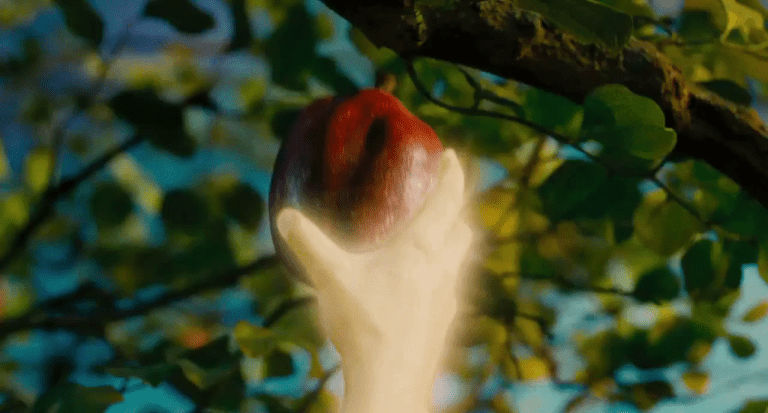 Brian Godawa has now updated his post on the Noah serpent — twice! — in response to posts of mine in which I debunked the claim that Noah is Gnostic and tried to untangle just what the snakeskin represents, both in Judaism and within the film specifically.
Brian’s a good guy, and he’s done a lot of research into the Noah story, and I have found his posts on that subject very informative. But when it comes to his analysis of Darren Aronofsky’s film, it seems to me that he has certain blind spots, or that he insists too strongly on filtering his experience of the film through a certain worldview without fully engaging with the film on its own terms.
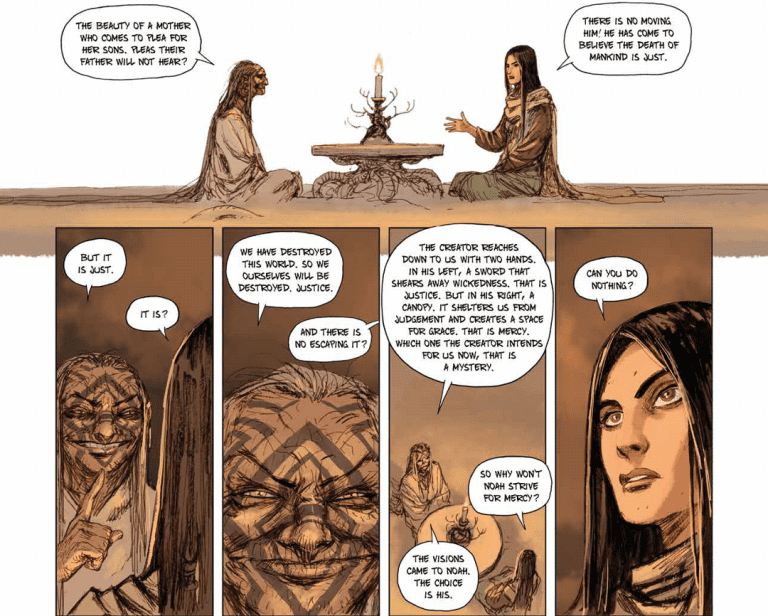 For example, two years ago Brian wrote a now-famous review of an early draft of the screenplay, in which Brian dubbed the title character an “environmentalist wacko”. When I read that same script a year later, I did not disagree with some of Brian’s criticisms, but I was struck by the fact that he had virtually ignored one of the most pivotal scenes, in which Methuselah spells out the film’s balancing act between divine justice and divine mercy. As it turns out, that bit of dialogue is missing from the actual film — perhaps the filmmakers thought it was too on-the-nose — but it was there in the script (it’s also in the graphic novel), and it seemed to me that any review which ignored this would be sorely lacking. So I wrote a blog post drawing attention to this scene.
Now that he has seen the finished film itself, Brian dislikes it as much as he disliked the script, and that’s fine; as they say, there’s no accounting for taste, and there is plenty of room to talk about what works in the film and what doesn’t.
But last week he jumped on the “Noah is Gnostic” bandwagon and wrote a couple posts arguing that the film exalts both humanity and the serpent that tempted Adam and Eve over God, and in this I think he is very, very mistaken.
I’ll get to some of Brian’s points in a minute, but the simplest way to show how mistaken he is, is to point to the concluding summary of his latest response to me:
The Bible: Serpent bad, God good. God decides Man’s value.
Aronofsky’s Noah: Serpent good, God bad (and silent). Man decides Man’s value.
I would argue that God is not completely silent in this film — he does send dreams and visions, after all — but that’s a separate issue. The more pertinent question here is whether the film actually says that God is bad, and that the serpent is good. And I just don’t see how that reading of the film can be supported in any way whatsoever.
As I’ve said before, the second sentence in the film is “Temptation led to sin,” and this sentence is followed by images of violence and chaos that ultimately lead to (and deserve) divine judgment. More recently, the film’s co-writer Ari Handel has talked about how “the Tempter arose through” the serpent, causing the serpent to shed its luminescent skin and become a darker, more blatantly evil creature.
So with the film itself telling us that the serpent was responsible for all this evil, and with the filmmakers themselves telling us that the serpent was responsible for all this evil, how can we say that the film or its makers are actually saying the opposite? This makes no sense to me, unless we’re going to call the filmmakers outright liars.
Ultimately, the crux of arguments like Godawa’s (and Brian Mattson’s) seems to be that they don’t like the scenes with the snakeskin, which is shed by the serpent in the Garden of Eden and is treated like a sort of holy relic by Noah and his family.
I admit, I kind of recoiled at this imagery myself the first time I saw the film. Or maybe it would be more accurate to say that I was puzzled by it. Unlike the two Brians, whose first instinct seems to have been to read all sorts of assumptions into that imagery, my first instinct was to wonder why the filmmakers had put those scenes in there — especially since those scenes weren’t in the early script that Godawa and I had read, and they didn’t seem to add all that much to the story.
Alas, I neglected to ask Aronofsky and Handel about the snakeskin when I interviewed them — there were so many other topics to discuss, and since the interview began mere seconds after the screening came to an end (I spoke to them in the very same screening room where I had just watched the film), I didn’t have a chance to check my notes or to adjust the list of questions I had compiled before the screening.
But a colleague of mine who spoke to them some time later did raise this question, and told me that the skin was meant to represent the serpent’s original goodness. And now Handel is on record to that effect in his recent interview with Relevant magazine.
Handel’s comments prompted me to do a bit of research, and I found that there are multiple sources in the Jewish tradition which hypothesize that the “garments of skin” worn by Adam and Eve when they were cast out of Eden were made from a skin shed by the serpent. Some of those sources even dwell on the paradox that a skin shed by the Tempter should be the means by which Adam and Eve were able to preserve some of their human dignity. (I discuss this in an addendum to one of my earlier posts.)
The filmmakers take this idea even further and suggest that the serpent shed the skin at the very point when it turned to evil, thus, the serpent loses its “garment of light” just as Adam and Eve will lose theirs when they eat the forbidden fruit. (And please, no more nonsense about the “garments of light” being some sort of evil Gnostic-Kabbalistic heresy. The tradition that Adam and Eve were clothed in “garments of light” before they fell is accepted within my own Eastern Orthodox tradition.)
So, I came away from the film with a question, and now I have an answer; indeed, I have learned something that I didn’t know before. The two Brians, on the other hand, did not come away with questions; they assumed that they already knew what the answer would be. And this has coloured their commentary ever since.
This, it seems to me, is just one more example of how some viewers are judging this “most Jewish” of Bible movies according to Christian presuppositions.
Brian does not dispute the fact that Jewish tradition posits all these ideas about the snakeskin; instead, his main rebuttal is to say that the Christian tradition is better than the Jewish tradition, and more authentically Jewish than the Jewish tradition.
Be that as it may — and setting aside the fact that the first-century Judaism which led to modern Christianity and modern Judaism was so diverse that some scholars are wont to speak of Judaisms, plural, in this period — my point here is not to say that I think the Jewish tradition is better than the Christian tradition or vice versa.
My point, rather, is to say that this film grows out of the Jewish tradition, and that it needs to be understood within that context if it is to be understood at all. As I wrote last year in an article on the Bible-epic revival for The Anglican Planet:
Second, we should recognize that not all of these stories are necessarily “ours.” The biblical story of Noah, for example, is as much a part of the Jewish scriptures as it is ours, and it seems Aronofsky’s film will be based in part on the pseudepigraphal Book of Enoch and other Jewish legends that elaborate on that narrative. Christians can, at least in theory, benefit from these traditions as surely as non-Catholics benefited from Mel Gibson’s deeply Catholic treatment of the Passion.
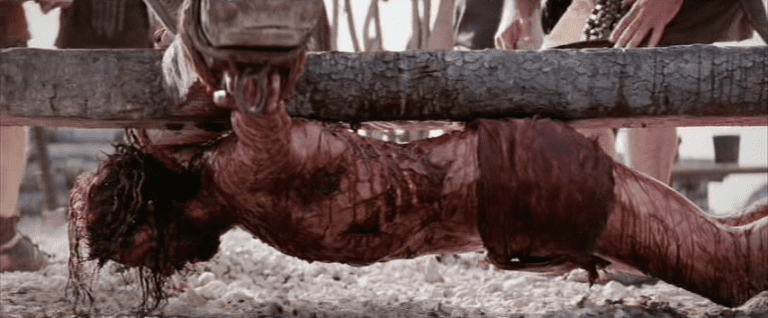 I’m sure there were probably some Protestants a decade ago who objected to the levitating cross and the mystical depiction of Mary and some of the various other things that Mel Gibson put into his film, all of which reflect an utterly non-Protestant sensibility. But by and large, evangelical Christians seemed to be okay with that film, and some of them were perhaps even willing to learn a thing or two about the Catholic tradition and what it can teach us about the death of Jesus.
Similarly, I think we should be able to approach a film like Noah in a spirit of honest curiosity. We don’t have to agree with everything the film says and does, and we don’t have to give up any of our Christian beliefs about Creation, the Fall, the Flood and so on. But we do a disservice to the film and to everyone who is trying to understand it when we try to shoehorn it into categories that it was never meant to fit into.
As for the question of God’s silence, or the fact that Noah assumes some of the functions within this film that the Bible ascribes to God (choosing between justice and mercy, blessing his offspring, etc.)… I will try to address that in another post.
Previous Post

April 9, 2014
How I helped Jon Stewart get one of his Noah facts wrong
Next Post
April 13, 2014 Watch the trailer for short-film anthology Words with Gods
Browse Our Archives
Select a Category Anglican Planet Articles BC Christian News BC Report Bible Movies Bible Review Blog Books & Culture Campus Times CBC Radio Christianity Today ChristianWeek Essays Faith Today Festival Cinemas Guide Film Journals Georgia Straight Interviews MB Herald National Catholic Register Salvationist Today's Christian Two Chairs Ubyssey Uncategorized Vancouver Courier Vancouver Sun
Select a Month August 2025 April 2025 January 2025 December 2024 November 2024 May 2024 February 2024 December 2023 May 2023 March 2023 November 2022 July 2022 June 2022 May 2022 April 2022 February 2022 January 2022 December 2021 November 2021 October 2021 September 2021 August 2021 July 2021 June 2021 April 2021 March 2021 February 2021 January 2021 December 2020 November 2020 October 2020 August 2020 July 2020 June 2020 May 2020 March 2020 February 2020 January 2020 December 2019 November 2019 September 2019 July 2019 May 2019 April 2019 March 2019 February 2019 January 2019 December 2018 November 2018 October 2018 September 2018 July 2018 June 2018 May 2018 April 2018 March 2018 February 2018 January 2018 December 2017 November 2017 October 2017 September 2017 August 2017 July 2017 June 2017 May 2017 April 2017 March 2017 February 2017 January 2017 December 2016 November 2016 October 2016 September 2016 August 2016 July 2016 June 2016 May 2016 April 2016 March 2016 February 2016 January 2016 December 2015 November 2015 October 2015 September 2015 August 2015 July 2015 June 2015 May 2015 April 2015 March 2015 February 2015 January 2015 December 2014 November 2014 October 2014 September 2014 August 2014 July 2014 June 2014 May 2014 April 2014 March 2014 February 2014 January 2014 December 2013 November 2013 October 2013 September 2013 August 2013 July 2013 June 2013 May 2013 April 2013 March 2013 February 2013 January 2013 December 2012 November 2012 October 2012 September 2012 August 2012 July 2012 June 2012 April 2012 January 2012 January 2011 December 2010 November 2010 October 2010 September 2010 August 2010 July 2010 June 2010 May 2010 April 2010 March 2010 February 2010 January 2010 December 2009 November 2009 October 2009 September 2009 August 2009 July 2009 June 2009 May 2009 April 2009 March 2009 February 2009 January 2009 December 2008 November 2008 October 2008 September 2008 August 2008 July 2008 June 2008 May 2008 April 2008 March 2008 February 2008 January 2008 December 2007 November 2007 October 2007 September 2007 August 2007 July 2007 June 2007 May 2007 April 2007 March 2007 February 2007 January 2007 December 2006 November 2006 October 2006 September 2006 August 2006 July 2006 June 2006 May 2006 April 2006 March 2006 February 2006 January 2006 December 2005 November 2005 October 2005 September 2005 August 2005 July 2005 June 2005 May 2005 April 2005 March 2005 January 2005 December 2004 November 2004 October 2004 September 2004 August 2004 July 2004 June 2004 May 2004 April 2004 March 2004 February 2004 January 2004 November 2003 October 2003 August 2003 July 2003 June 2003 May 2003 January 2003 December 2002 November 2002 August 2002 July 2002 June 2002 May 2002 March 2002 January 2002 December 2001 November 2001 September 2001 August 2001 July 2001 June 2001 April 2001 March 2001 February 2001 December 2000 November 2000 October 2000 September 2000 August 2000 July 2000 June 2000 May 2000 April 2000 March 2000 January 2000 October 1999 August 1999 May 1999 April 1999 February 1999 January 1999 December 1998 November 1998 October 1998 August 1998 July 1998 June 1998 April 1998 March 1998 January 1998 November 1997 September 1997 July 1997 June 1997 April 1997 March 1997 February 1997 January 1997 December 1996 October 1996 September 1996 June 1996 March 1996 February 1996 January 1996 April 1995 November 1994 September 1994 September 1991
Follow Us!
TAKE THE
Religious Wisdom Quiz
Which book of the Bible has a talking tree?
Select your answer to see how you score.
Proverbs Judges Ezekiel Genesis
Related posts from FilmChat

Joseph of Egypt – the Chosen spin-off announces...

Exclusive: A clip from Angel Studios' The King...

Exclusive: Watch a clip from Angel Studios' Brave...

Exclusive: Watch a clip from Angel Studios' Homestead
TRENDING AT PATHEOS Religious Music & Entertainment

"Les Diabolique" and Transgression
Alongside something like Arrival, Vertigo, or Charade, Les Diaboliques is a...

"The Plague Dogs" and Mortality
So, flashback to the late 70s, early 80s. Walt Disney Studios is...

With the recent and highly successful release of Christopher Nolan’s epic film,...

"L'avventura" and Human Weakness
Today's piece is going to be a little different for a few...

I first want to apologize for not posting or writing anything. I'm...

I've engaged in the multi-year project of reading through the Church Fathers,...
view all Religious Music & Entertainment blogs
Ad-Free & Subscriber Log-In Subscription Support
- About Us
- 2026 Calendar
- Videos
- Podcasts
- Library of World Religions
- Faith In Media Tracker
- Advertise With Us
- Write for Us
- Privacy Policy
- Terms of Service
- Do Not Sell My Data
- Contact Us
- Radiant Digital
- Manage Newsletter Subscriptions
- Unsubscribe From Notifications
- Sitemap
Copyright 2008-2026, Patheos. All rights reserved.
Subscription Support Ad-Free & Subscriber Log-In
Follow Patheos