
BuddhistCatholicContemplativeEvangelicalGeneral ChristianHinduJewishLatter-day SaintMuslimNew VisionsProgressive Christian
Beliefs
- Buddhist
- Catholic
- Contemplative
- Evangelical
- General Christian
- Hindu
- Jewish
- Latter-day Saint
- More Voices
- Muslim
- New Visions
- Pagan
- Progressive Christian
Topics
- Religion News
- Food and Religion
- Sports and Religion
- Religious Art
- Religious Music and Entertainment
- Religious Events
- History and Religion
- Style and Religion
- Politics and Religion
- Women in Religion
- Recreation Outdoors and Religion
- Business Finance and Religion
- Careers Workplace and Religion
- Education and Religion
- Family Parenting and Religion
- Health Fitness and Religion
- Home and Religion
- Relationships and Religion
- Technology and Religion
- Travel and Religion
Columnists
- Buddhist Columnists
- Business Finance and Religion Columnists
- Careers Workplace and Religion Columnists
- Catholic Columnists
- Contemplative Columnists
- Education and Religion Columnists
- Evangelists Columnists
- Family Parenting and Religion Columnists
- General Christian Columnists
- Health Fitness and Religion Columnists
- Hindu Columnists
- History and Religion Columnists
- Home and Religion Columnists
- Jewish Columnists
- More Voices Columnists
- Latter Day Columnists
- Muslim Columnists
- New Visions Columnists
- Nonreligious Columnists
- Pagan Columnists
- Politics and Religion Columnists
- Progressive Columnists
- Recreation Outdoors and Religion Columnists
- Relationships and Religion Columnists
- Religion News Columnists
- Religious Art Columnists
- Religious Events Columnists
- Religious Music and Entertainment Columnists
- Sports and Religion Columnists
- Style and Religion Columnists
- Technology and Religion Columnists
- Travel and Religion Columnists
- Women in Religion Columnists
Resource Library
- 2026 Calendar
- Library of World Religions
- The 100 Most Holy Places on Earth
- Patheos Answers
- Podcasts
- Videos
- Faith Leaders Database
- Anglican Episcopalian
- Bahai
- Baptist
- Buddhism
- Christianity
- Confucianism
- Eastern Orthodoxy
- Hinduism
- Holiness and Pentecostal
- ISKCON
- Islam
- Judaism
- Lutheran
- Methodist
- The Church of Jesus Christ of Latter-day Saints
- New Age
- Paganism
- Presbytarian and Reformed
- Protestantism
- Religion Behind the Scenes
- Roman Catholic
- Scientology
- Shia Islam
- Sikhism
- Sufism
- Sunni Islam
- Taoism
- Zen
- See all religions
Research Tools
 Ad-Free & Subscriber Log-In Subscription Support
Ad-Free & Subscriber Log-In Subscription Support
Follow Patheos 

- Trending:
- Forgiveness
- |
- Marriage
- |
- Consciousness
- |
- Death Penalty
- |
- Election
- |
- Halloween

-
Articles
- Home
- Religious Music & Entertainment
- Bible movie of the week: The Bible: In the Beginning… (1966)
Bible movie of the week: The Bible: In the Beginning… (1966)
Last updated on: September 29, 2016 at 12:05 pm by Peter T. Chattaway
Bible movie of the week: The Bible: In the Beginning… (1966) 2016-09-29T12:05:56-07:00 Peter T. Chattaway
Patheos Explore the world's faith through different perspectives on religion and spirituality! Patheos has the views of the prevalent religions and spiritualities of the world.
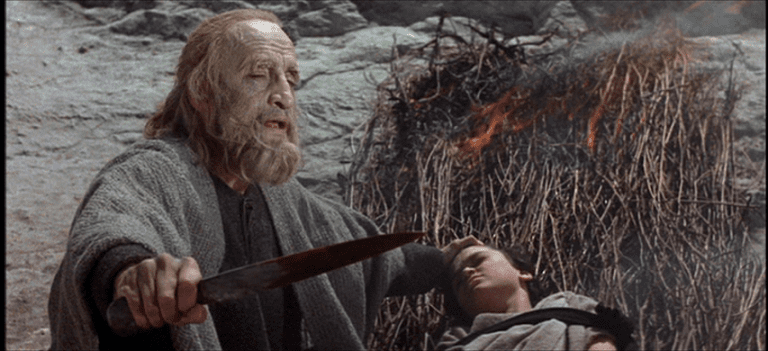 The title speaks of beginnings, but the film itself marked the end of an era. The post-war Bible-movie craze began with Samson and Delilah in 1949, and it arguably reached its peak with the 1959 remake of Ben-Hur. But the genre petered out over the next several years, and The Bible: In the Beginning…, released in 1966, was pretty much the last major Bible film to be produced by a Hollywood studio for the next couple of decades.
The problem was not that the film was a flop, per se, but that it cost so much to make. According to Wikipedia, The Bible was the top-grossing movie of its year, with a domestic take of $34 million. But roughly half of that money would have stayed with the theatres, and the film is said to have cost as much as $18 million — and that probably doesn’t count the cost of prints and advertising. So whether the film made its money back would seem to depend on how well it performed overseas.
In any case, I recently revisited this film and noticed a few things that I thought were worth noting here. (See also my recent post on Abraham and the Three Visitors, which discusses one scene from this film that I don’t get into here.)
Formality and abstraction. The Bible was produced at a time when the King James Version was still the most frequently used English translation of the Bible, and much of the dialogue is taken straight from there — and even the brand-new dialogue is written and performed to conform with the conventions of 17th-century English. Note, for example, how when Noah’s wife says that her son should be “ashamed”, she stretches the word out to three syllables, rather than the two that we would use.
This insistence on using an old-fashioned vernacular makes the film more formal than most recent Bible movies, and it sets the tone for the film as a whole. Directed by John Huston from a script by Christopher Fry (who had previously worked on Ben-Hur, where he reportedly changed lines like “How was your dinner?” to “Was the food not to your liking?”), the film proceeds at a leisurely pace, such that the first human being doesn’t appear until about ten minutes in. Until then, we are treated to a series of images, some more abstract than others, that depict the first five-and-a-half days of creation, all set to narration by Huston and music by Toshiro Mayuzumi.
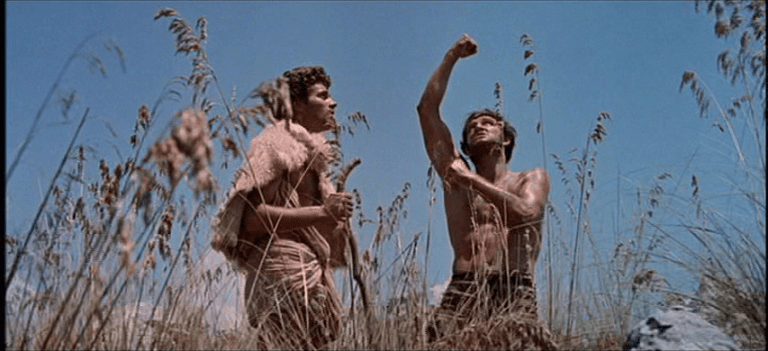 But the tendency towards abstraction appears in other sequences, too. After God favours Abel’s sacrifice over Cain’s, Cain communicates his feelings by jerking his arms around in a sort of pantomime, as though the filmmakers felt it wouldn’t be right to invent new dialogue to express Cain’s displeasure with God — and when Abel replies to Cain’s gestures, he does so with dialogue that, in the Bible, is actually spoken by God. At this point, the film is still very closely tied to the words of the KJV, even if it sometimes reassigns them.
Consider also the way the film handles the passage which details the generations that came after Noah: Noah himself stands in silhouette against a black background, and as the camera pulls back, we see his three sons spread out before him, and their sons spread out before them, and so on. It’s like a family tree with actual people.
And then there is the film’s treatment of Genesis 15, in which God makes a covenant with Abraham by participating in an ancient ritual with him, whereby Abraham cuts several animals in half and waits for God to pass between the severed halves. In the Bible, Abraham falls into a deep sleep after preparing the animals — but the film implies that the entire ritual may have been something that Abraham dreamed while he was sleeping, and the sacrifice itself is depicted with deep shadows and tilted camera angles and a strange wind blowing through Abraham’s hair.
And then there are the various scenes of wickedness just before God smites people, from the human sacrifices performed in Noah’s day to the various activities witnessed by the angels as they walk through Sodom. All of these things are expressed in their most extreme form so that there can be no question that God’s smiting is just.
Humour, intentional and otherwise. John Huston not only directed the film, he also provided the narration and the voice of God — and he also played Noah. And the Noah sequence, unlike the rest of the film, is treated almost like a comedy.
The mood is appropriately somber when the people of Noah’s day commit their crimes and are then punished for them, but Noah’s interactions with both his family and the animals in their care are repeatedly played for laughs.
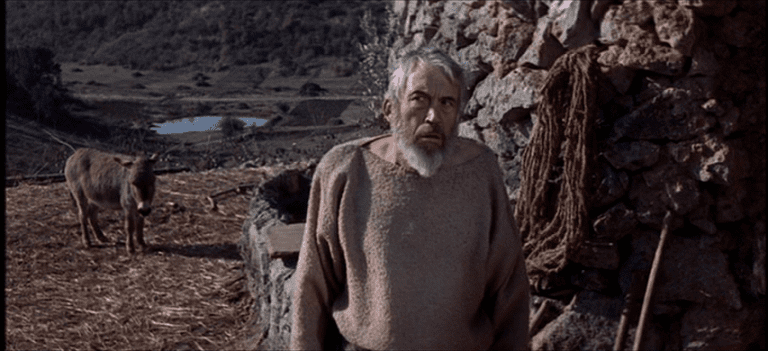 Come to that, even Noah’s interactions with God are played for laughs: when Noah first hears the voice of God, he gets a look on his face, like he’s worried that he might be hallucinating, and then he ducks behind a wall, as if to avoid any further communications. The music accentuates the lightly comical tone of this scene — and of several of Noah’s later scenes.
There are some other bits, though, that make me wonder if they were supposed to be as funny as I currently find them. I think particularly of the bit that follows God’s command that Adam and Eve “be fruitful and multiply”.
When God issues his command, the camera is looking down at the naked couple from far above as they lie face-down on the ground; after God issues his command, they move closer to each other. The film then dissolves to an image of two horses frolicking in a grassy field. Suddenly, in the distance, Adam and Eve get up from the grass — it is tall enough that we could not see them when they were lying down — and Adam gets down on all fours and kicks his legs in the air as if he were whinnying himself.
I’m sure Huston thought it would be amusing to show Adam celebrating his first act of sexual intercourse, so I don’t doubt that the scene was intended to be kind of funny, but still, given how utterly formal the film has been up to that point, it kind of takes you out of the movie in a way that the later stabs at humour don’t.
Creative use of the Bible. The film, which is just a few minutes shy of three hours long, can be divided into roughly two halves: the first half is a jumble of stories involving Adam, Eve, Cain, Abel, Noah and the Tower of Babel, but the second half focuses on a single protagonist, Abraham. And because the story of Abraham is spread out over roughly 80 minutes, the filmmakers opted to give him and the people he interacts with a fair bit of dialogue that is not from his section of the Bible.
What’s interesting is that a fair bit of their dialogue comes from other parts of the Bible. In one scene, Abraham teaches Isaac to memorize their ancestors going back to Noah, which is basically taken from Genesis 11. In another scene, Abraham and Sarah address each other with romantic dialogue that harks back to the Song of Solomon. And when Abraham takes Isaac through the ruins of Sodom and Gomorrah, he recites one of the more blistering passages from Isaiah 40 — though not the more famous and/or more uplifting bits from the beginning and end of that chapter.
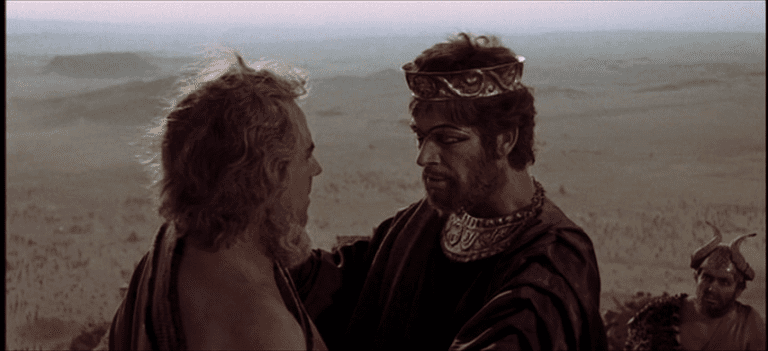 The film makes other connections between Bible passages too, for example by taking the king named Nimrod — about whom the Bible says relatively little, though all sorts of legends have grown up around him — and making him the king who builds the Tower of Babel.
Also, after Cain kills Abel, the narrator tells us that “the deed of Cain was multiplied a thousand times,” which implies that all the evil in Noah’s day stemmed from Cain somehow, and the narrator also notes that Noah was descended from Adam and Eve’s third son Seth, as if to suggest that Noah inherited his righteousness.
This is an old tradition, and it appears that Darren Aronofsky’s upcoming Noah might also cast the descendants of Cain as the bad guys and the descendants of Seth as the good guys, in some sense. (“Return to your cities of Cain!”) But of course, the Bible says that each of Noah’s ancestors had multiple children, so presumably there would have been many descendants of Seth’s who perished in the Flood, too.
Questioning vs. not questioning. For the most part, The Bible is content to present the biblical stories as is, without much interpretation or subversion. When Noah and his family hear the cries of the people drowning outside the Ark, for example, Noah says God is getting rid of the “chaff”, and leaves it at that. Where modern readers and viewers might feel compelled to question the wrath of God and how it is expressed in the text, the film simply accepts it…
…until God tells Abraham to sacrifice his son Isaac on an altar. Then, suddenly, the film begins to entertain questions regarding the rightness of God’s actions. When Abraham first gets his instructions from God, he shouts “No!” a few times and objects that sacrificing Isaac would make him no better than the Canaanites who offer human sacrifices before their idols — and thus, by extension, he implies that God’s instructions would make God no better than the Canaanite deities.
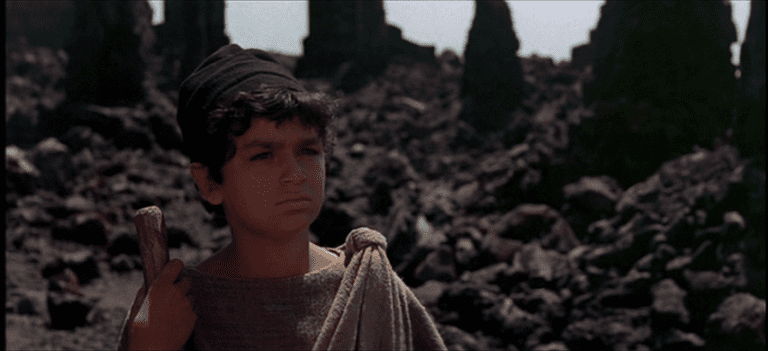 Later, as Abraham dutifully takes Isaac to the mountain where the sacrifice is to take place, they pass through the ruins of Sodom, and Abraham explains that everyone in those cities was killed. “The children also?” asks Isaac. “Were the children also wicked?” And with that, the extreme caricatures of the earlier Sodom sequence are subverted, and we cannot help but think of that city as a place with parents and children and families. (It is after Isaac’s question that Abraham recites the blistering passage from Isaiah 40.)
From a storytelling perspective, these doubts are resolved when God stays Abraham’s hand and saves the life of Isaac, thus ending the film on an upbeat note. But the questions are raised in the scenes that lead up to that moment, so the film might have given audiences something to think about in this regard on the way home.
Explanations. I have already noted the scene where Abraham teaches Isaac to memorize the list of their ancestors; in this way, the film offers one method by which the biblical information, if historical, could have come down to us.
The film does something similar in the Noah sequence, when Noah’s wife explains that she has been able to count the days that they have been at sea by keeping track of the number of times that she has milked the cows etc.
 Odds and ends. What little we see of the destruction of Sodom looks remarkably like a mushroom cloud. This film was made only a few years after the Cuban Missile Crisis, so nuclear weapons were very much on people’s minds.
From the people who mock Noah to the armies that attack Sodom to the people who demand that Lot bring out his visitors, there is one consistent motif: wicked people tend to be bald and/or to paint their faces a wee bit excessively.
When Abraham first settles in Canaan, there is a scene where he sees someone pour a handful of water on the head of one child, and then another. Is this supposed to be a form of baptism? If so, I cannot help but note that the film never mentions the fact that Abraham was instructed to circumcise all the men in his camp, and that Christian tradition regards baptism as a sort of substitute for circumcision. Is this one scene the film’s way of substituting baptism for circumcision, too? Just wondering.
A few of these actors appeared in other Bible films, as well. Stephen Boyd (Nimrod) had already played Messala in Ben-Hur. Gabrielle Ferzetti (Lot) played Piso in the 1985 version of Quo Vadis?. Ava Gardner (Sarah) played Agrippina in A.D. Anno Domini (1985). Richard Harris (Cain) played Abraham in Abraham (1993) and John in The Apocalypse (2002). Peter O’Toole (the Angels) played Samuel in One Night with the King (2006). And Franco Nero (Abel) played Nathan in David (1997), Gamaliel in Paul the Apostle (2000) and Zechariah in The Holy Family (2006).
And finally, there’s even a Quentin Tarantino connection here, given that Franco Nero (Abel) and Michael Parks (Adam) both had cameos in Django Unchained (2012). Nero, of course, had starred in the original Django (1966) and its follow-ups, while Parks had played a sheriff in a few earlier Tarantino films: From Dusk Till Dawn (1996), Kill Bill (2003-2004) and both parts of Grindhouse (2007).
Previous Post

January 20, 2014
New Noah interviews, plus an update on the soundtrack
Next Post
January 27, 2014 Terminator update: casting news and a change in producers
Browse Our Archives
Select a Category Anglican Planet Articles BC Christian News BC Report Bible Movies Bible Review Blog Books & Culture Campus Times CBC Radio Christianity Today ChristianWeek Essays Faith Today Festival Cinemas Guide Film Journals Georgia Straight Interviews MB Herald National Catholic Register Salvationist Today's Christian Two Chairs Ubyssey Uncategorized Vancouver Courier Vancouver Sun
Select a Month August 2025 April 2025 January 2025 December 2024 November 2024 May 2024 February 2024 December 2023 May 2023 March 2023 November 2022 July 2022 June 2022 May 2022 April 2022 February 2022 January 2022 December 2021 November 2021 October 2021 September 2021 August 2021 July 2021 June 2021 April 2021 March 2021 February 2021 January 2021 December 2020 November 2020 October 2020 August 2020 July 2020 June 2020 May 2020 March 2020 February 2020 January 2020 December 2019 November 2019 September 2019 July 2019 May 2019 April 2019 March 2019 February 2019 January 2019 December 2018 November 2018 October 2018 September 2018 July 2018 June 2018 May 2018 April 2018 March 2018 February 2018 January 2018 December 2017 November 2017 October 2017 September 2017 August 2017 July 2017 June 2017 May 2017 April 2017 March 2017 February 2017 January 2017 December 2016 November 2016 October 2016 September 2016 August 2016 July 2016 June 2016 May 2016 April 2016 March 2016 February 2016 January 2016 December 2015 November 2015 October 2015 September 2015 August 2015 July 2015 June 2015 May 2015 April 2015 March 2015 February 2015 January 2015 December 2014 November 2014 October 2014 September 2014 August 2014 July 2014 June 2014 May 2014 April 2014 March 2014 February 2014 January 2014 December 2013 November 2013 October 2013 September 2013 August 2013 July 2013 June 2013 May 2013 April 2013 March 2013 February 2013 January 2013 December 2012 November 2012 October 2012 September 2012 August 2012 July 2012 June 2012 April 2012 January 2012 January 2011 December 2010 November 2010 October 2010 September 2010 August 2010 July 2010 June 2010 May 2010 April 2010 March 2010 February 2010 January 2010 December 2009 November 2009 October 2009 September 2009 August 2009 July 2009 June 2009 May 2009 April 2009 March 2009 February 2009 January 2009 December 2008 November 2008 October 2008 September 2008 August 2008 July 2008 June 2008 May 2008 April 2008 March 2008 February 2008 January 2008 December 2007 November 2007 October 2007 September 2007 August 2007 July 2007 June 2007 May 2007 April 2007 March 2007 February 2007 January 2007 December 2006 November 2006 October 2006 September 2006 August 2006 July 2006 June 2006 May 2006 April 2006 March 2006 February 2006 January 2006 December 2005 November 2005 October 2005 September 2005 August 2005 July 2005 June 2005 May 2005 April 2005 March 2005 January 2005 December 2004 November 2004 October 2004 September 2004 August 2004 July 2004 June 2004 May 2004 April 2004 March 2004 February 2004 January 2004 November 2003 October 2003 August 2003 July 2003 June 2003 May 2003 January 2003 December 2002 November 2002 August 2002 July 2002 June 2002 May 2002 March 2002 January 2002 December 2001 November 2001 September 2001 August 2001 July 2001 June 2001 April 2001 March 2001 February 2001 December 2000 November 2000 October 2000 September 2000 August 2000 July 2000 June 2000 May 2000 April 2000 March 2000 January 2000 October 1999 August 1999 May 1999 April 1999 February 1999 January 1999 December 1998 November 1998 October 1998 August 1998 July 1998 June 1998 April 1998 March 1998 January 1998 November 1997 September 1997 July 1997 June 1997 April 1997 March 1997 February 1997 January 1997 December 1996 October 1996 September 1996 June 1996 March 1996 February 1996 January 1996 April 1995 November 1994 September 1994 September 1991
Follow Us!
TAKE THE
Religious Wisdom Quiz
What were the Ten Commandments written down on?
Select your answer to see how you score.
Stone tablets The Ark of the Covenant Scrolls Papyrus
Related posts from FilmChat

Joseph of Egypt – the Chosen spin-off announces...

Exclusive: A clip from Angel Studios' The King...

Exclusive: Watch a clip from Angel Studios' Brave...

Exclusive: Watch a clip from Angel Studios' Homestead
TRENDING AT PATHEOS Religious Music & Entertainment

"Les Diabolique" and Transgression
Alongside something like Arrival, Vertigo, or Charade, Les Diaboliques is a...

"The Plague Dogs" and Mortality
So, flashback to the late 70s, early 80s. Walt Disney Studios is...

With the recent and highly successful release of Christopher Nolan’s epic film,...

"L'avventura" and Human Weakness
Today's piece is going to be a little different for a few...

I first want to apologize for not posting or writing anything. I'm...

I've engaged in the multi-year project of reading through the Church Fathers,...
view all Religious Music & Entertainment blogs
Ad-Free & Subscriber Log-In Subscription Support
- About Us
- 2026 Calendar
- Videos
- Podcasts
- Library of World Religions
- Faith In Media Tracker
- Advertise With Us
- Write for Us
- Privacy Policy
- Terms of Service
- Do Not Sell My Data
- Contact Us
- Radiant Digital
- Manage Newsletter Subscriptions
- Unsubscribe From Notifications
- Sitemap
Copyright 2008-2026, Patheos. All rights reserved.
Subscription Support Ad-Free & Subscriber Log-In
Follow Patheos